grammar chart · Lithuanian
The vocative case in Lithuanian (šauksmininkas)
The vocative (šauksmininkas) is the form you use to call or address someone: Jonai, eik čia! Mama, kur tu? It has no question word of its own. In writing, the name or title you address is set off by commas.
When to use the vocative
Šauksmininkas: addressing someone
The vocative (šauksmininkas) is used to address people directly: Jonai!, mama!, drauge!. A masculine noun in -as takes -e (vyre!, drauge!), but a name in -as takes -ai (Jonai!) and a noun in -jas takes -jau (mokytojau!); an -is noun of the first declension takes -i (broli!), one of the third -ie (pilie!).
- Jonai, eik čia! — Jonas, come here!
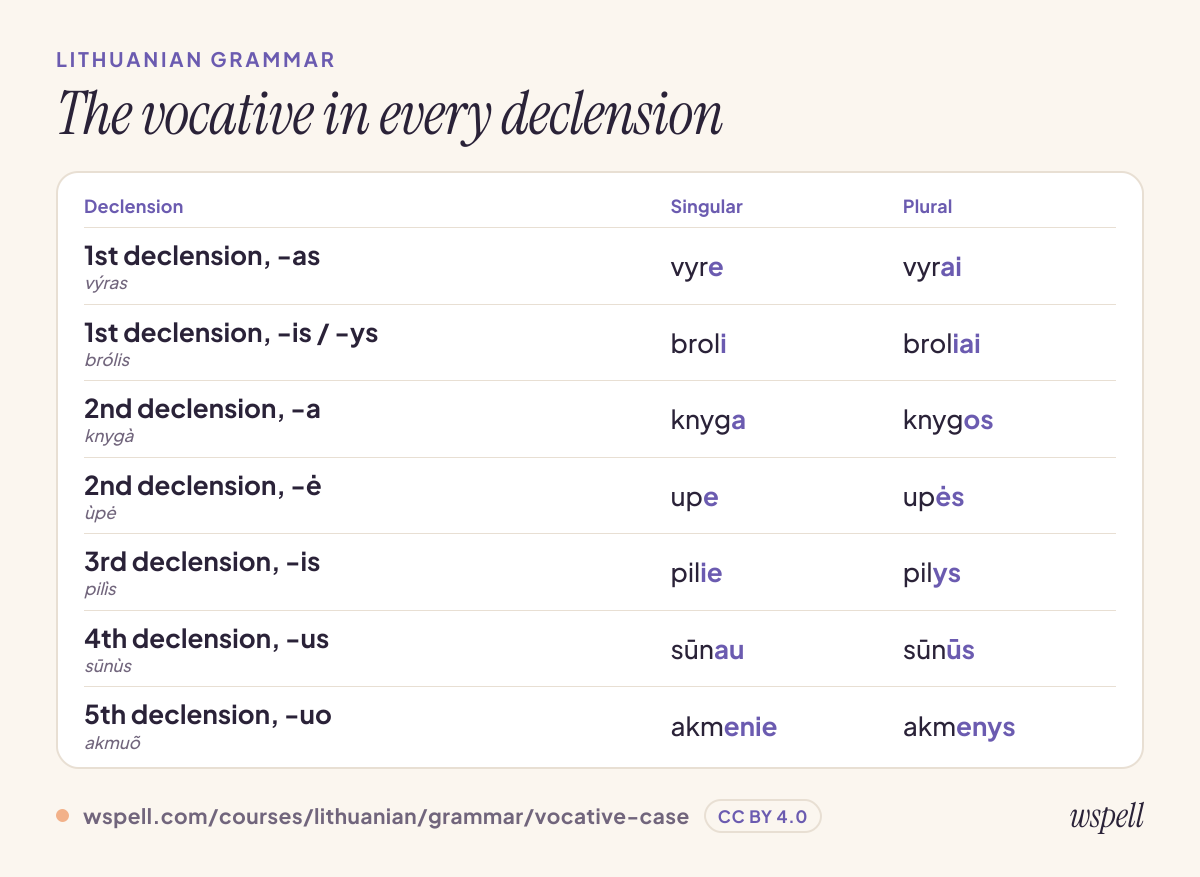
Vocative endings, singular and plural
| Declension | Singular | Plural |
|---|---|---|
| 1st declension, -as výras | vyre | vyrai |
| 1st declension, -is / -ys brólis | broli | broliai |
| 2nd declension, -a knygà | knyga | knygos |
| 2nd declension, -ė ùpė | upe | upės |
| 3rd declension, -is pilìs | pilie | pilys |
| 4th declension, -us sūnùs | sūnau | sūnūs |
| 5th declension, -uo akmuõ | akmenie | akmenys |
Commas in a direct address
Kreipinys: the person addressed goes between commas
A direct address (kreipinys), in the vocative case, is set off by commas: Petrai, ateik čia; Ačiū, mokytojau. At the start it takes a following comma; in the middle, commas on both sides.
- Mama, kur tu? — Mum, where are you?
practise this chart
Drill these forms in real sentences — every answer checked, every word spoken.
practise now — free to try; some drills ask for a free account
save or print this chart
Under the main tables on this page sits a picture of each — keep one on your phone, share it or print it.
Free to share and adapt under CC BY 4.0 — credit wspell and link to this page. the licence
credit line to copy: The vocative case in Lithuanian (šauksmininkas) — wspell, CC BY 4.0, https://wspell.com/courses/lithuanian/grammar/vocative-case
questions
What is the vocative case used for in Lithuanian?
Only for addressing someone directly — calling a person by name or title: Jonai, eik čia!, Mama, kur tu?, Ačiū, mokytojau.
How do Lithuanian names change in the vocative?
Names in -as end in -ai (Jonas → Jonai, Petras → Petrai); other -as nouns take -e (vyras → vyre, draugas → drauge), and -jas nouns -jau (mokytojas → mokytojau). First-declension -is nouns take -i (brolis → broli), third-declension ones -ie (pilis → pilie); -us becomes -au (sūnus → sūnau), and feminine -a stays (mama!).
Do you need a comma after a name in Lithuanian?
Yes. The person you address (kreipinys) is set off by commas: one after it at the start of a sentence (Mama, kur tu?), one on each side in the middle.