grammar chart · Lithuanian
The accusative case in Lithuanian (galininkas)
The accusative (galininkas) answers ką? — whom? what? It marks the direct object (skaitau knygą) and a stretch of time (visą dieną), and it follows prepositions such as į and per. In the singular a noun or adjective always ends in a nasal vowel.
When to use the accusative
Galininkas: the direct object and a stretch of time
The accusative (galininkas) marks the direct object (skaitau knygą) and stretches of time (visą dieną). Answers ką? (what/whom?).
- Skaitau knygą. — I am reading a book.
- Dirbau visą dieną. — I worked all day.
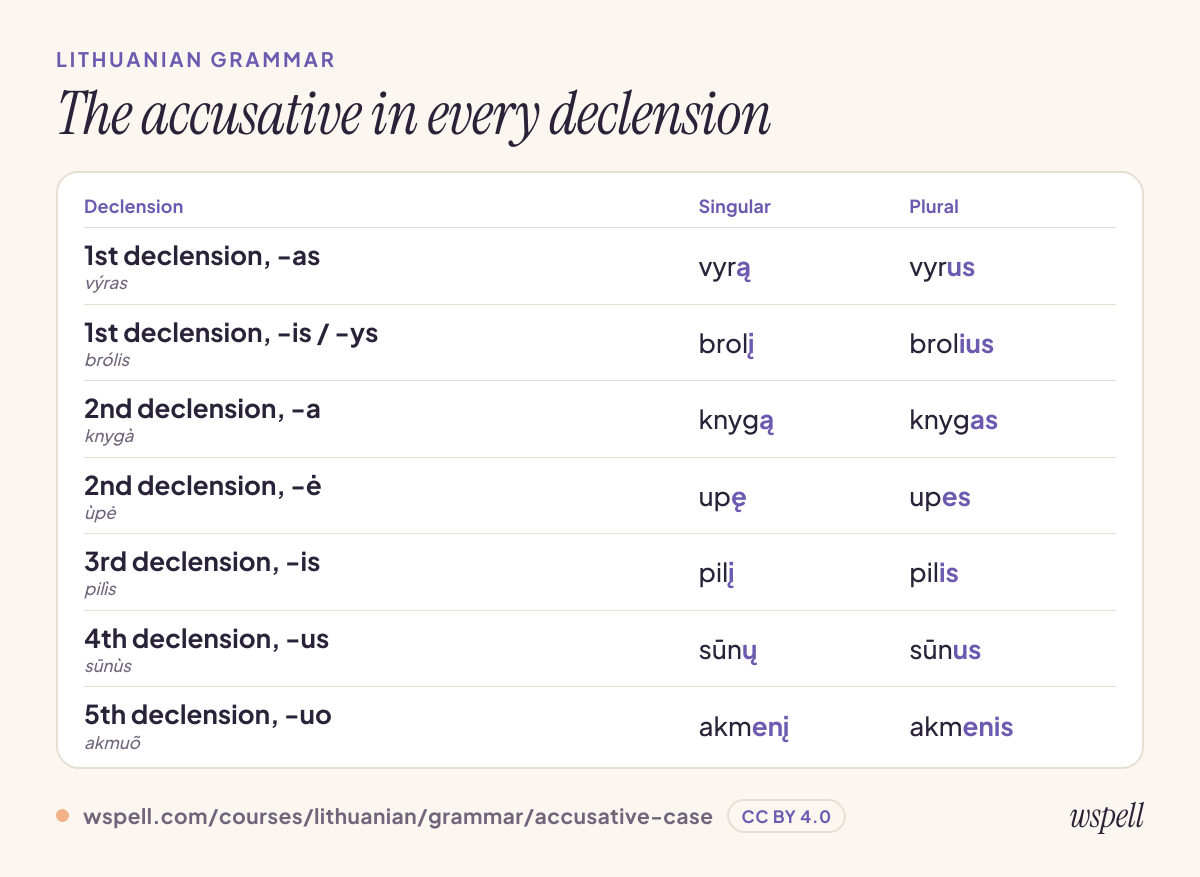
Accusative endings, singular and plural
| Declension | Singular | Plural |
|---|---|---|
| 1st declension, -as výras | vyrą | vyrus |
| 1st declension, -is / -ys brólis | brolį | brolius |
| 2nd declension, -a knygà | knygą | knygas |
| 2nd declension, -ė ùpė | upę | upes |
| 3rd declension, -is pilìs | pilį | pilis |
| 4th declension, -us sūnùs | sūnų | sūnus |
| 5th declension, -uo akmuõ | akmenį | akmenis |
Accusative singular of nouns: a nasal vowel
The accusative singular of nouns and adjectives ends in a nasal vowel: -ą (knygą, namą), -ę (upę), -į (brolį, dantį), -ų (sūnų). Direct object = nasal ending — only the personal pronouns go their own way (mane, tave).
- Skaitau knygą, matau brolį. — I read a book, I see my brother.
Prepositions followed by the accusative
| Preposition | Meaning | Example |
|---|---|---|
| į | to, into | į parduotuvę |
| apie | about, around | apie orą |
| pas | to/at someone's | pas gydytoją |
| per | through, across, during | per parką |
| aplink | around | aplink stadioną |
| pagal | according to, along | pagal planą |
| palei | along | palei jūrą |
| paskui | after, following | paskui mane |
| po | distributive / around | po vieną obuolį |
| prieš | before, against, opposite | prieš darbą |
| priešais | opposite, in front of | priešais stotį |
| pro | past, through an opening | pro langą |
| už | for / than | už pagalbą |
Time words and aches
Pirmadienį, vasarą: when something happens
When something happens takes the accusative: pirmadienį (on Monday), vasarą (in summer), rytą (in the morning), šį vakarą (tonight), visą dieną (all day).
- Penktadienį einame į kiną. — On Friday we go to the cinema.
Man skauda galvą: the aching body part in the accusative
With skaudėti the experiencer is dative and the aching body part is ACCUSATIVE: man skauda galvą (my head hurts), jai skauda gerklę.
- Man skauda galvą. — I have a headache.
practise this chart
Drill these forms in real sentences — every answer checked, every word spoken.
practise now — free to try; some drills ask for a free account
save or print this chart
Under the main tables on this page sits a picture of each — keep one on your phone, share it or print it.
Free to share and adapt under CC BY 4.0 — credit wspell and link to this page. the licence
credit line to copy: The accusative case in Lithuanian (galininkas) — wspell, CC BY 4.0, https://wspell.com/courses/lithuanian/grammar/accusative-case
questions
When is the accusative used in Lithuanian?
For the direct object (skaitau knygą), for how long something lasts (dirbau visą dieną), for when it happens (pirmadienį, vasarą), and after prepositions such as į, per, apie and pas.
How do you spell the accusative singular in Lithuanian?
A noun or adjective always ends in a nasal vowel: -ą (knygą, namą), -ę (upę), -į (brolį, dantį) or -ų (sūnų); only the personal pronouns differ (mane, tave). The feminine instrumental has no nasal: su knyga, su upe.
Does a negated object stay in the accusative?
No. When the verb is negated, the direct object moves to the genitive: turiu knygą, but neturiu knygos.