grammar chart · Lithuanian
The locative case in Lithuanian (vietininkas)
The locative (vietininkas) answers kur? kame? — where? The ending itself does the work of 'in' or 'at', so no preposition is needed: gyvenu Vilniuje (I live in Vilnius), mokykloje (at school). For where to, Lithuanian uses į + accusative instead.
When to use the locative
Vietininkas: location, with no preposition
The locative (vietininkas) expresses location inside something and needs NO preposition: Vilniuje (in Vilnius), knygoje (in the book), mokykloje (at school). Answers kur? / kame? (where?).
- Gyvenu Vilniuje. — I live in Vilnius.
Locative endings, singular and plural
| Declension | Singular | Plural |
|---|---|---|
| 1st declension, -as výras | vyre | vyruose |
| 1st declension, -is / -ys brólis | brolyje | broliuose |
| 2nd declension, -a knygà | knygoje | knygose |
| 2nd declension, -ė ùpė | upėje | upėse |
| 3rd declension, -is pilìs | pilyje | pilyse |
| 4th declension, -us sūnùs | sūnuje | sūnuose |
| 5th declension, -uo akmuõ | akmenyje | akmenyse |
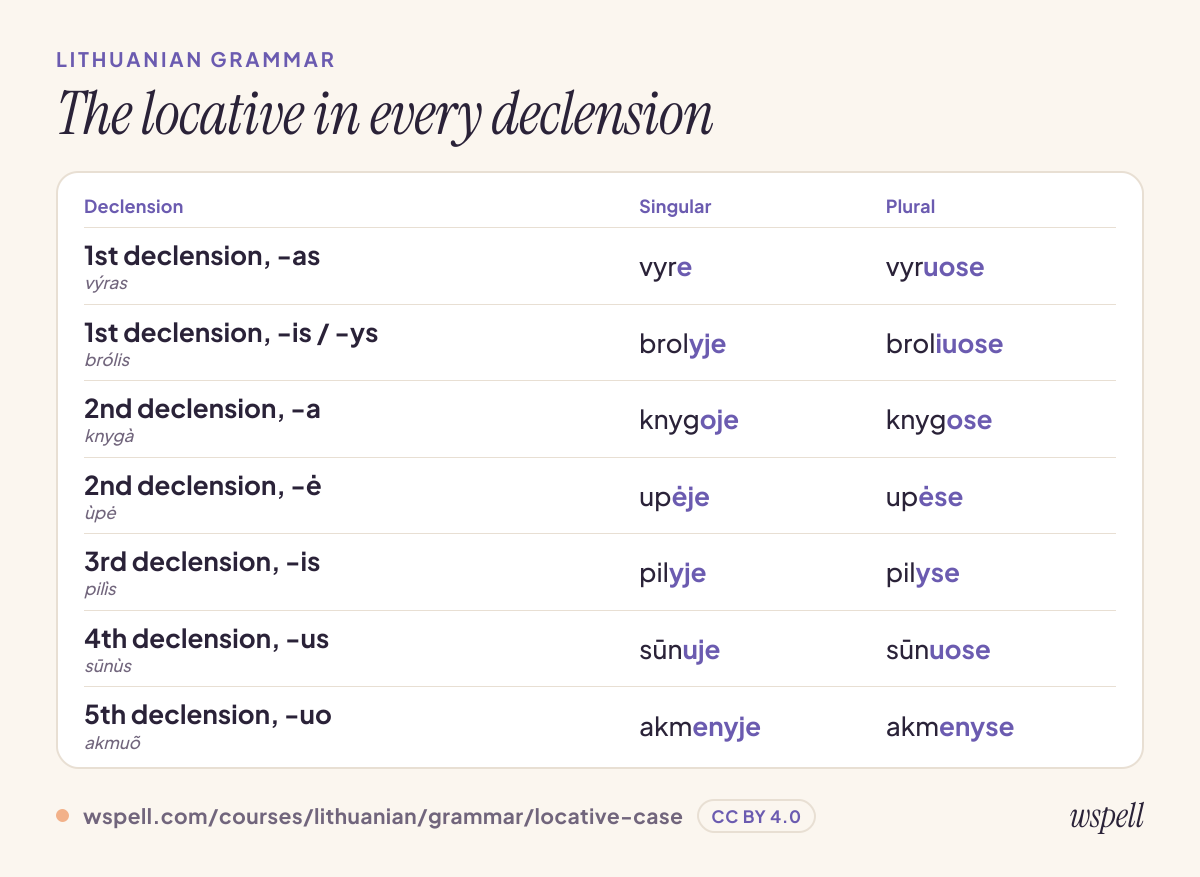
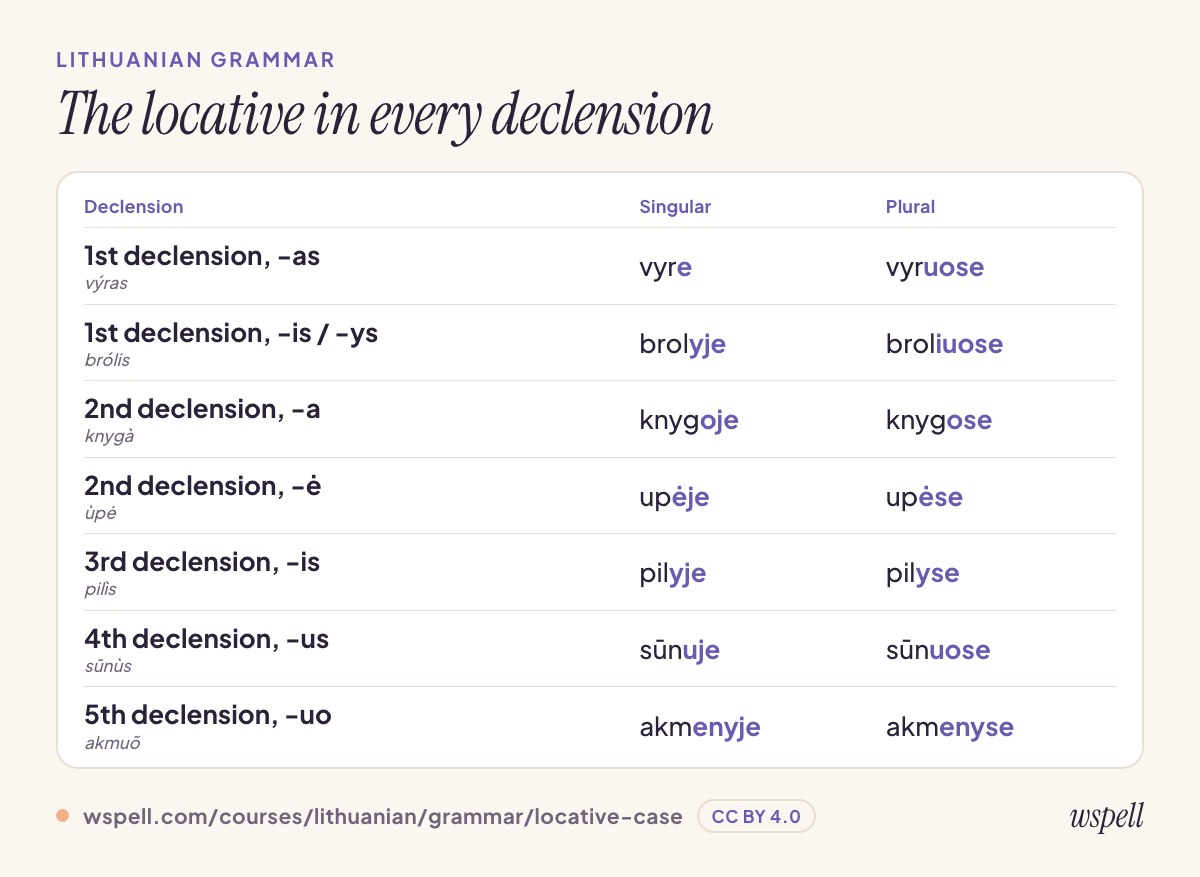
practise this chart
Drill these forms in real sentences — every answer checked, every word spoken.
practise now — free to try; some drills ask for a free account
save or print this chart
Under the main tables on this page sits a picture of each — keep one on your phone, share it or print it.
Free to share and adapt under CC BY 4.0 — credit wspell and link to this page. the licence
credit line to copy: The locative case in Lithuanian (vietininkas) — wspell, CC BY 4.0, https://wspell.com/courses/lithuanian/grammar/locative-case
questions
When do you use the locative in Lithuanian?
To say where something is — in a place, a town or a thing: Vilniuje (in Vilnius), knygoje (in the book), mokykloje (at school). It never takes a preposition.
What are the locative endings in Lithuanian?
In the singular: -e (vyre), -yje (brolyje, pilyje), -oje (knygoje), -ėje (upėje), -uje (sūnuje) and -enyje/-eryje (akmenyje). In the plural: -uose, -iuose, -ose, -ėse, -yse and -enyse/-eryse.
How do you say 'where to' in Lithuanian?
Kur covers both where and where to, but the answers differ. Where something is takes the locative (Kur gyveni? — Kaune); where someone goes takes į + accusative (Kur eini? — Į parduotuvę).