grammar chart · Lithuanian
The nominative case in Lithuanian (vardininkas)
The nominative (vardininkas) answers kas? — who? what? It names the subject of the sentence and is the form you find in a dictionary. The table shows it on one example noun of each type, and the last section explains when a job or role takes the instrumental instead (dirba mokytoju, tapo gydytoju).
When to use the nominative
Vardininkas: the subject and the dictionary form
The nominative (vardininkas) names the subject of the sentence and is the dictionary form. Answers kas? (who/what?).
- Knyga įdomi. — The book is interesting.
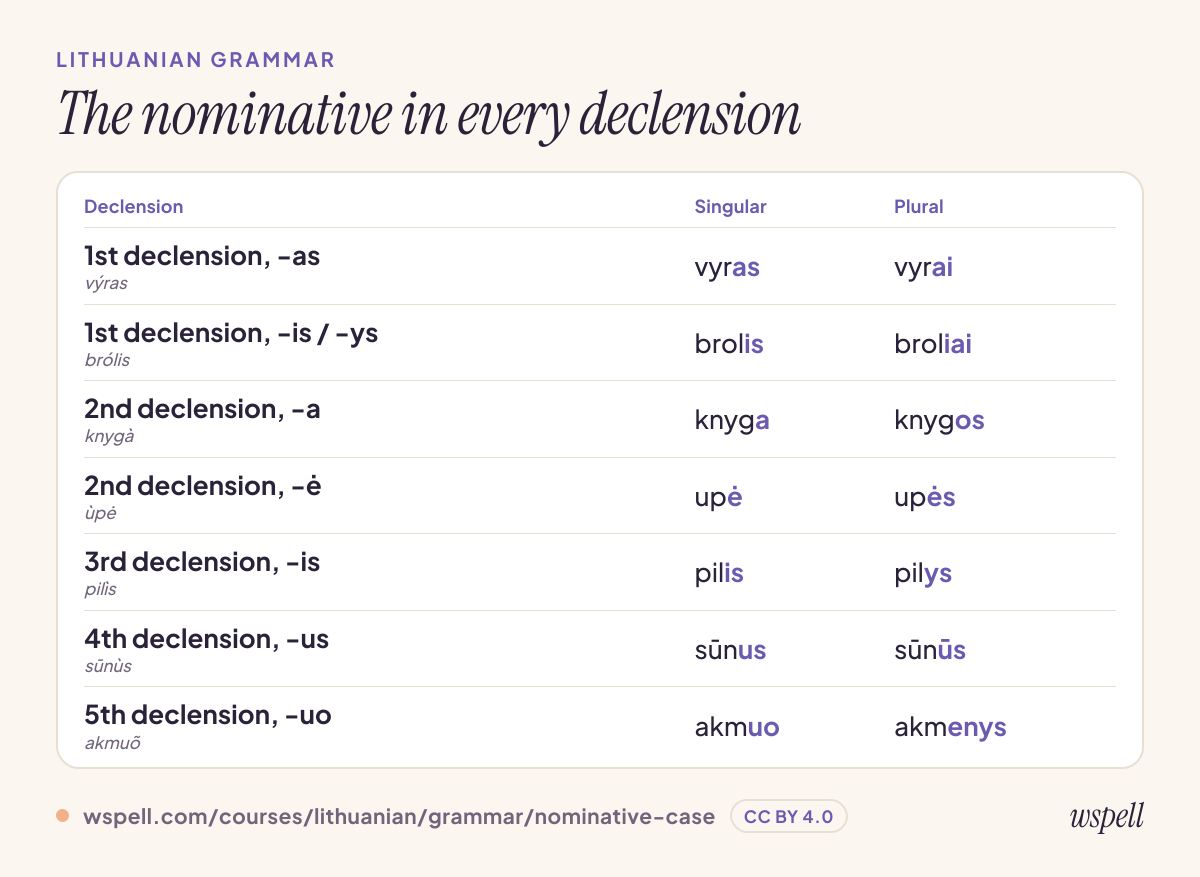
Nominative endings, singular and plural
| Declension | Singular | Plural |
|---|---|---|
| 1st declension, -as výras | vyras | vyrai |
| 1st declension, -is / -ys brólis | brolis | broliai |
| 2nd declension, -a knygà | knyga | knygos |
| 2nd declension, -ė ùpė | upė | upės |
| 3rd declension, -is pilìs | pilis | pilys |
| 4th declension, -us sūnùs | sūnus | sūnūs |
| 5th declension, -uo akmuõ | akmuo | akmenys |
After būti: nominative or instrumental?
Who you are (nominative) or the role you play (instrumental)
Permanent identity takes the nominative (jis yra mokytojas — he is a teacher), while function, temporary state, or change takes the instrumental: dirba mokytoju (works as a teacher), tapo gydytoju (became a doctor), buvo vaiku (as a child).
- Jis yra gydytojas, bet dirba vairuotoju. — He is a doctor but works as a driver.
learn it step by step
save or print this chart
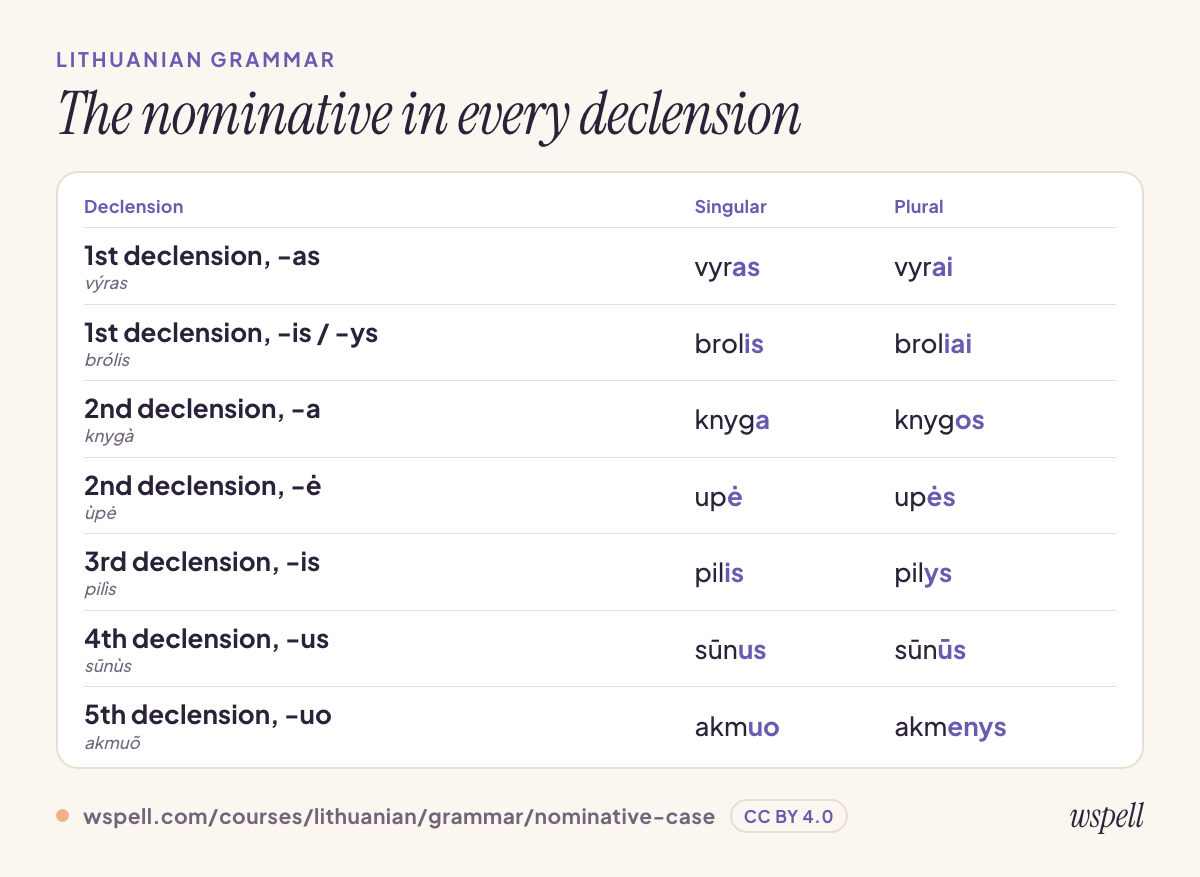
Under the main tables on this page sits a picture of each — keep one on your phone, share it or print it.
Free to share and adapt under CC BY 4.0 — credit wspell and link to this page. the licence
credit line to copy: The nominative case in Lithuanian (vardininkas) — wspell, CC BY 4.0, https://wspell.com/courses/lithuanian/grammar/nominative-case
questions
What is the nominative case in Lithuanian?
The nominative (vardininkas) is the case of the subject and the dictionary form of a word. It answers kas? (who? what?): Knyga įdomi — the book is interesting.
What are the nominative endings in Lithuanian?
In the singular: -as, -is/-ys (first declension), -a, -ė (second), -is (third), -us (fourth) and -uo (fifth). In the plural: -ai, -iai, -os, -ės, -ys, -ūs and -enys/-erys.
Is it 'jis yra mokytojas' or 'mokytoju'?
The nominative states who someone is: jis yra mokytojas. A function, a temporary state or a change takes the instrumental: dirba mokytoju (works as a teacher), tapo gydytoju (became a doctor).