grammar chart · Lithuanian
The Lithuanian future tense
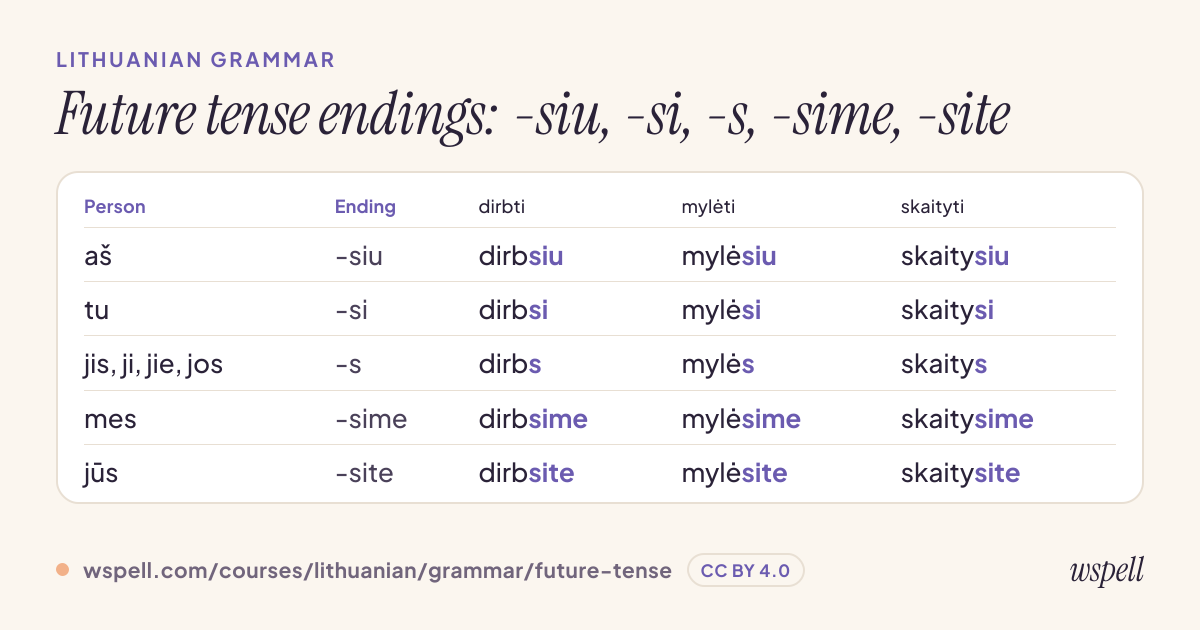
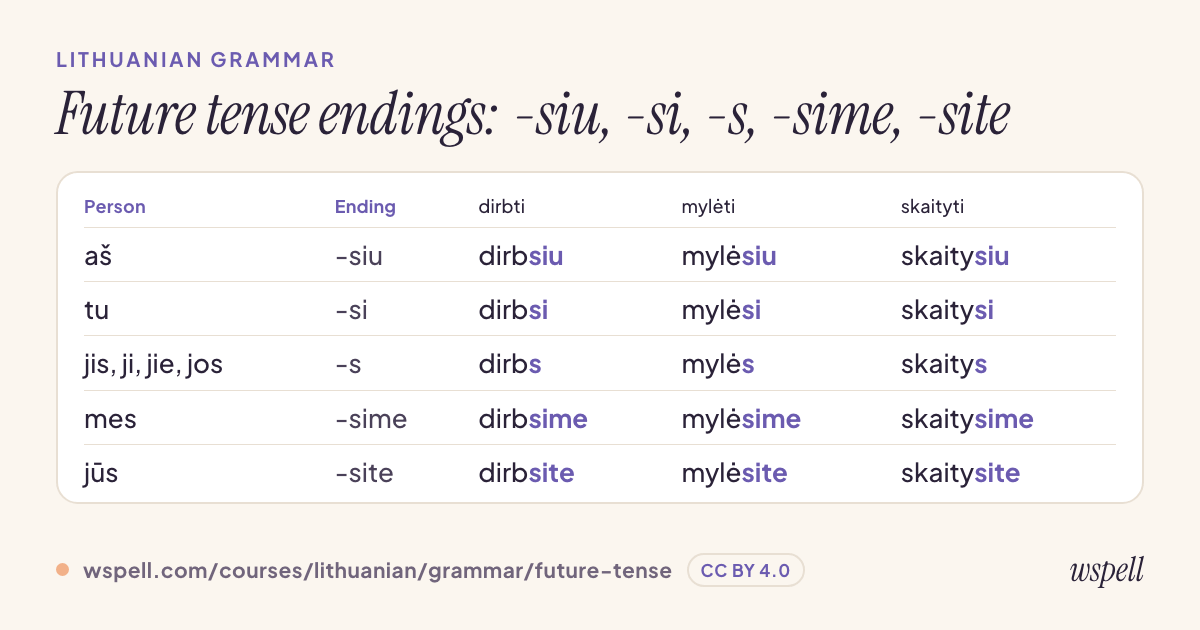
The future has one set of endings for every verb: drop -ti from the infinitive and add -siu, -si, -s, -sime, -site. Two things change: a stem ending in s, š, z or ž merges with the s (nešti → nešiu), and one-syllable -yti/-ūti verbs shorten the vowel in the 3rd person (būti → bus, lyti → lis).
Forming the future
| Person | Ending | dirbti | mylėti | skaityti |
|---|---|---|---|---|
| aš | -siu | dirbsiu | mylėsiu | skaitysiu |
| tu | -si | dirbsi | mylėsi | skaitysi |
| jis, ji, jie, jos | -s | dirbs | mylės | skaitys |
| mes | -sime | dirbsime | mylėsime | skaitysime |
| jūs | -site | dirbsite | mylėsite | skaitysite |
-s- on the infinitive stem
The future adds -s- to the infinitive stem: dirbsiu, dirbsi, dirbs. Stem-final s/š/z/ž merges with the ending: nešti → nešiu, vežti → vešiu; one-syllable -yti/-ūti verbs shorten the vowel in the 3rd person: būti → bus, lyti → lis.
- Rytoj dirbsiu namie. — Tomorrow I will work at home.
practise this chart
Drill these forms in real sentences — every answer checked, every word spoken.
practise now — free to try; some drills ask for a free account
save or print this chart
Under the main tables on this page sits a picture of each — keep one on your phone, share it or print it.
Free to share and adapt under CC BY 4.0 — credit wspell and link to this page. the licence
credit line to copy: The Lithuanian future tense — wspell, CC BY 4.0, https://wspell.com/courses/lithuanian/grammar/future-tense
questions
How do you form the future tense in Lithuanian?
Drop -ti from the infinitive and add -siu, -si, -s, -sime, -site: dirbti → dirbsiu, dirbsi, dirbs, dirbsime, dirbsite.
What happens to nešti or vežti in the future?
A stem ending in s, š, z or ž merges with the future s: nešti → nešiu, neši, neš; vežti → vešiu.
Is the future 3rd person the same for 'he' and 'they'?
Yes. As in every Lithuanian tense, one 3rd-person form serves the singular and the plural: jis dirbs, jie dirbs.