grammar chart · Lithuanian
The Lithuanian present tense
A Lithuanian verb's present tense follows its 3rd person, which ends in -a, -i or -o and sets the class: dirba, myli, skaito. Learn it with the infinitive and the past, and every other form follows. The 3rd person is the same in the singular and the plural.
The three present-tense classes: -a, -i, -o
| Person | -a verbs (dirba) dirbti | -i verbs (myli) mylėti | -o verbs (skaito) skaityti |
|---|---|---|---|
| aš | dirbu -u | myliu -iu | skaitau -au |
| tu | dirbi -i | myli -i | skaitai -ai |
| jis, ji, jie, jos | dirba -a | myli -i | skaito -o |
| mes | dirbame -ame | mylime -ime | skaitome -ome |
| jūs | dirbate -ate | mylite -ite | skaitote -ote |
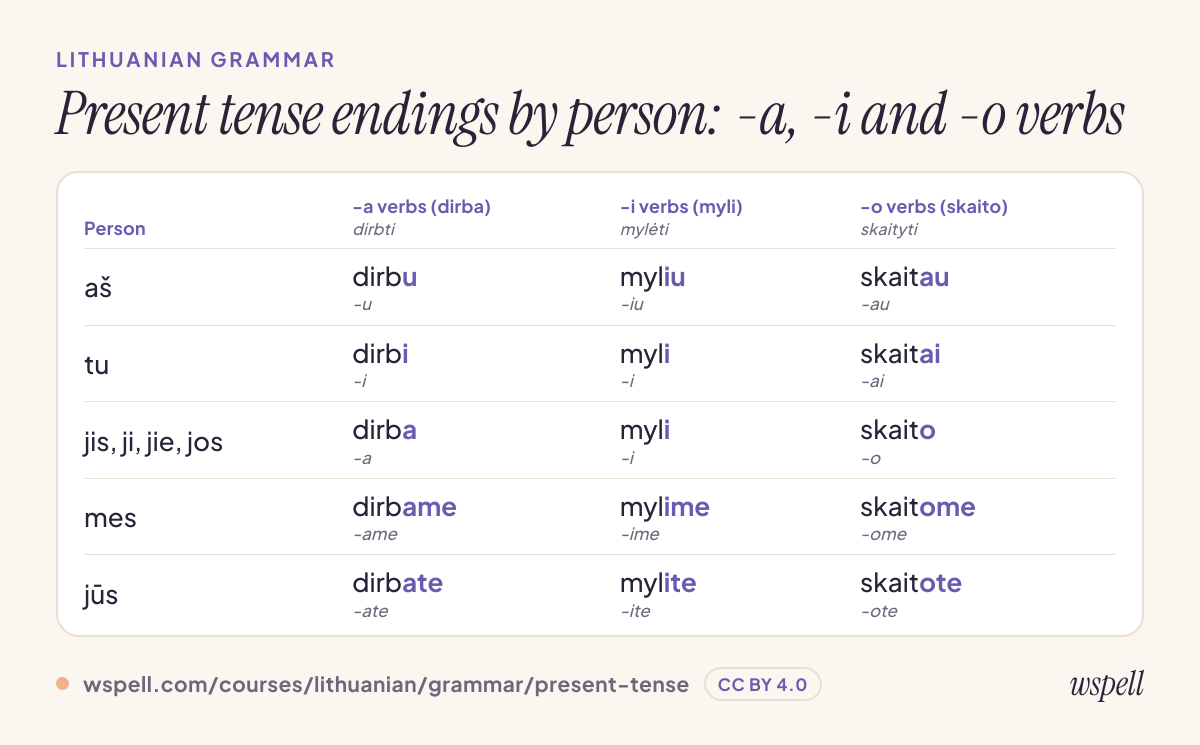
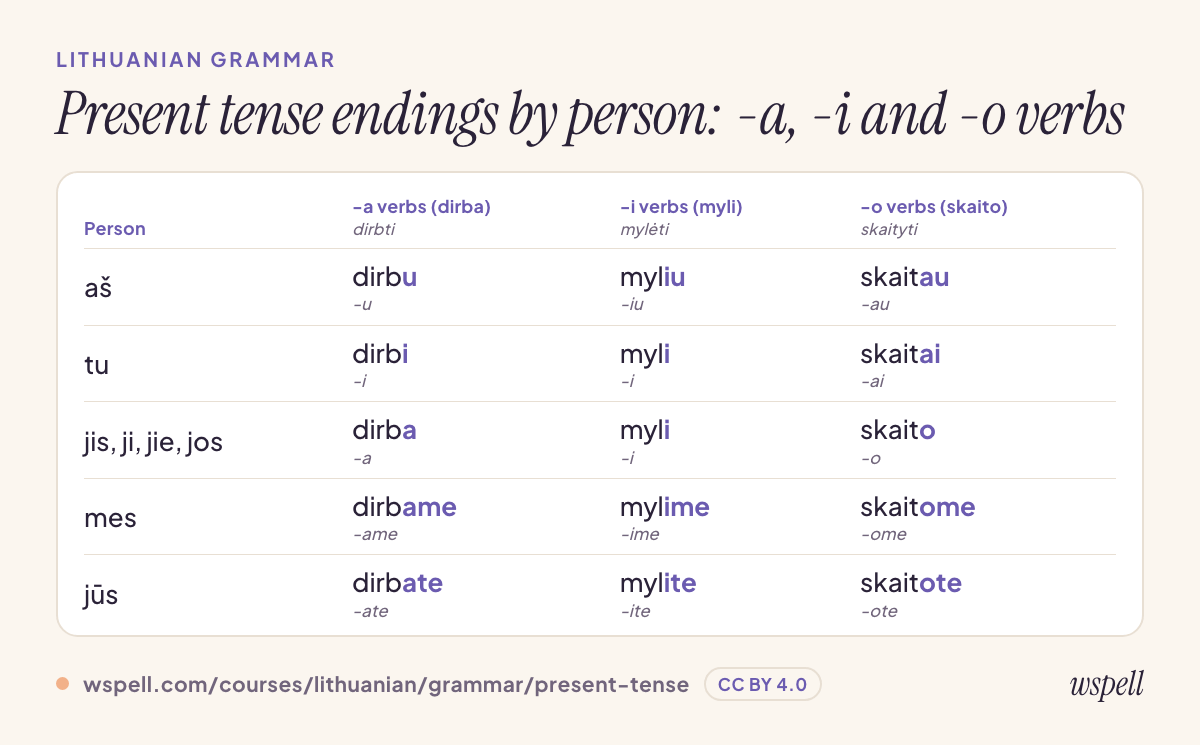
Which class? Look at the 3rd person
Lithuanian verbs fall into three present-tense classes by the 3rd-person ending: -a (dirba), -i (myli), -o (skaito). Learn the three principal parts (infinitive, present-3, past-3) and every form follows.
- Jis dirba, myli, skaito. — He works, loves, reads.
Reflexive verbs: mokausi, mokosi
| Person | Ending |
|---|---|
| aš | -uosi/-(i)uosi/-ausi |
| tu | -iesi/-aisi |
| jis, ji, jie, jos | -asi/-isi/-osi |
| mes | -amės/-imės/-omės |
| jūs | -atės/-itės/-otės |
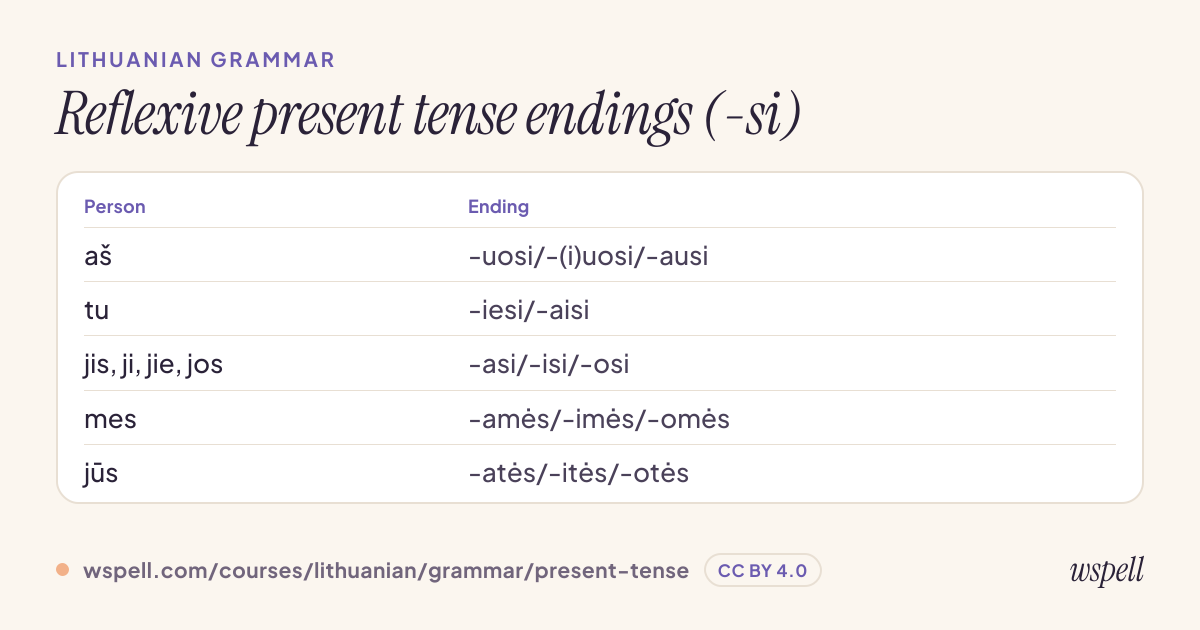
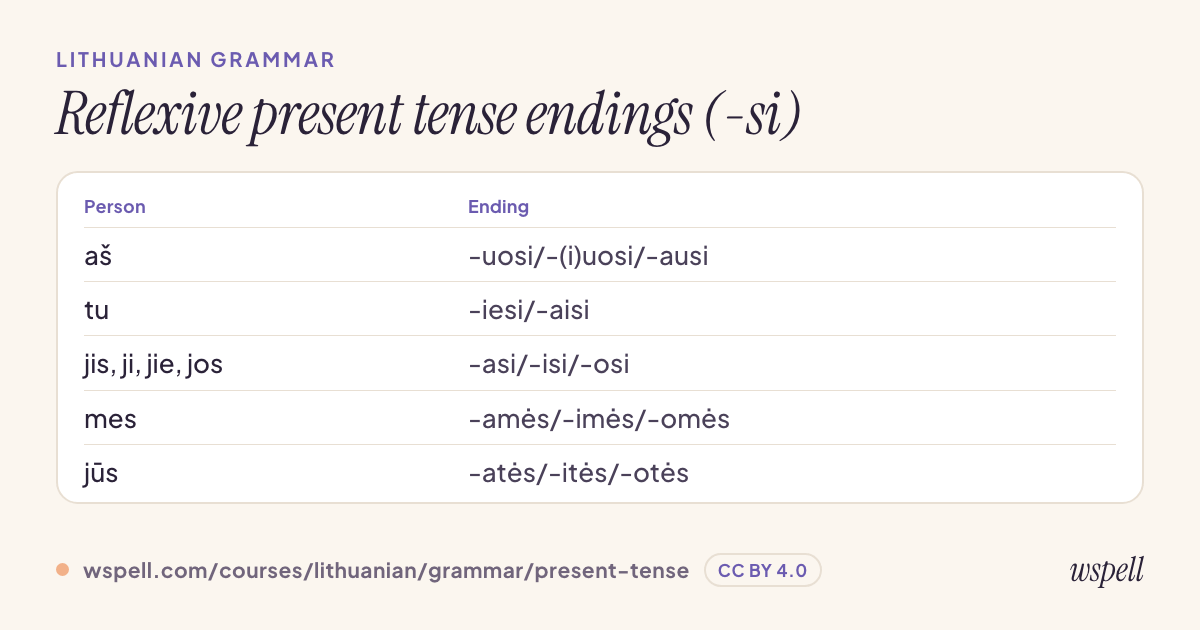
Where -si goes: after a prefix, and after ne-
Reflexive verbs end in -tis (mokytis). Without a prefix the marker stays at the end (mokosi); any prefix pulls it in right after itself: at-si-kelti → atsikeliu, nu-si-prausti → nusiprausiu. The negative ne- counts as a prefix too, so the marker moves even when nothing else is added: mokausi → ne-si-mokau (nesimokau), not *nemokausi.
- Jis mokosi. — He studies.
- Aš atsikeliu anksti. — I get up early.
Negative verbs: nedirbu
Ne- is written together with the verb
Negation is the prefix ne- written TOGETHER with the verb: dirbu → nedirbu, noriu → nenoriu. nebe- means 'no longer' (nebedirbu).
- Aš nenoriu valgyti. — I don't want to eat.
practise this chart
Drill these forms in real sentences — every answer checked, every word spoken.
practise now — free to try; some drills ask for a free account
save or print this chart
Under the main tables on this page sits a picture of each — keep one on your phone, share it or print it.
Free to share and adapt under CC BY 4.0 — credit wspell and link to this page. the licence
credit line to copy: The Lithuanian present tense — wspell, CC BY 4.0, https://wspell.com/courses/lithuanian/grammar/present-tense
questions
How many verb conjugations does Lithuanian have?
In the present tense, three classes named by the 3rd-person ending: -a (dirba), -i (myli) and -o (skaito). The past tense has two, -o and -ė.
How do you know which class a Lithuanian verb is in?
From its present 3rd person, the second of the three principal parts (infinitive, present, past): dirbti, dirba, dirbo. Learn those three forms and every other form follows.
How do you make a Lithuanian verb negative?
Write ne- together with the verb: dirbu → nedirbu, noriu → nenoriu. In a reflexive verb the -si moves in after ne-: mokausi → nesimokau.