grammar chart · Lithuanian
The Lithuanian past tense
The simple past is built from a verb's third principal part, whose 3rd person ends in -o or -ė: dirbo, skaitė. That ending sets the class for every other person. For what you used to do again and again, Lithuanian has a separate past in -davo.
The simple past: -o and -ė verbs
| Person | -o verbs (dirbo) dirbti | -ė verbs (skaitė) skaityti |
|---|---|---|
| aš | dirbau -au | skaičiau -iau |
| tu | dirbai -ai | skaitei -ei |
| jis, ji, jie, jos | dirbo -o | skaitė -ė |
| mes | dirbome -ome | skaitėme -ėme |
| jūs | dirbote -ote | skaitėte -ėte |
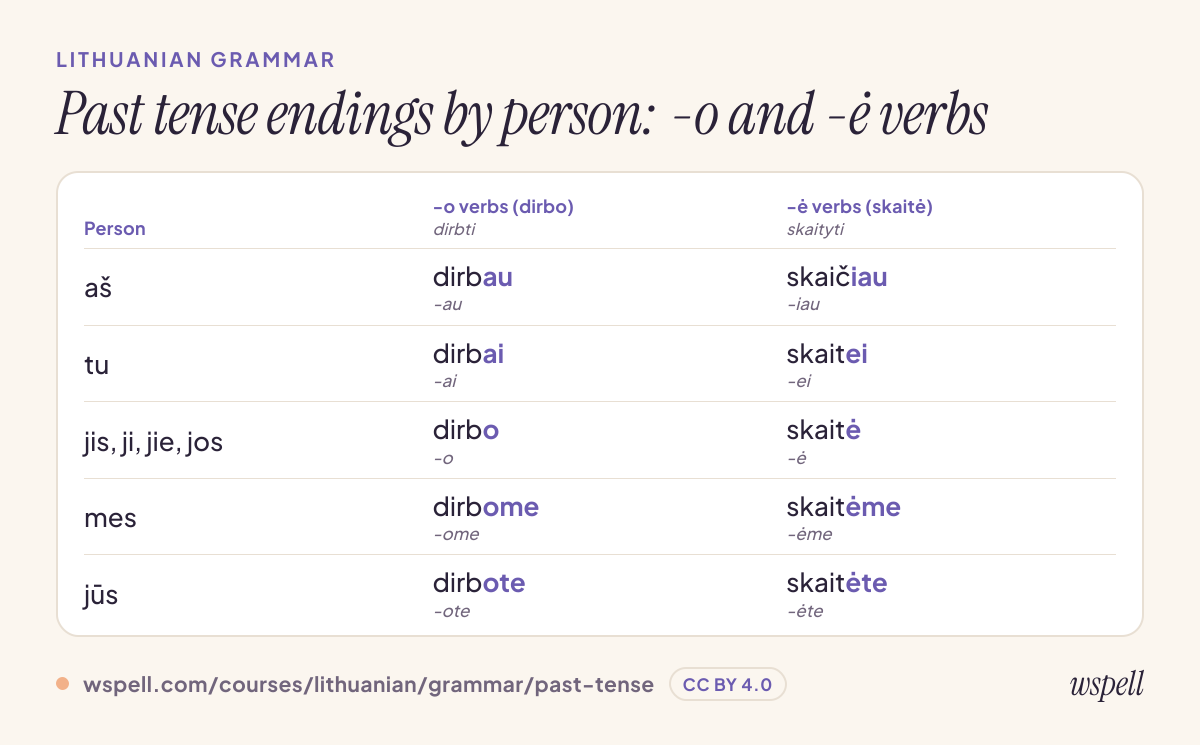
The past stem is the third principal part
The simple past 3rd person ends in -o or -ė: dirbo, skaitė. The past stem is the third principal part.
- Vakar jis dirbo ir skaitė. — Yesterday he worked and read.
The past of habits: -davo
| Person | Ending | dirbti | mylėti | skaityti |
|---|---|---|---|---|
| aš | -davau | dirbdavau | mylėdavau | skaitydavau |
| tu | -davai | dirbdavai | mylėdavai | skaitydavai |
| jis, ji, jie, jos | -davo | dirbdavo | mylėdavo | skaitydavo |
| mes | -davome | dirbdavome | mylėdavome | skaitydavome |
| jūs | -davote | dirbdavote | mylėdavote | skaitydavote |
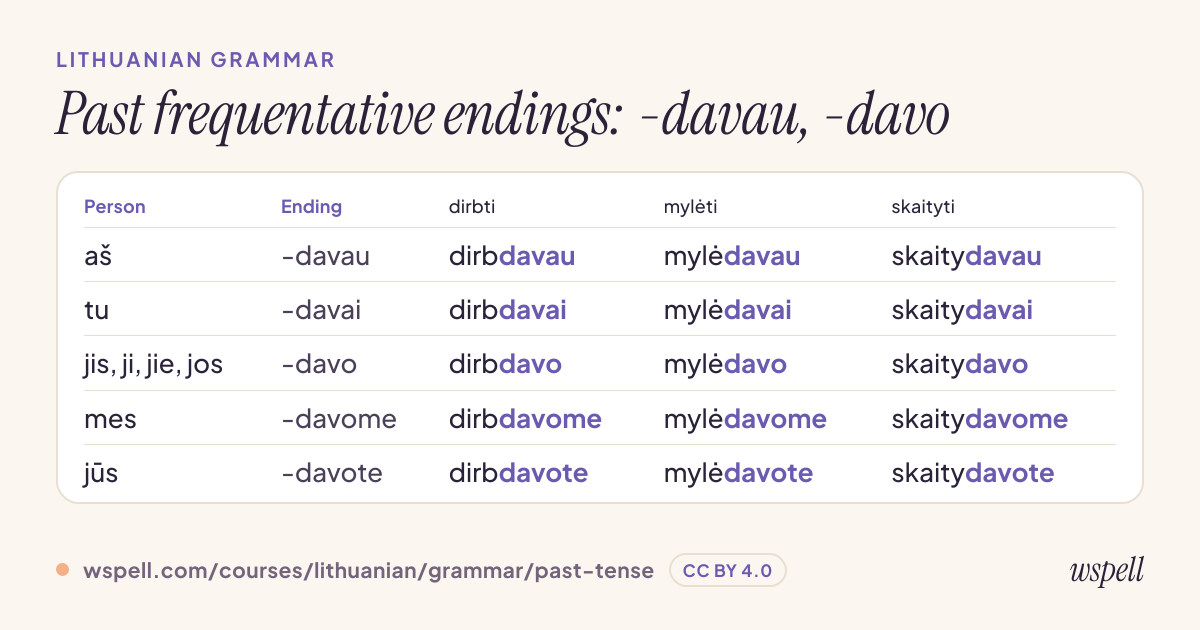
Skaitydavau: I used to read
-davo expresses repeated/habitual past actions: skaitydavau (I used to read). Built from the infinitive stem + -dav- + person endings.
- Vaikystėje daug skaitydavau. — In childhood I used to read a lot.
practise this chart
Drill these forms in real sentences — every answer checked, every word spoken.
practise now — free to try; some drills ask for a free account
save or print this chart
Under the main tables on this page sits a picture of each — keep one on your phone, share it or print it.
Free to share and adapt under CC BY 4.0 — credit wspell and link to this page. the licence
credit line to copy: The Lithuanian past tense — wspell, CC BY 4.0, https://wspell.com/courses/lithuanian/grammar/past-tense
questions
How do you form the past tense in Lithuanian?
Take the past 3rd person — the third principal part, ending in -o or -ė — and change the ending for each person: dirbau, dirbai, dirbo, dirbome, dirbote; skaičiau, skaitei, skaitė, skaitėme, skaitėte.
Why is it skaičiau but skaitei?
The 1st-person ending -iau softens a stem-final t to č and d to dž: skaityti → skaičiau, matyti → mačiau, vesti → vedžiau. No other person changes.
How do you say 'used to' in Lithuanian?
Use the frequentative past: drop -ti and add -davau, -davai, -davo, -davome, -davote. Vaikystėje daug skaitydavau — in childhood I used to read a lot.