grammar chart · Lithuanian
Lithuanian adjective declension
A Lithuanian adjective agrees with its noun in gender, number and case, so every adjective has a masculine and a feminine set of endings. There are three types, named by the masculine nominative: -as (naujas), -is (didelis) and -us (gražus).
Agreement: gender, number and case
An adjective copies its noun's gender, number and case
An adjective agrees with its noun in gender, number, AND case: gražus namas (m), graži knyga (f), gražūs namai (m pl), gražiose knygose (f pl loc). Pick the adjective form whose features match the noun's.
- naujas namas / nauja knyga — a new house / a new book
- naujuose namuose — in the new houses
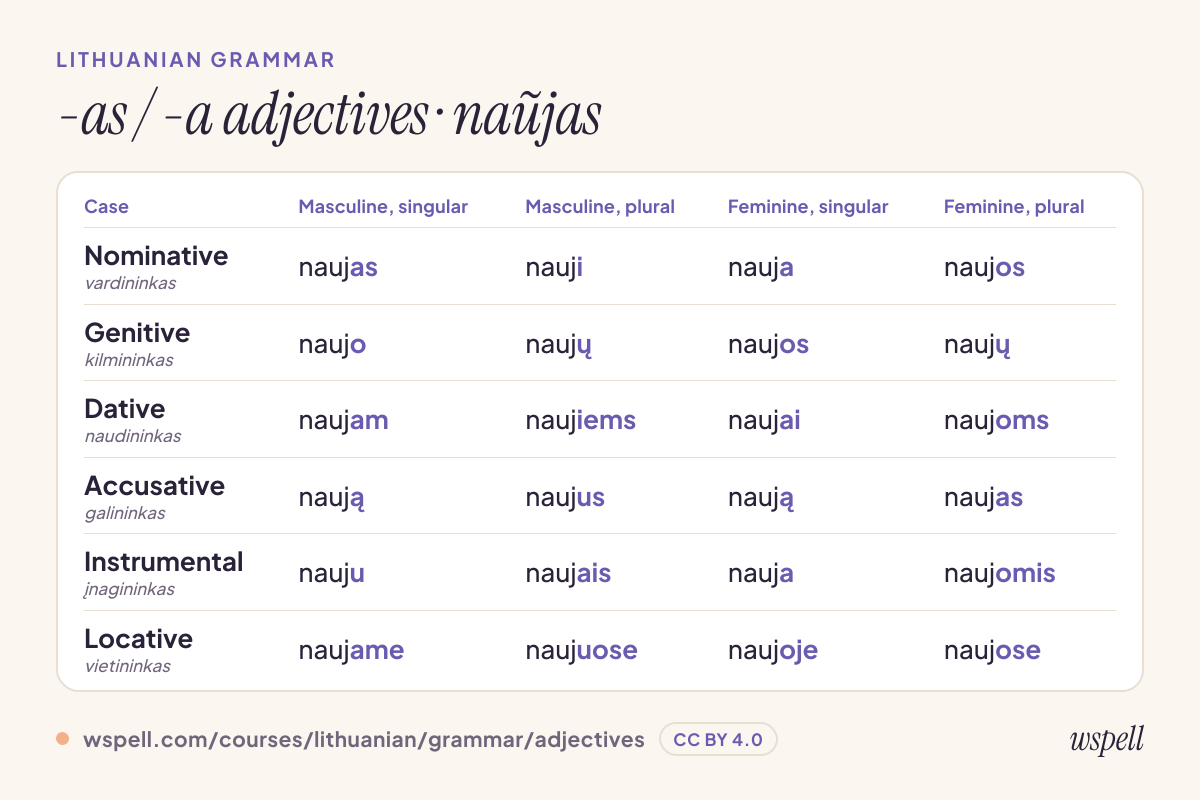
Adjectives in -as (naujas, nauja)
Masculine -as, feminine -a
Adjectives in -as decline like nouns but with adjectival endings; the feminine is -a. Masculine locative singular is -ame (naujame name).
- naujas namas, naujame name, naujų namų — a new house, in the new house, of new houses
| Case | Masculine, singular | Masculine, plural | Feminine, singular | Feminine, plural |
|---|---|---|---|---|
| Nominative vardininkas | naujas | nauji | nauja | naujos |
| Genitive kilmininkas | naujo | naujų | naujos | naujų |
| Dative naudininkas | naujam | naujiems | naujai | naujoms |
| Accusative galininkas | naują | naujus | naują | naujas |
| Instrumental įnagininkas | nauju | naujais | nauja | naujomis |
| Locative vietininkas | naujame | naujuose | naujoje | naujose |
Adjectives in -is (didelis, didelė)
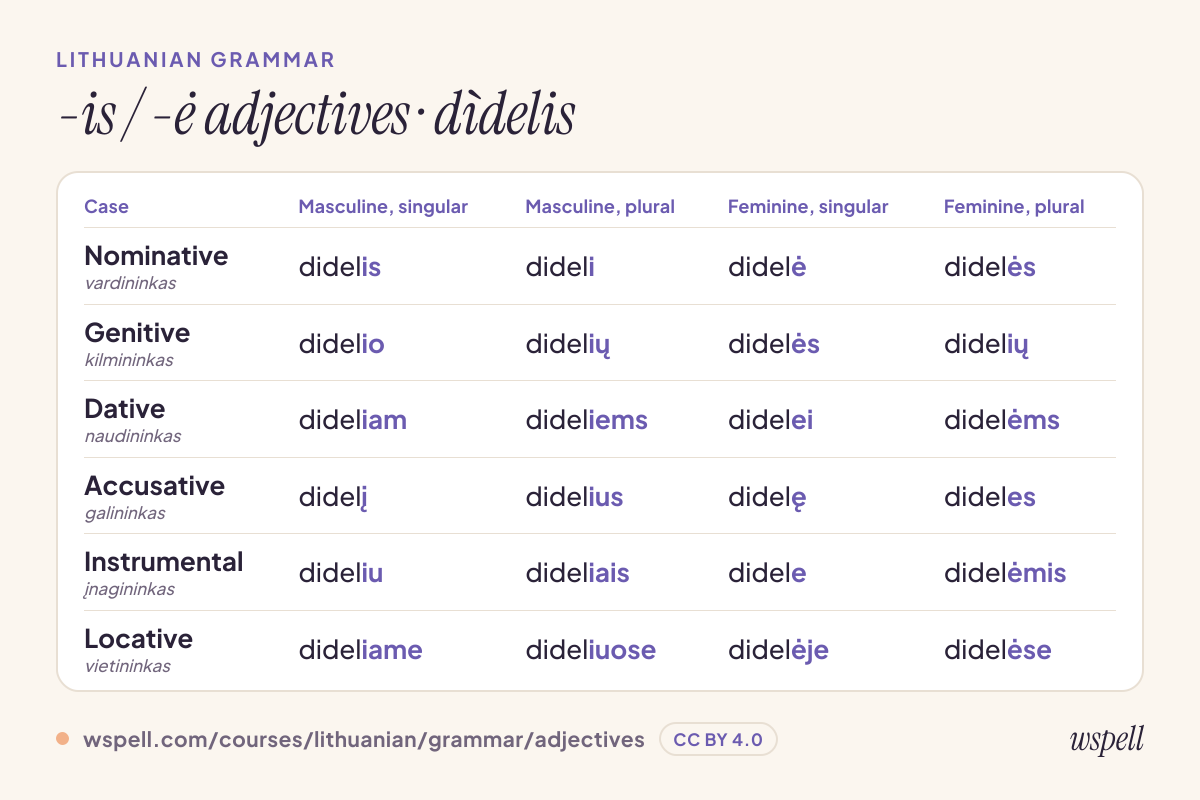
Masculine -is, feminine -ė
The -is/-ė adjective type: masculine -is, feminine -ė — didelis/didelė (big), naminis/naminė (home-made), medinis/medinė (wooden). The masculine takes the soft adjective endings (didelio, dideliam, didelį) and the feminine exactly like the -ė nouns (didelės, didelei, didelę). In the masculine plural didelis itself has dideli, dideliems, while the -inis adjectives keep -iai, -iams (mediniai, mediniams). Most relative adjectives (material, origin, purpose) belong here, which is why the type is so productive: geležinis, vasarinis, rytinis.
- Didelis namas stovi prie didelės upės. — A big house stands by a big river.
- Tai medinis stalas ir medinė kėdė. — This is a wooden table and a wooden chair.
| Case | Masculine, singular | Masculine, plural | Feminine, singular | Feminine, plural |
|---|---|---|---|---|
| Nominative vardininkas | didelis | dideli | didelė | didelės |
| Genitive kilmininkas | didelio | didelių | didelės | didelių |
| Dative naudininkas | dideliam | dideliems | didelei | didelėms |
| Accusative galininkas | didelį | didelius | didelę | dideles |
| Instrumental įnagininkas | dideliu | dideliais | didele | didelėmis |
| Locative vietininkas | dideliame | dideliuose | didelėje | didelėse |
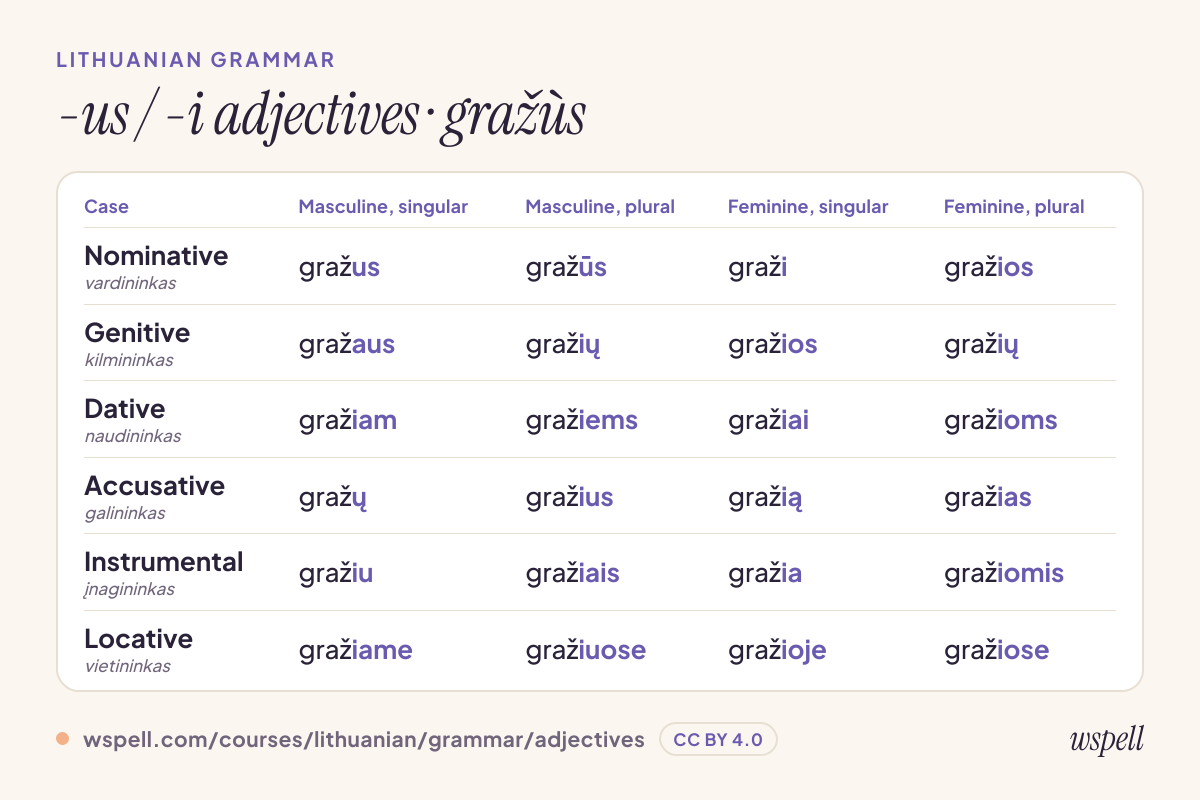
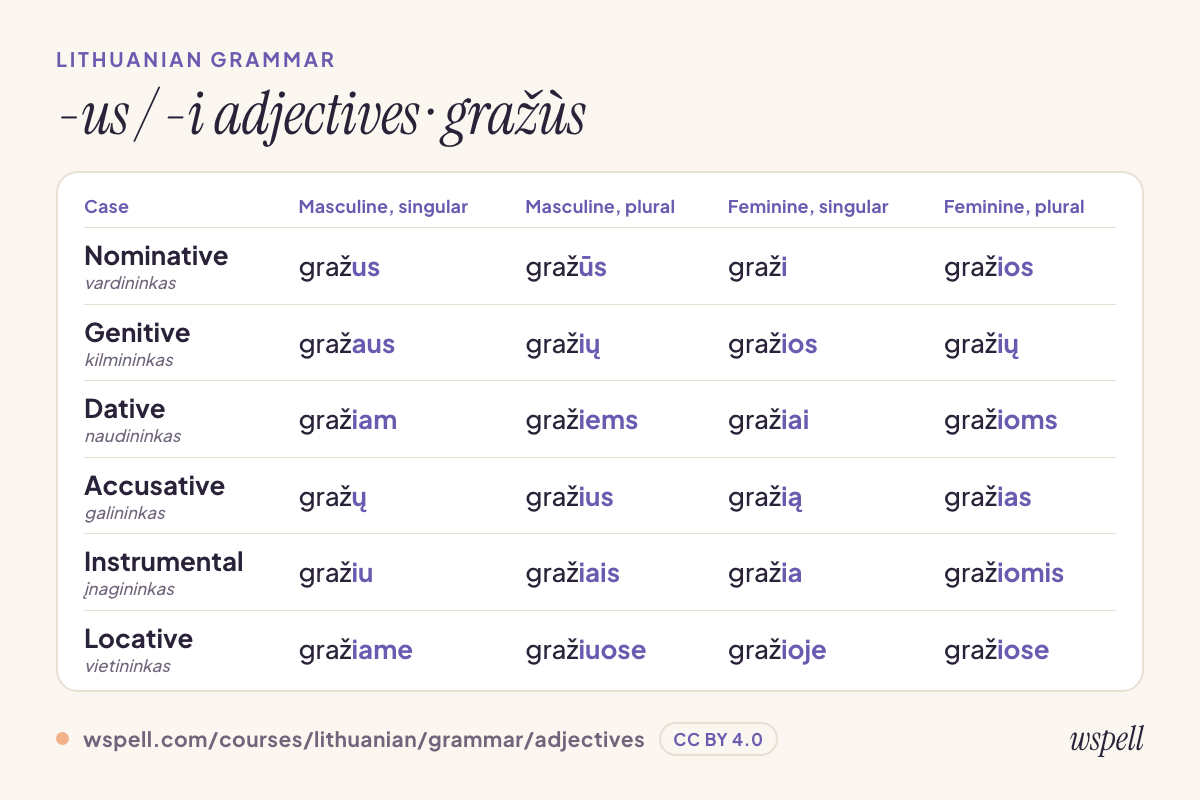
Adjectives in -us (gražus, graži)
Masculine -us, feminine -i
Adjectives in -us have feminine -i (gražus / graži) and take -i- in many forms: gražiam, gražiame, gražių. Masculine plural nominative is -ūs (gražūs).
- gražus miestas / graži gatvė / gražūs namai — a beautiful city / street / beautiful houses
| Case | Masculine, singular | Masculine, plural | Feminine, singular | Feminine, plural |
|---|---|---|---|---|
| Nominative vardininkas | gražus | gražūs | graži | gražios |
| Genitive kilmininkas | gražaus | gražių | gražios | gražių |
| Dative naudininkas | gražiam | gražiems | gražiai | gražioms |
| Accusative galininkas | gražų | gražius | gražią | gražias |
| Instrumental įnagininkas | gražiu | gražiais | gražia | gražiomis |
| Locative vietininkas | gražiame | gražiuose | gražioje | gražiose |
The genderless form
No gender, no number: Šiandien šalta
Besides masculine and feminine, a quality adjective has a THIRD form with no gender and no number, used when there is no noun to agree with. From -as adjectives it ends in -a, from -us adjectives in -u: šaltas → šalta, geras → gera, įdomus → įdomu, gražus → gražu. It states the weather, a feeling or a verdict: Šiandien šalta. Man čia labai gera. Kaip įdomu! Man buvo labai įdomu. Do not confuse it with the feminine, which looks the same for -as adjectives but always has a noun behind it: gera diena (feminine) against Man gera (genderless).
- Šiandien lauke labai šalta. — It is very cold outside today.
- Kaip įdomu! — How interesting!
Comparison and definite forms
Comparative -esnis, superlative -iausias
Comparative adds -esnis/-esnė (naujas → naujesnis, naujesnė); superlative adds -iausias/-iausia (naujausias). They decline like adjectives. Adverbs compare with -iau / -iausiai (greitai → greičiau → greičiausiai). Both -iau and -iausias begin with a softening i, so a stem-final d or t changes before them: saldus → saldžiausias, piktas → pikčiausias, arti → arčiau.
- didelis, didesnis, didžiausias — big, bigger, biggest
- Jis bėga greičiau už mane. — He runs faster than me.
Definite forms: naujasis, naujoji
The long pronominal forms -asis/-oji (naujasis, naujoji) mark a definite, well-known or term-like quality: Naujasis Testamentas, Didžioji Britanija, dešinioji pusė. Common in names, terms, and dates.
- Vilniaus senamiestis — senoji miesto dalis. — Vilnius old town — the old part of the city.
practise this chart
Drill these forms in real sentences — every answer checked, every word spoken.
practise now — free to try; some drills ask for a free account
save or print this chart
Under the main tables on this page sits a picture of each — keep one on your phone, share it or print it.
Free to share and adapt under CC BY 4.0 — credit wspell and link to this page. the licence
credit line to copy: Lithuanian adjective declension — wspell, CC BY 4.0, https://wspell.com/courses/lithuanian/grammar/adjectives
questions
How many adjective types does Lithuanian have?
Three, named by the masculine nominative: -as/-a (naujas, nauja), -is/-ė (didelis, didelė) and -us/-i (gražus, graži). Each has its own endings in both genders, both numbers and every case.
Do Lithuanian adjectives agree with the noun?
Yes, in gender, number and case: gražus namas, graži knyga, gražūs namai, and in the locative plural gražiose knygose.
How do you say 'bigger' and 'biggest' in Lithuanian?
The comparative adds -esnis/-esnė and the superlative -iausias/-iausia: didelis, didesnis, didžiausias. 'Than' is už + accusative: jis didesnis už mane.