cheat sheet · Lithuanian
Lithuanian verb conjugation cheat sheet: every tense on one page
The whole Lithuanian verb on one page: dirbti, mylėti and skaityti — one verb for each present-tense class — in the present, the past, the frequentative past, the future, the conditional and the imperative, person by person. Below them, the endings of the present and past classes and of reflexive verbs.
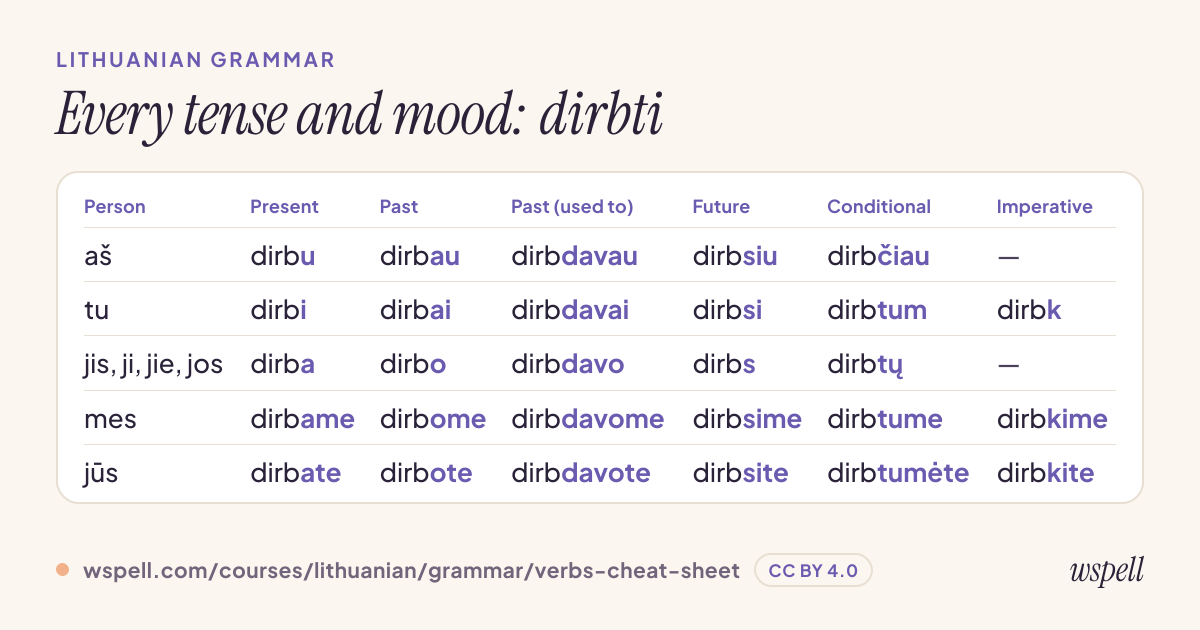
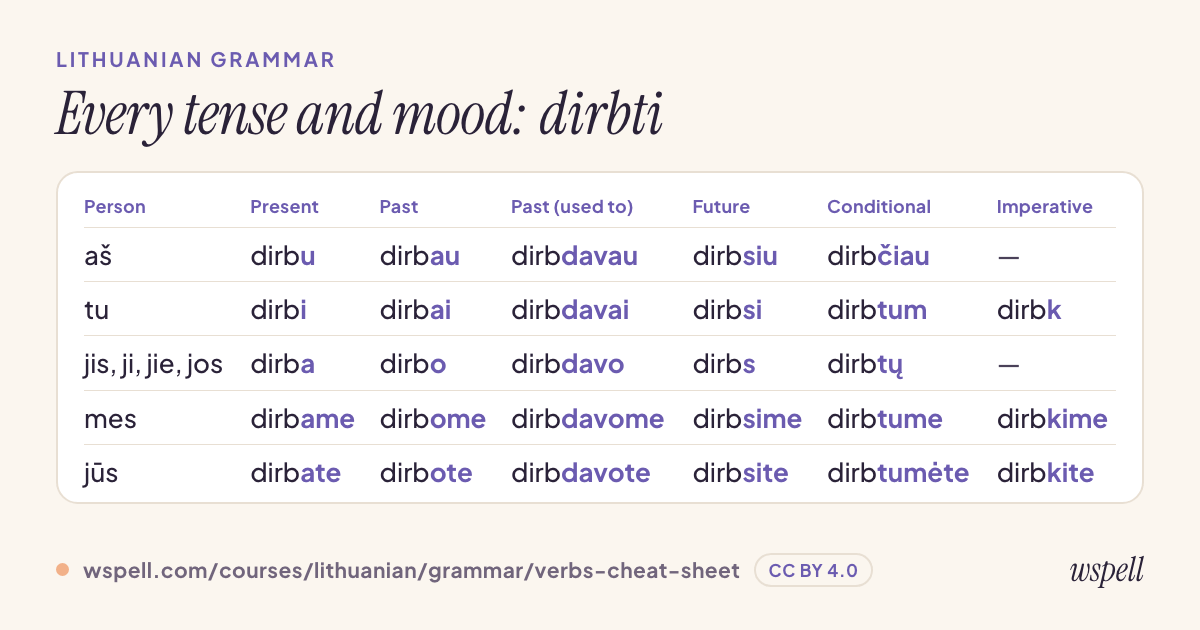
dirbti (to work): an -a verb
| Person | Present | Past | Past (used to) | Future | Conditional | Imperative |
|---|---|---|---|---|---|---|
| aš | dirbu | dirbau | dirbdavau | dirbsiu | dirbčiau | — |
| tu | dirbi | dirbai | dirbdavai | dirbsi | dirbtum | dirbk |
| jis, ji, jie, jos | dirba | dirbo | dirbdavo | dirbs | dirbtų | — |
| mes | dirbame | dirbome | dirbdavome | dirbsime | dirbtume | dirbkime |
| jūs | dirbate | dirbote | dirbdavote | dirbsite | dirbtumėte | dirbkite |
mylėti (to love): an -i verb
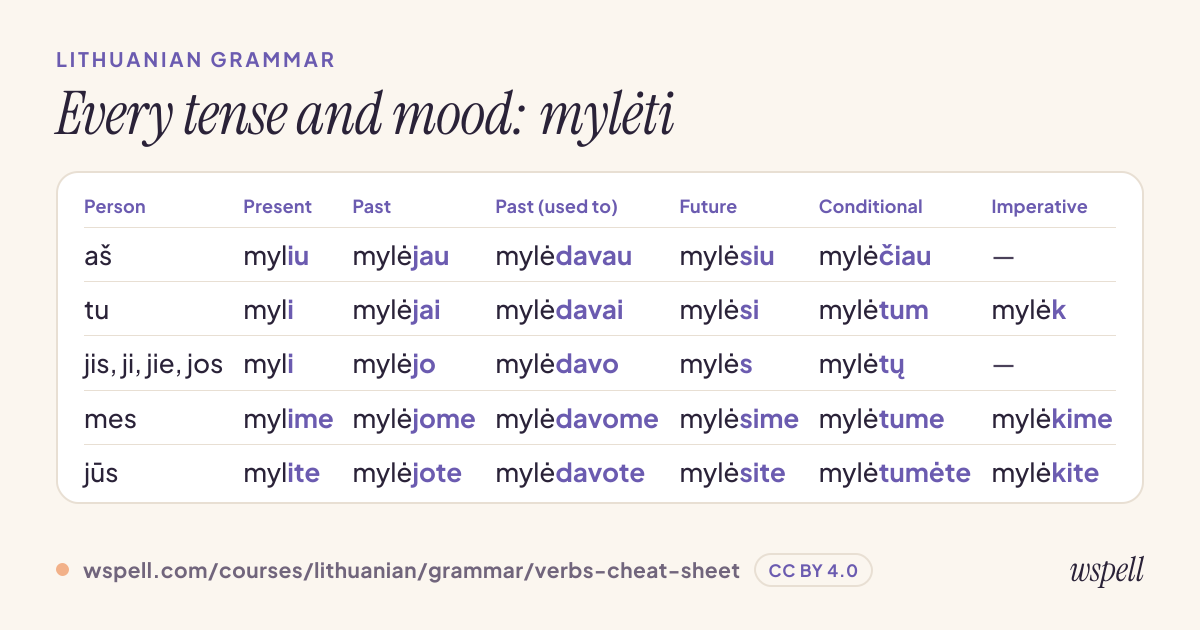
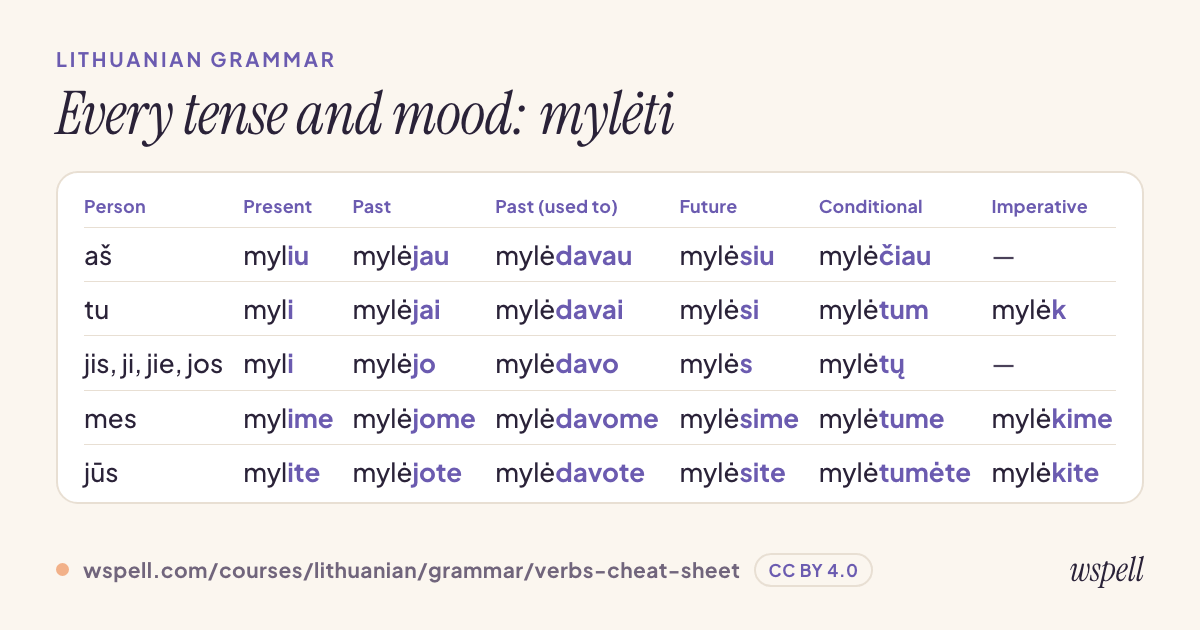
| Person | Present | Past | Past (used to) | Future | Conditional | Imperative |
|---|---|---|---|---|---|---|
| aš | myliu | mylėjau | mylėdavau | mylėsiu | mylėčiau | — |
| tu | myli | mylėjai | mylėdavai | mylėsi | mylėtum | mylėk |
| jis, ji, jie, jos | myli | mylėjo | mylėdavo | mylės | mylėtų | — |
| mes | mylime | mylėjome | mylėdavome | mylėsime | mylėtume | mylėkime |
| jūs | mylite | mylėjote | mylėdavote | mylėsite | mylėtumėte | mylėkite |
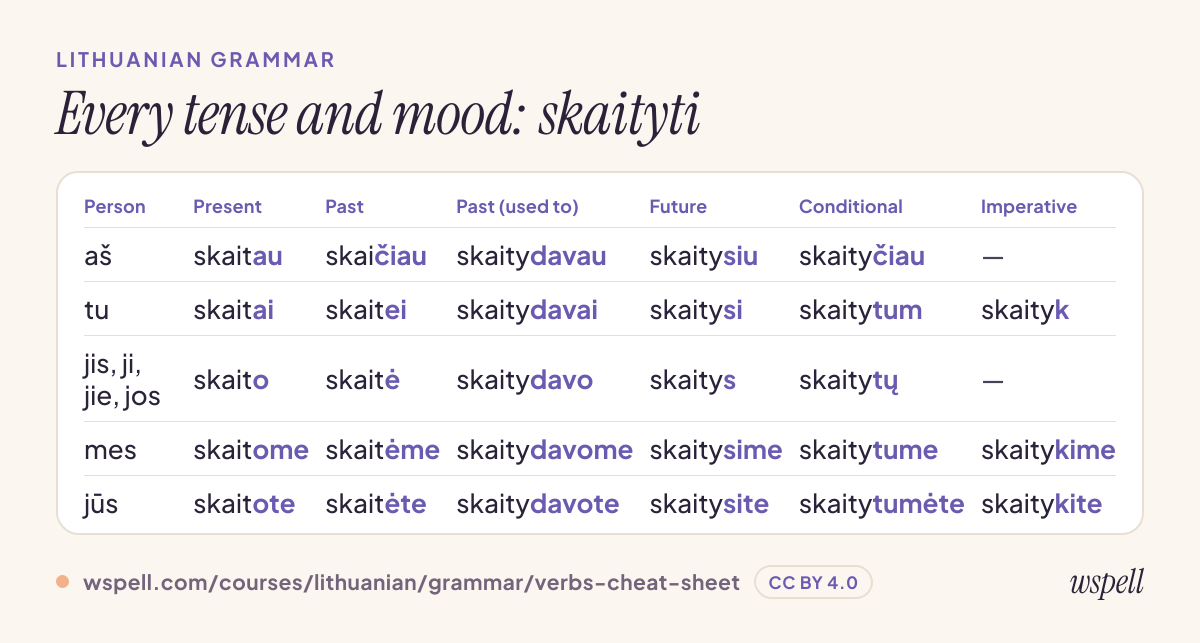
skaityti (to read): an -o verb
| Person | Present | Past | Past (used to) | Future | Conditional | Imperative |
|---|---|---|---|---|---|---|
| aš | skaitau | skaičiau | skaitydavau | skaitysiu | skaityčiau | — |
| tu | skaitai | skaitei | skaitydavai | skaitysi | skaitytum | skaityk |
| jis, ji, jie, jos | skaito | skaitė | skaitydavo | skaitys | skaitytų | — |
| mes | skaitome | skaitėme | skaitydavome | skaitysime | skaitytume | skaitykime |
| jūs | skaitote | skaitėte | skaitydavote | skaitysite | skaitytumėte | skaitykite |
Endings by class
| Person | -a verbs (dirba) dirbti | -i verbs (myli) mylėti | -o verbs (skaito) skaityti |
|---|---|---|---|
| aš | dirbu -u | myliu -iu | skaitau -au |
| tu | dirbi -i | myli -i | skaitai -ai |
| jis, ji, jie, jos | dirba -a | myli -i | skaito -o |
| mes | dirbame -ame | mylime -ime | skaitome -ome |
| jūs | dirbate -ate | mylite -ite | skaitote -ote |
| Person | -o verbs (dirbo) dirbti | -ė verbs (skaitė) skaityti |
|---|---|---|
| aš | dirbau -au | skaičiau -iau |
| tu | dirbai -ai | skaitei -ei |
| jis, ji, jie, jos | dirbo -o | skaitė -ė |
| mes | dirbome -ome | skaitėme -ėme |
| jūs | dirbote -ote | skaitėte -ėte |
Reflexive and negative verbs
| Person | Ending |
|---|---|
| aš | -uosi/-(i)uosi/-ausi |
| tu | -iesi/-aisi |
| jis, ji, jie, jos | -asi/-isi/-osi |
| mes | -amės/-imės/-omės |
| jūs | -atės/-itės/-otės |
Ne- is written together with the verb
Negation is the prefix ne- written TOGETHER with the verb: dirbu → nedirbu, noriu → nenoriu. nebe- means 'no longer' (nebedirbu).
- Aš nenoriu valgyti. — I don't want to eat.
practise this chart
Drill these forms in real sentences — every answer checked, every word spoken.
practise now — free to try; some drills ask for a free account
save or print this chart
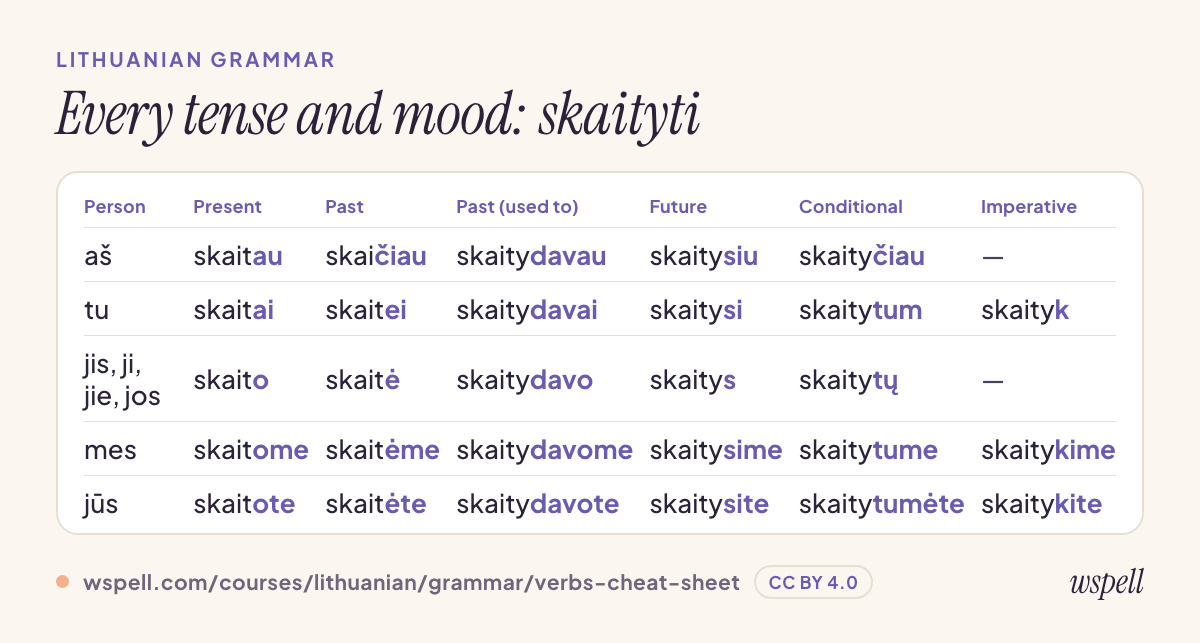
Under the main tables on this page sits a picture of each — keep one on your phone, share it or print it.
Free to share and adapt under CC BY 4.0 — credit wspell and link to this page. the licence
credit line to copy: Lithuanian verb conjugation cheat sheet: every tense on one page — wspell, CC BY 4.0, https://wspell.com/courses/lithuanian/grammar/verbs-cheat-sheet
questions
How many tenses do Lithuanian verbs have?
Four in the indicative — the present, the past, the frequentative past (-davo, 'used to') and the future — plus the conditional and imperative moods. The tables show all six for dirbti, mylėti and skaityti.
Why is there one form for the third person?
In every Lithuanian tense the third person is the same in the singular and the plural: jis dirba, jie dirba; ji skaitė, jos skaitė.
How do I know a Lithuanian verb's class?
From its present third person: dirba (-a), myli (-i), skaito (-o). The past third person gives its past class: dirbo (-o), skaitė (-ė).