grammar chart · Lithuanian
The Lithuanian imperative and conditional
Both moods start from the infinitive stem: drop -ti. The imperative gives orders (eik!, eikite!) and suggestions (eikime!); the conditional says 'would' — for wishes, unreal conditions with jei, and polite requests such as norėčiau kavos.
Imperative: orders and 'let's'
| Person | Ending | dirbti | mylėti | skaityti |
|---|---|---|---|---|
| tu | -k | dirbk | mylėk | skaityk |
| mes | -kime | dirbkime | mylėkime | skaitykime |
| jūs | -kite | dirbkite | mylėkite | skaitykite |
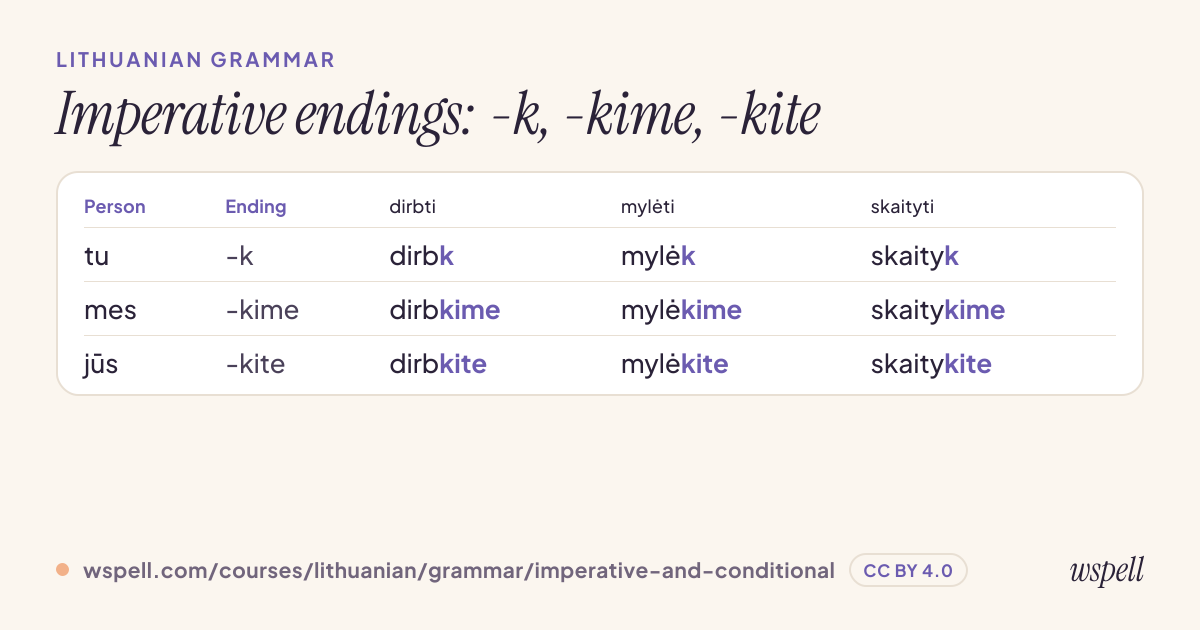
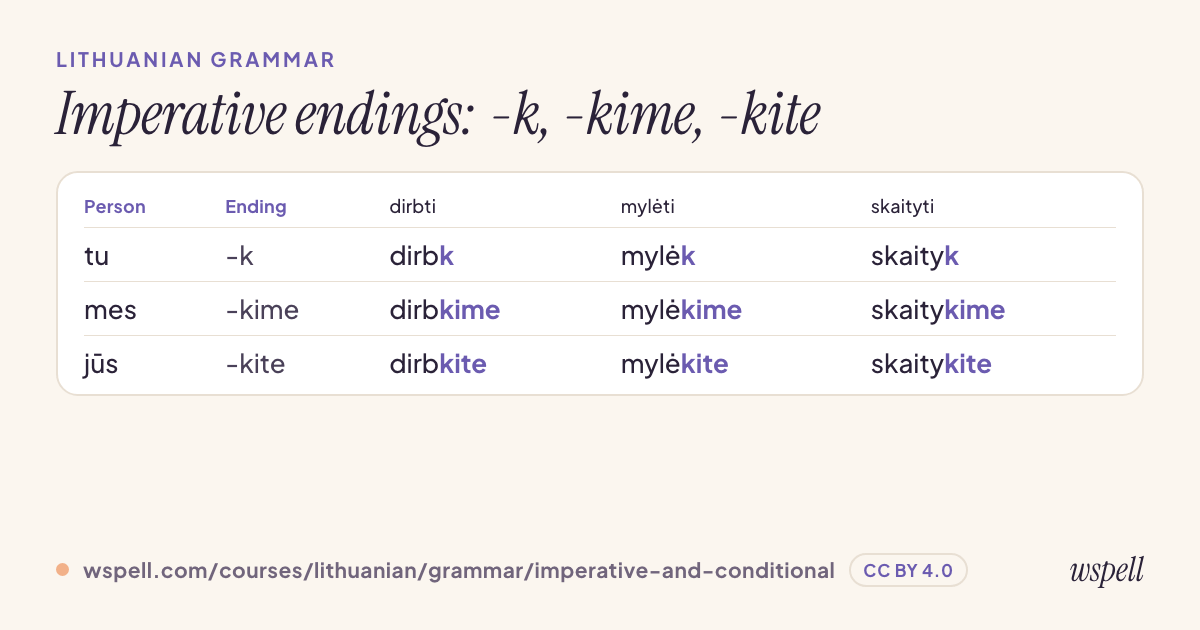
Eik!, eikite!, eikime!
Commands: -k for tu (eik!), -kite for jūs (eikite!), -kime for let's (eikime!). Built from the infinitive stem.
- Eik čia! Eikite čia! — Come here! (sg/pl)
Conditional: would, if, and polite requests
| Person | Ending | dirbti | mylėti | skaityti |
|---|---|---|---|---|
| aš | -čiau | dirbčiau | mylėčiau | skaityčiau |
| tu | -tum | dirbtum | mylėtum | skaitytum |
| jis, ji, jie, jos | -tų | dirbtų | mylėtų | skaitytų |
| mes | -tume | dirbtume | mylėtume | skaitytume |
| jūs | -tumėte | dirbtumėte | mylėtumėte | skaitytumėte |
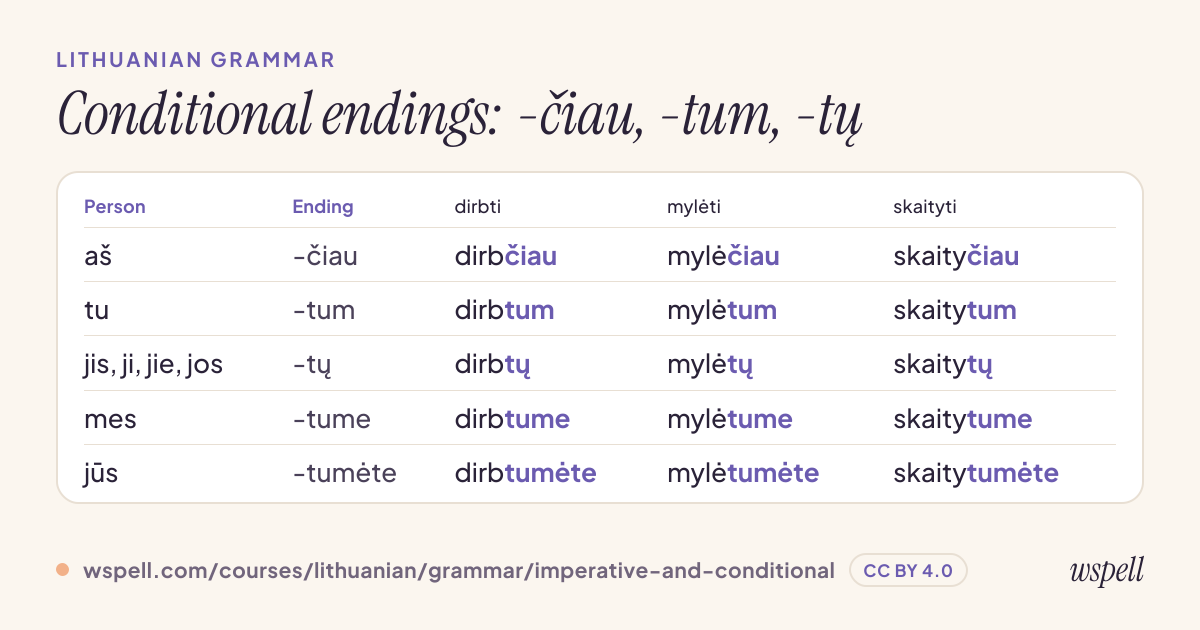
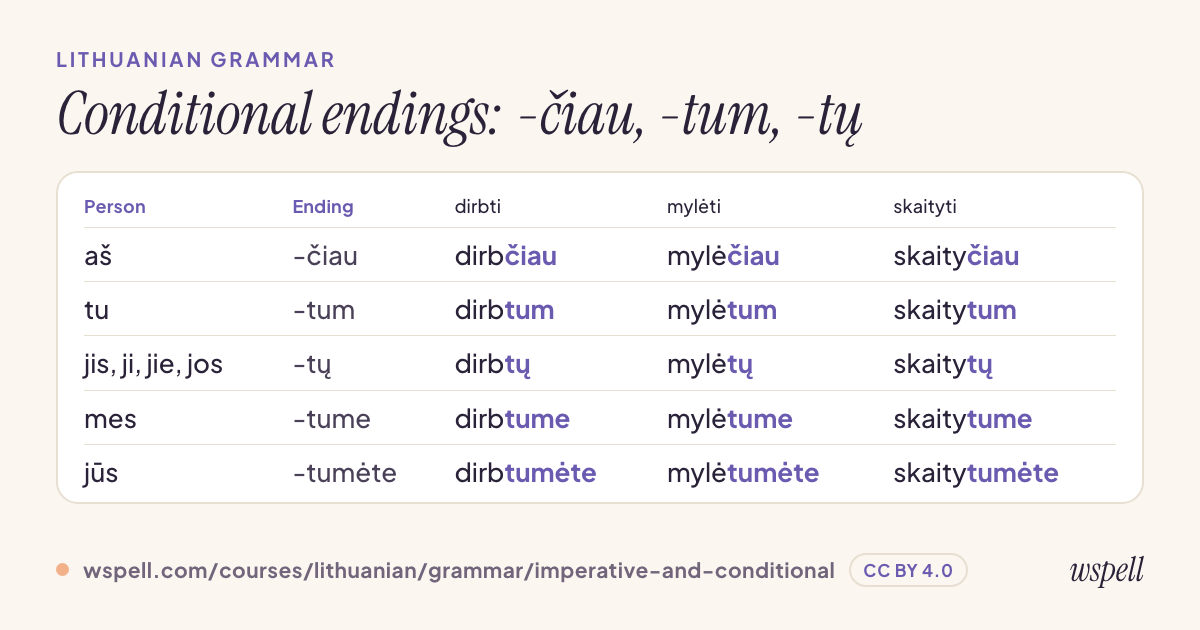
Dirbčiau: I would work
The conditional (would): dirbčiau, dirbtum, dirbtų, dirbtume, dirbtumėte, dirbtų. Used for polite requests and hypotheticals.
- Norėčiau kavos. — I would like a coffee.
Jei + conditional: if I had…, I would…
Real conditions use jei + indicative (jei lis, liksiu namie); unreal conditions put BOTH clauses in the conditional: jei turėčiau pinigų, pirkčiau namą.
- Jei turėčiau laiko, ateičiau. — If I had time, I would come.
practise this chart
Drill these forms in real sentences — every answer checked, every word spoken.
practise now — free to try; some drills ask for a free account
save or print this chart
Under the main tables on this page sits a picture of each — keep one on your phone, share it or print it.
Free to share and adapt under CC BY 4.0 — credit wspell and link to this page. the licence
credit line to copy: The Lithuanian imperative and conditional — wspell, CC BY 4.0, https://wspell.com/courses/lithuanian/grammar/imperative-and-conditional
questions
How do you form the imperative in Lithuanian?
Drop -ti from the infinitive and add -k for tu, -kite for jūs and -kime for 'let's': eik!, eikite!, eikime!. A stem-final g is absorbed by the -k: bėgti → bėk.
How do you say 'I would like' in Lithuanian?
Norėčiau, the conditional of norėti: Norėčiau kavos — I would like a coffee. The conditional also makes a request polite: Gal galėtumėte man padėti?
How do you say 'if I had' in Lithuanian?
For an unreal condition, put both clauses in the conditional: Jei turėčiau laiko, ateičiau — if I had time, I would come. A real condition keeps the indicative: jei lis, liksiu namie.