grammar chart · Lithuanian
Lithuanian numbers
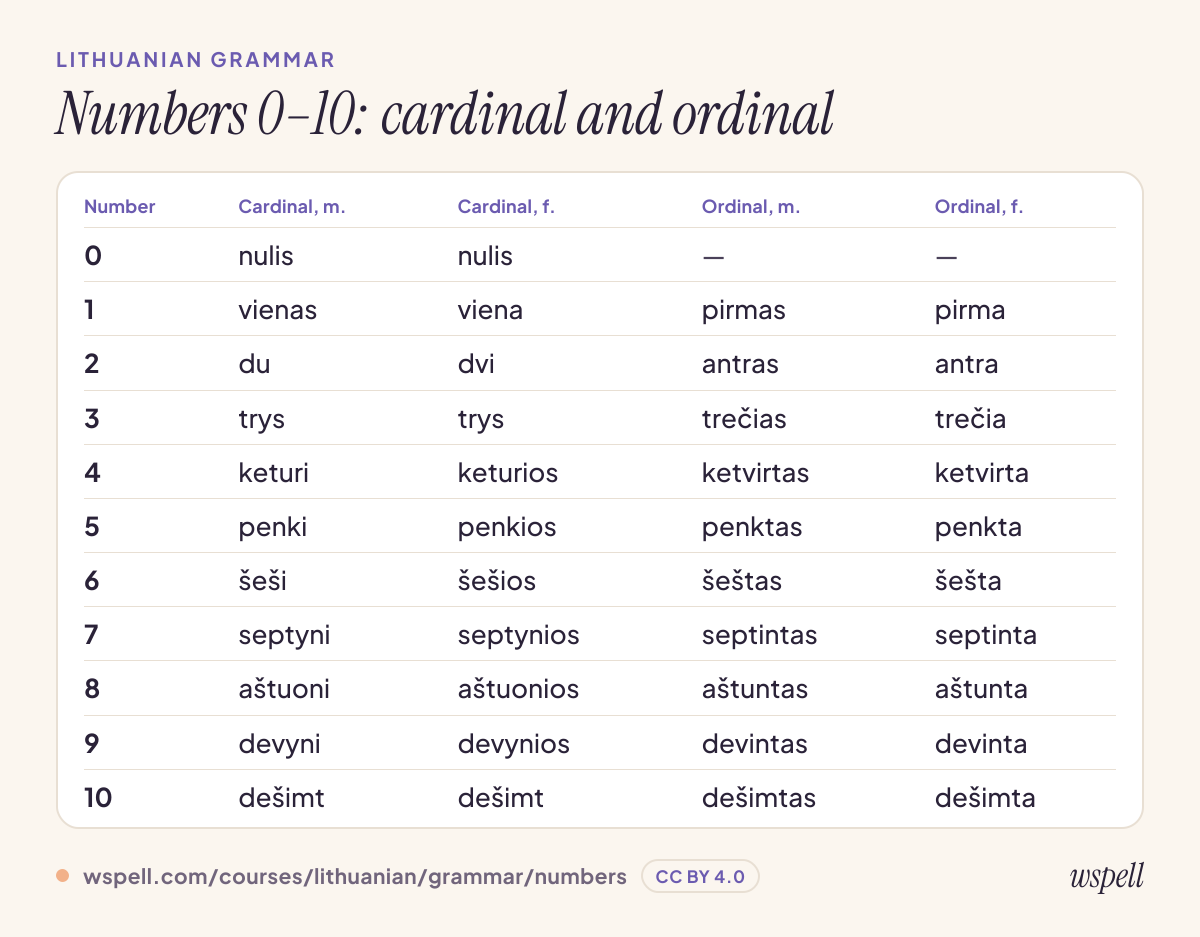
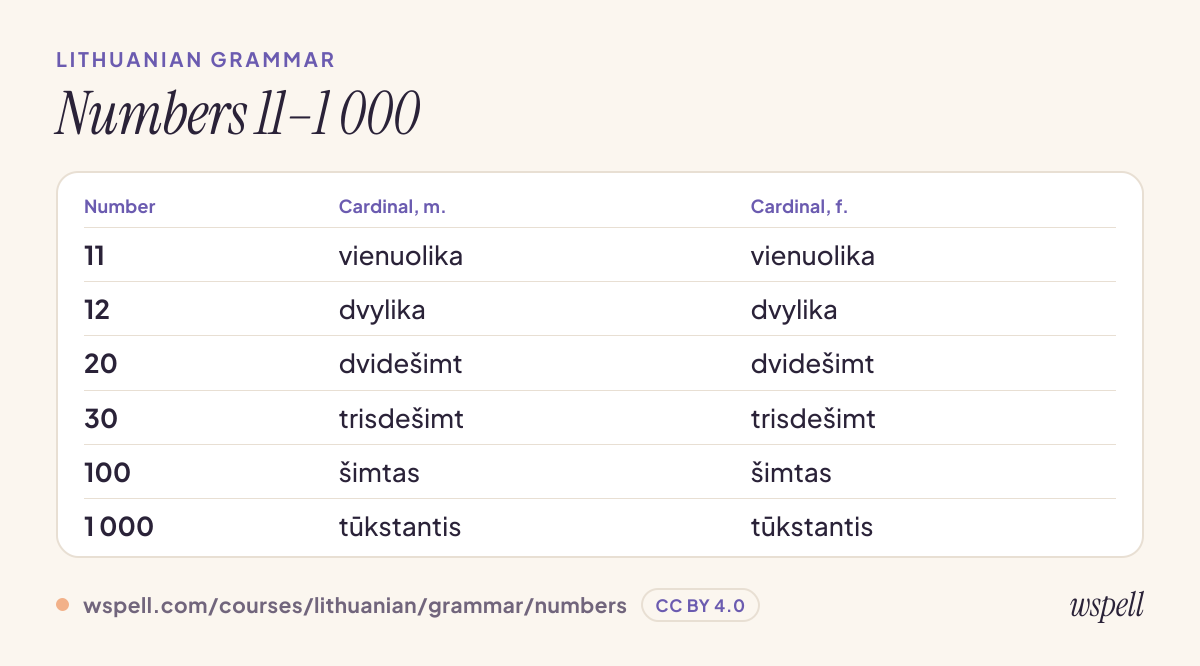
Lithuanian numbers have gender, and one to nine all decline — two and three irregularly. A number also decides its noun's case: vienas namas, du namai, dešimt namų. The first table gives the key cardinals from 0 to 1000 and the ordinals from first to tenth.
Counting from nulis to tūkstantis
| Number | Cardinal, m. | Cardinal, f. | Ordinal, m. | Ordinal, f. |
|---|---|---|---|---|
| 0 | nulis | nulis | — | — |
| 1 | vienas | viena | pirmas | pirma |
| 2 | du | dvi | antras | antra |
| 3 | trys | trys | trečias | trečia |
| 4 | keturi | keturios | ketvirtas | ketvirta |
| 5 | penki | penkios | penktas | penkta |
| 6 | šeši | šešios | šeštas | šešta |
| 7 | septyni | septynios | septintas | septinta |
| 8 | aštuoni | aštuonios | aštuntas | aštunta |
| 9 | devyni | devynios | devintas | devinta |
| 10 | dešimt | dešimt | dešimtas | dešimta |
| 11 | vienuolika | vienuolika | — | — |
| 12 | dvylika | dvylika | — | — |
| 20 | dvidešimt | dvidešimt | — | — |
| 30 | trisdešimt | trisdešimt | — | — |
| 100 | šimtas | šimtas | — | — |
| 1 000 | tūkstantis | tūkstantis | — | — |
Which case follows a number
1, 2–9, 10 and up: the case of the noun
1–9 agree with the noun in case. In the nominative, 1 takes the nominative singular (vienas namas) and 2–9 the nominative plural (du namai, penki namai); in any other case the number and the noun share it (su dviem draugais, apie tris brolius). 10 and up take the GENITIVE plural in every case — including the whole 11–19 series (vienuolika eurų, penkiolika metų), the tens, hundreds and thousands (dešimt namų, šimtas žmonių). Compound numbers behave like their last word, so 21 is nominative singular (dvidešimt vienas namas) but 25 is nominative plural (dvidešimt penki namai).
- vienas namas, du namai, dešimt namų — one house, two houses, ten houses
Two and three
| Nominative | Genitive | Dative | Accusative | Instrumental | Locative |
|---|---|---|---|---|---|
| du | dviejų | dviem | du | dviem | dviejuose |
| dvi | dviejų | dviem | dvi | dviem | dviejose |
| trys | trijų | trims | tris | trimis | trijuose |
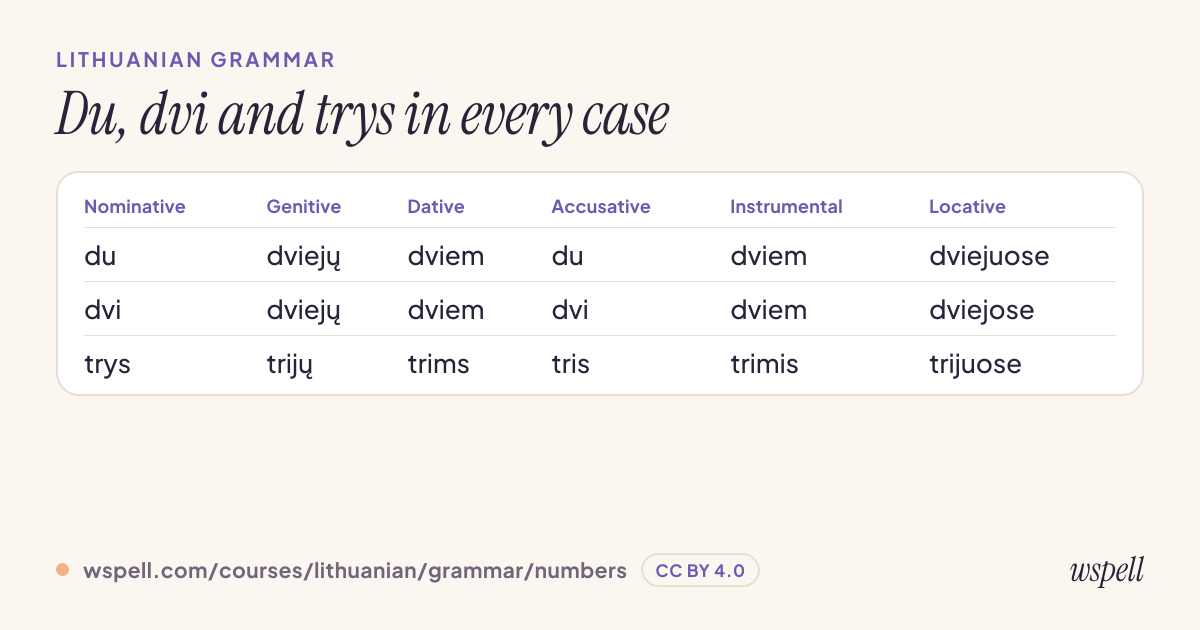
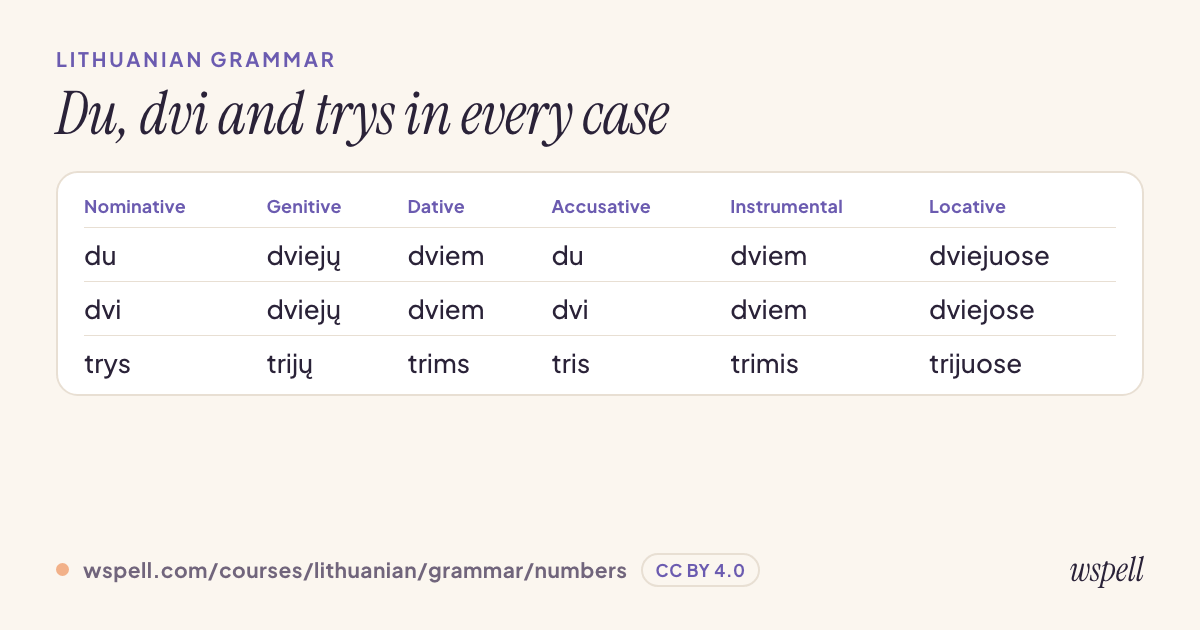
vienas/viena and keturi–devyni decline like adjectives, but du/dvi (two m/f) and trys (three) are irregular and must be learned: du/dvi — dviejų — dviem — du/dvi — dviem — dviejuose/dviejose; trys — trijų — trims — tris — trimis — trijuose/trijose.
- Su dviem draugais ėjome namo. — I walked home with two friends.
- Knyga apie tris brolius. — A book about three brothers.
Ordinals and collective numbers
Ordinals agree like adjectives
Ordinal numbers (pirmas, antras, trečias…) agree with the noun in gender, number, and case: pirmas aukštas, pirmoji vieta (pronominal form for titles/rankings), trečiame aukšte.
- Gyvenu trečiame aukšte. — I live on the third floor.
Dveji, trejos: numbers for plural-only nouns
Nouns that exist only in the plural (metai, durys, kelnės, akiniai) cannot take du/trys — they need the collective numerals: vieneri metai, dveji metai, trejos durys, ketverios kelnės.
- Jam dveji metai. — He is two years old.
Telling the time and giving dates
Kelinta valanda? Telling the time
Telling the time uses ordinals: dabar pirma valanda (it's one o'clock — nominative); at a time is accusative: pirmą valandą (at one), pusę dviejų (at half past one).
- Susitinkame trečią valandą. — We meet at three o'clock.
Dates and years
Dates: month in genitive + ordinal day (sausio penkta — January 5th; on that date: sausio penktą). Years take the instrumental with the pronominal ordinal: 1990-aisiais metais / dutūkstantaisiais metais.
- Gimiau kovo aštuntą. — I was born on March 8th.
- Tai įvyko 2020-aisiais metais. — It happened in 2020.
practise this chart
Drill these forms in real sentences — every answer checked, every word spoken.
practise now — free to try; some drills ask for a free account
save or print this chart
Under the main tables on this page sits a picture of each — keep one on your phone, share it or print it.
Free to share and adapt under CC BY 4.0 — credit wspell and link to this page. the licence
credit line to copy: Lithuanian numbers — wspell, CC BY 4.0, https://wspell.com/courses/lithuanian/grammar/numbers
questions
Which case comes after a number in Lithuanian?
In the nominative, 1 takes the nominative singular (vienas namas) and 2–9 the nominative plural (du namai); in the other cases 1–9 simply share the noun's case (su dviem draugais). From 10 up — including 11–19, the tens, hundreds and thousands — the noun is genitive plural in every case (dešimt namų, šimtas žmonių). A compound number follows its last word: dvidešimt vienas namas.
What is the difference between du and dvi?
Du goes with masculine nouns and dvi with feminine ones. Both are irregular in the other cases: dviejų, dviem.
How do you tell the time in Lithuanian?
With ordinals: dabar pirma valanda — it is one o'clock. 'At' a time takes the accusative: trečią valandą (at three), pusę dviejų (at half past one).