grammar chart · Lithuanian
The dative case in Lithuanian (naudininkas)
The dative (naudininkas) answers kam? — to whom? It marks who receives or benefits (duodu draugui), and the person who feels, needs or is a certain age: man šalta, man reikia, man 20 metų.
When to use the dative
Naudininkas: the receiver, and who feels or needs
The dative (naudininkas) marks the receiver or beneficiary (duodu draugui) and the experiencer in constructions like man šalta, man reikia, man 20 metų. Answers kam? (to whom/what?).
- Duodu knygą draugui. — I give the book to a friend.
- Man reikia pagalbos. — I need help.
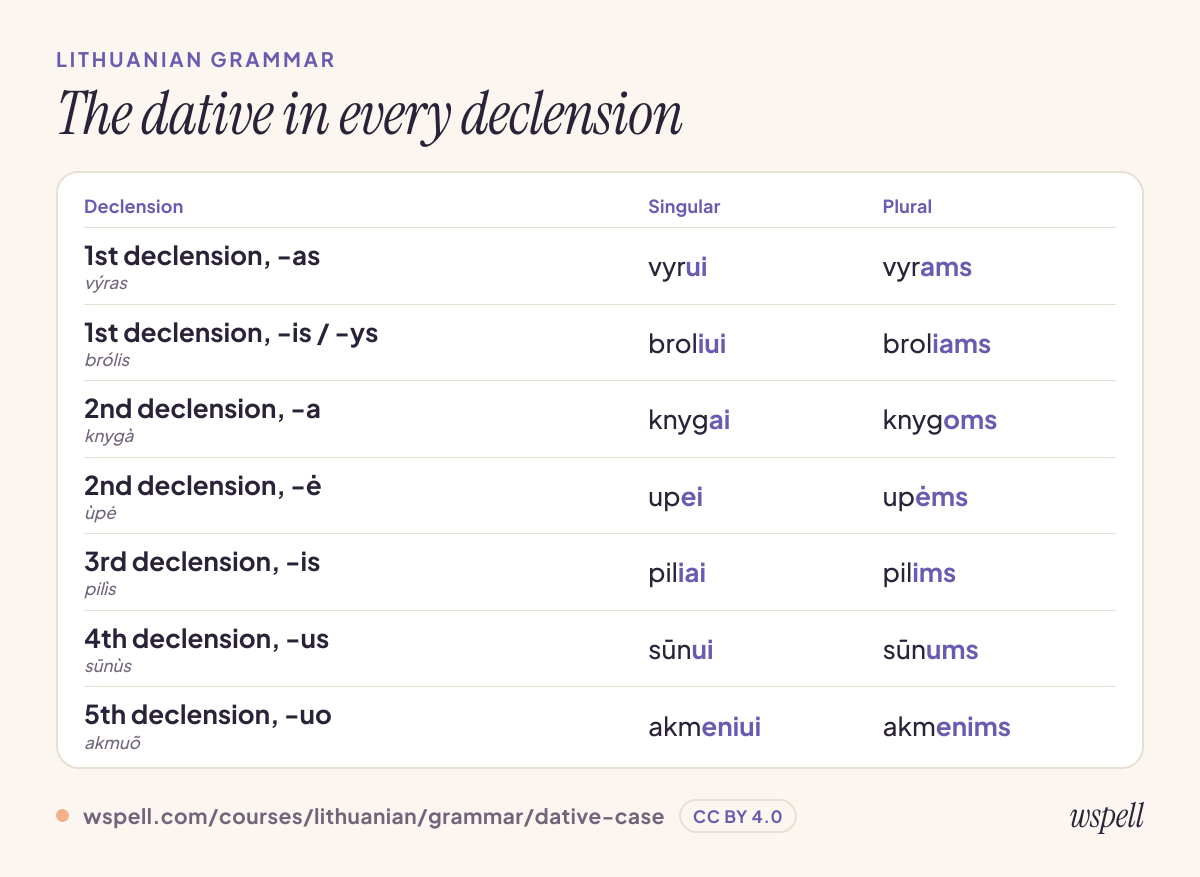
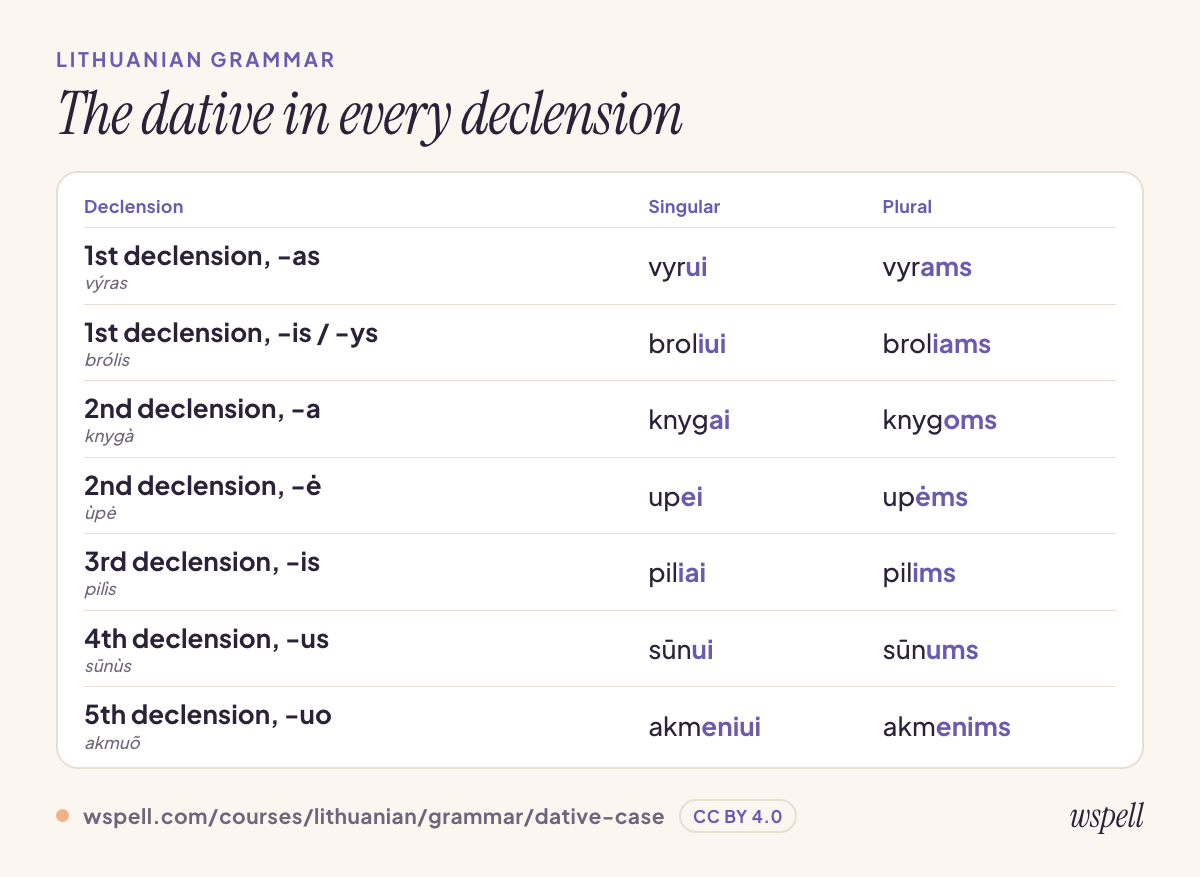
Dative endings, singular and plural
| Declension | Singular | Plural |
|---|---|---|
| 1st declension, -as výras | vyrui | vyrams |
| 1st declension, -is / -ys brólis | broliui | broliams |
| 2nd declension, -a knygà | knygai | knygoms |
| 2nd declension, -ė ùpė | upei | upėms |
| 3rd declension, -is pilìs | piliai | pilims |
| 4th declension, -us sūnùs | sūnui | sūnums |
| 5th declension, -uo akmuõ | akmeniui | akmenims |
Feelings, needs and age
Man šalta, man patinka, man reikia
States and needs use the dative experiencer: man šalta (I am cold), man patinka (I like), man reikia + Gen (I need), man sekasi (I am doing well), man 20 metų (I am 20).
- Man šalta. — I am cold.
- Vaikams reikia miego. — Children need sleep.
Verbs followed by the dative
Padėti, patikti, dėkoti and other dative verbs
These verbs govern the dative: padėti (help), patikti (please/like), dėkoti (thank), atstovauti (represent), vadovauti (lead), prieštarauti (contradict), pritarti (agree with), trukdyti (disturb), kenkti (harm), skambinti (call sb): padedu mamai, dėkoju tau.
- Padedu mamai. — I help my mother.
- Man patinka ši daina. — I like this song.
practise this chart
Drill these forms in real sentences — every answer checked, every word spoken.
practise now — free to try; some drills ask for a free account
save or print this chart
Under the main tables on this page sits a picture of each — keep one on your phone, share it or print it.
Free to share and adapt under CC BY 4.0 — credit wspell and link to this page. the licence
credit line to copy: The dative case in Lithuanian (naudininkas) — wspell, CC BY 4.0, https://wspell.com/courses/lithuanian/grammar/dative-case
questions
When do you use the dative in Lithuanian?
For the person who receives or benefits (duodu knygą draugui) and for the person who feels or needs something: man šalta (I am cold), man reikia pagalbos (I need help), man 20 metų (I am 20).
How do you say 'I like' in Lithuanian?
With patikti and the dative: man patinka ši daina — I like this song. The person who likes goes in the dative, and the thing liked is the subject.
Which verbs take the dative in Lithuanian?
Common ones are padėti (help), patikti (like), dėkoti (thank), skambinti (call someone), trukdyti (disturb) and kenkti (harm): padedu mamai, dėkoju tau.