grammar chart · Lithuanian
Lithuanian question words
Several Lithuanian question words are forms of kas in a case — ko, kam, ką, kuo — so the question tells you the case of the answer: Ko ieškai? — Rakto. Most k- words also have a matching answer word in t-: kur – ten, kada – tada.
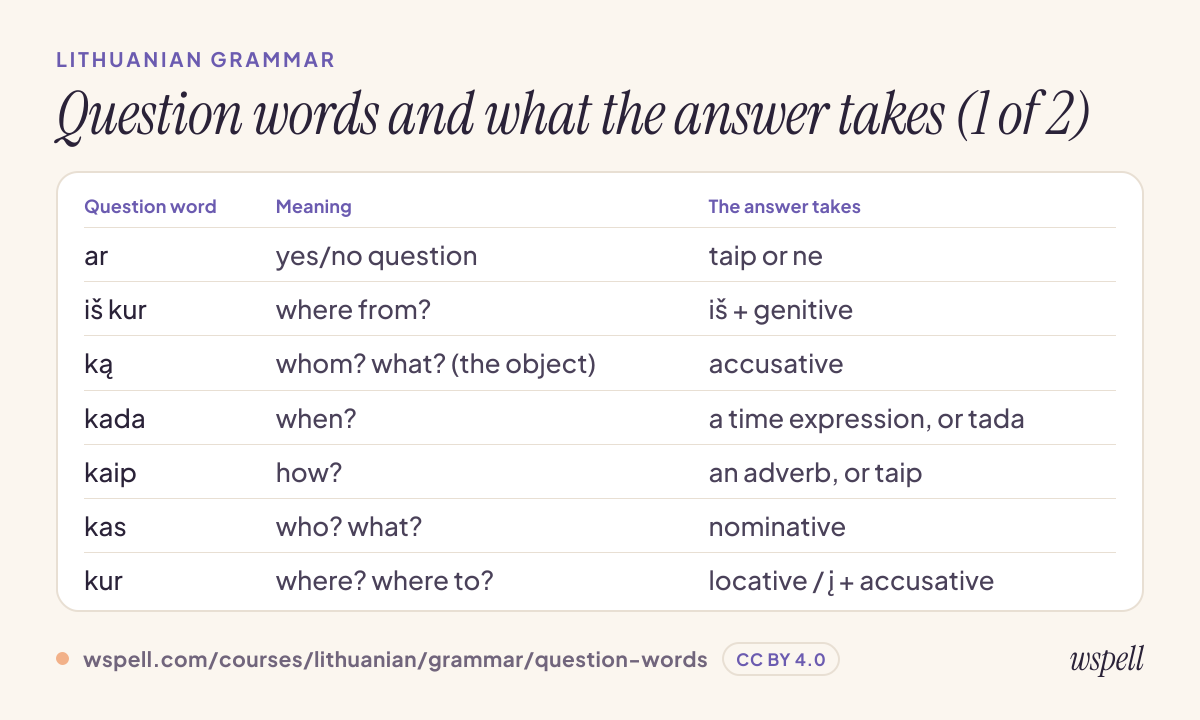
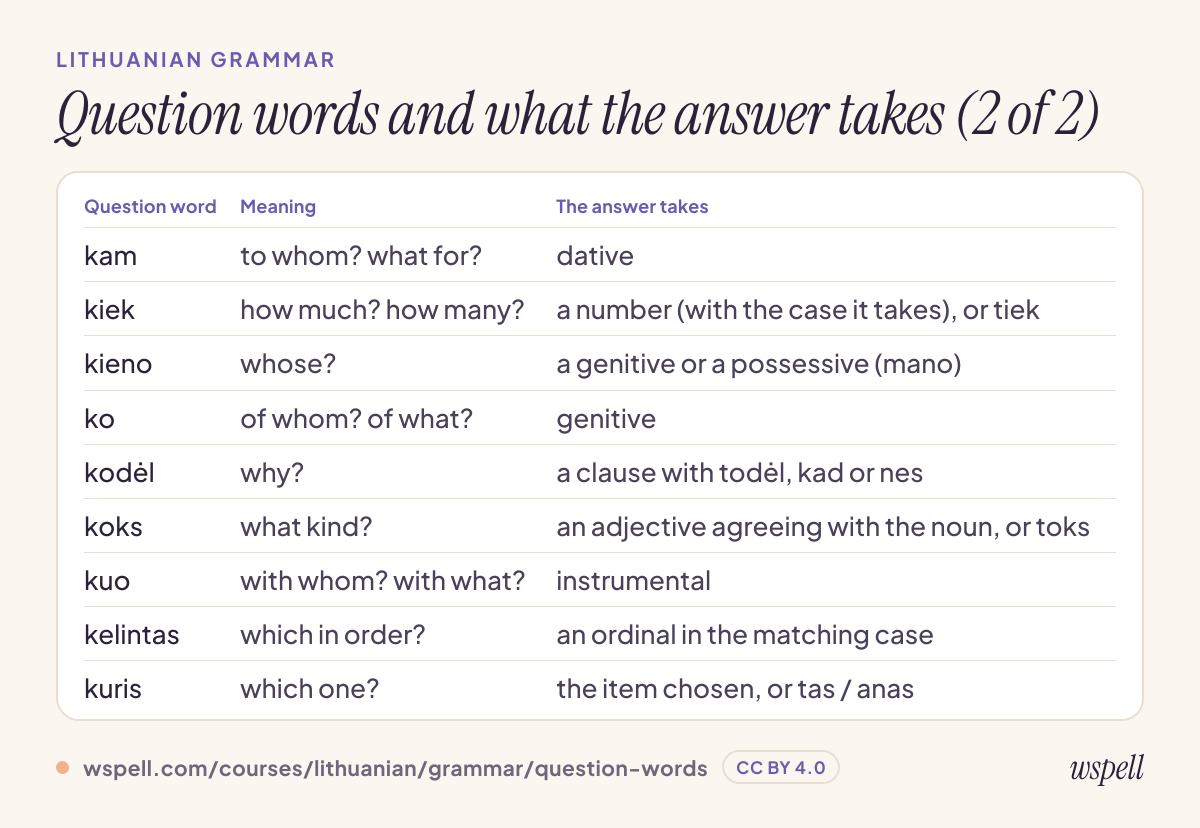
Question words at a glance
| Question word | Meaning | The answer takes |
|---|---|---|
| ar | yes/no question | taip or ne |
| iš kur | where from? | iš + genitive |
| ką | whom? what? (the object) | accusative |
| kada | when? | a time expression, or tada |
| kaip | how? | an adverb, or taip |
| kas | who? what? | nominative |
| kur | where? where to? | locative / į + accusative |
| kam | to whom? what for? | dative |
| kiek | how much? how many? | a number (with the case it takes), or tiek |
| kieno | whose? | a genitive or a possessive (mano) |
| ko | of whom? of what? | genitive |
| kodėl | why? | a clause with todėl, kad or nes |
| koks | what kind? | an adjective agreeing with the noun, or toks |
| kuo | with whom? with what? | instrumental |
| kelintas | which in order? | an ordinal in the matching case |
| kuris | which one? | the item chosen, or tas / anas |
Answer words: kur – ten, kada – tada
| Question word | Answer | None | Every |
|---|---|---|---|
| kas | tas | niekas | viskas/visi |
| kur | ten/čia | niekur | visur |
| kada | tada | niekada | visada |
| kaip | taip | niekaip | visaip |
| koks | toks | joks | visoks |
| kiek | tiek | — | — |
| kodėl | todėl | — | — |
| kuris | tas/anas | — | kiekvienas |
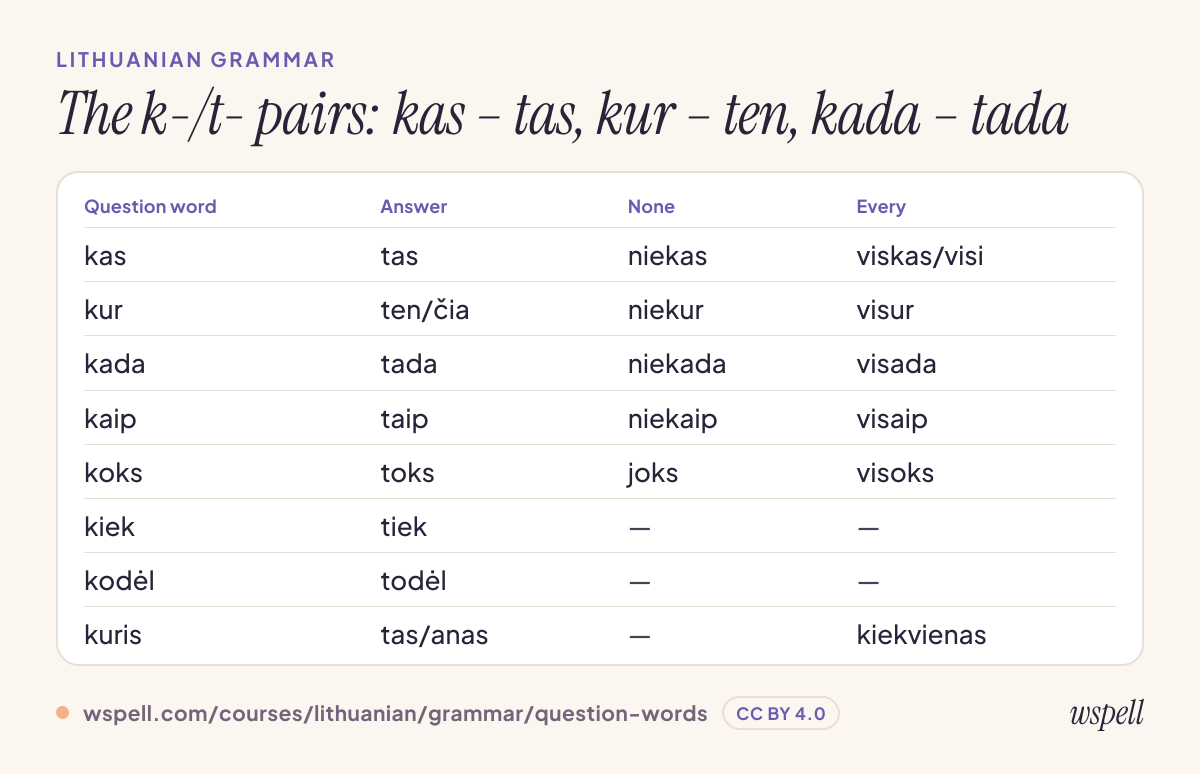
Lithuanian question words starting with k- have built-in answer words starting with t- (negatives mostly with niek- — though koks → joks — and universals with vis-): kas→tas, kur→ten, kada→tada, kaip→taip, koks→toks, kiek→tiek, kodėl→todėl. Learn them as pairs and both questions and answers come for free.
- Kada grįši? — Tada, kai baigsiu darbą. — When will you return? — Then, when I finish work.
- Kodėl neini? — Todėl, kad lyja. — Why aren't you going? — Because it is raining.
Three easy mistakes: kas, kur, kelintas
Kas: both who and what
kas asks about people AND things — one word for both 'who' and 'what': Kas čia? (who/what is here?). The answer stands in the nominative. kas is also 'what' as a subject: Kas atsitiko? (what happened?).
- Kas ten stovi? — Mano brolis. — Who is standing there? — My brother.
- Kas čia guli? — Knyga. — What is lying here? — A book.
Kur: both where and where to
kur covers location AND direction — one word for both 'where' and 'where to': Kur gyveni? (where do you live — answer in locative: Vilniuje) and Kur eini? (where are you going — answer with į + accusative: į mokyklą). The verb tells you which answer form to use.
- Kur gyveni? — Kaune. — Where do you live? — In Kaunas.
- Kur eini? — Į parduotuvę. — Where are you going? — To the shop.
Kelintas: which in order, answered by an ordinal
kelintas asks for a position in a sequence and is answered by an ORDINAL: Kelinta valanda? — Trečia. Kelintame aukšte? — Penktame. Kelinto autobuso lauki? — Septinto. English needs a whole phrase for it (which number, what floor).
- Kelinta dabar valanda? — Trečia. — What time is it now? — Three o'clock.
Yes/no questions
Ar: turning a statement into a question
Yes/no questions start with ar, with no word-order change: Ar tu dirbi? — Taip, dirbu / Ne, nedirbu. The particles argi and nejaugi add surprise or doubt: Nejaugi jau vėlu? ar itself is not translated — it only marks the question, and it always comes first.
- Ar kalbate lietuviškai? — Taip, truputį. — Do you speak Lithuanian? — Yes, a little.
learn it step by step
save or print this chart
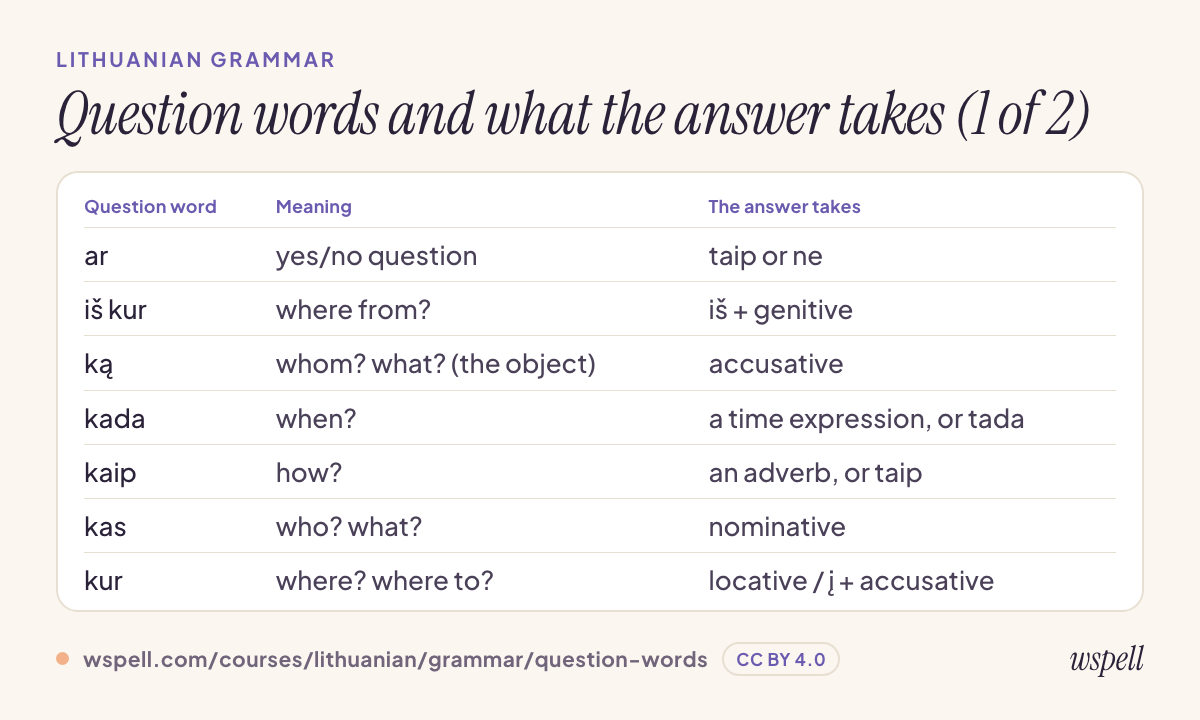
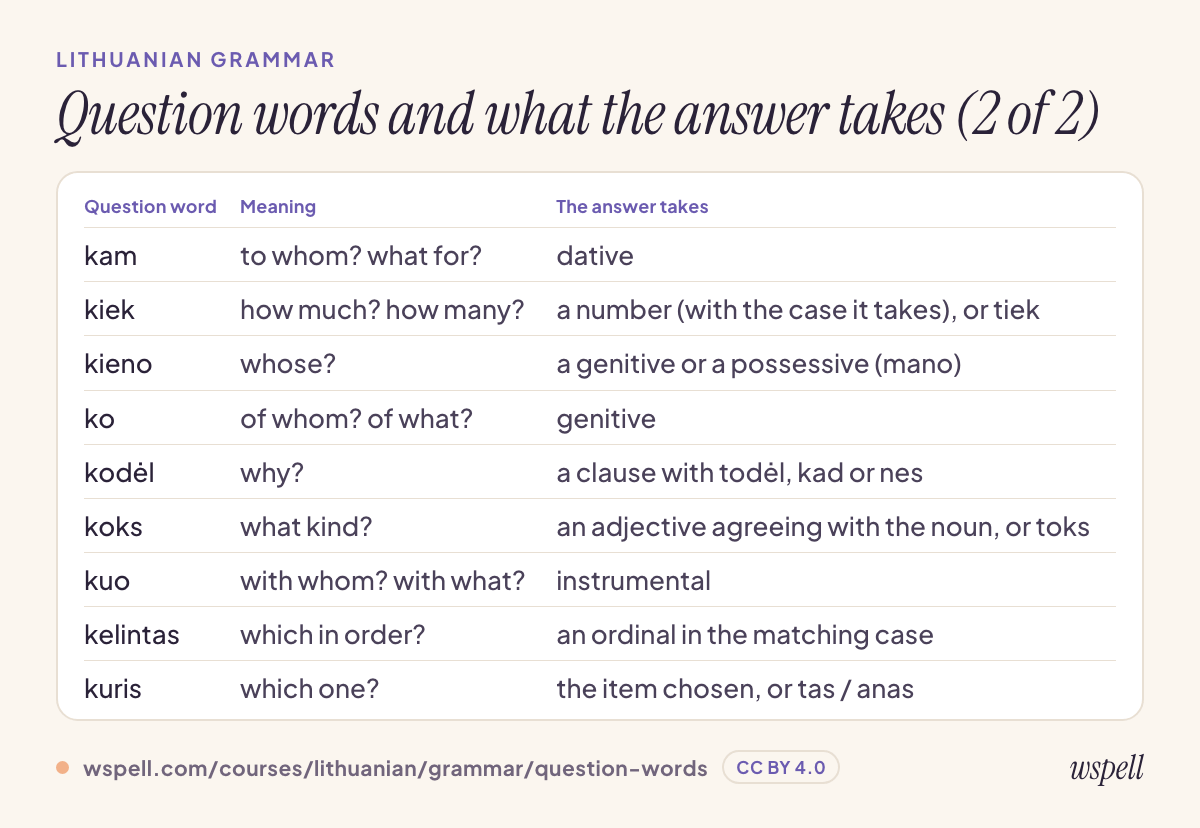
Under the main tables on this page sits a picture of each — keep one on your phone, share it or print it.
Free to share and adapt under CC BY 4.0 — credit wspell and link to this page. the licence
credit line to copy: Lithuanian question words — wspell, CC BY 4.0, https://wspell.com/courses/lithuanian/grammar/question-words
questions
Is kas 'who' or 'what' in Lithuanian?
Both. Kas asks about people and things alike: Kas ten stovi? — Mano brolis. Kas čia guli? — Knyga. The answer stands in the nominative.
How do you ask 'where to' in Lithuanian?
With kur, which means both where and where to; the verb tells you which. Kur gyveni? — Kaune (locative). Kur eini? — Į parduotuvę (į + accusative).
How do you ask a yes/no question in Lithuanian?
Put ar at the start and keep the word order: Ar tu dirbi? — Taip, dirbu / Ne, nedirbu.