grammar chart · Lithuanian
Lithuanian pronouns in every case
Lithuanian pronouns change with the case just as nouns do, and aš and tu change their stem as well (manęs, tavęs). The possessives mano, tavo and jo never change, and savo replaces them when the owner is the subject.
Personal pronouns: aš, tu, jis, ji, mes, jūs
| Nominative | Genitive | Dative | Accusative | Instrumental | Locative |
|---|---|---|---|---|---|
| aš | manęs | man | mane | manimi | manyje |
| tu | tavęs | tau | tave | tavimi | tavyje |
| jis | jo | jam | jį | juo | jame |
| ji | jos | jai | ją | ja | joje |
| mes | mūsų | mums | mus | mumis | mumyse |
| jūs | jūsų | jums | jus | jumis | jumyse |
| jie | jų | jiems | juos | jais | juose |
| jos | jų | joms | jas | jomis | jose |
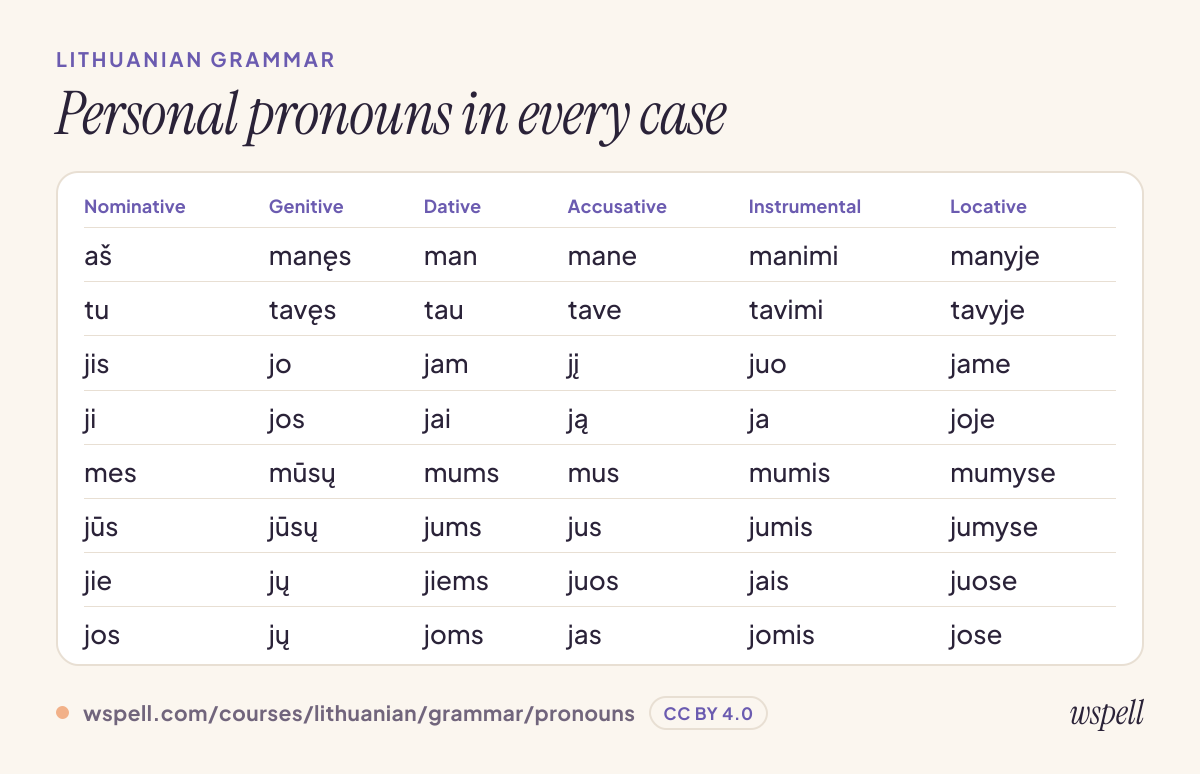
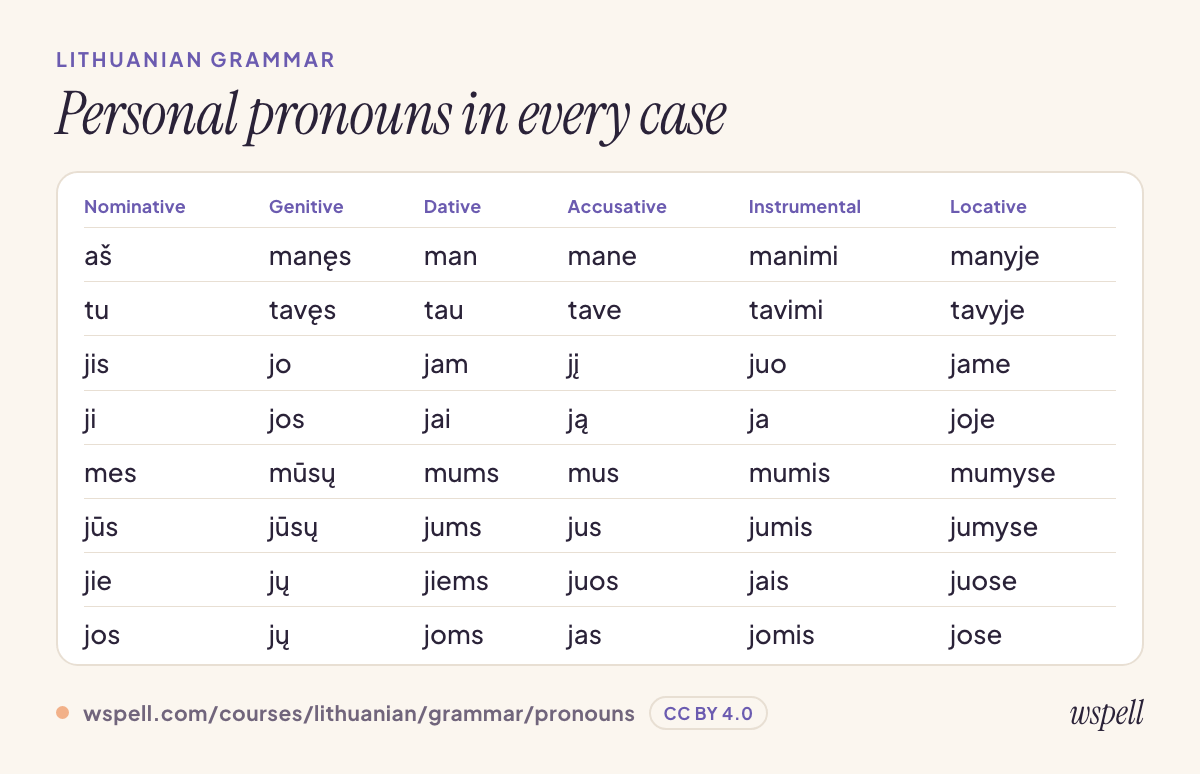
Personal pronouns decline irregularly; learn the table. aš/tu have suppletive stems (manęs, tavęs).
- Duok man knygą. Aš tave matau. — Give me the book. I see you.
This and that: šis and tas
| Nominative | Genitive | Dative | Accusative | Instrumental | Locative |
|---|---|---|---|---|---|
| tas | to | tam | tą | tuo | tame |
| ta | tos | tai | tą | ta | toje |
| šis | šio | šiam | šį | šiuo | šiame |
| ši | šios | šiai | šią | šia | šioje |
| tie | tų | tiems | tuos | tais | tuose |
| tos | tų | toms | tas | tomis | tose |
| šie | šių | šiems | šiuos | šiais | šiuose |
| šios | šių | šioms | šias | šiomis | šiose |
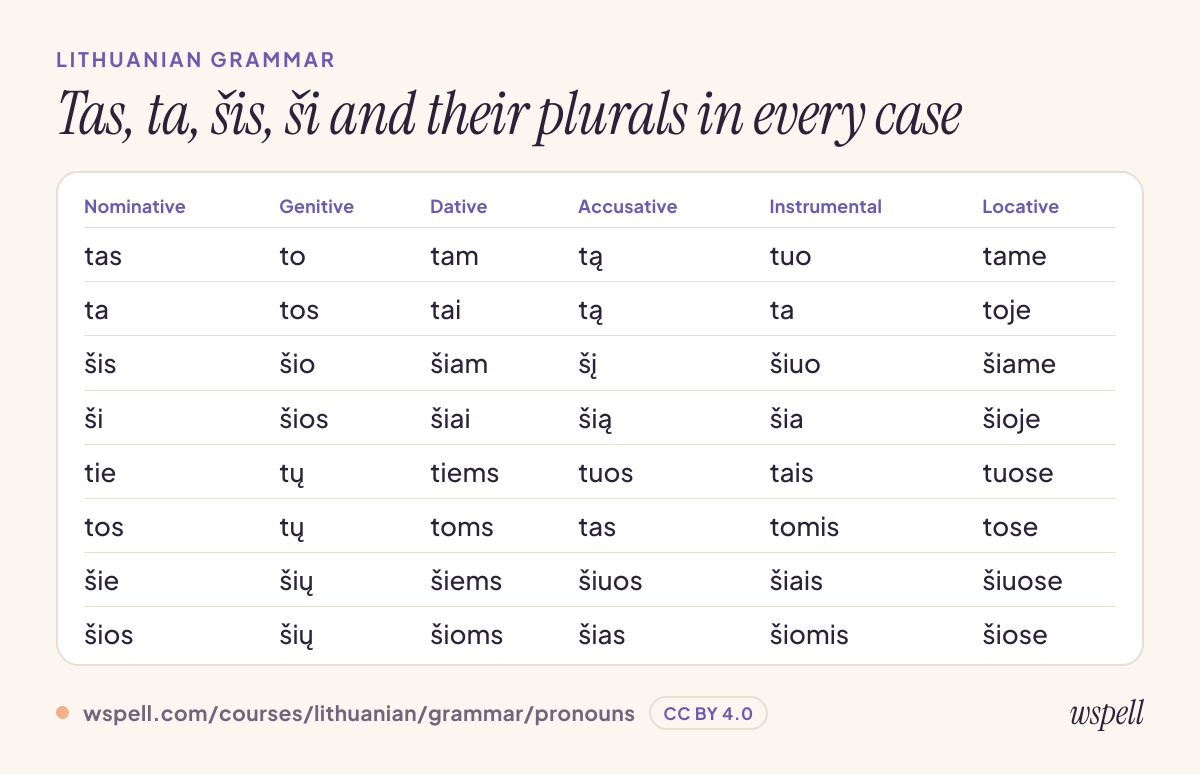
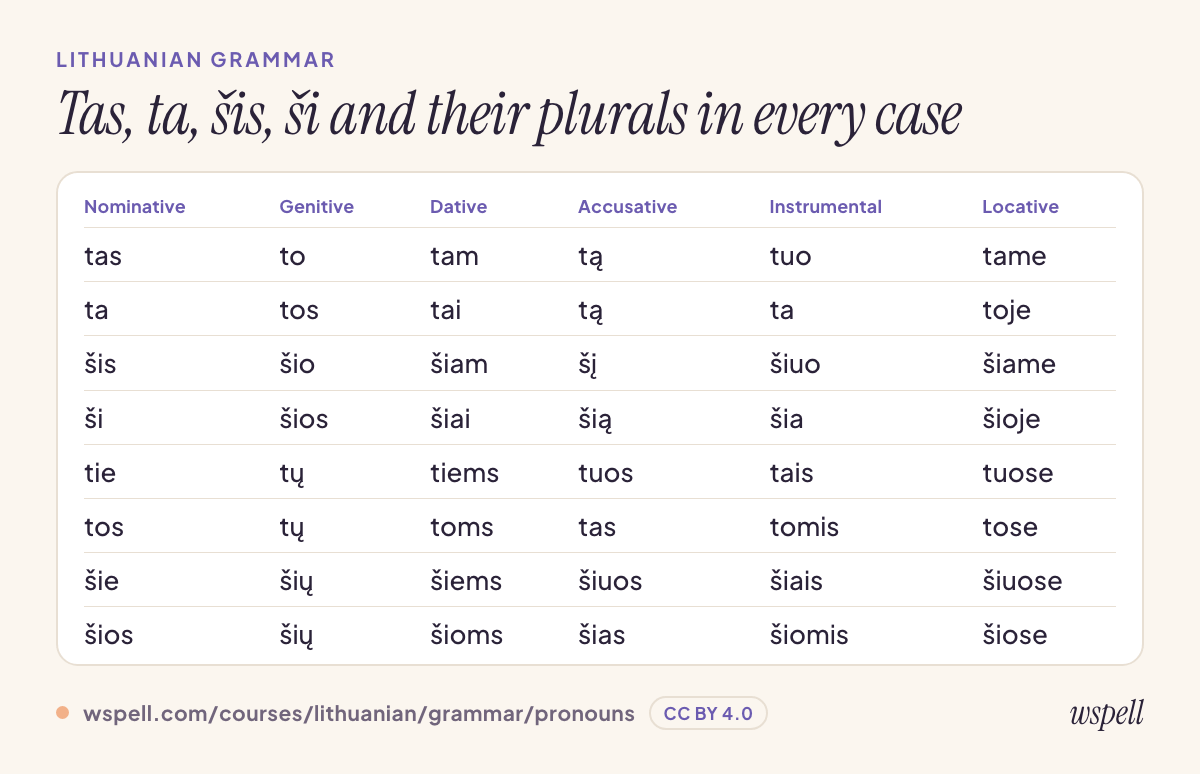
Demonstratives agree like adjectives
Demonstratives (tas, šis, anas) agree with the noun in gender, number, and case, like adjectives: tas vyras, ta moteris, tie vyrai, tose knygose.
- Ta knyga įdomi. — That book is interesting.
Possessives: mano, tavo, savo
Mano, tavo, jo never change
The possessive pronouns mano, tavo, jo, jos, mūsų, jūsų, jų are indeclinable — the NOUN declines, the possessive does not: mano namas, mano namo, mano namuose.
- mano name, mano namuose — in my house, in my houses
Savo: when the owner is the subject
Use savo (one's own) whenever the possessor is the sentence's subject; jo/jos/jų only for someone else's: Jis skaito SAVO knygą (his own) vs Jis skaito JO knygą (another man's). Wrong choice changes the meaning — a favourite exam trap.
- Ji myli savo darbą. — She loves her (own) job.
- Ji myli jos darbą. — She loves her (someone else's) job.
Polite address
Jūs for strangers, elders and officials
Address strangers, elders, and officials with jūs + plural verb forms even for one person: Ar jūs galite padėti? The polite conditional softens requests: gal galėtumėte…
- Gal galėtumėte man padėti? — Could you perhaps help me?
practise this chart
Drill these forms in real sentences — every answer checked, every word spoken.
practise now — free to try; some drills ask for a free account
save or print this chart
Under the main tables on this page sits a picture of each — keep one on your phone, share it or print it.
Free to share and adapt under CC BY 4.0 — credit wspell and link to this page. the licence
credit line to copy: Lithuanian pronouns in every case — wspell, CC BY 4.0, https://wspell.com/courses/lithuanian/grammar/pronouns
questions
How do Lithuanian personal pronouns decline?
Each has its own form in every case, and aš and tu change their stem: aš, manęs, man, mane, manimi, manyje; tu, tavęs, tau, tave, tavimi, tavyje.
When do you use savo instead of jo or jos?
Use savo whenever the owner is the subject of the sentence: Ji myli savo darbą — she loves her own job. Ji myli jos darbą means someone else's job.
Do mano, tavo and jo change with the case?
No. The possessives mano, tavo, jo, jos, mūsų, jūsų and jų never change; only the noun does: mano namas, mano namo, mano namuose.