grammar chart · Lithuanian
The genitive case in Lithuanian (kilmininkas)
The genitive (kilmininkas) answers ko? It marks the owner (brolio knyga), follows quantity words such as daug and kiek, and says what there is none of with nėra. It is also the case of a negated object, of 'some' (duok duonos), and of many prepositions and verbs.
When to use the genitive
Kilmininkas: possession, quantity and nėra
The genitive (kilmininkas) marks possession (brolio knyga), follows quantity words (daug, kiek, litras), and expresses non-existence with nėra. Answers ko? (of what/whom?).
- Tai mano brolio knyga. — This is my brother's book.
- Mieste daug žmonių. — There are many people in the city.
- Nėra laiko. — There is no time.
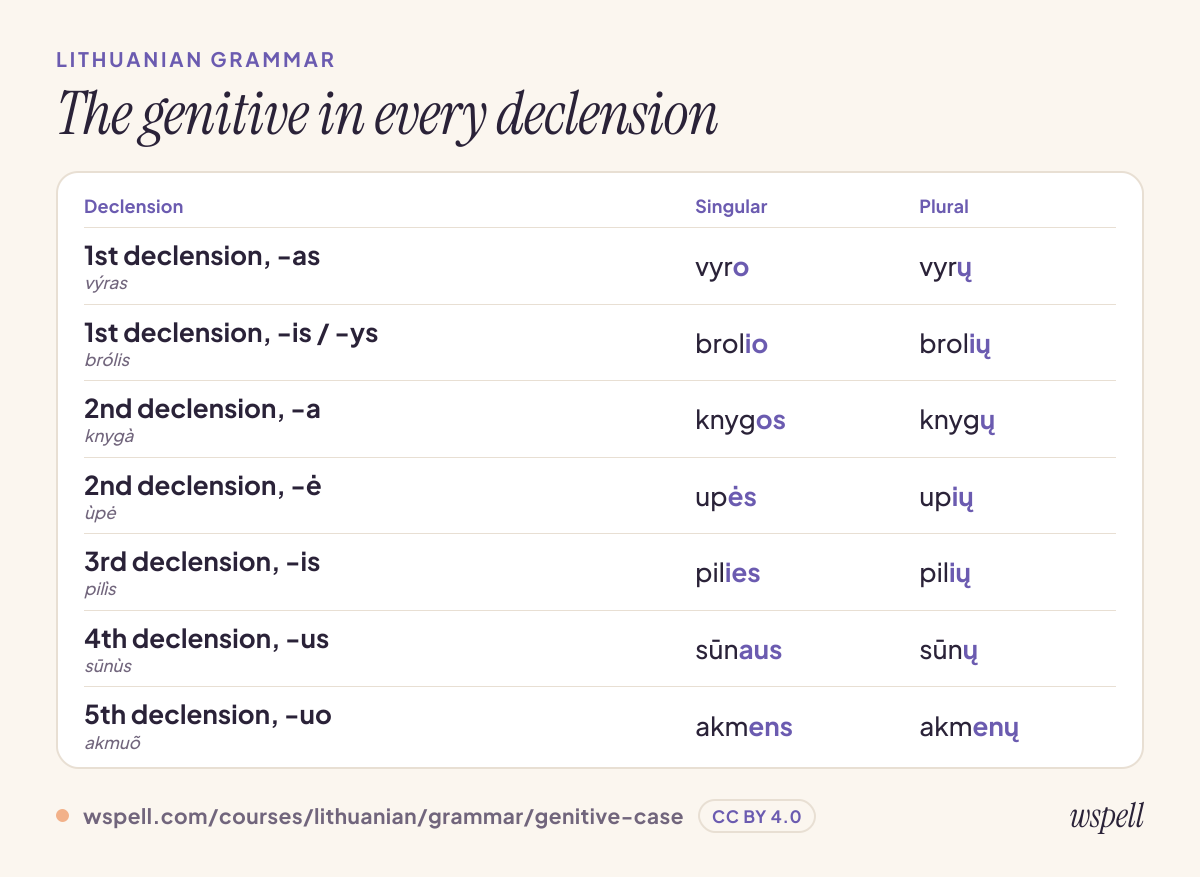
Genitive endings, singular and plural
| Declension | Singular | Plural |
|---|---|---|
| 1st declension, -as výras | vyro | vyrų |
| 1st declension, -is / -ys brólis | brolio | brolių |
| 2nd declension, -a knygà | knygos | knygų |
| 2nd declension, -ė ùpė | upės | upių |
| 3rd declension, -is pilìs | pilies | pilių |
| 4th declension, -us sūnùs | sūnaus | sūnų |
| 5th declension, -uo akmuõ | akmens | akmenų |
Prepositions followed by the genitive
| Preposition | Meaning | Example |
|---|---|---|
| ant | on | ant stalo |
| be | without | be cukraus |
| iš | from, out of | iš Lietuvos |
| iki | until, up to | iki vakaro |
| nuo | from, since | nuo ryto |
| prie | near, at, by | prie lango |
| arti | close to | arti jūros |
| dėl | because of | dėl lietaus |
| netoli | not far from | netoli centro |
| po | after | po darbo |
| šalia | beside | šalia manęs |
| tarp | between, among | tarp dviejų gatvių |
| už | behind | už namo |
| virš | above | virš stalo |
| abipus | on both sides of | abipus kelio |
| anapus | beyond, on the other side | anapus upės |
| anot | according to | anot tėvo |
| aukščiau | above, higher than | aukščiau jūros lygio |
| dėka | thanks to | tavo dėka |
| greta | next to | greta pašto |
| išilgai | along the length of | išilgai upės |
| link | towards | link stoties |
| pasak | according to | pasak ekspertų |
| vidury | in the middle of | vidury nakties |
| vietoj | instead of | vietoj cukraus |
| žemiau | below | žemiau nulio |
The genitive after a negative verb
Ne- turns the accusative object into the genitive
A direct object in the accusative becomes GENITIVE under negation: turiu knygą → neturiu knygos; matau namą → nematau namo. One of the most-tested rules in exams.
- Turiu knygą. / Neturiu knygos. — I have a book. / I don't have a book.
'Some' and the verbs that take the genitive
Duok duonos: the genitive for 'some'
The genitive object means an indefinite amount: duok duonos (give some bread) vs duok duoną (give the bread); atnešk vandens (bring some water).
- Nupirk pieno ir duonos. — Buy some milk and bread.
Laukti, ieškoti, norėti and other genitive verbs
Many frequent verbs govern the genitive instead of the accusative: bijoti (fear), ieškoti (look for), laukti (wait for), norėti (want), prašyti (ask for), reikėti (need), siekti (strive for), trūkti (lack), vengti (avoid), pasiilgti (miss), tikėtis (hope for), klausti (ask): laukiu autobuso, ieškau darbo.
- Laukiu autobuso. — I am waiting for the bus.
- Ieškau darbo. — I am looking for a job.
practise this chart
Drill these forms in real sentences — every answer checked, every word spoken.
practise now — free to try; some drills ask for a free account
save or print this chart
Under the main tables on this page sits a picture of each — keep one on your phone, share it or print it.
Free to share and adapt under CC BY 4.0 — credit wspell and link to this page. the licence
credit line to copy: The genitive case in Lithuanian (kilmininkas) — wspell, CC BY 4.0, https://wspell.com/courses/lithuanian/grammar/genitive-case
questions
When is the genitive used in Lithuanian?
For possession (brolio knyga), after quantity words (daug žmonių), with nėra (nėra laiko), for a negated object (neturiu laiko) and for an indefinite amount (nupirk pieno). It also follows prepositions such as be, iš, iki and prie, and verbs such as laukti and ieškoti.
Why does the object change after ne- in Lithuanian?
A direct object in the accusative becomes genitive when the verb is negated: turiu knygą → neturiu knygos, matau namą → nematau namo.
What is the genitive plural ending in Lithuanian?
It always ends in nasal -ų, never a plain -u: namų, knygų, upių, sūnų, dantų.