grammar chart · Lithuanian
The instrumental case in Lithuanian (įnagininkas)
The instrumental (įnagininkas) answers kuo? — with what? It names the tool (rašau pieštuku), the vehicle (važiuoju autobusu) and a role or job (dirba mokytoju), and it follows su (with). Its feminine singular has no nasal letter: su knyga, but skaitau knygą.
When to use the instrumental
Įnagininkas: tool, transport and role
The instrumental (įnagininkas) marks the tool or means (rašau pieštuku), the vehicle (važiuoju autobusu), and a role or profession taken on — with dirbti or tapti, or with būti for a temporary role (dirba mokytoju, tapo gydytoju). Answers kuo? (with what?).
- Rašau pieštuku. — I write with a pencil.
- Važiuoju autobusu. — I go by bus.
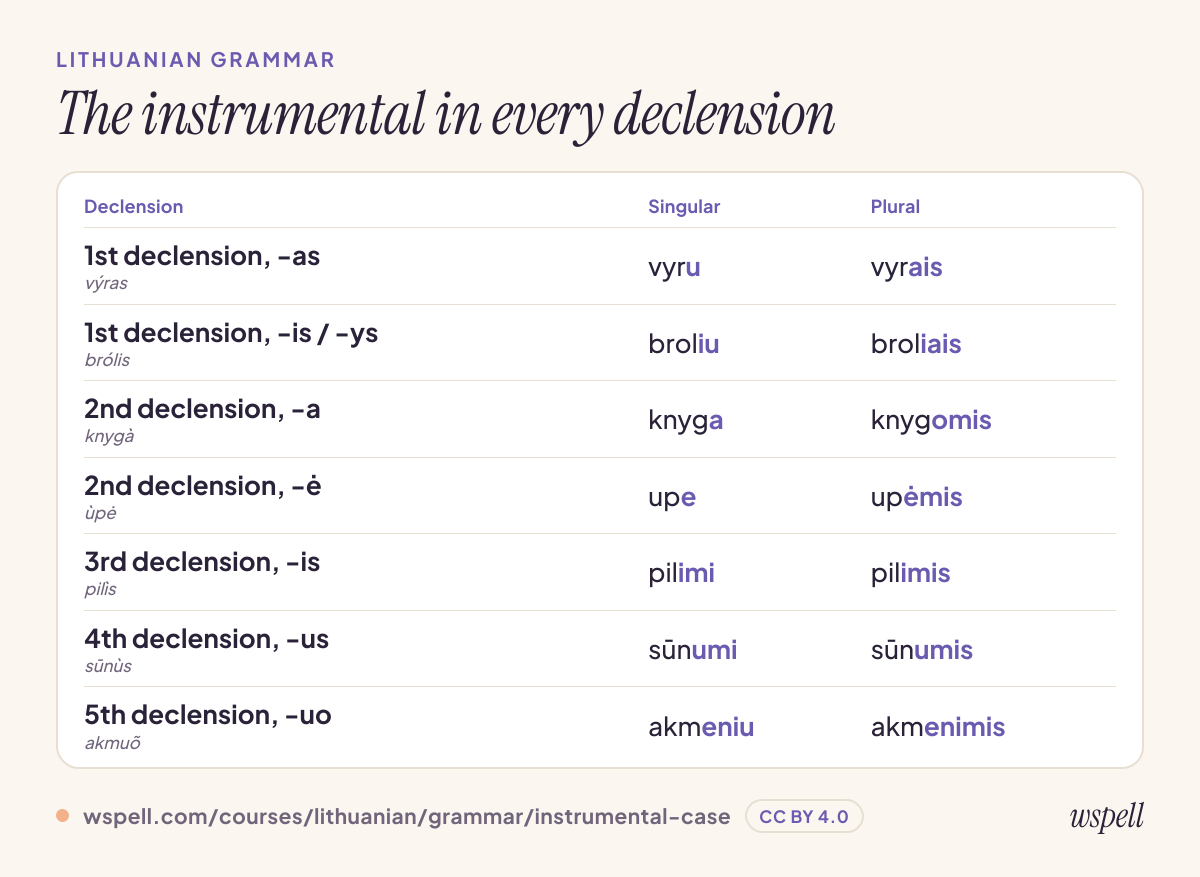
Instrumental endings, singular and plural
| Declension | Singular | Plural |
|---|---|---|
| 1st declension, -as výras | vyru | vyrais |
| 1st declension, -is / -ys brólis | broliu | broliais |
| 2nd declension, -a knygà | knyga | knygomis |
| 2nd declension, -ė ùpė | upe | upėmis |
| 3rd declension, -is pilìs | pilimi | pilimis |
| 4th declension, -us sūnùs | sūnumi | sūnumis |
| 5th declension, -uo akmuõ | akmeniu | akmenimis |
Su knyga or skaitau knygą: a or ą
Feminine singular instrumental has NO nasal (su knyga, su upe), the accusative HAS one (skaitau knygą, matau upę). The preposition su or an instrument meaning signals plain a/e; a direct object signals ą/ę.
- Rašau ranka. / Pakeliu ranką. — I write by hand. / I raise my hand.
Prepositions followed by the instrumental
| Preposition | Meaning | Example |
|---|---|---|
| su | with | su pienu |
| po | under | po stalu |
| ties | at, by, level with | ties mokykla |
| sulig | as tall/big as, upon | sulig tėvu |
Jobs and roles, and the verbs that take it
Who you are (nominative) or the role you play (instrumental)
Permanent identity takes the nominative (jis yra mokytojas — he is a teacher), while function, temporary state, or change takes the instrumental: dirba mokytoju (works as a teacher), tapo gydytoju (became a doctor), buvo vaiku (as a child).
- Jis yra gydytojas, bet dirba vairuotoju. — He is a doctor but works as a driver.
Domėtis, rūpintis, tapti and other instrumental verbs
These (mostly reflexive) verbs govern the instrumental: domėtis (be interested in), didžiuotis (be proud of), rūpintis (take care of), naudotis (use), džiaugtis (be glad about), girtis (boast), sirgti (be ill with), prekiauti (trade in), abejoti (doubt), žavėtis (admire), skųstis (complain of), tapti (become): domiuosi istorija, sergu gripu.
- Domiuosi Lietuvos istorija. — I am interested in Lithuanian history.
- Jis tapo gydytoju. — He became a doctor.
practise this chart
Drill these forms in real sentences — every answer checked, every word spoken.
practise now — free to try; some drills ask for a free account
save or print this chart
Under the main tables on this page sits a picture of each — keep one on your phone, share it or print it.
Free to share and adapt under CC BY 4.0 — credit wspell and link to this page. the licence
credit line to copy: The instrumental case in Lithuanian (įnagininkas) — wspell, CC BY 4.0, https://wspell.com/courses/lithuanian/grammar/instrumental-case
questions
When do you use the instrumental in Lithuanian?
For the tool or means (rašau pieštuku), the vehicle (važiuoju autobusu), a job or role (dirba vairuotoju, tapo gydytoju), after su (with), and after verbs such as domėtis, rūpintis and naudotis.
How do you say 'by bus' in Lithuanian?
Put the vehicle in the instrumental, with no preposition: važiuoju autobusu — I go by bus.
What is the difference between su knyga and knygą?
Su knyga is instrumental (with a book) and has no nasal letter; knygą is accusative (skaitau knygą — I am reading a book) and has one. The same goes for su upe and matau upę.