grammar chart · French
French verb conjugation: the endings of the main tenses in one chart
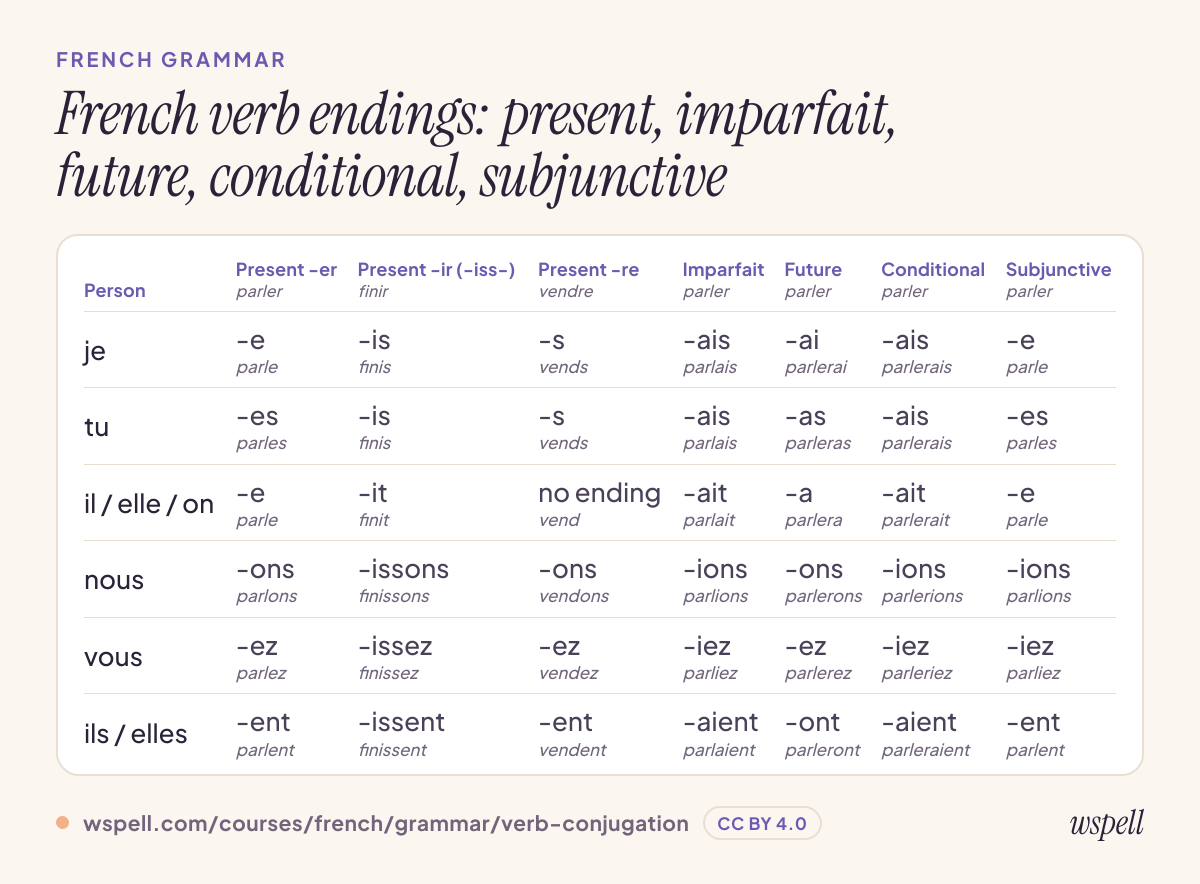
A French verb changes its ending for each person, and the endings change with the tense. The first table puts them side by side: the present of the three verb types, then the imparfait, the future and the conditional, whose endings are the same for every verb, and the subjunctive, whose endings fit every verb except être and avoir. Below it, parler, finir and vendre are conjugated in each of these tenses and in the passé composé.
The endings of the main tenses
Under each ending is the form of parler, finir or vendre that has it.
| Person | Present -er parler | Present -ir (-iss-) finir | Present -re vendre | Imparfait parler | Future parler | Conditional parler | Subjunctive parler |
|---|---|---|---|---|---|---|---|
| je | -e parle | -is finis | -s vends | -ais parlais | -ai parlerai | -ais parlerais | -e parle |
| tu | -es parles | -is finis | -s vends | -ais parlais | -as parleras | -ais parlerais | -es parles |
| il / elle / on | -e parle | -it finit | no ending vend | -ait parlait | -a parlera | -ait parlerait | -e parle |
| nous | -ons parlons | -issons finissons | -ons vendons | -ions parlions | -ons parlerons | -ions parlerions | -ions parlions |
| vous | -ez parlez | -issez finissez | -ez vendez | -iez parliez | -ez parlerez | -iez parleriez | -iez parliez |
| ils / elles | -ent parlent | -issent finissent | -ent vendent | -aient parlaient | -ont parleront | -aient parleraient | -ent parlent |
parler (to speak): an -er verb
| Person | Present présent | Imperfect imparfait | Future futur simple | Conditional conditionnel | Subjunctive subjonctif | Compound past passé composé |
|---|---|---|---|---|---|---|
| je (j') | parle | parlais | parlerai | parlerais | parle | ai parlé |
| tu | parles | parlais | parleras | parlerais | parles | as parlé |
| il / elle / on | parle | parlait | parlera | parlerait | parle | a parlé |
| nous | parlons | parlions | parlerons | parlerions | parlions | avons parlé |
| vous | parlez | parliez | parlerez | parleriez | parliez | avez parlé |
| ils / elles | parlent | parlaient | parleront | parleraient | parlent | ont parlé |
-er verbs: drop -er, add -e, -es, -e, -ons, -ez, -ent
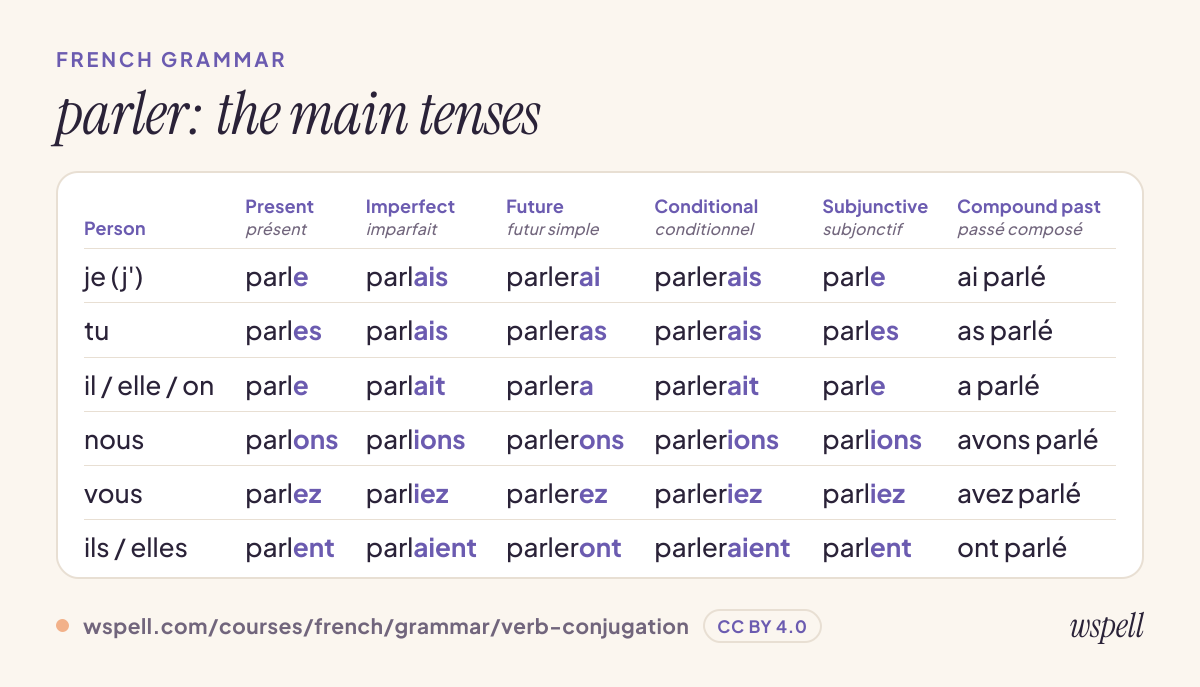
The largest, fully regular group: drop -er and add -e, -es, -e, -ons, -ez, -ent. The three singular forms and the 3pl are pronounced identically; only spelling and -ons/-ez differ audibly.
- je parle, tu parles, il parle, nous parlons, vous parlez, ils parlent — to speak — present
finir (to finish): an -ir verb with -iss-
| Person | Present présent | Imperfect imparfait | Future futur simple | Conditional conditionnel | Subjunctive subjonctif | Compound past passé composé |
|---|---|---|---|---|---|---|
| je (j') | finis | finissais | finirai | finirais | finisse | ai fini |
| tu | finis | finissais | finiras | finirais | finisses | as fini |
| il / elle / on | finit | finissait | finira | finirait | finisse | a fini |
| nous | finissons | finissions | finirons | finirions | finissions | avons fini |
| vous | finissez | finissiez | finirez | finiriez | finissiez | avez fini |
| ils / elles | finissent | finissaient | finiront | finiraient | finissent | ont fini |
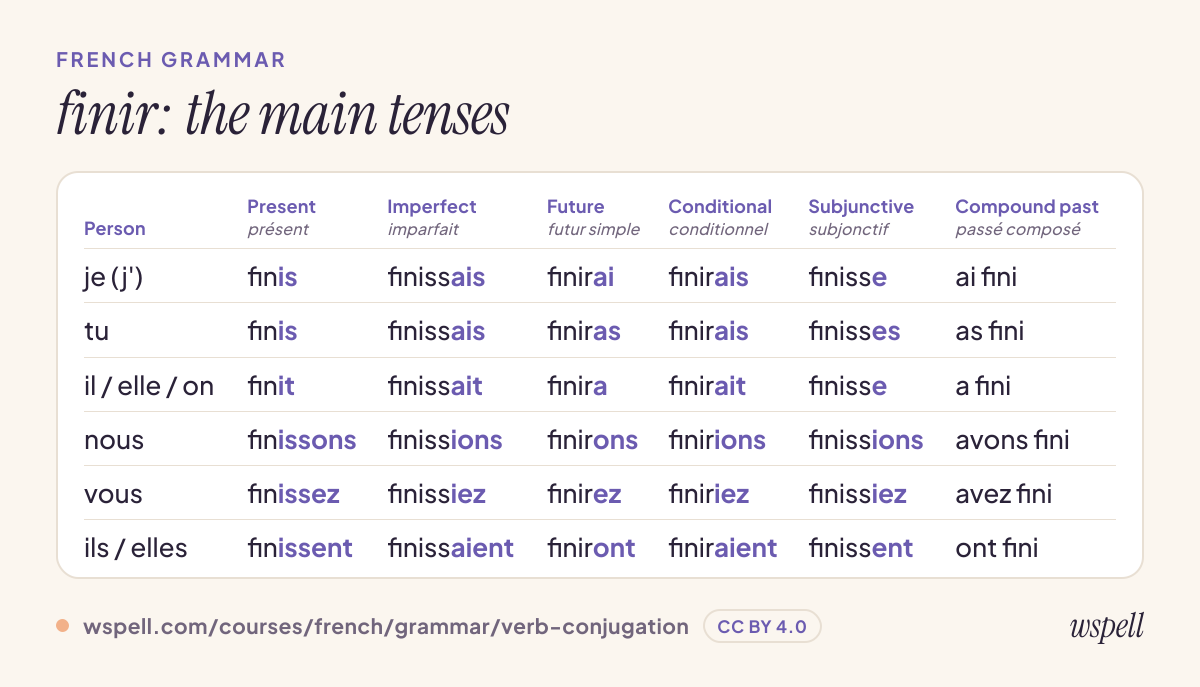
-ir verbs like finir: -iss- in the plural
The -iss- group: stem + -is, -is, -it, -issons, -issez, -issent. The -iss- infix appears throughout the plural and marks this class off from short -ir verbs like partir/dormir.
- je finis, tu finis, il finit, nous finissons, vous finissez, ils finissent — to finish — present
vendre (to sell): an -re verb
| Person | Present présent | Imperfect imparfait | Future futur simple | Conditional conditionnel | Subjunctive subjonctif | Compound past passé composé |
|---|---|---|---|---|---|---|
| je (j') | vends | vendais | vendrai | vendrais | vende | ai vendu |
| tu | vends | vendais | vendras | vendrais | vendes | as vendu |
| il / elle / on | vend | vendait | vendra | vendrait | vende | a vendu |
| nous | vendons | vendions | vendrons | vendrions | vendions | avons vendu |
| vous | vendez | vendiez | vendrez | vendriez | vendiez | avez vendu |
| ils / elles | vendent | vendaient | vendront | vendraient | vendent | ont vendu |
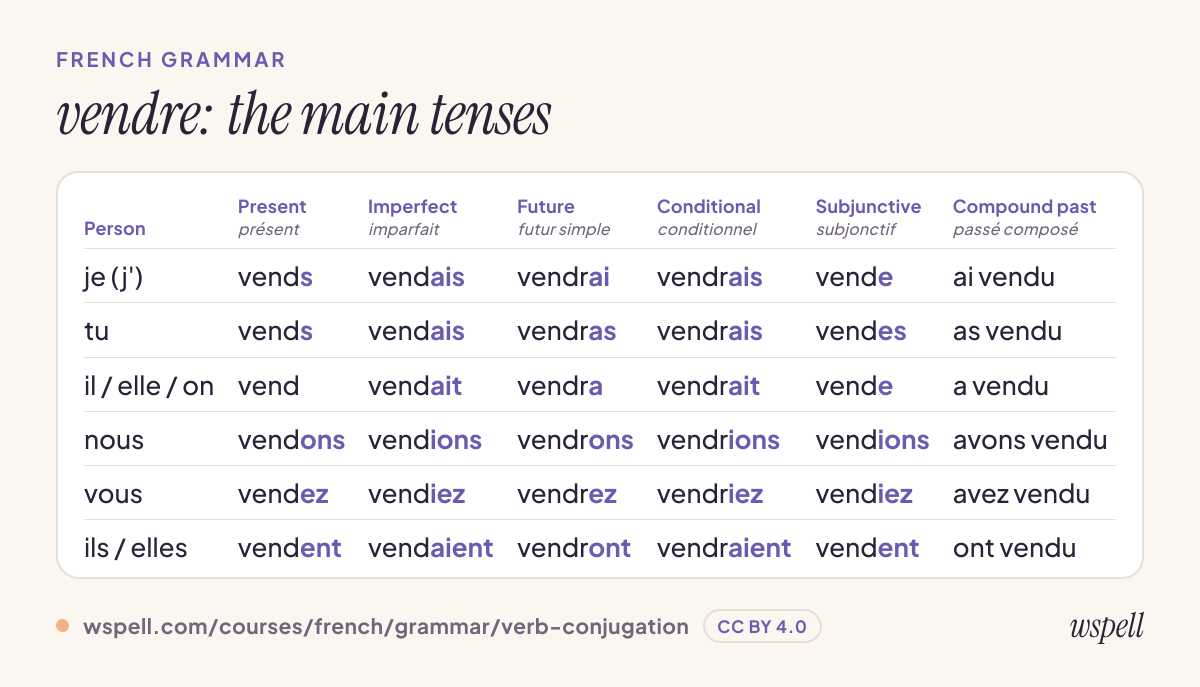
-re verbs like vendre: no ending in il vend
Drop -re and add -s, -s, -(nothing), -ons, -ez, -ent. The 3sg has a bare stem (il vend), and the -d is silent, so 1/2/3 singular sound alike.
- je vends, tu vends, il vend, nous vendons, vous vendez, ils vendent — to sell — present
Irregular verbs: the forms to learn
The verbs used most are irregular. For each: the present with je, nous and ils, the future, the passé composé and the subjunctive — the forms that show its stems.
| Verb | Present je | Present nous | Present ils |
|---|---|---|---|
| être to be | je suis | nous sommes | ils sont |
| avoir to have | j'ai | nous avons | ils ont |
| aller to go | je vais | nous allons | ils vont |
| faire to do, to make | je fais | nous faisons | ils font |
| venir to come | je viens | nous venons | ils viennent |
| prendre to take | je prends | nous prenons | ils prennent |
| pouvoir can, to be able | je peux | nous pouvons | ils peuvent |
| vouloir to want | je veux | nous voulons | ils veulent |
| devoir must, to have to | je dois | nous devons | ils doivent |
| savoir to know (how) | je sais | nous savons | ils savent |
| Verb | Future je | Compound past je | Subjunctive que je |
|---|---|---|---|
| être to be | je serai | j'ai été | que je sois |
| avoir to have | j'aurai | j'ai eu | que j'aie |
| aller to go | j'irai | je suis allé(e) | que j'aille |
| faire to do, to make | je ferai | j'ai fait | que je fasse |
| venir to come | je viendrai | je suis venu(e) | que je vienne |
| prendre to take | je prendrai | j'ai pris | que je prenne |
| pouvoir can, to be able | je pourrai | j'ai pu | que je puisse |
| vouloir to want | je voudrai | j'ai voulu | que je veuille |
| devoir must, to have to | je devrai | j'ai dû | que je doive |
| savoir to know (how) | je saurai | j'ai su | que je sache |
learn it step by step
save or print this chart
Under the main tables on this page sits a picture of each — keep one on your phone, share it or print it.
Free to share and adapt under CC BY 4.0 — credit wspell and link to this page. the licence
credit line to copy: French verb conjugation: the endings of the main tenses in one chart — wspell, CC BY 4.0, https://wspell.com/courses/french/grammar/verb-conjugation
questions
What are the three groups of French verbs?
Regular -er verbs (parler), by far the largest group; regular -ir verbs that take -iss- in the plural (finir → nous finissons); and the third group: -re verbs like vendre, -ir verbs without -iss- like partir, and the irregular verbs.
Which French tenses have the same endings for every verb?
The imparfait (-ais, -ais, -ait, -ions, -iez, -aient), the future (-ai, -as, -a, -ons, -ez, -ont) and the conditional, which puts the imparfait endings on the future stem. The subjunctive endings -e, -es, -e, -ions, -iez, -ent fit every verb except être and avoir.
How is the passé composé formed?
With the present of avoir — or of être for some verbs of movement and change of state (aller, naître) and for every reflexive verb — and the past participle: j'ai parlé, j'ai fini, j'ai vendu, je suis allé(e), je me suis levé(e).