grammar chart · French
The passé composé: avoir or être + past participle
The passé composé is the past tense of everyday French: j'ai parlé — I spoke, I have spoken. It is the present of avoir or être plus the past participle. Most verbs take avoir; a small group of verbs of movement and change of state, and every reflexive verb, take être. After être the participle of these verbs agrees with the subject like an adjective — elle est allée, ils sont partis — while a reflexive verb follows a rule of its own, below.
With avoir and with être
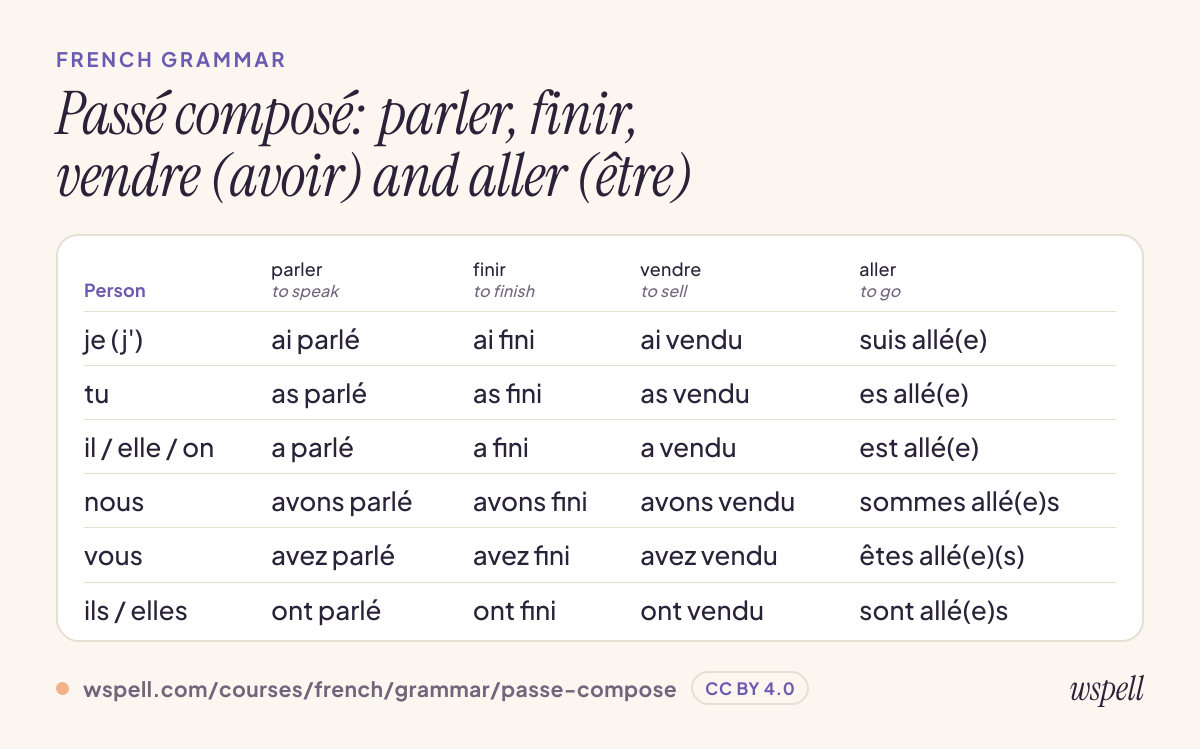
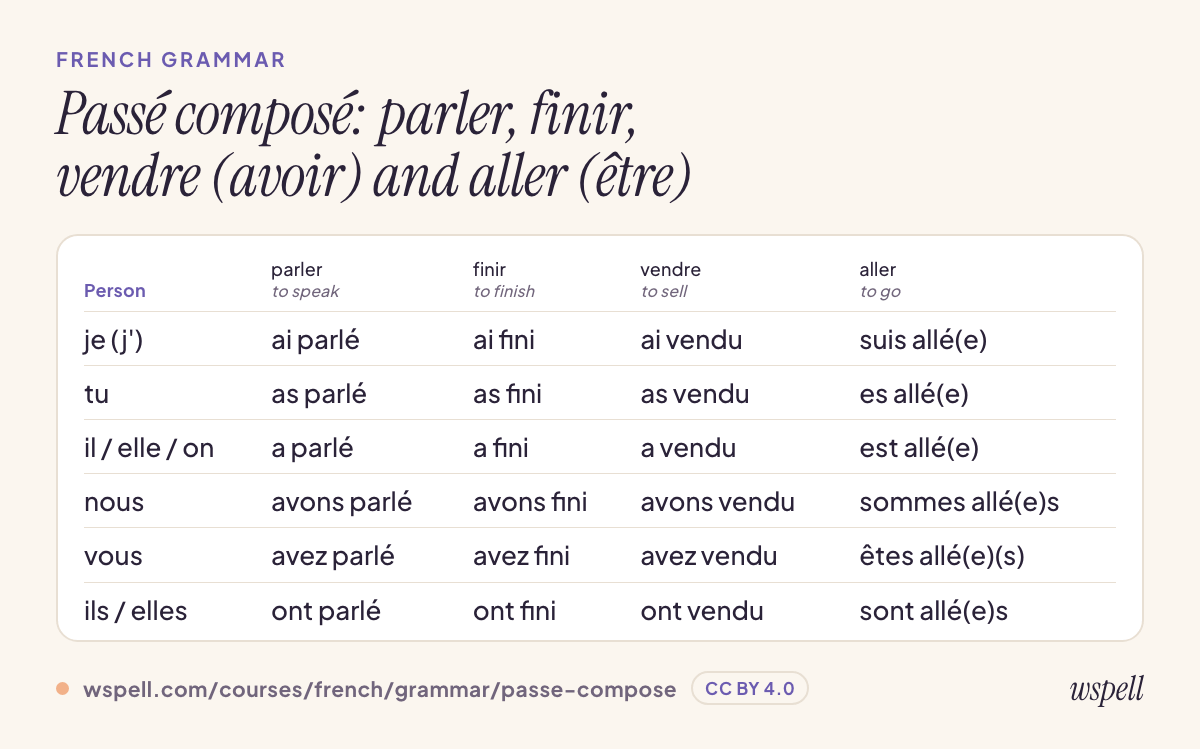
Regular participles end in -é (-er verbs), -i (-ir verbs) and -u (-re verbs). (e) and (e)s show the agreement with a feminine or a plural subject; (e)(s) is vous, which can be one person or several.
| Person | parler to speak | finir to finish | vendre to sell | aller to go |
|---|---|---|---|---|
| je (j') | ai parlé | ai fini | ai vendu | suis allé(e) |
| tu | as parlé | as fini | as vendu | es allé(e) |
| il / elle / on | a parlé | a fini | a vendu | est allé(e) |
| nous | avons parlé | avons fini | avons vendu | sommes allé(e)s |
| vous | avez parlé | avez fini | avez vendu | êtes allé(e)(s) |
| ils / elles | ont parlé | ont fini | ont vendu | sont allé(e)s |
Passé composé with avoir
The main spoken past: present of avoir + past participle. Regular participles end -é (-er), -i (-ir), -u (-re). Most verbs take avoir.
- J'ai mangé une pomme. — I ate/have eaten an apple.
- Nous avons fini le travail. — We finished the work.
The verbs that take être
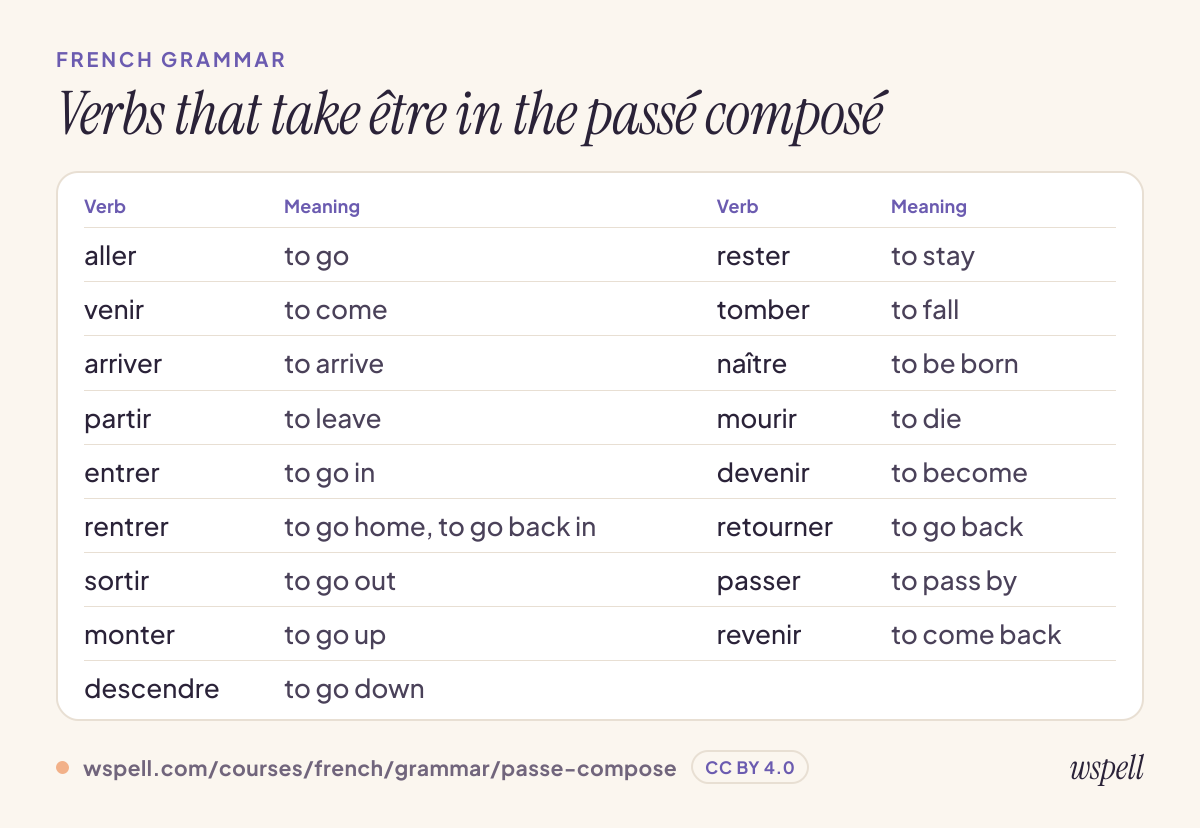
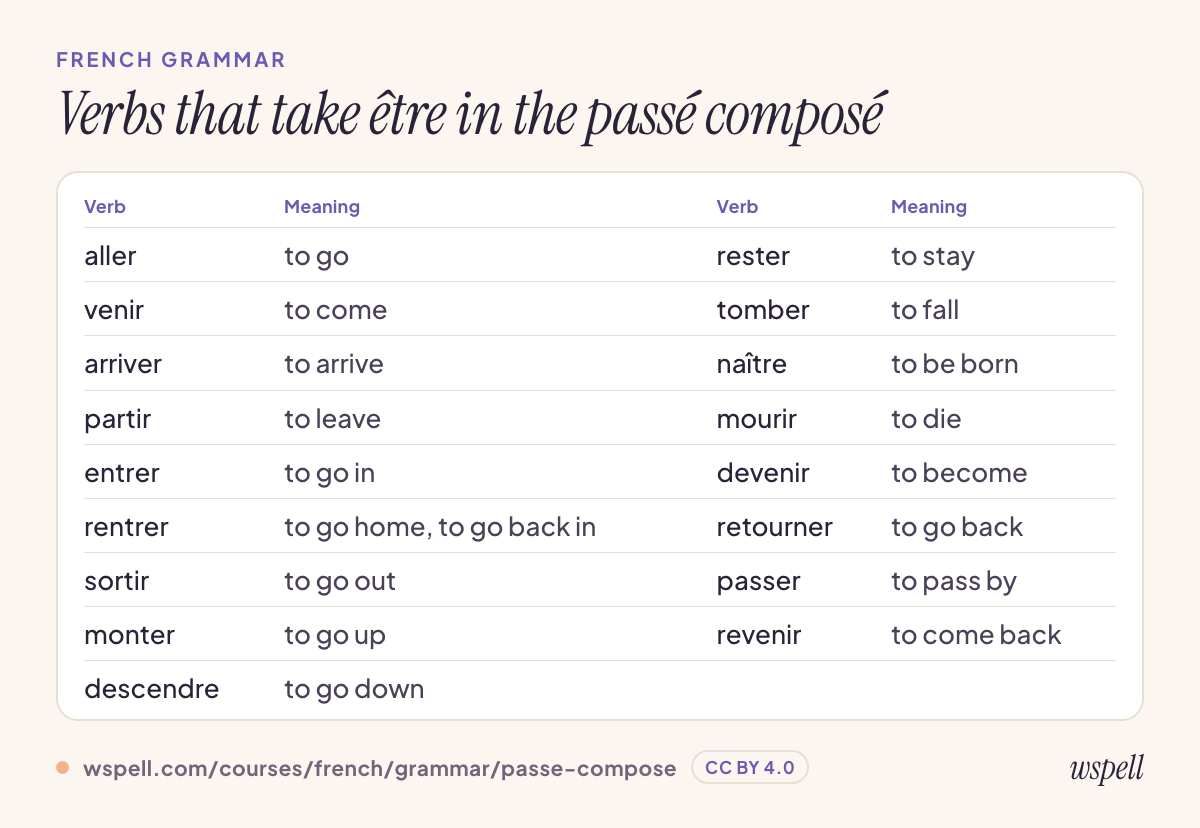
| Verb | Meaning | Verb | Meaning |
|---|---|---|---|
| aller | to go | rester | to stay |
| venir | to come | tomber | to fall |
| arriver | to arrive | naître | to be born |
| partir | to leave | mourir | to die |
| entrer | to go in | devenir | to become |
| rentrer | to go home, to go back in | retourner | to go back |
| sortir | to go out | passer | to pass by |
| monter | to go up | revenir | to come back |
| descendre | to go down |
Passé composé with être: verbs of movement
A closed set of intransitive verbs of motion and change of state takes être, not avoir: aller, venir, entrer, sortir, monter, descendre, arriver, partir, rester, tomber, naître, mourir, devenir, retourner and their compounds (the 'DR & MRS VANDERTRAMP' list).
- Elle est arrivée à midi. — She arrived at noon.
- Ils sont partis très tôt. — They left very early.
Irregular past participles
| Infinitive | Participle | Infinitive | Participle |
|---|---|---|---|
| avoir | eu | devoir | dû |
| être | été | savoir | su |
| faire | fait | venir | venu |
| prendre | pris | écrire | écrit |
| mettre | mis | ouvrir | ouvert |
| voir | vu | offrir | offert |
| vouloir | voulu | boire | bu |
| pouvoir | pu | lire | lu |
When the participle agrees
With être, the participle agrees with the subject
With the être auxiliary the past participle agrees in gender and number with the SUBJECT: add -e (fem), -s (pl), -es (fem pl). This is audible only where the participle ends in a silent consonant that the -e makes heard: mort → morte.
- Marie est partie et ses amies sont restées. — Marie left and her friends stayed.
- Nous sommes nés en France. — We were born in France.
With avoir, it agrees only with a direct object before it
With avoir the participle NEVER agrees with the subject, but DOES agree with a direct object placed BEFORE the verb (a preceding pronoun, que-relative, or fronted quel/combien). No preceding DO → no agreement.
- Les pommes que j'ai mangées étaient bonnes. — The apples I ate were good.
- Je les ai vues hier. — I saw them (fem) yesterday.
Reflexive verbs always take être
All pronominal verbs take être. The participle agrees with the reflexive pronoun only when it is the DIRECT object (elle s'est lavée) — not when a following direct object exists (elle s'est lavé les mains) or the pronoun is indirect (elles se sont parlé). A verb that exists only in the pronominal form agrees with the subject (elle s'est souvenue).
- Elle s'est levée tôt. — She got up early.
- Elle s'est lavé les mains. — She washed her hands.
Negation and pronouns: je n'ai pas…, je l'ai vu
ne … pas goes around the verb
Basic negation places ne before the conjugated verb and pas after it: je ne comprends pas. Before a vowel or mute h, ne elides to n': il n'est pas là. In the passé composé the wrap is around the auxiliary: je n'ai pas mangé.
- Je ne parle pas anglais. — I don't speak English.
- Elle n'a pas compris. — She didn't understand.
Pronouns go before the auxiliary: je l'ai vu
In the passé composé and other compound tenses, object pronouns sit before the auxiliary (avoir/être), not before the past participle: 'je l'ai vu', 'il nous a parlé', 'je m'en suis souvenu'.
- Ce film ? Je l'ai déjà vu. — That film? I've already seen it.
- Elle nous a téléphoné hier. — She phoned us yesterday.
Passé composé or imparfait?
Imparfait for the scene, passé composé for the event
The imparfait sets the ongoing scene/habit/description; the passé composé reports a completed, bounded event that moves the story forward. A sudden action interrupting a background one contrasts the two.
- Je dormais quand le téléphone a sonné. — I was sleeping when the phone rang.
- Il faisait beau, alors nous sommes sortis. — The weather was nice, so we went out.
learn it step by step
save or print this chart
Under the main tables on this page sits a picture of each — keep one on your phone, share it or print it.
Free to share and adapt under CC BY 4.0 — credit wspell and link to this page. the licence
credit line to copy: The passé composé: avoir or être + past participle — wspell, CC BY 4.0, https://wspell.com/courses/french/grammar/passe-compose
questions
Which verbs take être in the passé composé?
The verbs in the table above and most of their compounds, such as repartir and redescendre — verbs of movement or change of state used without a direct object — and every reflexive verb: je me suis levé(e). All other verbs take avoir.
What does DR & MRS VANDERTRAMP stand for?
It is a memory aid for the être verbs: devenir, revenir, monter, rester, sortir, venir, aller, naître, descendre, entrer, rentrer, tomber, retourner, arriver, mourir, partir.
When does the past participle agree?
With être, it agrees with the subject: elle est partie, nous sommes allés (a reflexive verb has a rule of its own). With avoir, it agrees only with a direct object placed before the verb: la lettre que j'ai écrite, je les ai vues.