grammar chart · French
French articles: definite, indefinite and partitive
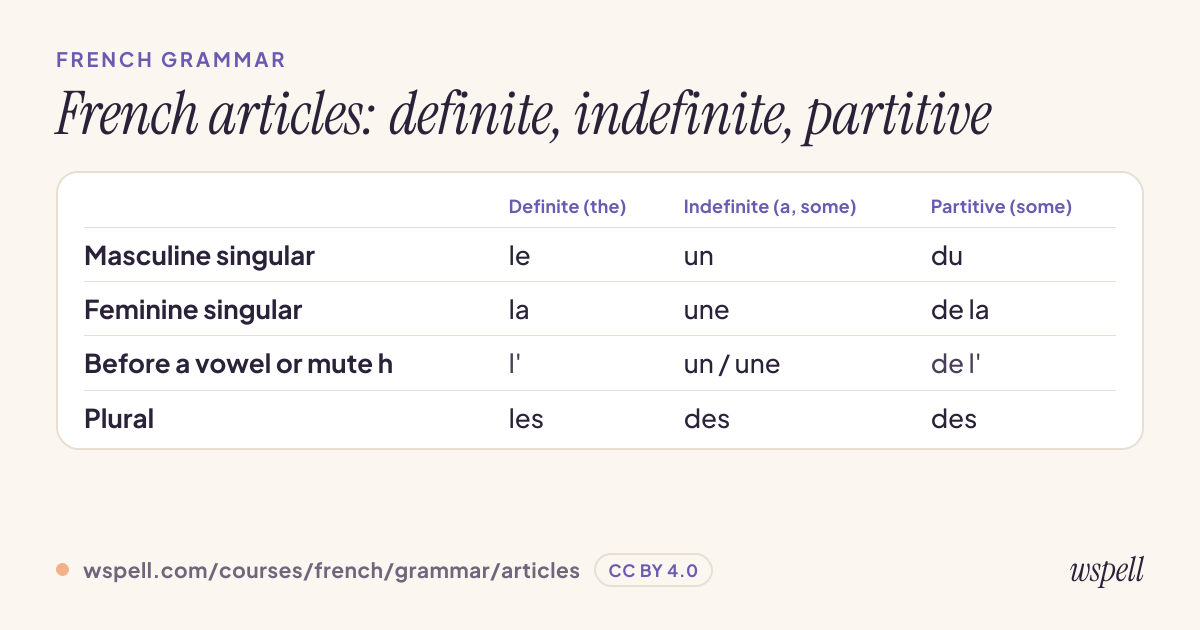
A French noun almost always comes with an article, and the article shows its gender and number. Le, la and les mean 'the'; un, une and des 'a' or 'some'; du, de la and de l' 'some' of something you cannot count. Before a vowel or a mute h, le and la become l'. After à and de, le and les merge with the preposition: au, aux, du, des.
The three articles
| Definite (the) | Indefinite (a, some) | Partitive (some) | |
|---|---|---|---|
| Masculine singular | le | un | du |
| Feminine singular | la | une | de la |
| Before a vowel or mute h | l' | un / une | de l' |
| Plural | les | des | des |
du café or le café?
Use the partitive (du/de la) for an unspecified amount consumed or handled, but the definite (le/la) for the thing in general or a specific one: Je bois du café (some now) vs J'aime le café (coffee as a class).
- Je veux du pain, j'adore le pain. — I want some bread, I love bread.
J'aime le chocolat: the article for things in general
Unlike English, French uses the definite article for a whole class, an abstraction, or a general like/dislike: J'aime le café, La patience est une vertu. The bare noun is wrong here.
- J'aime le chocolat. — I like chocolate.
- La liberté est précieuse. — Freedom is precious.
le and la before a vowel: l'
l'ami, l'heure — but le héros
Le and la lose their vowel and become l' before a word starting with a vowel or a mute h (l'ami, l'heure), but NOT before an aspirate h (le héros, la hache). Elision is orthographic, not optional.
- l'ami de l'école — the friend from the school
- le héros du film — the hero of the film
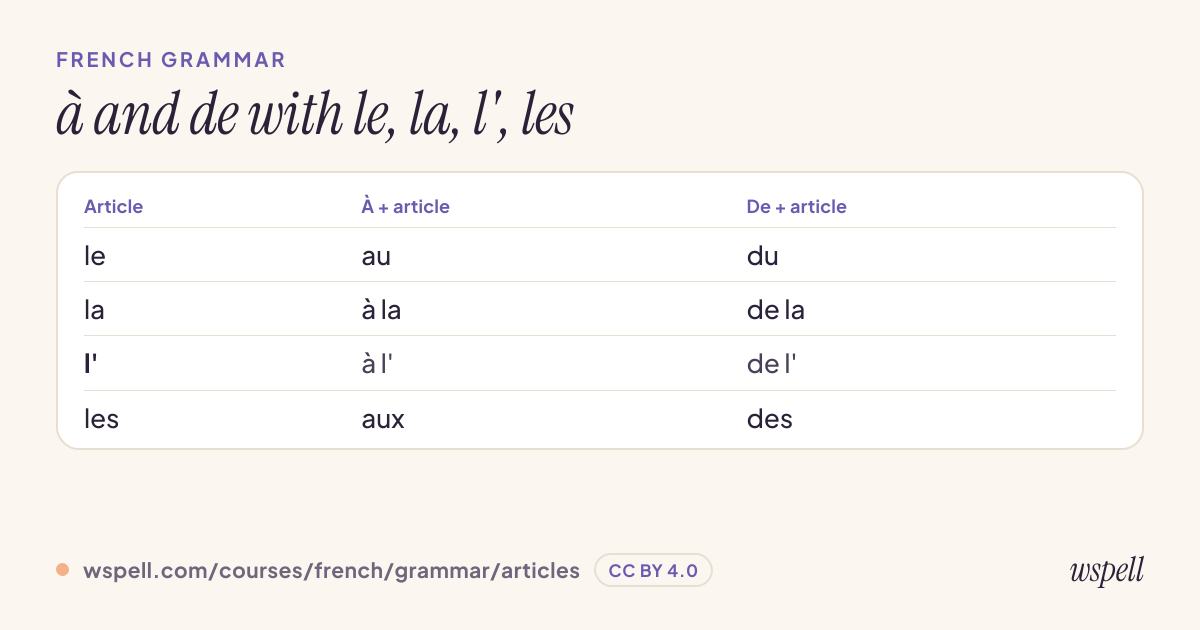
à + le = au, de + le = du
| Article | À + article | De + article |
|---|---|---|
| le | au | du |
| la | à la | de la |
| l' | à l' | de l' |
| les | aux | des |
de + le = du, de + les = des
The preposition de contracts obligatorily with le and les: de + le = du, de + les = des. de la and de l' stay. Note this du/des is homographic with the partitive but is a preposition + article.
- Il revient du travail. — He is coming back from work.
- C'est la fin des vacances. — It's the end of the holidays.
pas de, beaucoup de: when du and des become de
pas de pain: de after a negative
After a negative verb, the indefinite (un/une/des) and partitive (du/de la/des) collapse to bare de (or d' before a vowel): j'ai du pain → je n'ai pas de pain. Exception: after être the article stays (ce n'est pas un chat).
- Je n'ai pas de voiture. — I don't have a car.
- Il n'y a plus d'eau. — There is no more water.
- Ce n'est pas un problème. — It's not a problem.
beaucoup de, un kilo de
Expressions of quantity (beaucoup, peu, trop, assez, un kilo, une tasse…) are followed by bare de/d', not du/de la/des: beaucoup de gens, une tasse de thé. Exceptions: bien des, la plupart des keep the article.
- Il a beaucoup de travail. — He has a lot of work.
- Une bouteille de vin, s'il vous plaît. — A bottle of wine, please.
No article: il est médecin, en voiture
No article: il est médecin, j'ai faim
French drops the article after être/devenir with an unmodified profession (Il est médecin), after en (en voiture, en français), and in many fixed verb+noun collocations (avoir faim, faire attention). Once the noun is modified, an article comes back — usually the indefinite, with c'est: C'est un bon médecin.
- Ma sœur est avocate. — My sister is a lawyer.
- J'ai faim. — I'm hungry.
learn it step by step
save or print this chart
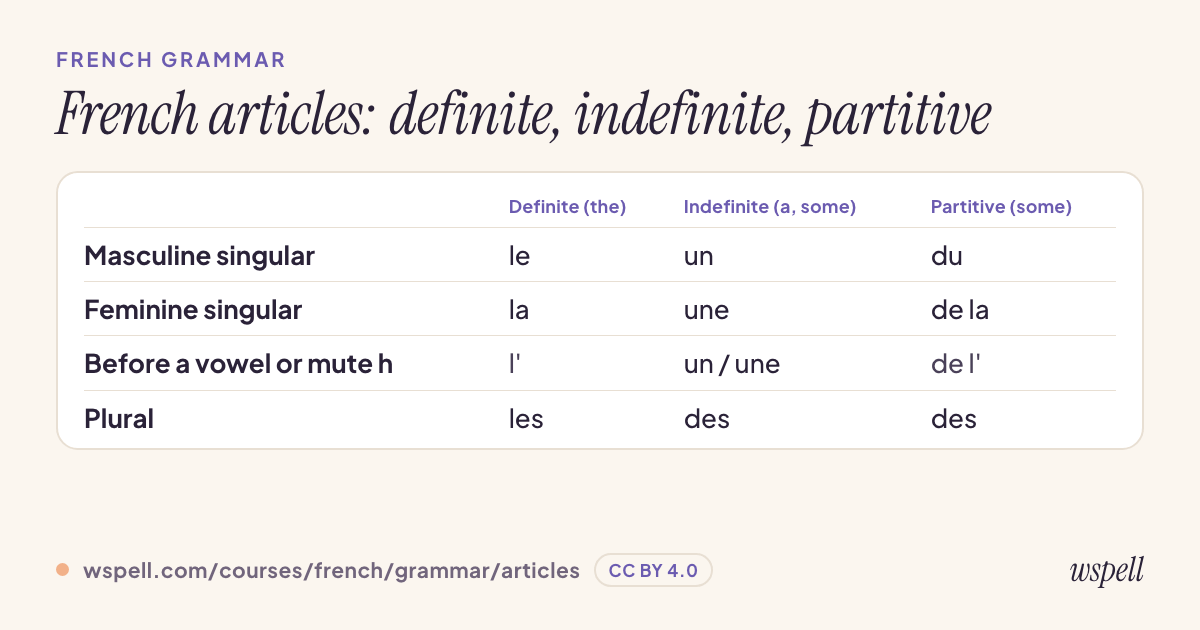
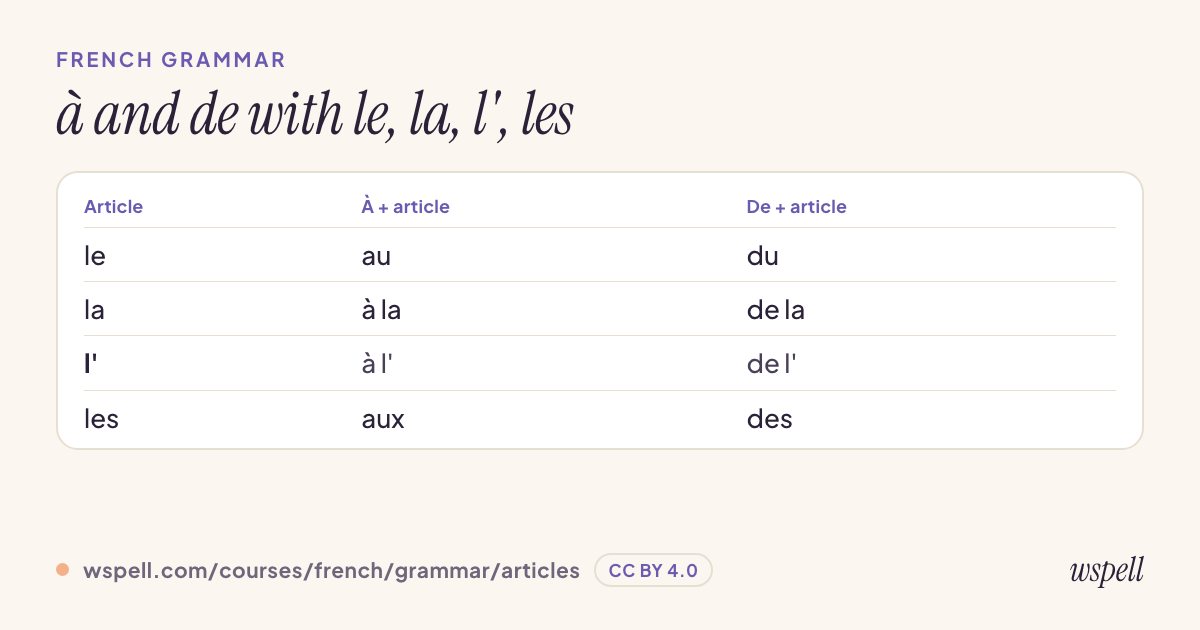
Under the main tables on this page sits a picture of each — keep one on your phone, share it or print it.
Free to share and adapt under CC BY 4.0 — credit wspell and link to this page. the licence
credit line to copy: French articles: definite, indefinite and partitive — wspell, CC BY 4.0, https://wspell.com/courses/french/grammar/articles
questions
What is the difference between du, de la and des?
Du is the partitive before a masculine noun (du pain), de la before a feminine one (de la soupe), de l' before a vowel (de l'eau) and des before a plural (des pommes). They mean 'some', and French cannot leave them out the way English does.
When do you use le and when du?
Le for the thing in general or a particular one: j'aime le café. Du for an unspecified amount of it: je bois du café.
Why is it 'je n'ai pas de pain' and not 'pas du pain'?
After a negative, un, une, des, du and de la all become de (d' before a vowel): j'ai du pain → je n'ai pas de pain. The definite article does not change (je n'aime pas le pain), and neither does an article after être: ce n'est pas un problème.