grammar chart · French
French numbers: 1 to 100 and beyond
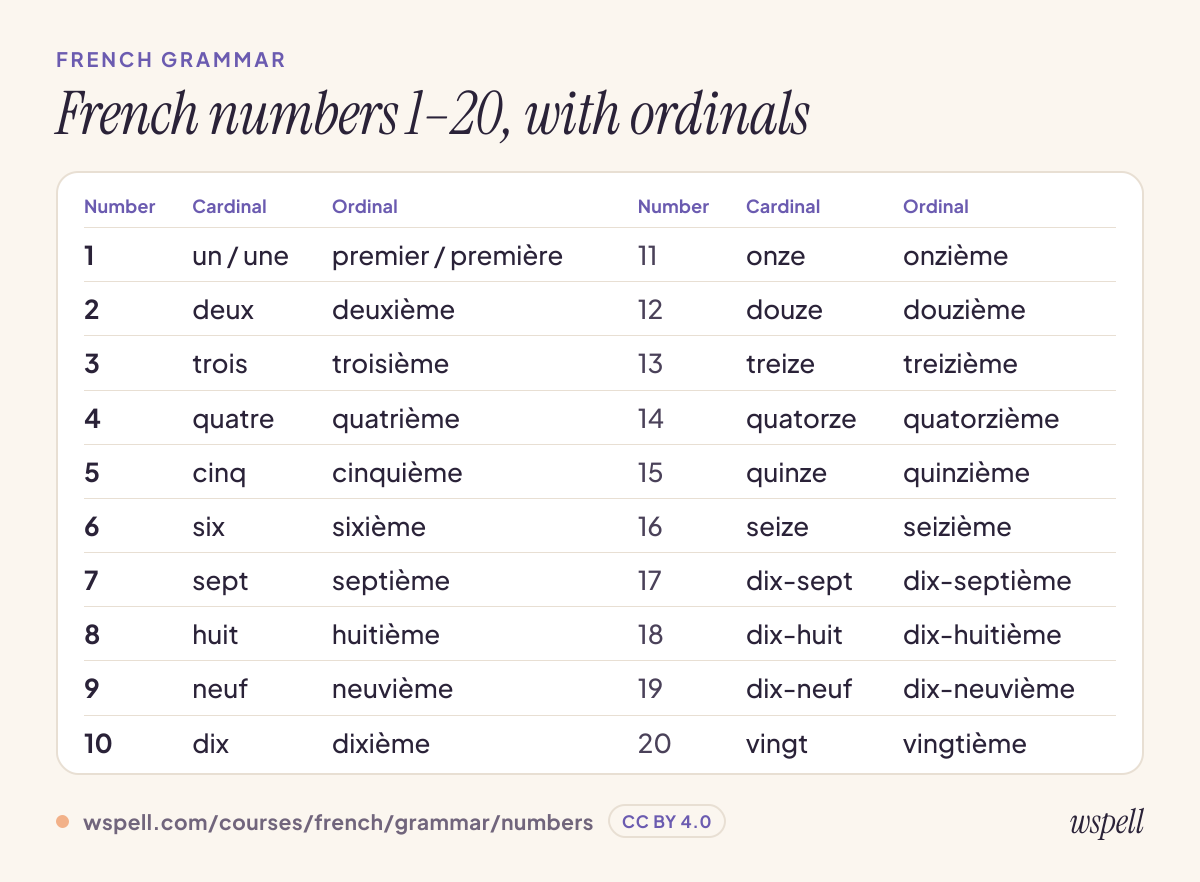
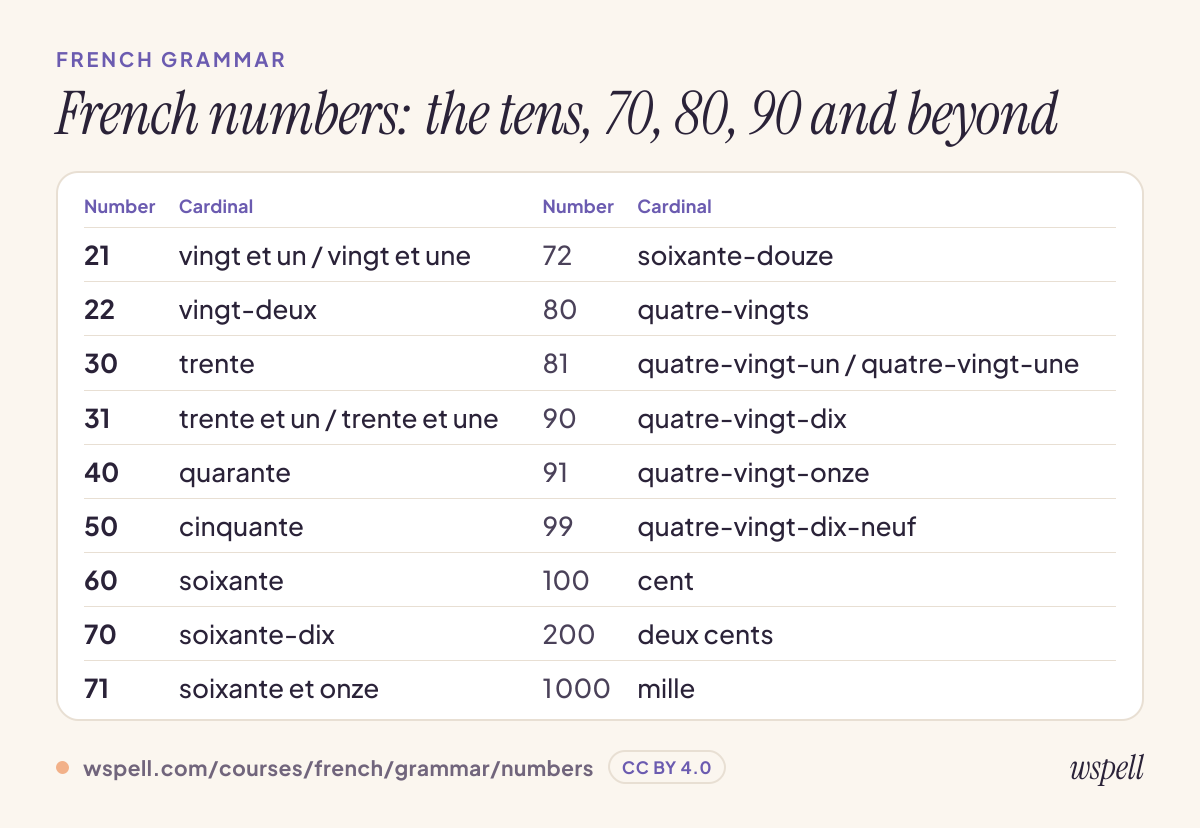
Up to 69 French counts like most languages: the tens vingt, trente, quarante, cinquante, soixante, with the units after them. Then it counts in twenties: 70 is soixante-dix (60 + 10), 80 is quatre-vingts (4 × 20) and 90 is quatre-vingt-dix (80 + 10). The first table gives 1 to 20 with the ordinals, the second the tens and the numbers people get wrong.
1 to 20, with the ordinals
Un and premier agree with a feminine noun: une, première.
| Number | Cardinal | Ordinal | Number | Cardinal | Ordinal |
|---|---|---|---|---|---|
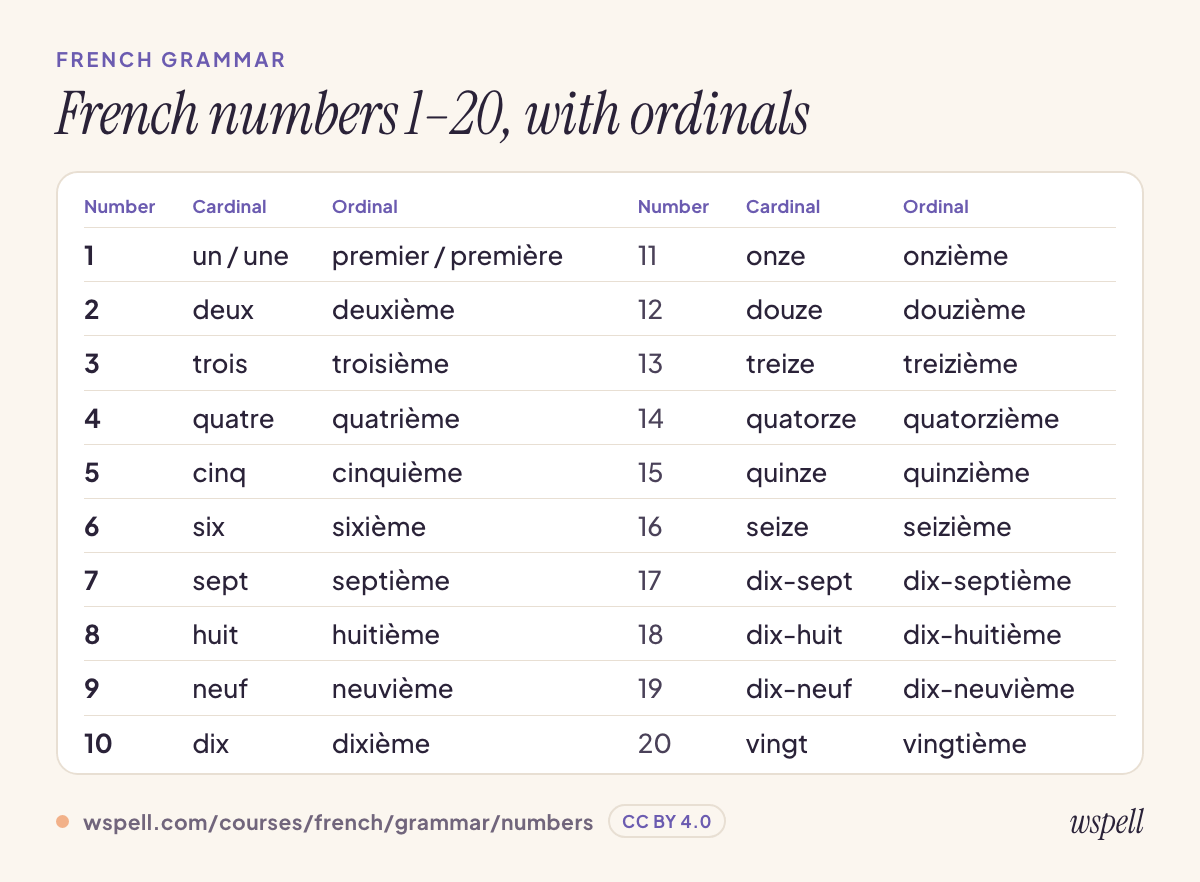
| 1 | un / une | premier / première | 11 | onze | onzième |
| 2 | deux | deuxième | 12 | douze | douzième |
| 3 | trois | troisième | 13 | treize | treizième |
| 4 | quatre | quatrième | 14 | quatorze | quatorzième |
| 5 | cinq | cinquième | 15 | quinze | quinzième |
| 6 | six | sixième | 16 | seize | seizième |
| 7 | sept | septième | 17 | dix-sept | dix-septième |
| 8 | huit | huitième | 18 | dix-huit | dix-huitième |
| 9 | neuf | neuvième | 19 | dix-neuf | dix-neuvième |
| 10 | dix | dixième | 20 | vingt | vingtième |
The tens, from 21 to 1000
| Number | Cardinal | Number | Cardinal |
|---|---|---|---|
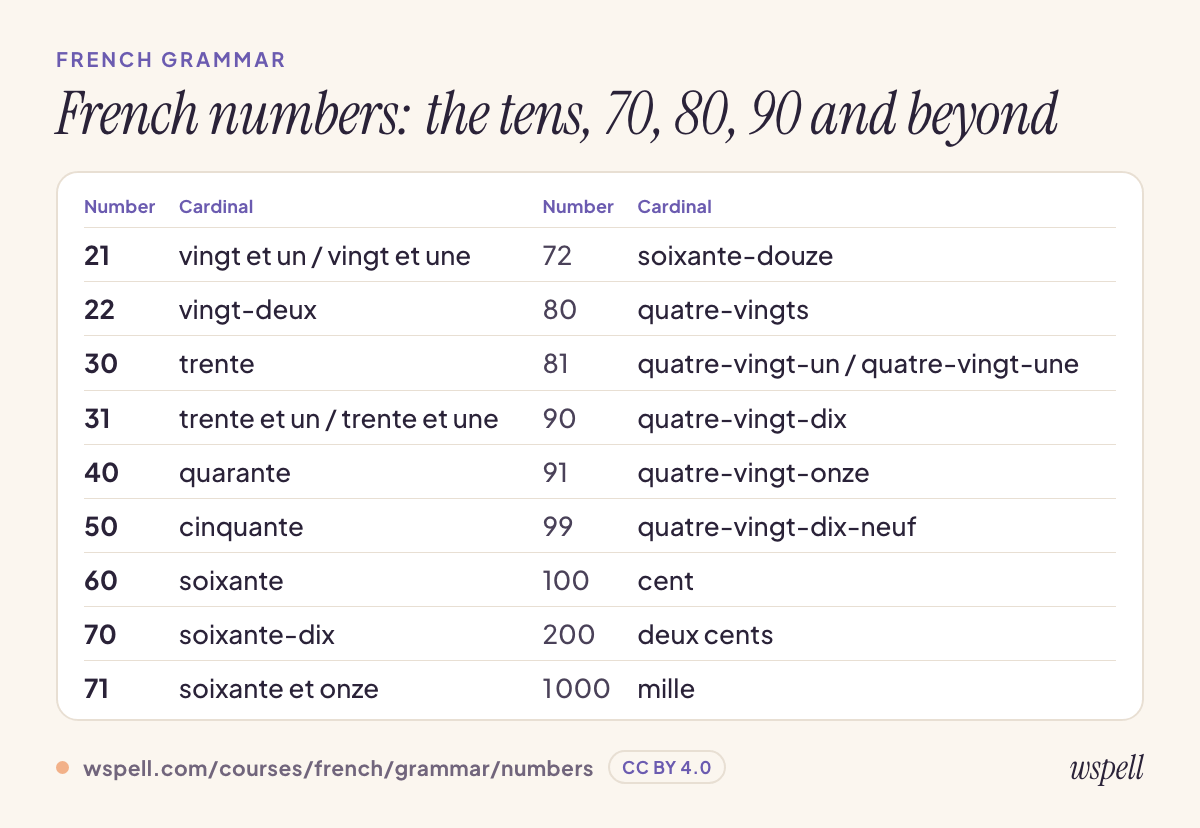
| 21 | vingt et un / vingt et une | 72 | soixante-douze |
| 22 | vingt-deux | 80 | quatre-vingts |
| 30 | trente | 81 | quatre-vingt-un / quatre-vingt-une |
| 31 | trente et un / trente et une | 90 | quatre-vingt-dix |
| 40 | quarante | 91 | quatre-vingt-onze |
| 50 | cinquante | 99 | quatre-vingt-dix-neuf |
| 60 | soixante | 100 | cent |
| 70 | soixante-dix | 200 | deux cents |
| 71 | soixante et onze | 1 000 | mille |
vingt et un — but quatre-vingt-un
The unit un is joined to the ten with et and NO hyphen in vingt et un, trente et un, quarante et un, cinquante et un, soixante et un, soixante et onze. But 81 and 91 have no et: quatre-vingt-un, quatre-vingt-onze.
- Il a vingt et un ans. — He is twenty-one years old.
- soixante et onze euros — seventy-one euros
70, 80 and 90
70: soixante-dix
Standard French has no single word for seventy: it counts 60 + 10 through 60 + 19, so 70 is soixante-dix, 71 soixante et onze, 79 soixante-dix-neuf. Belgian/Swiss French uses septante instead.
- Ma grand-mère a soixante-quinze ans. — My grandmother is seventy-five years old.
80: quatre-vingts
Eighty is 4 × 20 = quatre-vingts, which takes a final -s only when it ends the number; before a following unit the -s is dropped: quatre-vingts but quatre-vingt-un, quatre-vingt-trois. Belgian French also says quatre-vingts; huitante is used only in parts of Switzerland (Vaud, Valais, Fribourg), and octante is obsolete.
- Il a quatre-vingts ans. — He is eighty years old.
- quatre-vingt-deux pages — eighty-two pages
90: quatre-vingt-dix
Ninety continues the vigesimal count: quatre-vingt-dix (80 + 10) through quatre-vingt-dix-neuf (80 + 19); note quatre-vingt-onze for 91. Belgian/Swiss French uses nonante.
- quatre-vingt-dix-sept — ninety-seven
Ordinals: premier, deuxième
premier, première
First is premier (m.) / première (f.), agreeing in gender and number (les premiers, les premières). It is the only ordinal with no -ième form; 2nd can be deuxième or second.
- C'est la première fois. — It's the first time.
-ième: deuxième, cinquième, neuvième
Most ordinals add -ième to the cardinal, dropping a final -e first: quatre → quatrième, onze → onzième. Two spelling quirks: cinq → cinquième (add u) and neuf → neuvième (f → v).
- au cinquième étage — on the fifth floor
- la neuvième symphonie — the ninth symphony
Age, dates and the time
J'ai vingt ans: age with avoir
French states age with avoir, not être: j'ai vingt ans (lit. I have twenty years). Ans is never omitted, and asking is Quel âge as-tu ? / avez-vous ?
- Elle a trente-deux ans. — She is thirty-two years old.
Dates: le 14 juillet, le premier mai
Days of the month use a plain cardinal, not an ordinal: le 3 mars, le 21 juin. The one exception is the first, which is ordinal: le premier mai (le 1er mai). No preposition before the month.
- Mon anniversaire est le quatorze juillet. — My birthday is July 14th.
- le premier janvier — January 1st
Telling the time: il est huit heures et quart
The clock uses il est + number + heure(s): il est une heure, il est deux heures. Minutes follow directly (deux heures dix); use et quart (:15), et demie (:30), moins le quart (:45), and moins for the last minutes (trois heures moins dix).
- Il est huit heures et quart. — It's a quarter past eight.
- Il est midi et demi. — It's half past twelve (noon).
learn it step by step
save or print this chart
Under the main tables on this page sits a picture of each — keep one on your phone, share it or print it.
Free to share and adapt under CC BY 4.0 — credit wspell and link to this page. the licence
credit line to copy: French numbers: 1 to 100 and beyond — wspell, CC BY 4.0, https://wspell.com/courses/french/grammar/numbers
questions
How do you say 70, 80 and 90 in French?
Soixante-dix (60 + 10), quatre-vingts (4 × 20) and quatre-vingt-dix (4 × 20 + 10). In Belgium and Switzerland you will also hear septante (70) and nonante (90).
When does French use 'et' in numbers?
In 21, 31, 41, 51, 61 and 71: vingt et un, trente et un, soixante et onze. Not in 81 and 91: quatre-vingt-un, quatre-vingt-onze.
Does quatre-vingts always have an s?
Only when it ends the number: quatre-vingts ans, but quatre-vingt-deux. Cent works the same way: deux cents, but deux cent trois.