grammar chart · French
The French present tense: regular and irregular verbs
The French present tense (présent) covers both 'I speak' and 'I am speaking'. A regular verb drops its infinitive ending and adds the endings of its group: parler → je parle, finir → nous finissons, vendre → ils vendent. The tables show the three groups side by side with partir, the verbs with a spelling change, the irregular verbs you need from the first day, reflexive verbs, and the imperative, which is built from the present.
The -er, -ir and -re verbs
partir is an -ir verb without -iss-: it drops the t of its stem in the singular (je pars) and keeps it in the plural (nous partons).
| Person | parler to speak | finir to finish | partir to leave | vendre to sell |
|---|---|---|---|---|
| je | parle | finis | pars | vends |
| tu | parles | finis | pars | vends |
| il / elle / on | parle | finit | part | vend |
| nous | parlons | finissons | partons | vendons |
| vous | parlez | finissez | partez | vendez |
| ils / elles | parlent | finissent | partent | vendent |
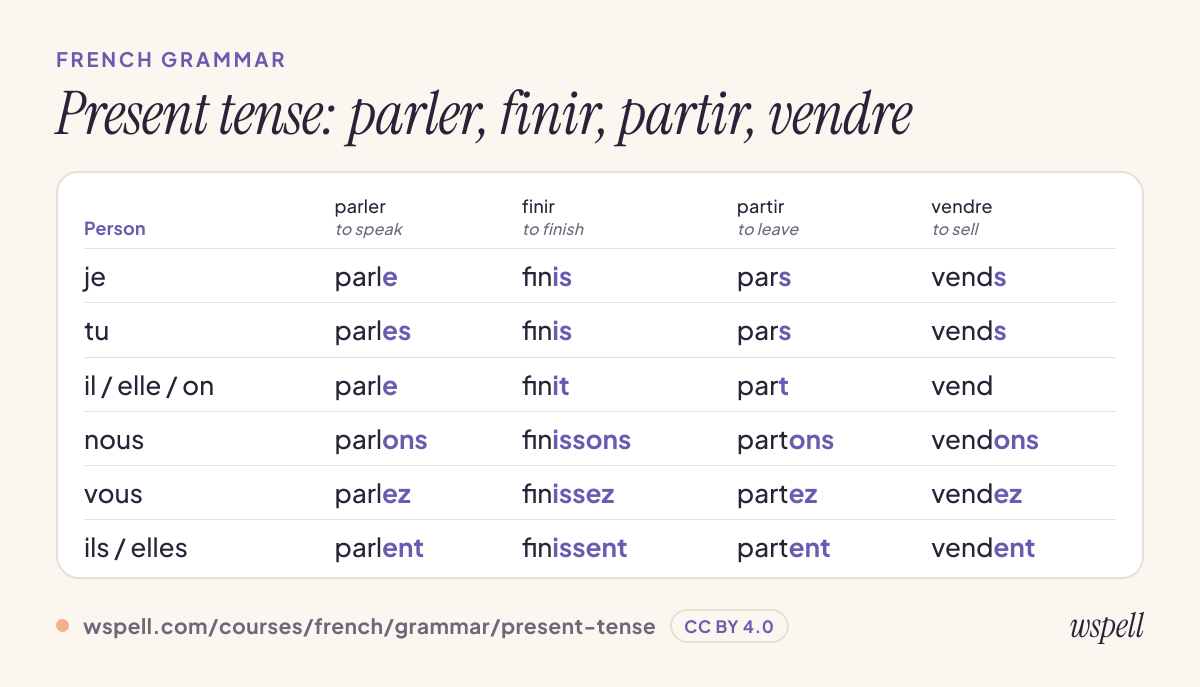
-ir verbs like finir: -iss- in the plural
The -iss- group: stem + -is, -is, -it, -issons, -issez, -issent. The -iss- infix appears throughout the plural and marks this class off from short -ir verbs like partir/dormir.
- je finis, tu finis, il finit, nous finissons, vous finissez, ils finissent — to finish — present
partir, dormir, sortir: -ir verbs without -iss-
A second -ir class with NO -iss-: the singular drops the final stem consonant (pars, dors, sors), the plural restores it (partons, dormons). Includes partir, sortir, dormir, mentir, sentir, servir.
- je pars, tu pars, il part, nous partons, vous partez, ils partent — to leave — present
Spelling changes: nous mangeons, je lève
| Person | manger to eat | lever to raise |
|---|---|---|
| je | mange | lève |
| tu | manges | lèves |
| il / elle / on | mange | lève |
| nous | mangeons | levons |
| vous | mangez | levez |
| ils / elles | mangent | lèvent |
nous mangeons, j'achète: spelling changes
Regular endings, adjusted stems: -cer → ç and -ger → ge before -ons keep the sound (commençons, mangeons); elsewhere the stem changes before a silent ending, and its sound with it — a mute e (or é) becomes è (achète, lève, préfère) or the consonant doubles (appelle, jette); -oyer and -uyer change y → i (emploie, essuie), and -ayer verbs may do so (paie or paye).
- Nous mangeons et nous commençons à travailler. — We are eating and starting to work.
- J'achète du pain. — I buy some bread.
Être, avoir, aller and faire
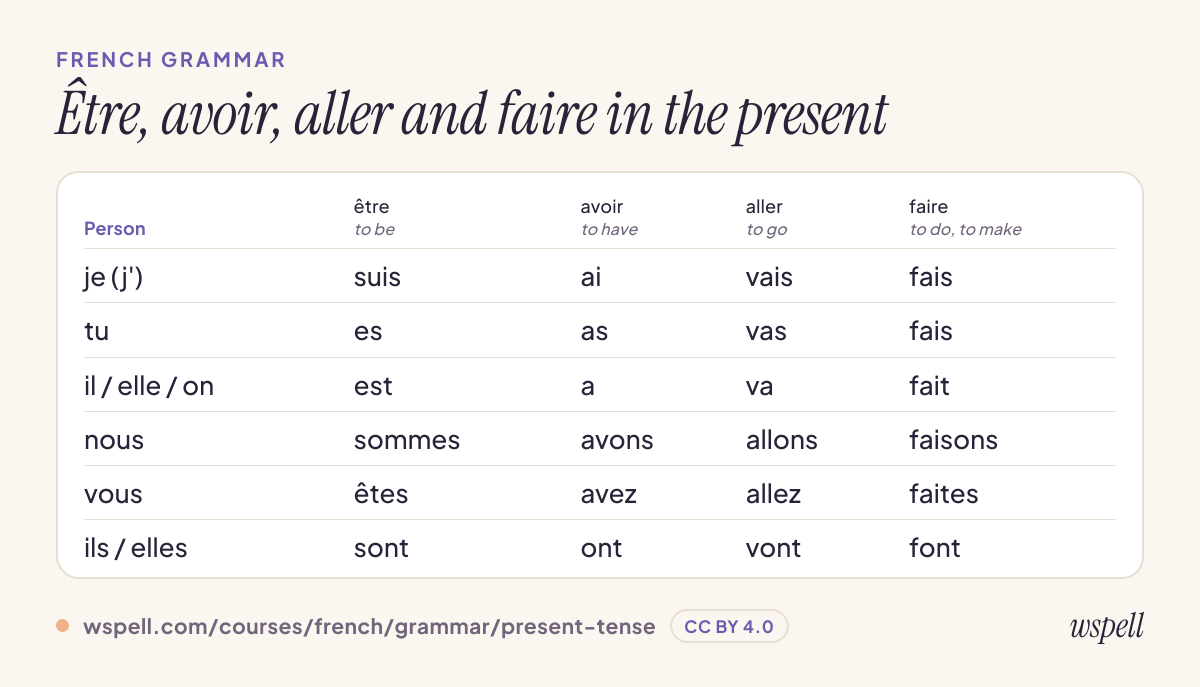
| Person | être to be | avoir to have | aller to go | faire to do, to make |
|---|---|---|---|---|
| je (j') | suis | ai | vais | fais |
| tu | es | as | vas | fais |
| il / elle / on | est | a | va | fait |
| nous | sommes | avons | allons | faisons |
| vous | êtes | avez | allez | faites |
| ils / elles | sont | ont | vont | font |
Reflexive verbs: se lever
| Person | Present présent | Compound past passé composé | Imperative impératif |
|---|---|---|---|
| je | me lève | me suis levé(e) | — |
| tu | te lèves | t'es levé(e) | lève-toi |
| il / elle / on | se lève | s'est levé(e) | — |
| nous | nous levons | nous sommes levé(e)s | levons-nous |
| vous | vous levez | vous êtes levé(e)(s) | levez-vous |
| ils / elles | se lèvent | se sont levé(e)s | — |
Reflexive verbs: me, te, se before the verb
A reflexive pronoun (me, te, se, nous, vous, se) agrees with the subject and sits before the verb. Reflexive (se laver = wash oneself), reciprocal (se parler = talk to each other), or inherently pronominal (se souvenir, s'en aller).
- Je me lève à sept heures. — I get up at seven.
- Ils se parlent tous les jours. — They talk to each other every day.
Negation: je ne parle pas
| Negation | Meaning |
|---|---|
| ne … pas | not |
| ne … jamais | never |
| ne … plus | no longer |
| ne … rien | nothing |
| ne … personne | nobody |
| ne … que | only |
ne … pas goes around the verb
Basic negation places ne before the conjugated verb and pas after it: je ne comprends pas. Before a vowel or mute h, ne elides to n': il n'est pas là. In the passé composé the wrap is around the auxiliary: je n'ai pas mangé.
- Je ne parle pas anglais. — I don't speak English.
- Elle n'a pas compris. — She didn't understand.
pas de: du, de la and un become de
After a negation, the partitive and indefinite articles (du, de la, des, un, une) collapse to plain de/d': j'ai du pain → je n'ai pas de pain. être is the exception (ce n'est pas un chat keeps un).
- Je n'ai pas d'argent. — I have no money.
- Il ne mange pas de viande. — He doesn't eat meat.
The imperative: parle !, finissons !, allez !
| Person | parler to speak | finir to finish | vendre to sell | aller to go |
|---|---|---|---|---|
| tu | parle | finis | vends | va |
| nous | parlons | finissons | vendons | allons |
| vous | parlez | finissez | vendez | allez |
| Verb | tu | nous | vous |
|---|---|---|---|
| être | sois | soyons | soyez |
| avoir | aie | ayons | ayez |
| savoir | sache | sachons | sachez |
| vouloir | veuille | — | veuillez |
The imperative: tu, nous, vous without the pronoun
Formed from the present without the subject pronoun for tu, nous, vous. -er verbs drop the -s of tu (parle!, mange!). Object pronouns follow and hyphenate in the affirmative (donne-moi), precede in the negative (ne me donne pas).
- Parle plus fort ! Écoutez-moi ! — Speak louder! Listen to me!
- Ne mange pas ça. — Don't eat that.
Present + depuis: for how long
depuis + present: j'habite ici depuis trois ans
For an action begun in the past and still continuing, French uses the PRESENT with depuis (since/for), where English uses the perfect. In a past-continuing frame the imparfait replaces it.
- J'habite ici depuis trois ans. — I have lived here for three years.
learn it step by step
save or print this chart
Under the main tables on this page sits a picture of each — keep one on your phone, share it or print it.
Free to share and adapt under CC BY 4.0 — credit wspell and link to this page. the licence
credit line to copy: The French present tense: regular and irregular verbs — wspell, CC BY 4.0, https://wspell.com/courses/french/grammar/present-tense
questions
What are the present tense endings of -er verbs?
-e, -es, -e, -ons, -ez, -ent: je parle, tu parles, il parle, nous parlons, vous parlez, ils parlent. Je parle, tu parles, il parle and ils parlent all sound the same.
What is the difference between finir and partir in the present?
Finir adds -iss- in the plural (nous finissons, ils finissent). Partir does not; instead it drops the t of its stem with je and tu — je pars, tu pars (the t of il part is its ending) — and keeps it in the plural: nous partons.
Does French have a present continuous?
Not as a separate tense: je parle means both 'I speak' and 'I am speaking'. To stress that something is in progress right now, French says être en train de: je suis en train de manger.