cheat sheet · French
French grammar cheat sheet: the essentials on one page
What a beginner looks up most, on one page: the endings of the main tenses, four of the most-used verbs, the passé composé, the articles, the personal pronouns, negation, the prepositions for cities and countries, and the numbers to twenty. Print it or save the pictures.
Verb endings in the main tenses
Each column is a tense; the three present-tense columns are the regular -er verbs, the -ir verbs with -iss- and the -re verbs like vendre. Under each ending is the form of parler, finir or vendre that has it.
| Person | Present -er parler | Present -ir (-iss-) finir | Present -re vendre | Imparfait parler | Future parler | Conditional parler | Subjunctive parler |
|---|---|---|---|---|---|---|---|
| je | -e parle | -is finis | -s vends | -ais parlais | -ai parlerai | -ais parlerais | -e parle |
| tu | -es parles | -is finis | -s vends | -ais parlais | -as parleras | -ais parlerais | -es parles |
| il / elle / on | -e parle | -it finit | no ending vend | -ait parlait | -a parlera | -ait parlerait | -e parle |
| nous | -ons parlons | -issons finissons | -ons vendons | -ions parlions | -ons parlerons | -ions parlerions | -ions parlions |
| vous | -ez parlez | -issez finissez | -ez vendez | -iez parliez | -ez parlerez | -iez parleriez | -iez parliez |
| ils / elles | -ent parlent | -issent finissent | -ent vendent | -aient parlaient | -ont parleront | -aient parleraient | -ent parlent |
Être, avoir, aller and faire
| Person | être to be | avoir to have | aller to go | faire to do, to make |
|---|---|---|---|---|
| je (j') | suis | ai | vais | fais |
| tu | es | as | vas | fais |
| il / elle / on | est | a | va | fait |
| nous | sommes | avons | allons | faisons |
| vous | êtes | avez | allez | faites |
| ils / elles | sont | ont | vont | font |
The passé composé: avoir or être + participle
(e) and (e)s show the agreement with a feminine or a plural subject after être; (e)(s) is vous, which can be one person or several.
| Person | parler to speak | finir to finish | vendre to sell | aller to go |
|---|---|---|---|---|
| je (j') | ai parlé | ai fini | ai vendu | suis allé(e) |
| tu | as parlé | as fini | as vendu | es allé(e) |
| il / elle / on | a parlé | a fini | a vendu | est allé(e) |
| nous | avons parlé | avons fini | avons vendu | sommes allé(e)s |
| vous | avez parlé | avez fini | avez vendu | êtes allé(e)(s) |
| ils / elles | ont parlé | ont fini | ont vendu | sont allé(e)s |
Articles: le, la, les, un, une, du
| Definite (the) | Indefinite (a, some) | Partitive (some) | |
|---|---|---|---|
| Masculine singular | le | un | du |
| Feminine singular | la | une | de la |
| Before a vowel or mute h | l' | un / une | de l' |
| Plural | les | des | des |
Personal pronouns
| Subject | Direct object | Indirect object | Reflexive | Stressed |
|---|---|---|---|---|
| je (j') | me (m') | me (m') | me (m') | moi |
| tu | te (t') | te (t') | te (t') | toi |
| il | le (l') | lui | se (s') | lui |
| elle | la (l') | lui | se (s') | elle |
| nous | nous | nous | nous | nous |
| vous | vous | vous | vous | vous |
| ils | les | leur | se (s') | eux |
| elles | les | leur | se (s') | elles |
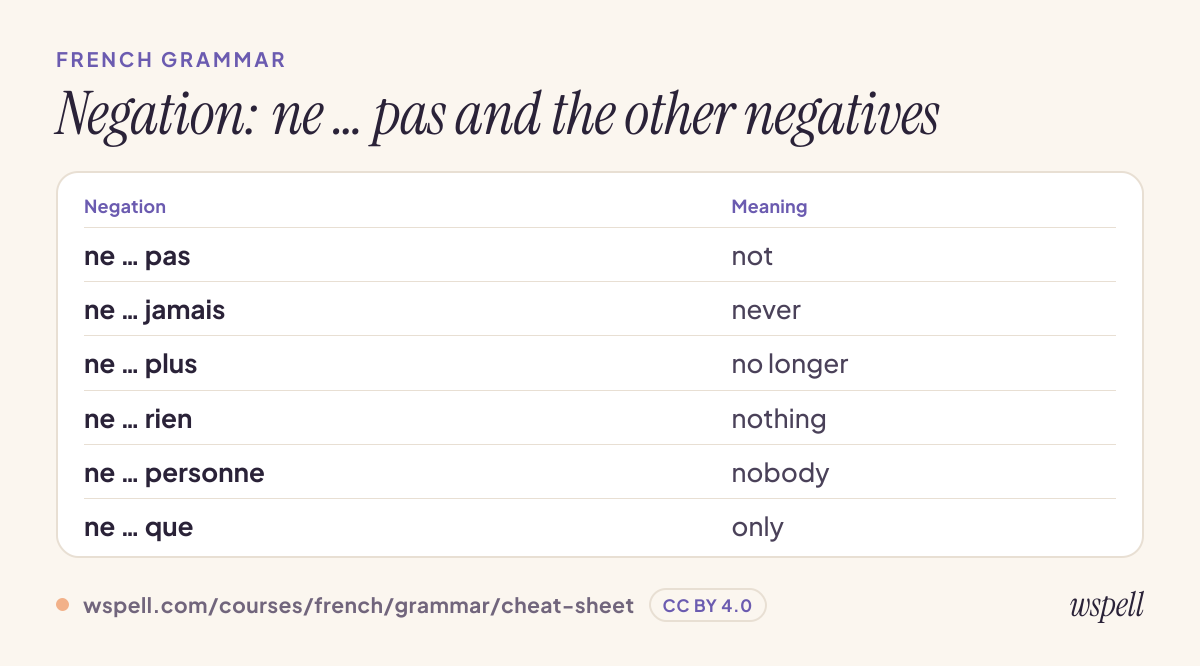
Negation: ne … pas and the others
| Negation | Meaning |
|---|---|
| ne … pas | not |
| ne … jamais | never |
| ne … plus | no longer |
| ne … rien | nothing |
| ne … personne | nobody |
| ne … que | only |
Cities and countries: à, en, au, aux
Numbers 1–20
| Number | Cardinal | Ordinal | Number | Cardinal | Ordinal |
|---|---|---|---|---|---|
| 1 | un / une | premier / première | 11 | onze | onzième |
| 2 | deux | deuxième | 12 | douze | douzième |
| 3 | trois | troisième | 13 | treize | treizième |
| 4 | quatre | quatrième | 14 | quatorze | quatorzième |
| 5 | cinq | cinquième | 15 | quinze | quinzième |
| 6 | six | sixième | 16 | seize | seizième |
| 7 | sept | septième | 17 | dix-sept | dix-septième |
| 8 | huit | huitième | 18 | dix-huit | dix-huitième |
| 9 | neuf | neuvième | 19 | dix-neuf | dix-neuvième |
| 10 | dix | dixième | 20 | vingt | vingtième |
learn it step by step
save or print this chart
Under the main tables on this page sits a picture of each — keep one on your phone, share it or print it.
Free to share and adapt under CC BY 4.0 — credit wspell and link to this page. the licence
credit line to copy: French grammar cheat sheet: the essentials on one page — wspell, CC BY 4.0, https://wspell.com/courses/french/grammar/cheat-sheet
questions
Can I print this French grammar cheat sheet?
Yes. Print the page, or download the chart pictures — they are free to share and adapt under CC BY 4.0, with a credit and a link to wspell.
Which French tenses should a beginner learn first?
The present first, then the passé composé for finished past events and the futur proche (je vais + infinitive) for plans. The imparfait follows for descriptions and habits in the past; the conditional and the subjunctive come after them.
How many verb groups does French have?
Three, by tradition: regular -er verbs like parler, by far the largest group; regular -ir verbs like finir, which add -iss- in the plural; and a third group of everything else — -re verbs like vendre, -ir verbs like partir and irregular verbs such as aller and faire. Être and avoir, the two auxiliaries, are usually learned apart from the groups.