grammar chart · French
Être and avoir: conjugation in the main tenses
Être and avoir are the two verbs to learn first. Both are irregular — in the present, the future and the subjunctive alike — and they are the auxiliaries of every compound tense: j'ai parlé, je suis allé(e). Each table gives one of them in all the main tenses, person by person.
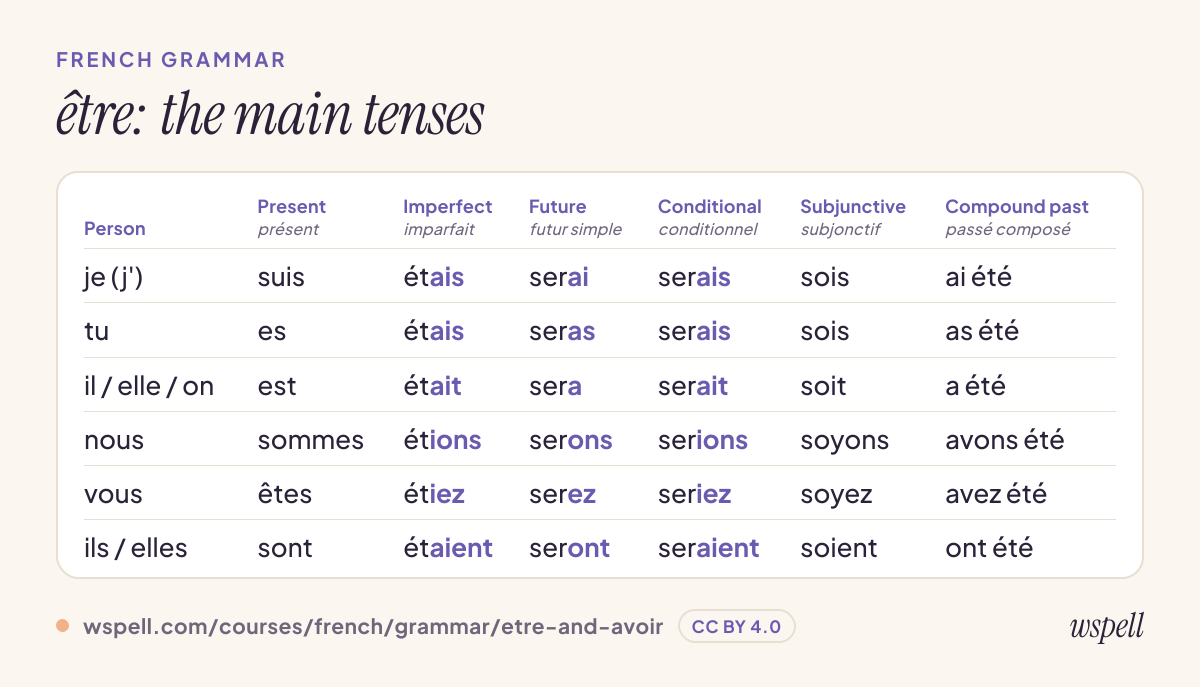
être (to be)
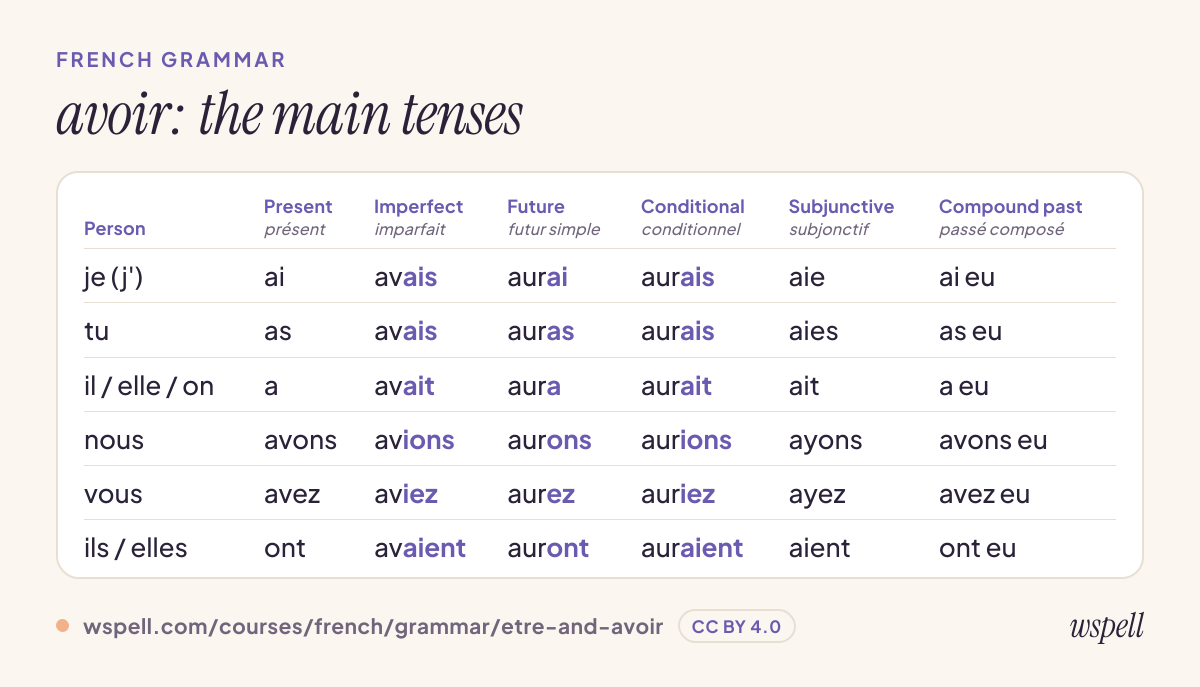
| Person | Present présent | Imperfect imparfait | Future futur simple | Conditional conditionnel | Subjunctive subjonctif | Compound past passé composé |
|---|---|---|---|---|---|---|
| je (j') | suis | étais | serai | serais | sois | ai été |
| tu | es | étais | seras | serais | sois | as été |
| il / elle / on | est | était | sera | serait | soit | a été |
| nous | sommes | étions | serons | serions | soyons | avons été |
| vous | êtes | étiez | serez | seriez | soyez | avez été |
| ils / elles | sont | étaient | seront | seraient | soient | ont été |
avoir (to have)
| Person | Present présent | Imperfect imparfait | Future futur simple | Conditional conditionnel | Subjunctive subjonctif | Compound past passé composé |
|---|---|---|---|---|---|---|
| je (j') | ai | avais | aurai | aurais | aie | ai eu |
| tu | as | avais | auras | aurais | aies | as eu |
| il / elle / on | a | avait | aura | aurait | ait | a eu |
| nous | avons | avions | aurons | aurions | ayons | avons eu |
| vous | avez | aviez | aurez | auriez | ayez | avez eu |
| ils / elles | ont | avaient | auront | auraient | aient | ont eu |
The imperative: sois, aie
Être, avoir, savoir and vouloir build their imperative on the subjunctive stem.
| Verb | tu | nous | vous |
|---|---|---|---|
| être | sois | soyons | soyez |
| avoir | aie | ayons | ayez |
| savoir | sache | sachons | sachez |
| vouloir | veuille | — | veuillez |
The present: the forms to know by heart
Être and avoir: the two verbs to learn first
être (suis, es, est, sommes, êtes, sont) and avoir (ai, as, a, avons, avez, ont) must be memorized first — they are the auxiliaries for every compound tense.
- Je suis fatigué et j'ai faim. — I am tired and I am hungry.
Avoir or être in the passé composé?
Passé composé with avoir
The main spoken past: present of avoir + past participle. Regular participles end -é (-er), -i (-ir), -u (-re). Most verbs take avoir.
- J'ai mangé une pomme. — I ate/have eaten an apple.
- Nous avons fini le travail. — We finished the work.
Passé composé with être: verbs of movement
A closed set of intransitive verbs of motion and change of state takes être, not avoir: aller, venir, entrer, sortir, monter, descendre, arriver, partir, rester, tomber, naître, mourir, devenir, retourner and their compounds (the 'DR & MRS VANDERTRAMP' list).
- Elle est arrivée à midi. — She arrived at noon.
- Ils sont partis très tôt. — They left very early.
Age with avoir, and c'est or il est
J'ai vingt ans: age with avoir
French states age with avoir, not être: j'ai vingt ans (lit. I have twenty years). Ans is never omitted, and asking is Quel âge as-tu ? / avez-vous ?
- Elle a trente-deux ans. — She is thirty-two years old.
C'est or il est?
Use il/elle est + bare noun of profession or adjective referring to a specific person: il est médecin, elle est gentille. Use c'est + article/determiner + noun, or c'est + adjective referring to a general idea: c'est un médecin, c'est difficile, c'est vrai.
- Il est professeur. C'est un bon professeur. — He is a teacher. He's a good teacher.
- Apprendre le français, c'est utile. — Learning French is useful.
learn it step by step
save or print this chart
Under the main tables on this page sits a picture of each — keep one on your phone, share it or print it.
Free to share and adapt under CC BY 4.0 — credit wspell and link to this page. the licence
credit line to copy: Être and avoir: conjugation in the main tenses — wspell, CC BY 4.0, https://wspell.com/courses/french/grammar/etre-and-avoir
questions
What is the passé composé of être?
J'ai été, tu as été, il a été, nous avons été, vous avez été, ils ont été: être forms its own compound tenses with avoir.
Is it 'je suis faim' or 'j'ai faim'?
J'ai faim. French uses avoir where English says 'to be' in several set phrases: avoir faim (to be hungry), avoir soif (thirsty), avoir froid (cold), and avoir … ans for age: j'ai vingt ans.
Which verbs take être in the passé composé?
A small group of verbs of movement and change of state — aller, venir, partir, arriver, entrer, sortir, monter, descendre, rester, tomber, naître, mourir, devenir, retourner, passer and most of their compounds — and every reflexive verb: je me suis levé(e). All other verbs take avoir.