grammar chart · French
French prepositions: places, cities and countries
To say 'in' or 'to' a place, French looks at what the place is: à for a city (à Paris), en for a feminine country or one that starts with a vowel (en France, en Iran), au for a masculine country (au Japon) and aux for a plural one (aux États-Unis). 'From' follows the same split: de Paris, de France, du Japon, des États-Unis. Below are the everyday prepositions — the first to learn, then the next — each with an example.
Cities and countries: à, en, au, aux
en, au, aux + country
Location/destination for countries follows gender: en + feminine or vowel-initial country (en France, en Iran), au + masculine country (au Japon, au Canada), aux + plural country (aux États-Unis, aux Pays-Bas).
- Elle vit en Espagne. — She lives in Spain.
- Nous allons au Portugal. — We're going to Portugal.
- Il travaille aux Pays-Bas. — He works in the Netherlands.
de, du, des: coming from a country
Origin from a country also follows gender: de + feminine/vowel (de France, d'Italie), du + masculine (du Japon), des + plural (des États-Unis). The location form and the origin form are chosen separately.
- Ce fromage vient de France. — This cheese comes from France.
- Il rentre du Canada. — He's coming back from Canada.
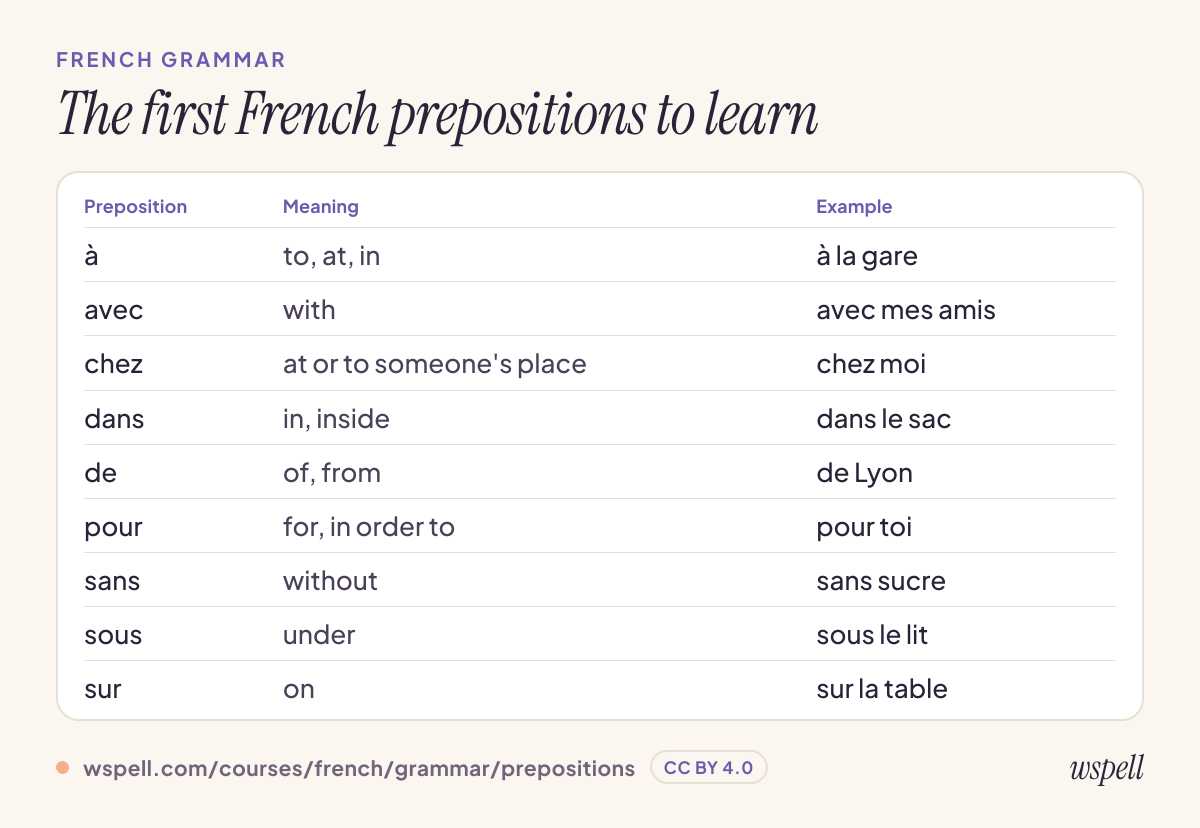
Everyday prepositions: the first to learn, then the next
| Preposition | Meaning | Example |
|---|---|---|
| à | to, at, in | à la gare |
| avec | with | avec mes amis |
| chez | at or to someone's place | chez moi |
| dans | in, inside | dans le sac |
| de | of, from | de Lyon |
| pour | for, in order to | pour toi |
| sans | without | sans sucre |
| sous | under | sous le lit |
| sur | on | sur la table |
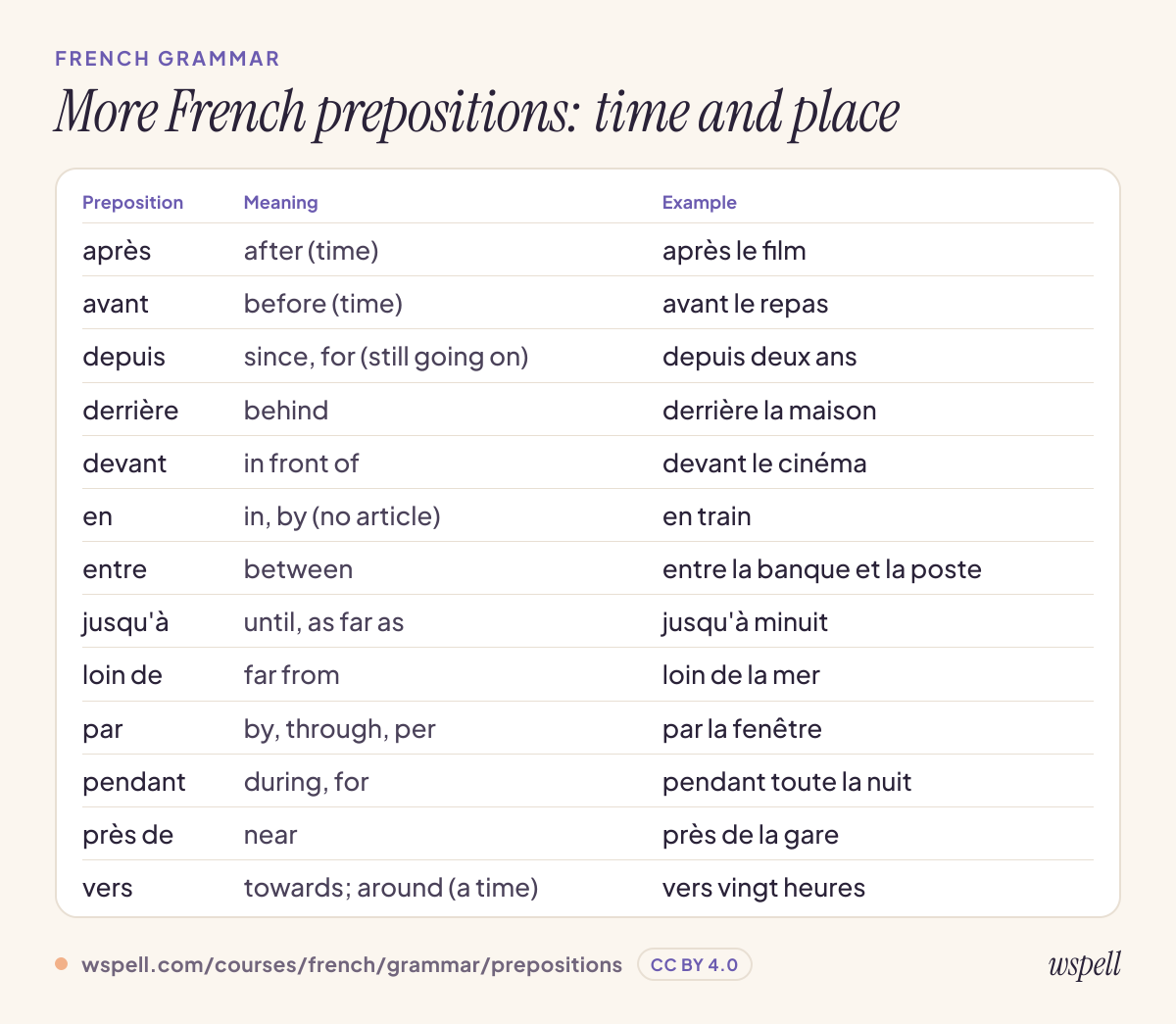
| Preposition | Meaning | Example |
|---|---|---|
| après | after (time) | après le film |
| avant | before (time) | avant le repas |
| depuis | since, for (still going on) | depuis deux ans |
| derrière | behind | derrière la maison |
| devant | in front of | devant le cinéma |
| en | in, by (no article) | en train |
| entre | between | entre la banque et la poste |
| jusqu'à | until, as far as | jusqu'à minuit |
| loin de | far from | loin de la mer |
| par | by, through, per | par la fenêtre |
| pendant | during, for | pendant toute la nuit |
| près de | near | près de la gare |
| vers | towards; around (a time) | vers vingt heures |
au, aux, du, des
| Article | À + article | De + article |
|---|---|---|
| le | au | du |
| la | à la | de la |
| l' | à l' | de l' |
| les | aux | des |
en voiture or à pied?
à pied, à vélo — en voiture, en train
Use à when you are ON or astride the vehicle (à pied, à vélo, à cheval, à moto); use en when you get INSIDE it (en voiture, en bus, en train, en avion, en bateau).
- Je vais au travail à vélo. — I go to work by bike.
- Ils sont partis en voiture. — They left by car.
depuis, pendant, il y a — en or dans
depuis, pendant, pour, il y a
depuis = since a point, action still ongoing (depuis 2020); pendant = the completed span (pendant 3 ans); pour = intended future duration (partir pour un mois); il y a = 'ago', a point in the past (il y a trois jours).
- Elle est partie il y a trois jours. — She left three days ago.
- Il part pour une semaine. — He's leaving for a week.
en une heure or dans une heure?
With time, en states how long an action TAKES (je le fais en une heure = it takes me an hour); dans states the delay AFTER which it happens (je le fais dans une heure = an hour from now).
- Je finis le travail en deux heures. — I finish the work in two hours (it takes me two).
- Le train part dans dix minutes. — The train leaves in ten minutes.
learn it step by step
save or print this chart
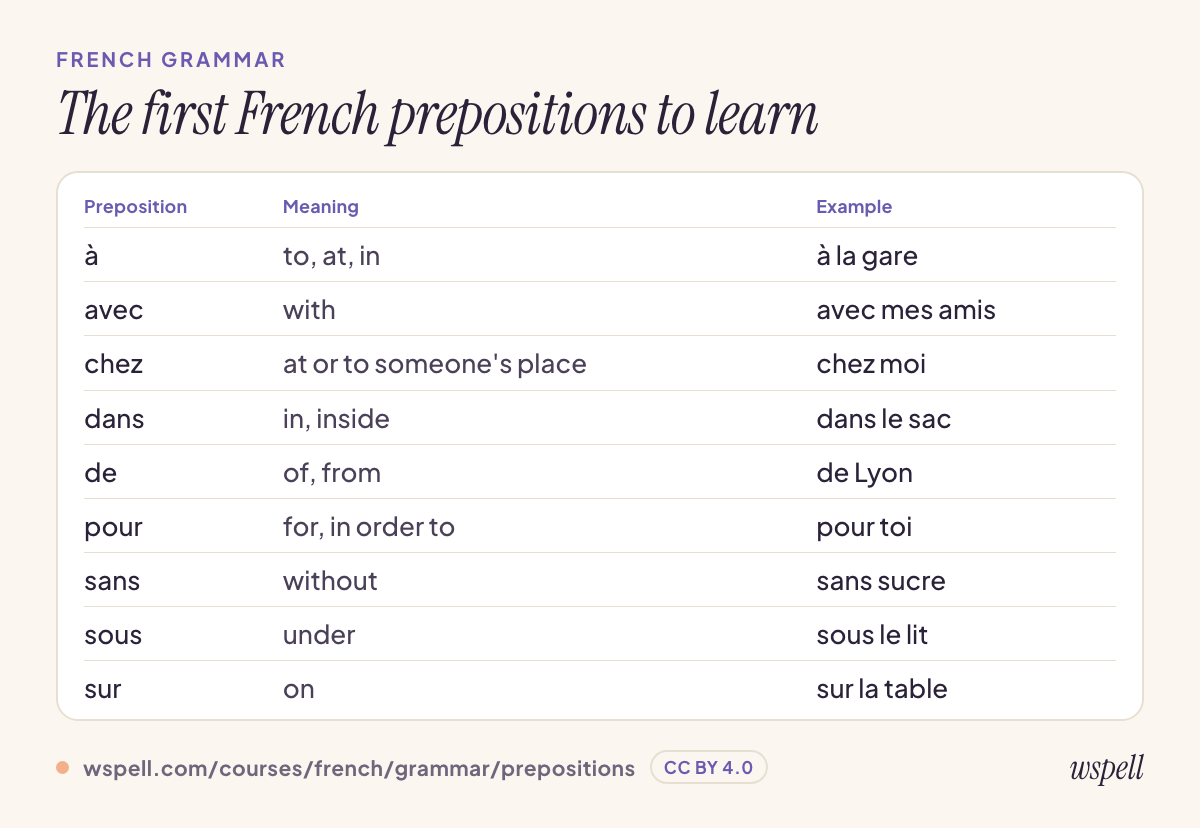
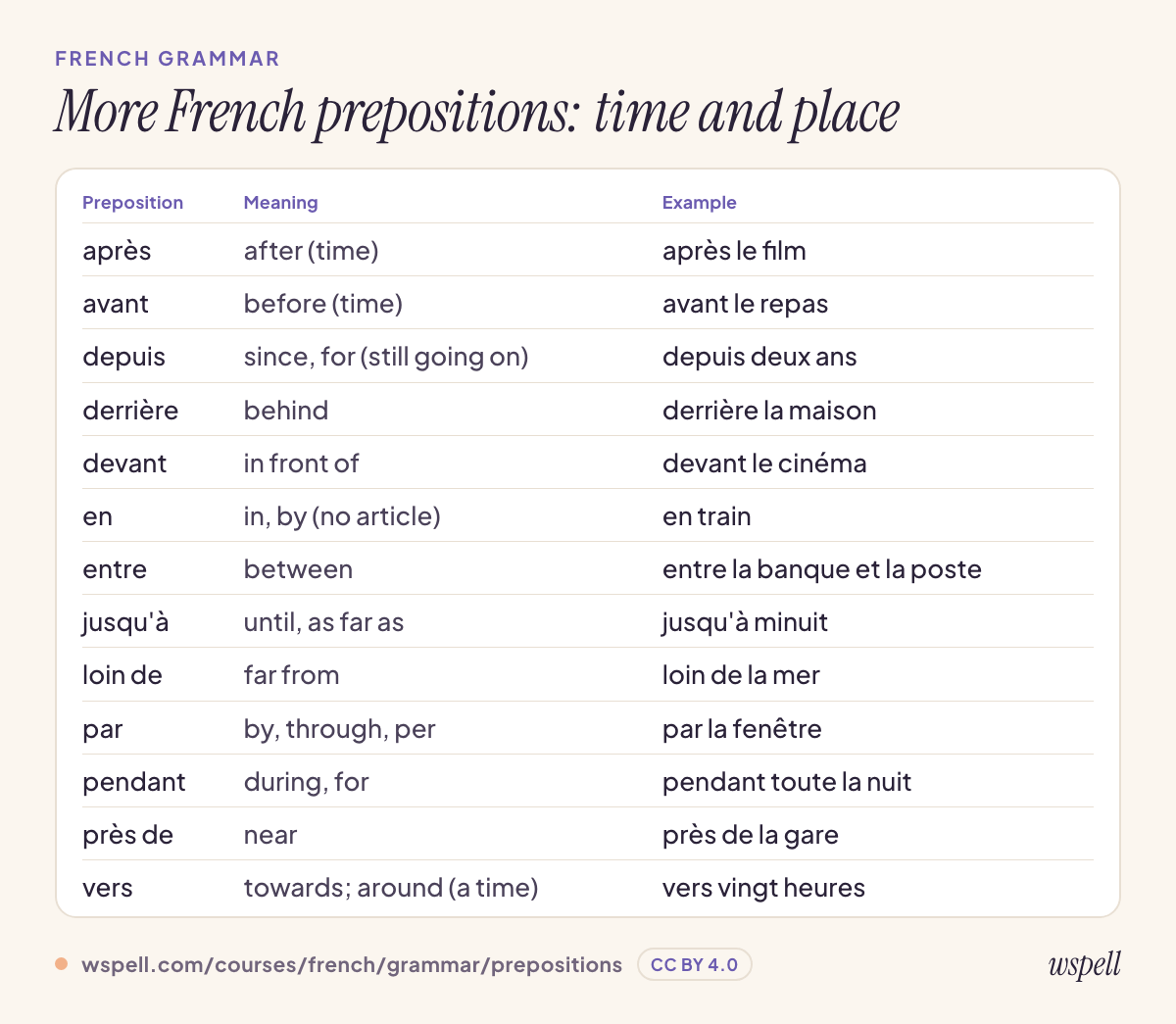
Under the main tables on this page sits a picture of each — keep one on your phone, share it or print it.
Free to share and adapt under CC BY 4.0 — credit wspell and link to this page. the licence
credit line to copy: French prepositions: places, cities and countries — wspell, CC BY 4.0, https://wspell.com/courses/french/grammar/prepositions
questions
Is it 'en France' or 'au France'?
En France: France is feminine, and feminine countries take en. Masculine countries starting with a consonant take au (au Canada, au Japon), plural ones aux (aux États-Unis), and cities à (à Paris).
How do you know if a country is masculine or feminine in French?
Most countries ending in -e are feminine (la France, la Chine, l'Italie) and most others masculine (le Japon, le Canada, le Portugal). A few ending in -e are masculine: le Mexique, le Cambodge, le Mozambique.
What is the difference between en and dans with time?
En says how long something takes: je le fais en une heure. Dans says when it will happen, counting from now: je pars dans une heure.