grammar chart · French
French personal pronouns: the complete chart
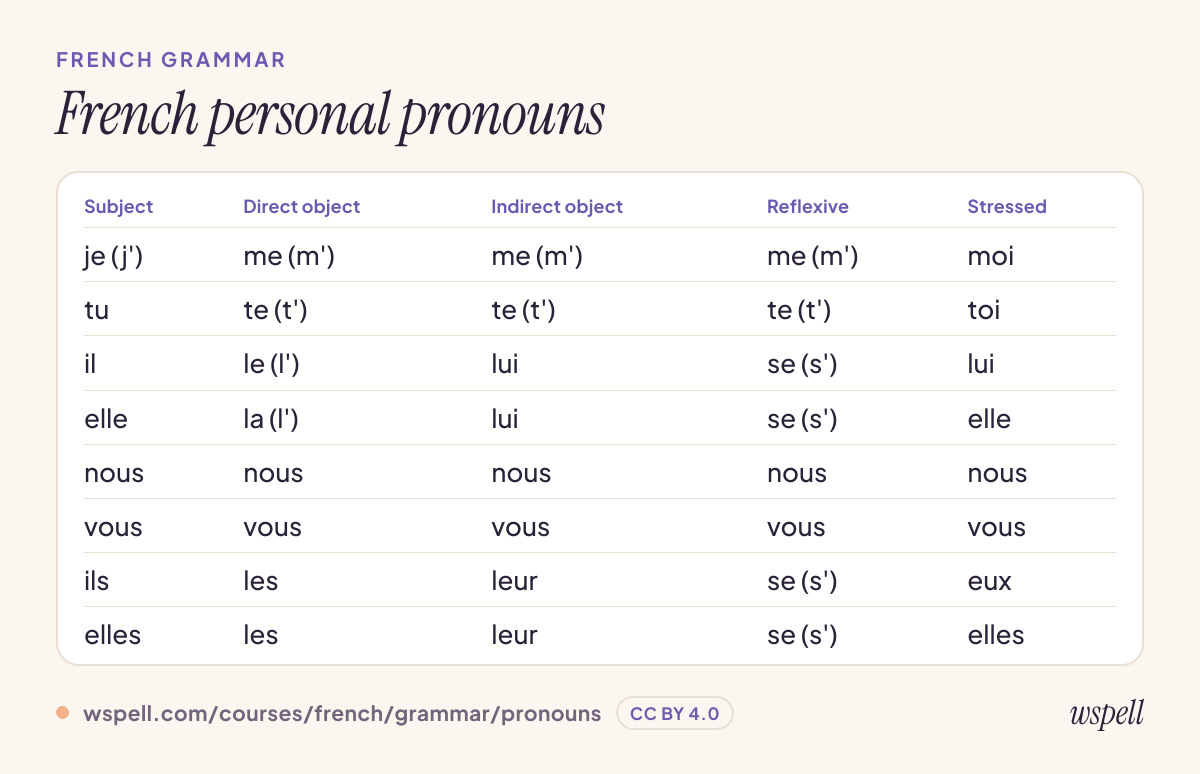
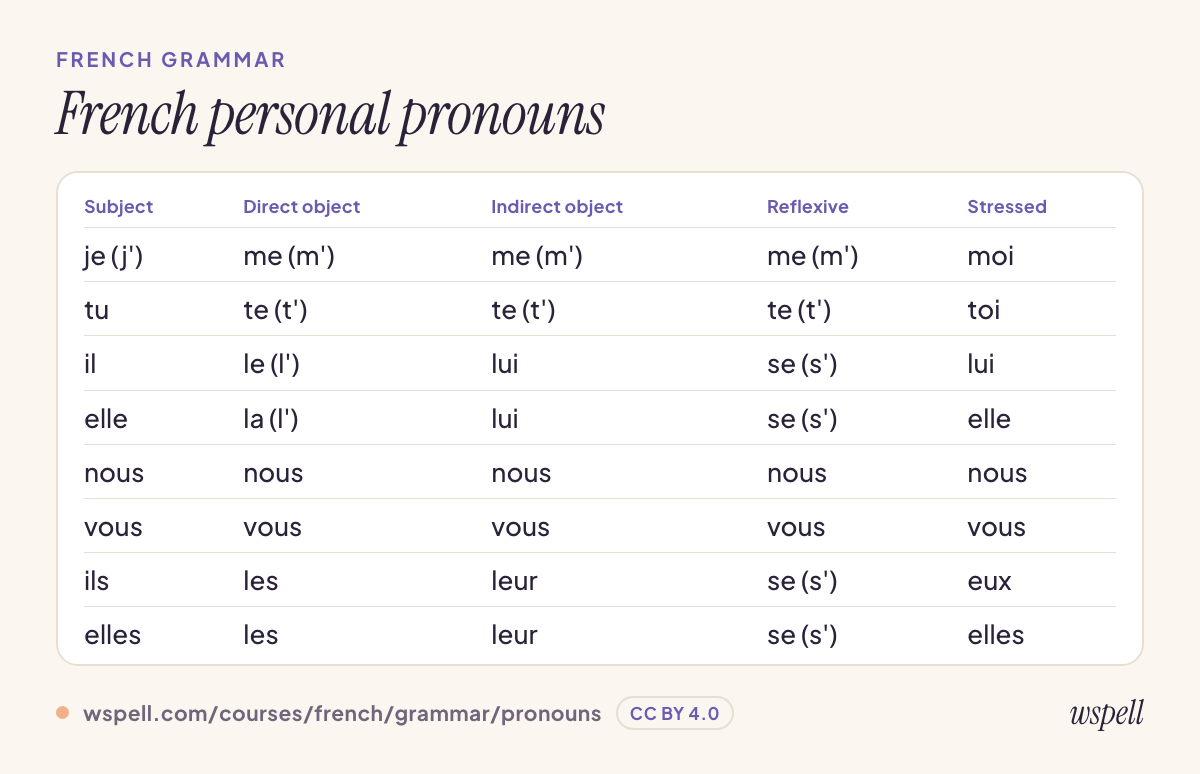
French has a different pronoun for each job in the sentence: the subject (je), the direct object (me, le, la), the indirect object (me, lui, leur), the reflexive (me, se) and the stressed form used alone or after a preposition (moi, lui, eux). The chart gives them all, person by person; below are y and en, and the fixed order when two pronouns meet: il me le donne, je le lui explique.
All the personal pronouns
In brackets: the form before a vowel or a mute h — je m'appelle, je l'aime.
| Subject | Direct object | Indirect object | Reflexive | Stressed |
|---|---|---|---|---|
| je (j') | me (m') | me (m') | me (m') | moi |
| tu | te (t') | te (t') | te (t') | toi |
| il | le (l') | lui | se (s') | lui |
| elle | la (l') | lui | se (s') | elle |
| nous | nous | nous | nous | nous |
| vous | vous | vous | vous | vous |
| ils | les | leur | se (s') | eux |
| elles | les | leur | se (s') | elles |
Subject pronouns: je, tu, on, vous
A conjugated verb needs its subject pronoun
French subject pronouns are obligatory (the verb alone is not enough) and pick the verb ending. Je elides to j' before a vowel or mute h. The -s of ils/elles is silent before a consonant but sounds [z] before a vowel: ils sont [il sɔ̃], ils ont [il zɔ̃].
- Je parle et tu écoutes. — I speak and you listen.
- Ils habitent à Paris. — They live in Paris.
On: 'we' in speech, 'people' in general
on takes a 3rd-person singular verb but means 'we' in everyday speech (replacing nous) or a generic 'one/people/they'. Adjectives and past participles referring to on can still agree with the real-world subject (on est content(e)s).
- On va au cinéma ce soir ? — Shall we go to the cinema tonight?
- En France, on dîne tard. — In France, people eat dinner late.
Tu or vous?
vous is both the plural 'you' and the polite singular for strangers, elders, and formal settings; tu is singular and familiar (friends, family, children). Choosing tu with a stranger can be rude, so default to vous until invited to tutoyer.
- Vous êtes très aimable, monsieur. — You are very kind, sir.
- Tu viens avec moi ? — Are you coming with me?
Direct or indirect object: le or lui?
Direct object: me, te, le, la, nous, vous, les
A direct object (no preposition) is replaced by me, te, le/la, nous, vous, les, placed BEFORE the verb. le/la = 'it/him/her', les = 'them'; le/la elide to l' before a vowel.
- Tu vois le film ? — Oui, je le vois. — Do you see the film? — Yes, I see it.
- Elle nous invite à la fête. — She is inviting us to the party.
Indirect object: lui and leur for à + a person
An indirect object introduced by à + a person is replaced by me, te, lui, nous, vous, leur before the verb. Crucially lui = 'to him/her' (both genders) and leur = 'to them' — they carry no gender and never take an -s.
- Je téléphone à ma sœur → Je lui téléphone. — I phone my sister → I phone her.
- Il offre des fleurs à ses parents → Il leur offre des fleurs. — He gives flowers to his parents → He gives them flowers.
le or lui? The verb decides
Whether you use le/la/les or lui/leur depends on whether the verb links its object directly or with à. Some verbs trap learners: écouter, regarder, attendre, chercher take a DIRECT object (le/la), while téléphoner à, répondre à, plaire à take an INDIRECT one (lui/leur).
- J'écoute le professeur → Je l'écoute. — I listen to the teacher → I listen to him.
- Je réponds au professeur → Je lui réponds. — I answer the teacher → I answer him.
y and en
y: there, to it
y stands before the verb and replaces a location or a thing introduced by à/dans/sur/chez: 'à Paris → j'y vais', 'à la question → j'y réponds'. It means 'there' or 'to/about it' but is NOT used for people.
- Tu vas à la banque ? — Oui, j'y vais. — Are you going to the bank? — Yes, I'm going there.
- Je pense à mon travail → J'y pense. — I'm thinking about my work → I'm thinking about it.
en: some, of it, about it
en stands before the verb and replaces a phrase introduced by de: partitive/indefinite objects (du café → j'en bois), and complements of verbs/adjectives built with de (parler de → j'en parle). It answers 'of it/them, some, any'.
- Tu veux du café ? — Oui, j'en veux. — Do you want coffee? — Yes, I want some.
- Il parle de ses vacances → Il en parle. — He talks about his holidays → He talks about them.
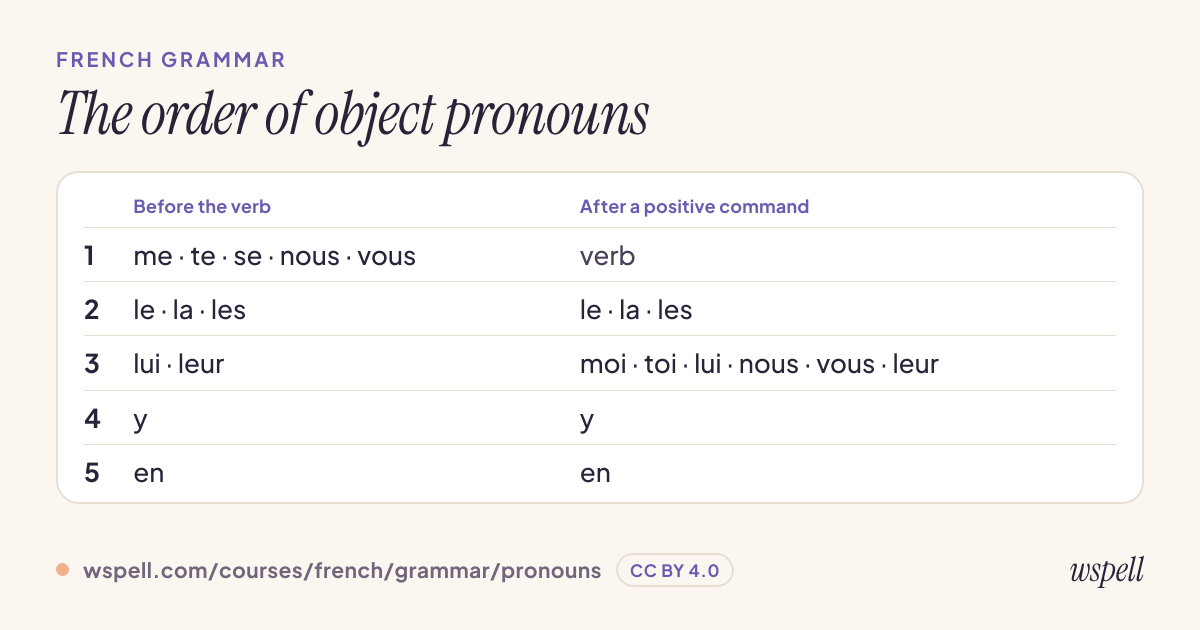
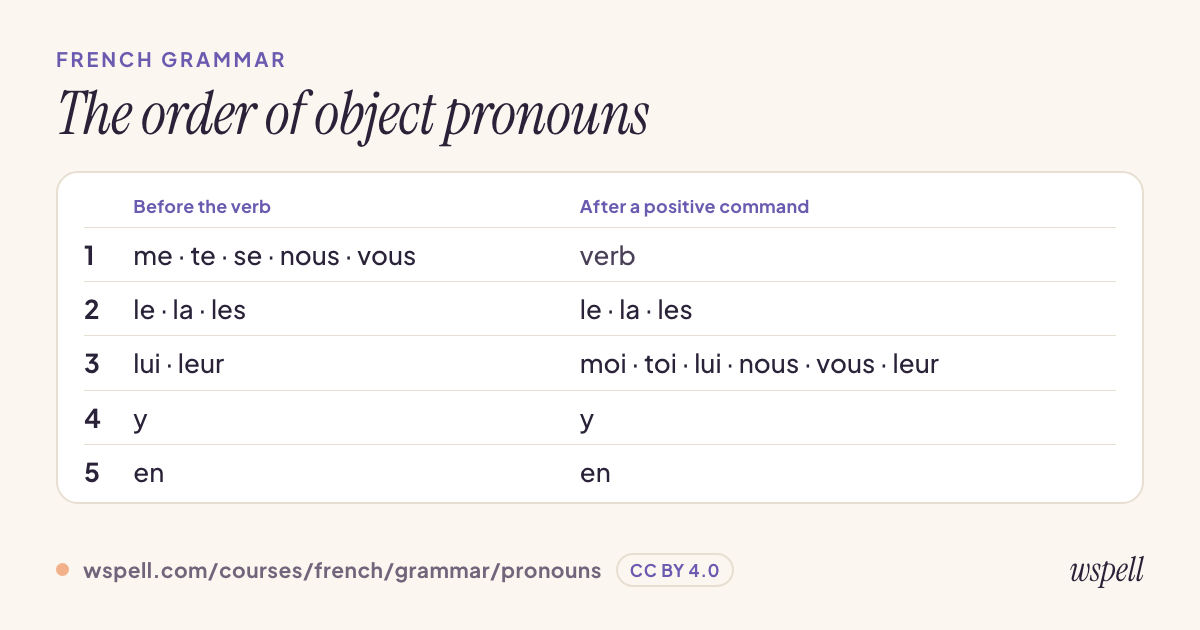
Two pronouns together: me le, le lui, y en
| Before the verb | After a positive command | |
|---|---|---|
| 1 | me · te · se · nous · vous | verb |
| 2 | le · la · les | le · la · les |
| 3 | lui · leur | moi · toi · lui · nous · vous · leur |
| 4 | y | y |
| 5 | en | en |
Two pronouns before the verb
When several object pronouns pile up before the verb, they follow one fixed order: (me te se nous vous) → (le la les) → (lui leur) → y → en. Me, te, se, nous and vous never combine with lui or leur: 'he introduces me to her' is il me présente à elle.
- Il me le donne. — He gives it to me.
- Je le lui explique. — I explain it to him.
After a positive command: donne-moi, lève-toi
In a positive command the object pronoun follows the verb, joined by a hyphen, and me/te become the stressed moi/toi: 'donne-le', 'lève-toi', 'dis-moi'. This is the one context where clitics come after the verb.
- Regarde-moi et écoute-moi ! — Look at me and listen to me!
- Lève-toi, il est tard ! — Get up, it's late!
Stressed pronouns: moi, toi, eux
moi, toi, lui, elle, nous, vous, eux, elles
The stressed pronouns stand alone or after a preposition, unlike the clitics glued to the verb. Use them after prepositions (avec moi), for emphasis (Moi, je pense…), in one-word answers (Qui ? — Moi), after c'est (c'est lui), and in comparisons (plus grand que toi).
- Tu viens avec moi ? — Are you coming with me?
- Eux, ils préfèrent le thé. — As for them, they prefer tea.
learn it step by step
save or print this chart
Under the main tables on this page sits a picture of each — keep one on your phone, share it or print it.
Free to share and adapt under CC BY 4.0 — credit wspell and link to this page. the licence
credit line to copy: French personal pronouns: the complete chart — wspell, CC BY 4.0, https://wspell.com/courses/french/grammar/pronouns
questions
What is the difference between le and lui in French?
Le (la, les) replaces a direct object: je vois Paul → je le vois. Lui (leur) replaces à + a person: je parle à Paul → je lui parle. The verb decides: écouter and regarder take a direct object, téléphoner à and répondre à an indirect one.
In what order do French object pronouns go?
Before the verb: me, te, se, nous or vous first, then le, la or les, then lui or leur, then y, then en — il me le donne, je le lui donne, il y en a. After a positive command the direct object comes first: donne-le-moi.
What do y and en replace?
Y replaces à + a thing or a place: je vais à Paris → j'y vais. En replaces de + a noun, and a noun with a number or a quantity: tu veux du café ? → j'en veux; j'ai deux frères → j'en ai deux.