grammar chart · French
The French future: futur simple and futur proche
French has two everyday futures. The futur proche — aller + infinitive, je vais parler — is the spoken one for plans and for what is about to happen. The futur simple adds -ai, -as, -a, -ons, -ez, -ont to the infinitive (without its final e for -re verbs): je parlerai, nous finirons, ils vendront. Some of the most common verbs have a future stem of their own.
The futur simple
| Person | parler to speak | finir to finish | vendre to sell |
|---|---|---|---|
| je | parlerai | finirai | vendrai |
| tu | parleras | finiras | vendras |
| il / elle / on | parlera | finira | vendra |
| nous | parlerons | finirons | vendrons |
| vous | parlerez | finirez | vendrez |
| ils / elles | parleront | finiront | vendront |
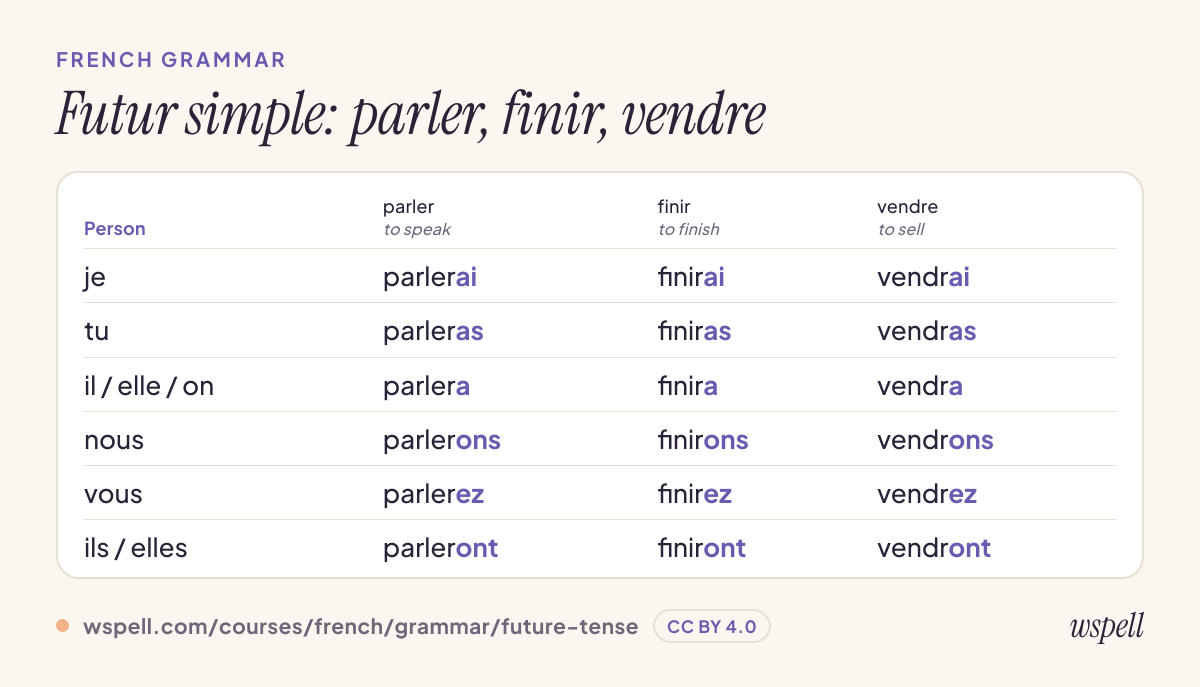
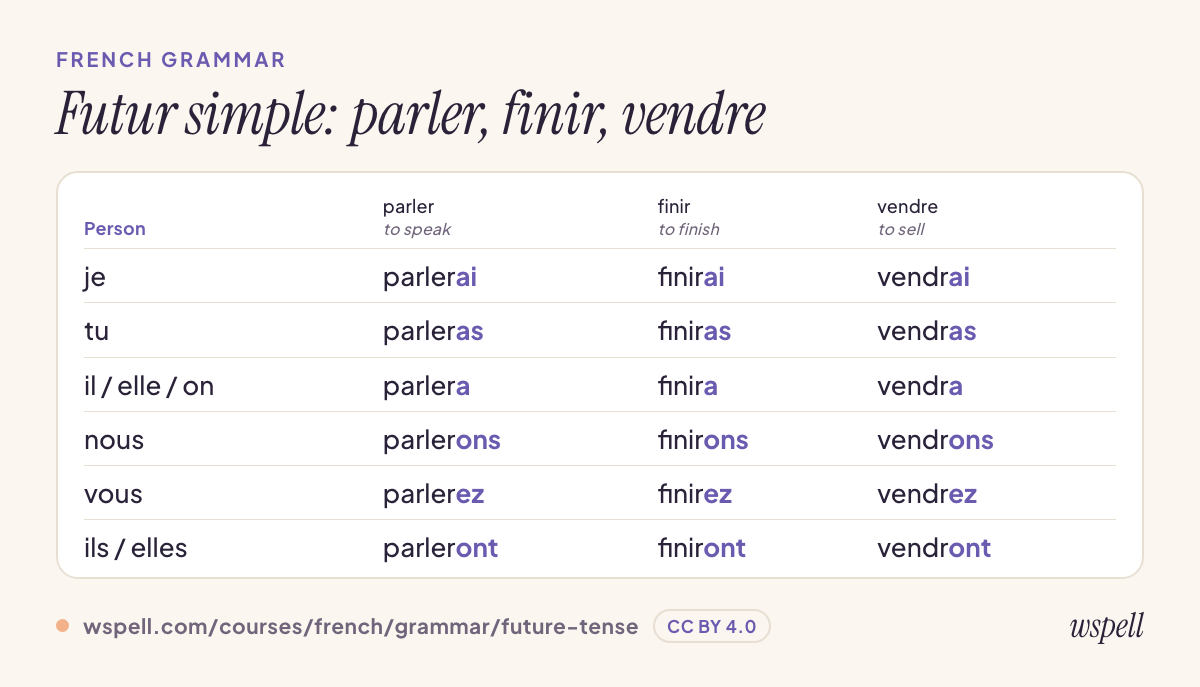
Futur simple: infinitive + -ai, -as, -a, -ons, -ez, -ont
Add -ai, -as, -a, -ons, -ez, -ont to the infinitive (drop the final -e of -re verbs). Same endings for all groups; the endings are the present of avoir. Many high-frequency verbs have irregular future stems (ser-, aur-, ir-, fer-, viendr-).
- Je partirai demain matin. — I will leave tomorrow morning.
- Nous serons prêts à huit heures. — We will be ready at eight.
Irregular future stems
The conditional is built on the same stem: je serai → je serais.
| Verb | Future je | Future nous | Conditional je |
|---|---|---|---|
| être to be | je serai | nous serons | je serais |
| avoir to have | j'aurai | nous aurons | j'aurais |
| aller to go | j'irai | nous irons | j'irais |
| faire to do, to make | je ferai | nous ferons | je ferais |
| venir to come | je viendrai | nous viendrons | je viendrais |
| pouvoir can, to be able | je pourrai | nous pourrons | je pourrais |
| vouloir to want | je voudrai | nous voudrons | je voudrais |
| devoir must, to have to | je devrai | nous devrons | je devrais |
| savoir to know (how) | je saurai | nous saurons | je saurais |
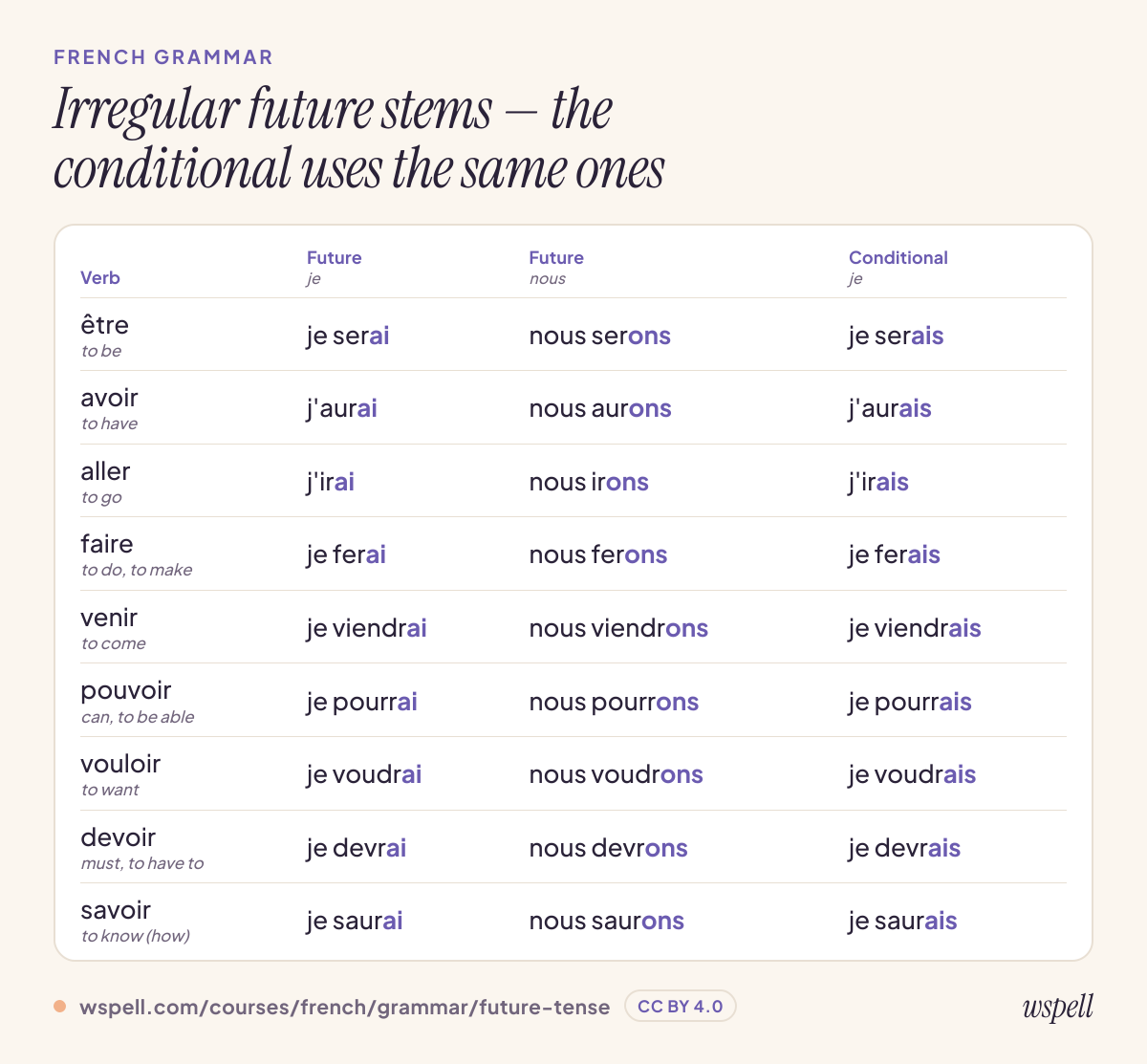
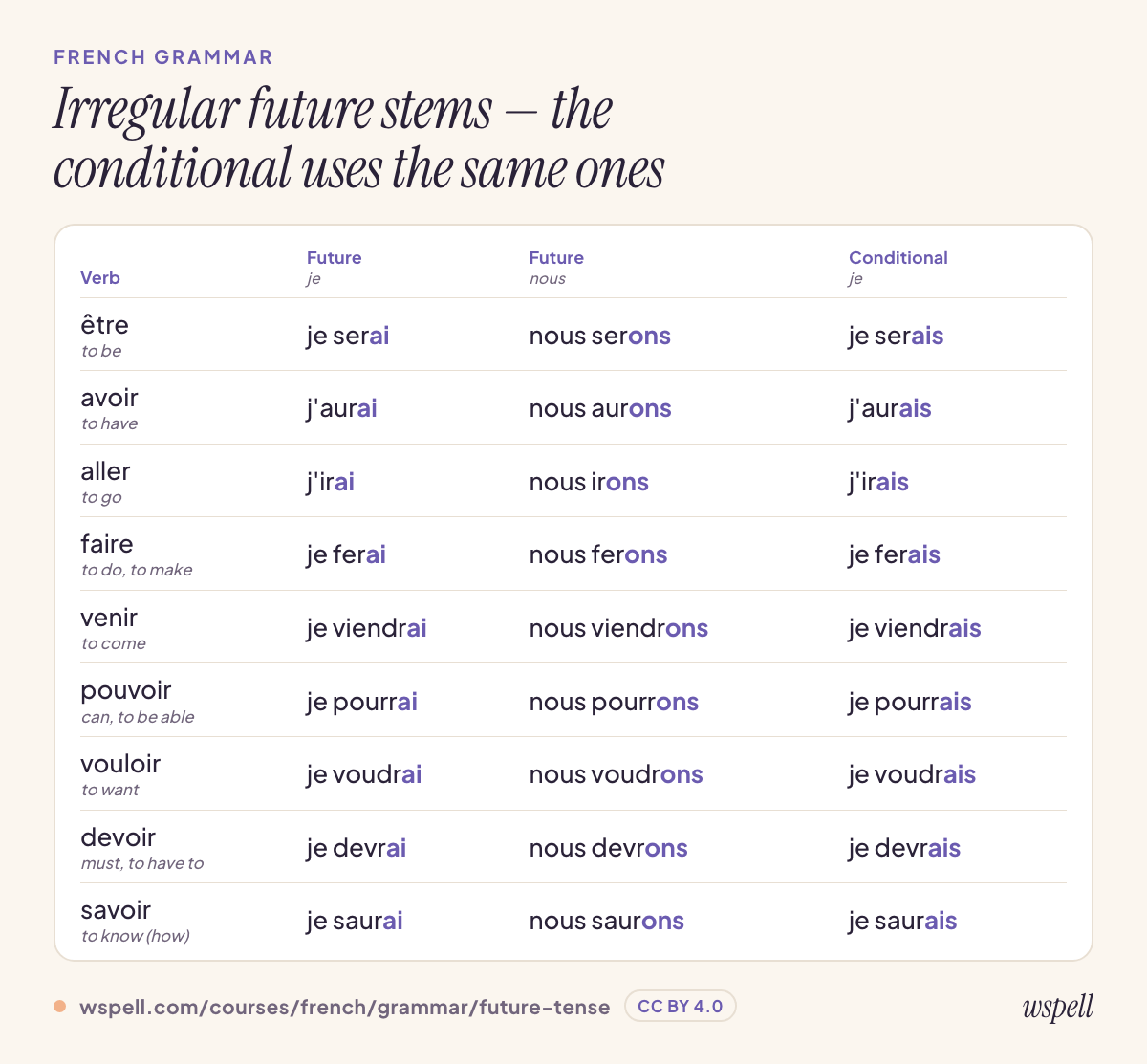
The futur proche: je vais parler
| Person | parler to speak | partir to leave |
|---|---|---|
| je | vais parler | vais partir |
| tu | vas parler | vas partir |
| il / elle / on | va parler | va partir |
| nous | allons parler | allons partir |
| vous | allez parler | allez partir |
| ils / elles | vont parler | vont partir |
The everyday spoken future: present of aller + infinitive expresses an intended or imminent action. Far more common in speech than the simple future.
- Je vais manger dans dix minutes. — I am going to eat in ten minutes.
Quand + future
Quand il arrivera: the future after quand
Unlike English, French uses a real future (or futur antérieur) after temporal quand, lorsque, dès que, aussitôt que when the main clause is future — never the present.
- Quand il arrivera, nous mangerons. — When he arrives, we will eat.
learn it step by step
save or print this chart
Under the main tables on this page sits a picture of each — keep one on your phone, share it or print it.
Free to share and adapt under CC BY 4.0 — credit wspell and link to this page. the licence
credit line to copy: The French future: futur simple and futur proche — wspell, CC BY 4.0, https://wspell.com/courses/french/grammar/future-tense
questions
What is the difference between the futur simple and the futur proche?
The futur proche (je vais partir) is the everyday spoken future for plans and things about to happen. The futur simple (je partirai) is more neutral and is the usual future in writing, for forecasts and promises.
Which French verbs have an irregular future?
Among the common ones: être (je serai), avoir (j'aurai), aller (j'irai), faire (je ferai), venir (je viendrai), pouvoir (je pourrai), vouloir (je voudrai), devoir (je devrai), savoir (je saurai) and voir (je verrai). The endings are always regular.
Do you use the future after quand in French?
Yes. When the main clause is about the future, the quand clause is in the future too: quand il arrivera, nous mangerons — where English says 'when he arrives'.