grammar chart · French
The imparfait: the French imperfect tense
The imparfait describes the past as it was going on: the background of a story, a description, a habit — il faisait beau, je jouais dehors. Take the nous form of the present, drop -ons and add -ais, -ais, -ait, -ions, -iez, -aient; only être has a stem of its own, ét-. The plus-que-parfait — 'had done' — is the imparfait of avoir or être plus the past participle.
Imparfait endings
| Person | parler to speak | finir to finish | vendre to sell | être to be |
|---|---|---|---|---|
| je (j') | parlais | finissais | vendais | étais |
| tu | parlais | finissais | vendais | étais |
| il / elle / on | parlait | finissait | vendait | était |
| nous | parlions | finissions | vendions | étions |
| vous | parliez | finissiez | vendiez | étiez |
| ils / elles | parlaient | finissaient | vendaient | étaient |
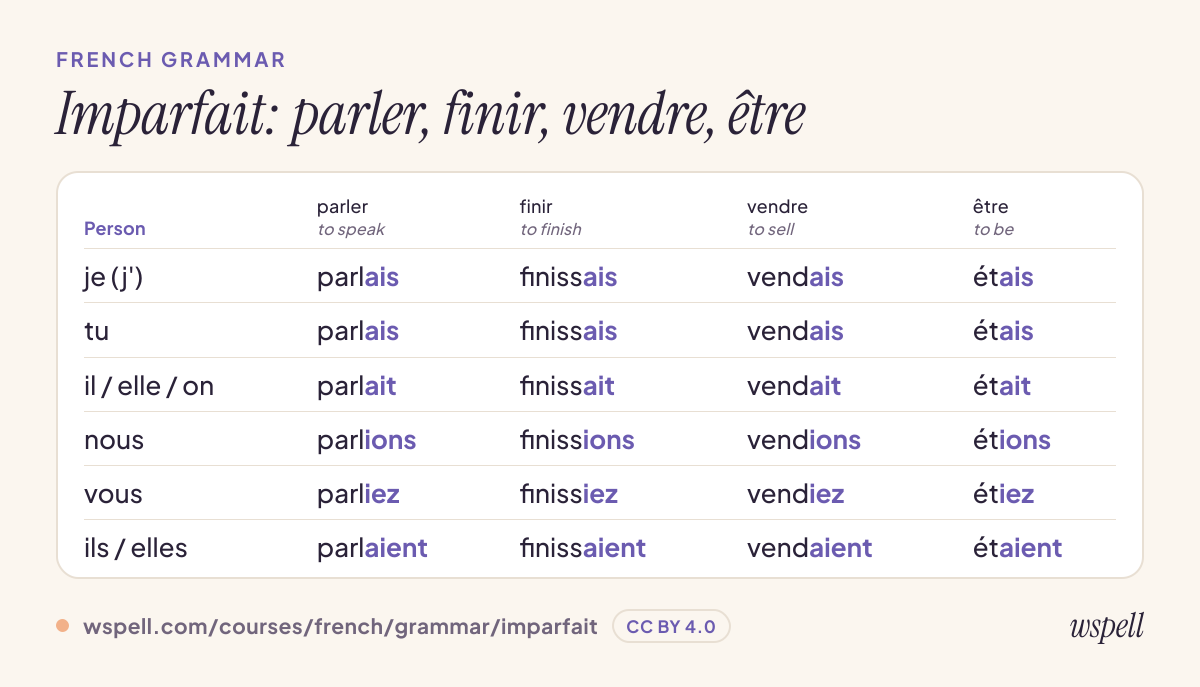
The imparfait: nous stem + -ais, -ait, -aient
Take the nous-present stem, drop -ons, add -ais, -ais, -ait, -ions, -iez, -aient. Expresses ongoing background, habits, and descriptions in the past ('was doing', 'used to'). Only être is irregular (ét-).
- Quand j'étais petit, je jouais dehors. — When I was little, I used to play outside.
Imparfait or passé composé?
Imparfait for the scene, passé composé for the event
The imparfait sets the ongoing scene/habit/description; the passé composé reports a completed, bounded event that moves the story forward. A sudden action interrupting a background one contrasts the two.
- Je dormais quand le téléphone a sonné. — I was sleeping when the phone rang.
- Il faisait beau, alors nous sommes sortis. — The weather was nice, so we went out.
The plus-que-parfait: j'avais parlé, j'étais allé(e)
| Person | parler to speak | aller to go |
|---|---|---|
| je (j') | avais parlé | étais allé(e) |
| tu | avais parlé | étais allé(e) |
| il / elle / on | avait parlé | était allé(e) |
| nous | avions parlé | étions allé(e)s |
| vous | aviez parlé | étiez allé(e)(s) |
| ils / elles | avaient parlé | étaient allé(e)s |
Plus-que-parfait: the past before the past
Imparfait of the auxiliary (avais/étais) + past participle. Marks an action completed before another past moment ('had done'). Same auxiliary choice and agreement rules as the passé composé.
- Quand je suis arrivé, ils étaient déjà partis. — When I arrived, they had already left.
learn it step by step
save or print this chart
Under the main tables on this page sits a picture of each — keep one on your phone, share it or print it.
Free to share and adapt under CC BY 4.0 — credit wspell and link to this page. the licence
credit line to copy: The imparfait: the French imperfect tense — wspell, CC BY 4.0, https://wspell.com/courses/french/grammar/imparfait
questions
How do you form the imparfait in French?
From the nous form of the present without -ons: nous finissons → je finissais, nous prenons → je prenais. Add -ais, -ais, -ait, -ions, -iez, -aient. The one exception is être: j'étais.
When do you use the imparfait and when the passé composé?
The imparfait sets the scene — what was going on, what things were like, what used to happen. The passé composé tells what happened next: je dormais quand le téléphone a sonné.
How do you say 'I used to' in French?
With the imparfait: quand j'étais petit, je jouais dehors — when I was little, I used to play outside.