grammar chart · French
French irregular verbs: the forms to learn
The verbs used most are the irregular ones. The first two tables give ten of them in the forms you cannot guess from the infinitive: the present with je, nous and ils, the future, the passé composé and the subjunctive. Below them, the whole present of aller, faire, venir and prendre and of the four modal verbs, and the irregular past participles.
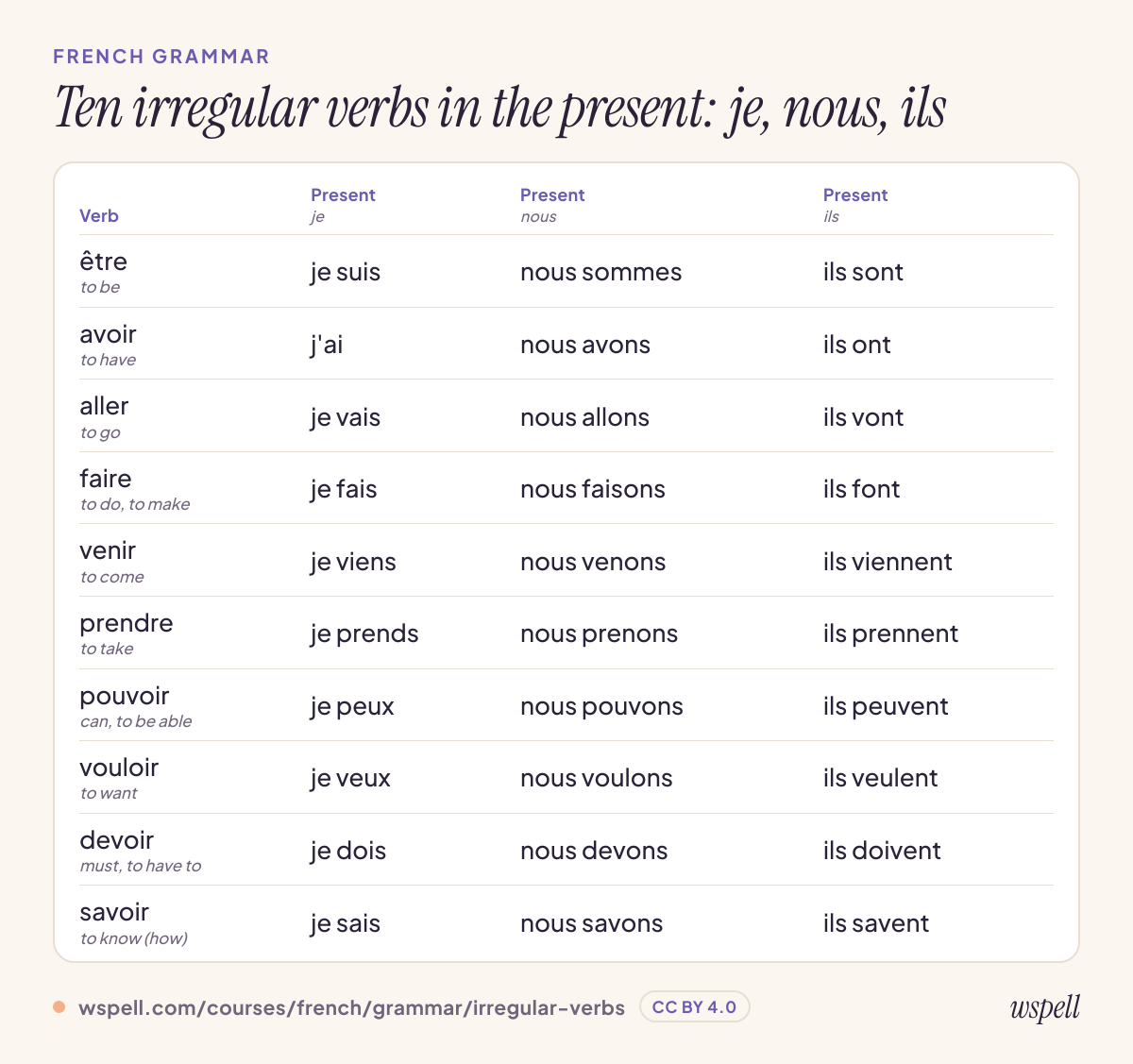
Ten irregular verbs: the key forms
For each verb: the present with je, nous and ils, the future, the passé composé and the subjunctive — the forms that show its stems.
| Verb | Present je | Present nous | Present ils |
|---|---|---|---|
| être to be | je suis | nous sommes | ils sont |
| avoir to have | j'ai | nous avons | ils ont |
| aller to go | je vais | nous allons | ils vont |
| faire to do, to make | je fais | nous faisons | ils font |
| venir to come | je viens | nous venons | ils viennent |
| prendre to take | je prends | nous prenons | ils prennent |
| pouvoir can, to be able | je peux | nous pouvons | ils peuvent |
| vouloir to want | je veux | nous voulons | ils veulent |
| devoir must, to have to | je dois | nous devons | ils doivent |
| savoir to know (how) | je sais | nous savons | ils savent |
| Verb | Future je | Compound past je | Subjunctive que je |
|---|---|---|---|
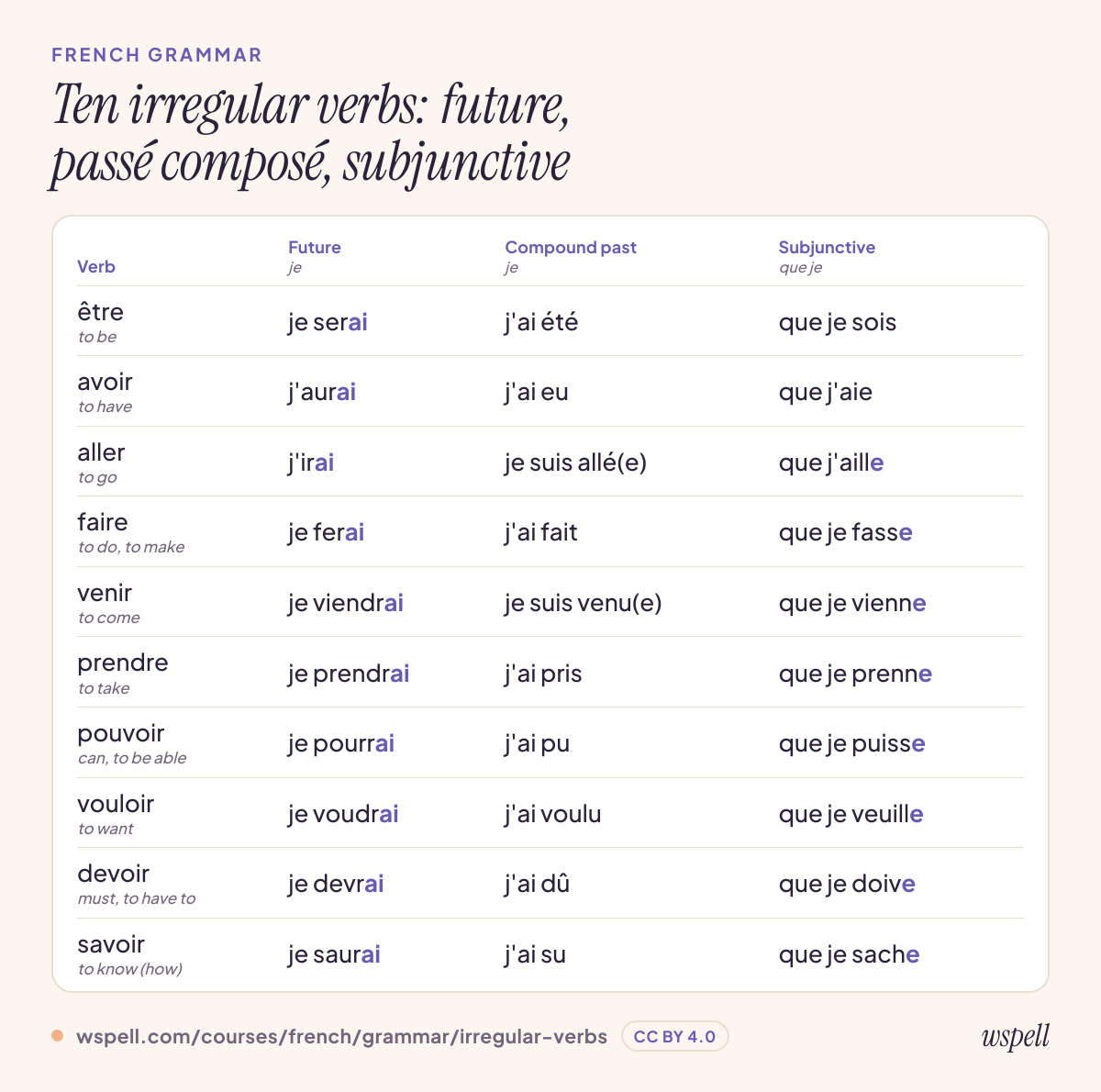
| être to be | je serai | j'ai été | que je sois |
| avoir to have | j'aurai | j'ai eu | que j'aie |
| aller to go | j'irai | je suis allé(e) | que j'aille |
| faire to do, to make | je ferai | j'ai fait | que je fasse |
| venir to come | je viendrai | je suis venu(e) | que je vienne |
| prendre to take | je prendrai | j'ai pris | que je prenne |
| pouvoir can, to be able | je pourrai | j'ai pu | que je puisse |
| vouloir to want | je voudrai | j'ai voulu | que je veuille |
| devoir must, to have to | je devrai | j'ai dû | que je doive |
| savoir to know (how) | je saurai | j'ai su | que je sache |
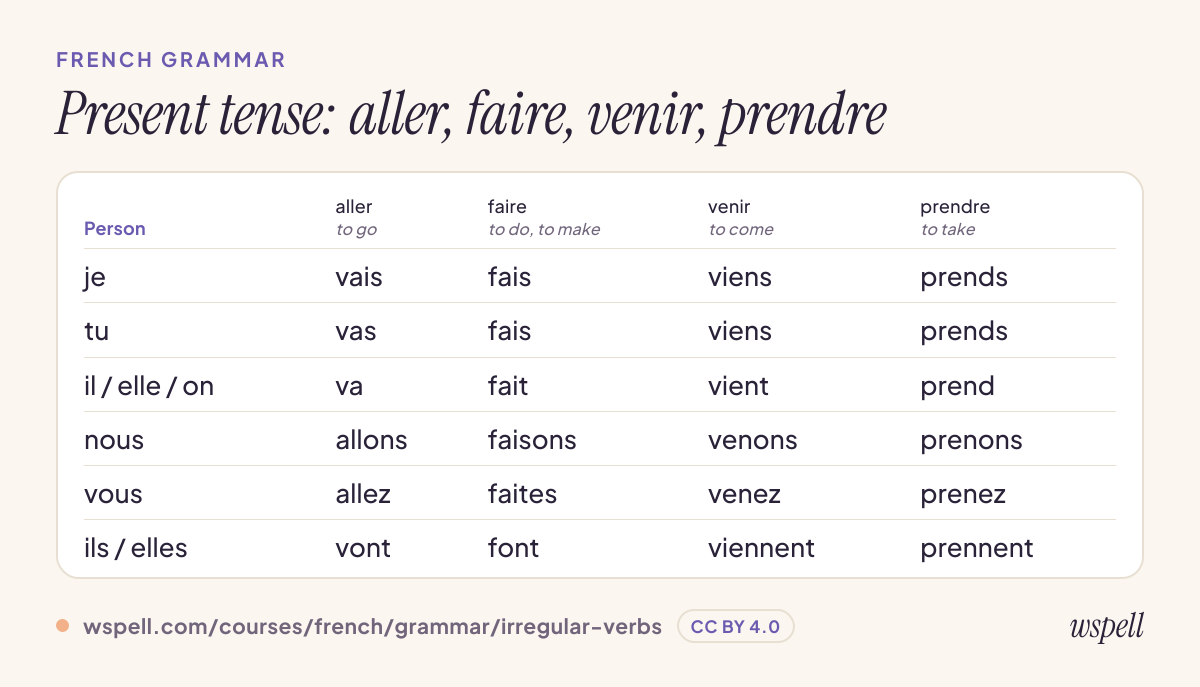
aller, faire, venir and prendre in the present
| Person | aller to go | faire to do, to make | venir to come | prendre to take |
|---|---|---|---|---|
| je | vais | fais | viens | prends |
| tu | vas | fais | viens | prends |
| il / elle / on | va | fait | vient | prend |
| nous | allons | faisons | venons | prenons |
| vous | allez | faites | venez | prenez |
| ils / elles | vont | font | viennent | prennent |
aller, faire, venir, prendre: learn them whole
The most-used verbs are irregular and worth memorizing whole: aller (vais, vas, va, allons, allez, vont), faire (fais…faisons, faites, font), venir (viens…venons, venez, viennent), prendre (prends…prenons, prenez, prennent).
- Nous faisons du sport et ils vont au parc. — We do sport and they go to the park.
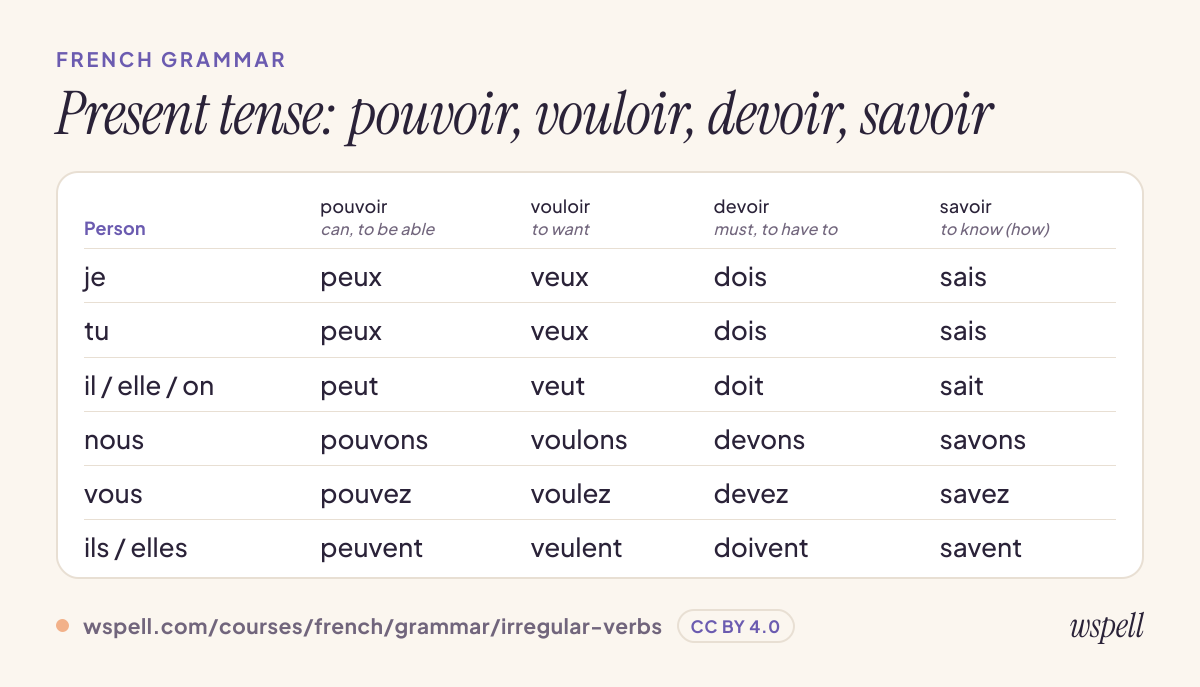
The modal verbs: pouvoir, vouloir, devoir, savoir
| Person | pouvoir can, to be able | vouloir to want | devoir must, to have to | savoir to know (how) |
|---|---|---|---|---|
| je | peux | veux | dois | sais |
| tu | peux | veux | dois | sais |
| il / elle / on | peut | veut | doit | sait |
| nous | pouvons | voulons | devons | savons |
| vous | pouvez | voulez | devez | savez |
| ils / elles | peuvent | veulent | doivent | savent |
pouvoir, vouloir, devoir, savoir + infinitive
These modals take a bare infinitive (no preposition): pouvoir (can/may), devoir (must/have to), vouloir (want), savoir (know how to). savoir = learned ability, pouvoir = possibility/permission.
- Je peux t'aider si tu veux. — I can help you if you want.
- Elle sait nager. — She knows how to swim.
Irregular past participles
| Infinitive | Participle | Infinitive | Participle |
|---|---|---|---|
| avoir | eu | devoir | dû |
| être | été | savoir | su |
| faire | fait | venir | venu |
| prendre | pris | écrire | écrit |
| mettre | mis | ouvrir | ouvert |
| voir | vu | offrir | offert |
| vouloir | voulu | boire | bu |
| pouvoir | pu | lire | lu |
Irregular stems in the future and the subjunctive
Futur simple: infinitive + -ai, -as, -a, -ons, -ez, -ont
Add -ai, -as, -a, -ons, -ez, -ont to the infinitive (drop the final -e of -re verbs). Same endings for all groups; the endings are the present of avoir. Many high-frequency verbs have irregular future stems (ser-, aur-, ir-, fer-, viendr-).
- Je partirai demain matin. — I will leave tomorrow morning.
- Nous serons prêts à huit heures. — We will be ready at eight.
The subjunctive: ils stem + -e, -es, -e, -ions, -iez, -ent
Take the ils-present stem, drop -ent, add -e, -es, -e, -ions, -iez, -ent; for most verbs nous and vous look like the imparfait (que nous venions). Key irregulars: être (sois…), avoir (aie…), faire (fasse), aller (aille), pouvoir (puisse), savoir (sache), vouloir (veuille).
- Il faut que tu finisses tes devoirs. — You must finish your homework.
learn it step by step
save or print this chart
Under the main tables on this page sits a picture of each — keep one on your phone, share it or print it.
Free to share and adapt under CC BY 4.0 — credit wspell and link to this page. the licence
credit line to copy: French irregular verbs: the forms to learn — wspell, CC BY 4.0, https://wspell.com/courses/french/grammar/irregular-verbs
questions
What are the most common irregular verbs in French?
Être, avoir, faire, pouvoir, devoir, aller, prendre, vouloir, savoir and venir are among the most frequent verbs in French, and all of them are irregular. Learn their present first, then their future and their past participle.
Is prendre irregular?
Yes. Its singular looks regular (je prends, il prend), but the plural changes the stem — nous prenons, ils prennent — and the participle is pris. Apprendre and comprendre are conjugated the same way.
Which French verbs have an irregular future?
Among the common ones: être (je serai), avoir (j'aurai), aller (j'irai), faire (je ferai), venir (je viendrai), pouvoir (je pourrai), vouloir (je voudrai), devoir (je devrai), savoir (je saurai) and voir (je verrai). The endings stay regular.