grammar chart · French
French possessive adjectives — and ce, cet, cette, ces
A French possessive agrees with the thing owned, not with the owner: son frère and sa sœur can each be his or hers. The table gives the masculine, feminine and plural form for each owner. Before a feminine word starting with a vowel or a mute h, ma, ta and sa become mon, ton and son: mon amie. The demonstratives agree in the same way — ce livre, cette table, ces livres — and ce becomes cet before a masculine word starting with a vowel or a mute h (cet ami), while a feminine one keeps cette (cette amie).
Possessive adjectives
| Owner | Masculine noun | Feminine noun | Plural noun |
|---|---|---|---|
| My je | mon | ma | mes |
| Your tu | ton | ta | tes |
| His, her, its il / elle / on | son | sa | ses |
| Our nous | notre | notre | nos |
| Your vous | votre | votre | vos |
| Their ils / elles | leur | leur | leurs |
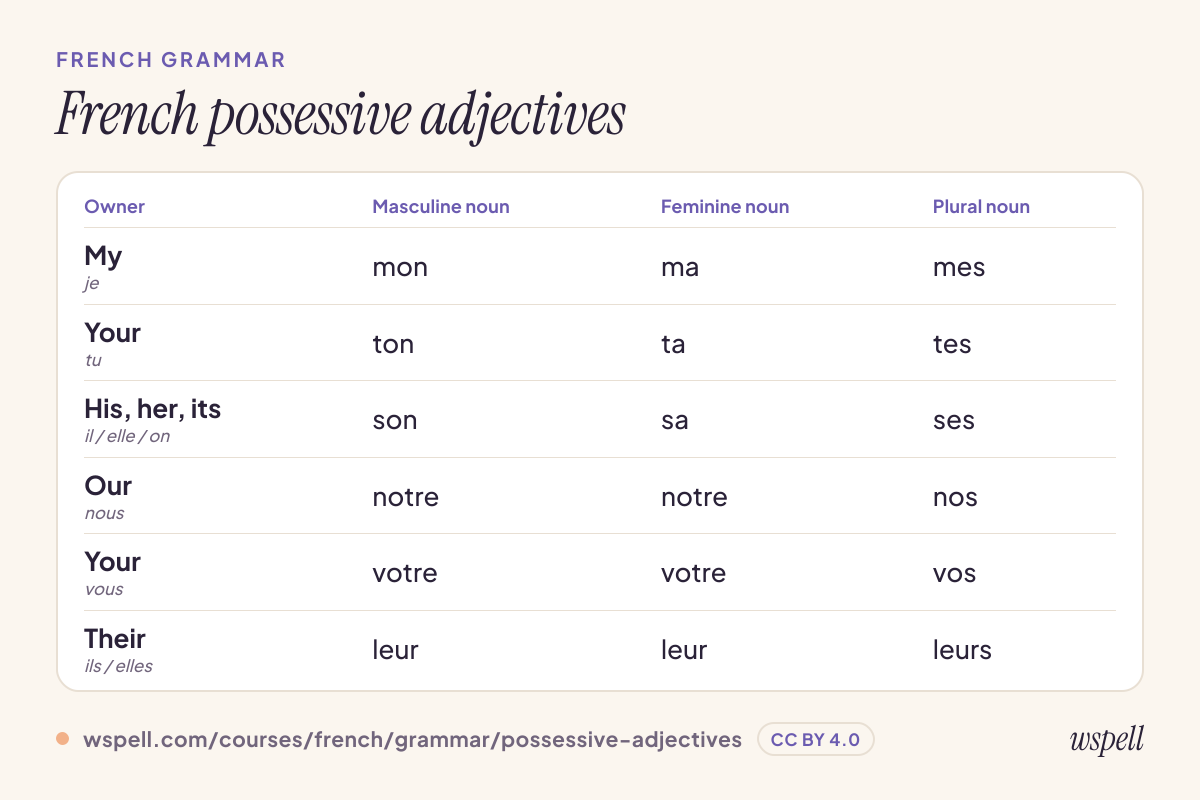
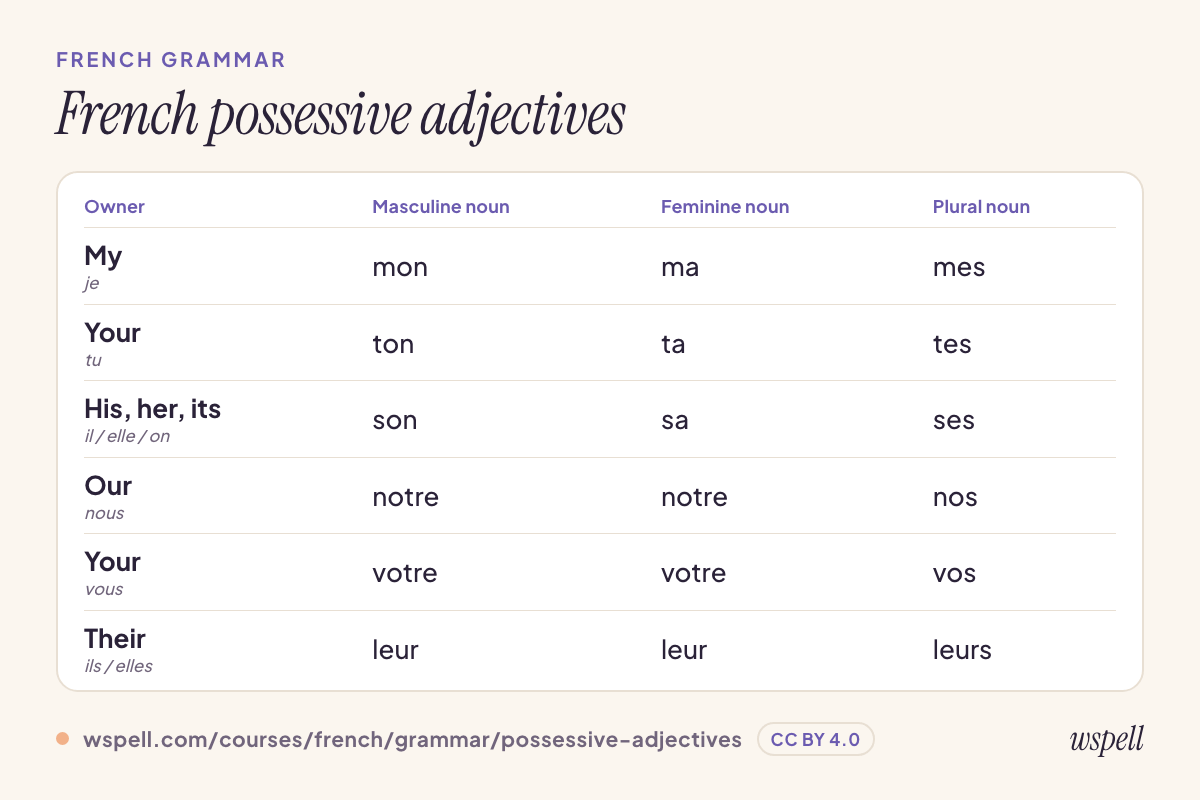
The possessive agrees with the thing owned
Possessives agree with the POSSESSED noun, not the owner: mon/ma/mes (my), ton/ta/tes (your), son/sa/ses (his/her/its), notre/nos (our), votre/vos (your pl/formal), leur/leurs (their).
- mon frère, ma sœur, mes parents — my brother, my sister, my parents
- Ils aiment leurs enfants. — They love their children.
mon amie — and son or leur?
mon amie, ton école, son histoire
Before a feminine noun beginning with a vowel or mute h, the feminine ma/ta/sa switch to mon/ton/son for euphony, even though the noun is feminine: mon amie, ton école, son histoire.
- mon amie Claire — my friend Claire (f)
- son histoire est triste — her story is sad
son or leur: one owner or several
son/sa/ses = one possessor (his/her/its); leur/leurs = several possessors (their). son does not encode the owner's gender, so son livre can mean 'his' or 'her book' — context decides.
- Marie et Paul lavent leur voiture. — Marie and Paul wash their car.
- Elle cherche son sac. — She is looking for her bag.
Possessive pronouns: le mien, la mienne
le mien, la mienne: possessive pronouns
A possessive pronoun replaces 'possessive adjective + noun' and includes the definite article: le mien, la mienne, les miens… It agrees in gender and number with the THING possessed, not the owner (like the possessive adjective).
- C'est ta voiture ? — Non, la mienne est bleue. — Is that your car? — No, mine is blue.
- Nos enfants et les leurs jouent ensemble. — Our children and theirs play together.
This and that: ce, cet, cette, ces
| This, that + noun | The one(s) | |
|---|---|---|
| Masculine singular | ce / cet | celui |
| Feminine singular | cette | celle |
| Masculine plural | ces | ceux |
| Feminine plural | ces | celles |
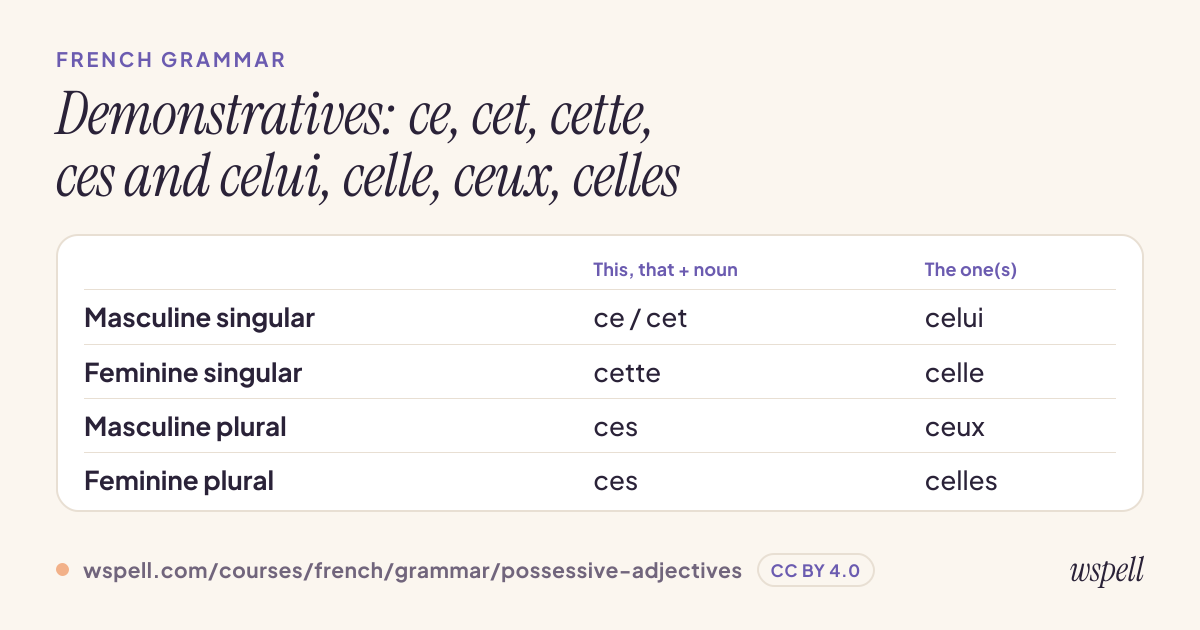
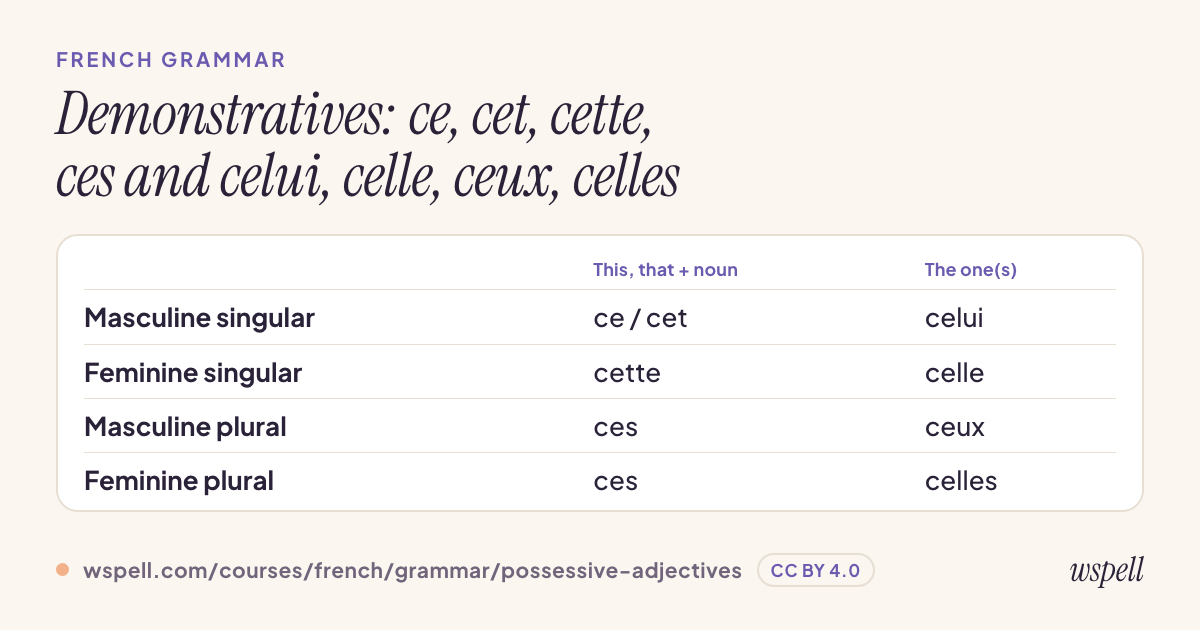
ce, cet, cette, ces
The demonstrative points to a noun ('this/that'): ce (m before a consonant), cet (m before a vowel/mute h), cette (f), ces (pl). Cet exists only to avoid a vowel clash (cet homme, cet arbre).
- ce garçon, cet homme, cette femme — this boy, this man, this woman
- Ces livres sont à moi. — These books are mine.
ce livre-ci, ce livre-là
To distinguish near from far or one from another, attach -ci (near) or -là (far) to the noun with a hyphen: ce livre-ci vs ce livre-là. In everyday speech -là dominates and the near/far contrast is often neutral.
- Je préfère cette robe-ci à cette robe-là. — I prefer this dress to that dress.
learn it step by step
save or print this chart
Under the main tables on this page sits a picture of each — keep one on your phone, share it or print it.
Free to share and adapt under CC BY 4.0 — credit wspell and link to this page. the licence
credit line to copy: French possessive adjectives — and ce, cet, cette, ces — wspell, CC BY 4.0, https://wspell.com/courses/french/grammar/possessive-adjectives
questions
Why is it 'mon amie' and not 'ma amie'?
Before a feminine noun that starts with a vowel or a mute h, ma, ta and sa become mon, ton and son, so that two vowels do not clash: mon amie, ton école, son histoire. The noun stays feminine.
How do you say 'his' and 'her' in French?
With the same words: son, sa and ses agree with the thing owned, not with the owner. Son livre is his book or her book; sa voiture is his car or her car.
When do you use cet instead of ce?
Before a masculine singular noun that starts with a vowel or a mute h: cet homme, cet ami. Cet sounds just like cette.