grammar chart · English
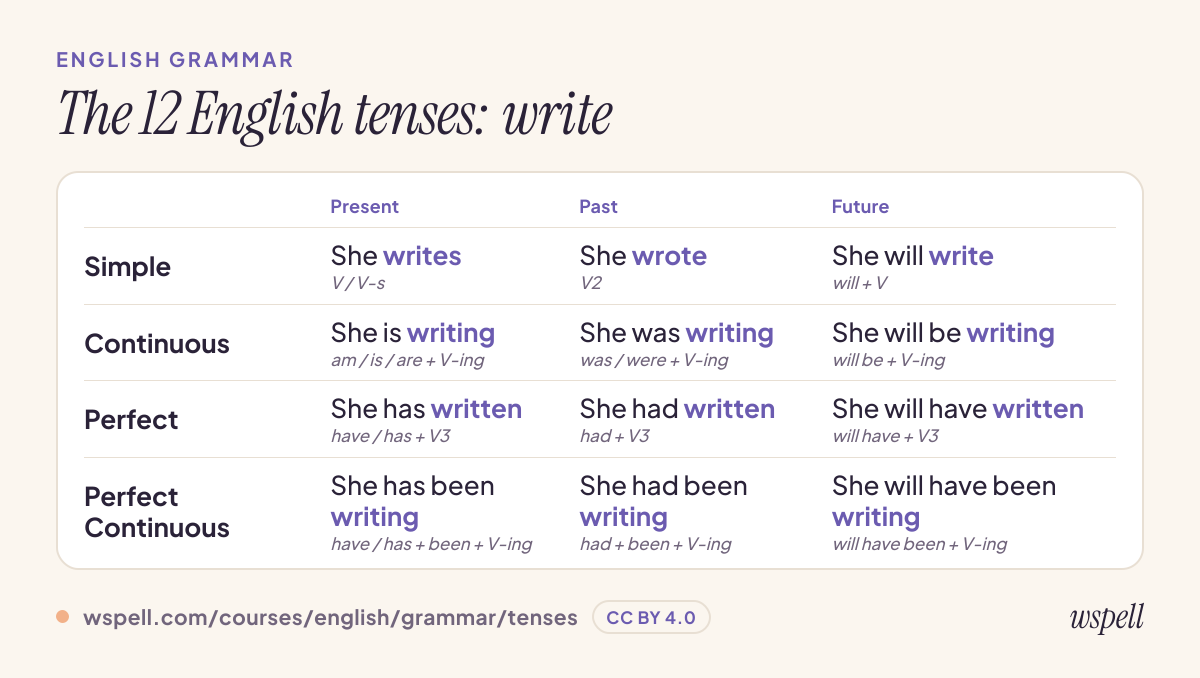
English tenses table: all 12 tenses with formulas and examples
English has three times — present, past and future — and each comes in four forms: simple, continuous, perfect and perfect continuous. The first table shows all twelve on one verb; the next three give each tense's formula, when to use it, an example and its signal words, and the last one makes every tense negative and turns it into a question.
The 12 tenses at a glance
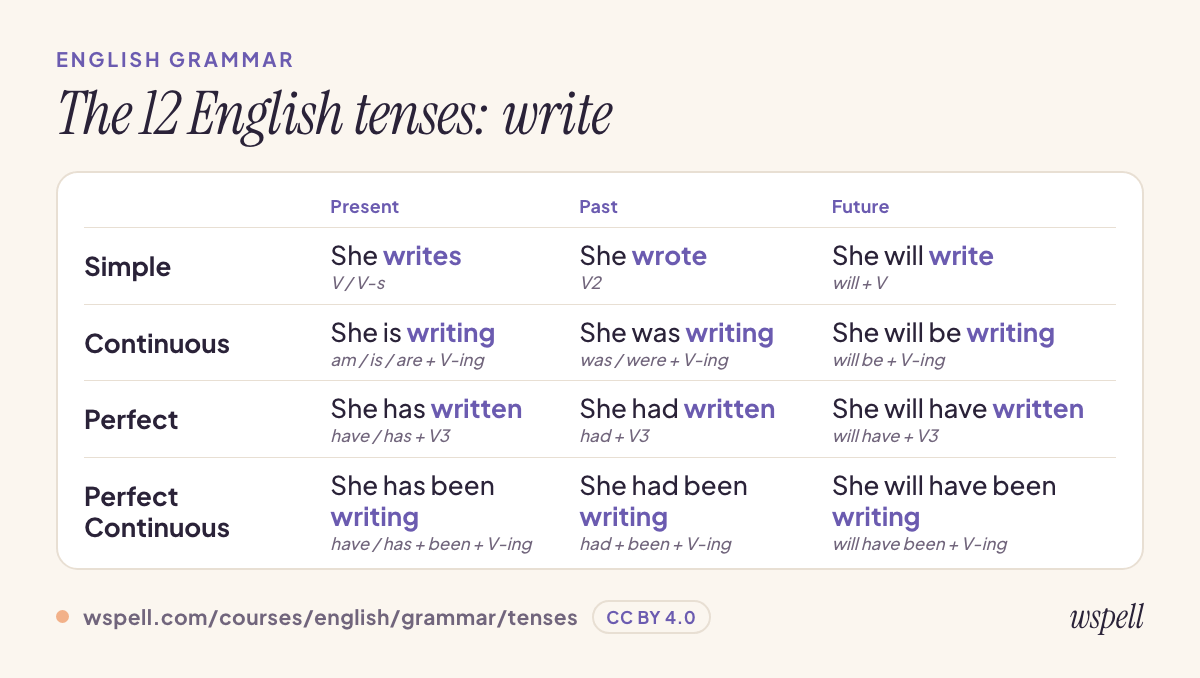
Rows are the four forms, columns the three times. Under each form is its formula: V = base form, V-s = the he / she / it form, V2 = past simple, V3 = past participle, V-ing = the -ing form.
| Present | Past | Future | |
|---|---|---|---|
| Simple | She writes V / V-s | She wrote V2 | She will write will + V |
| Continuous | She is writing am / is / are + V-ing | She was writing was / were + V-ing | She will be writing will be + V-ing |
| Perfect | She has written have / has + V3 | She had written had + V3 | She will have written will have + V3 |
| Perfect Continuous | She has been writing have / has + been + V-ing | She had been writing had + been + V-ing | She will have been writing will have been + V-ing |
The present tenses
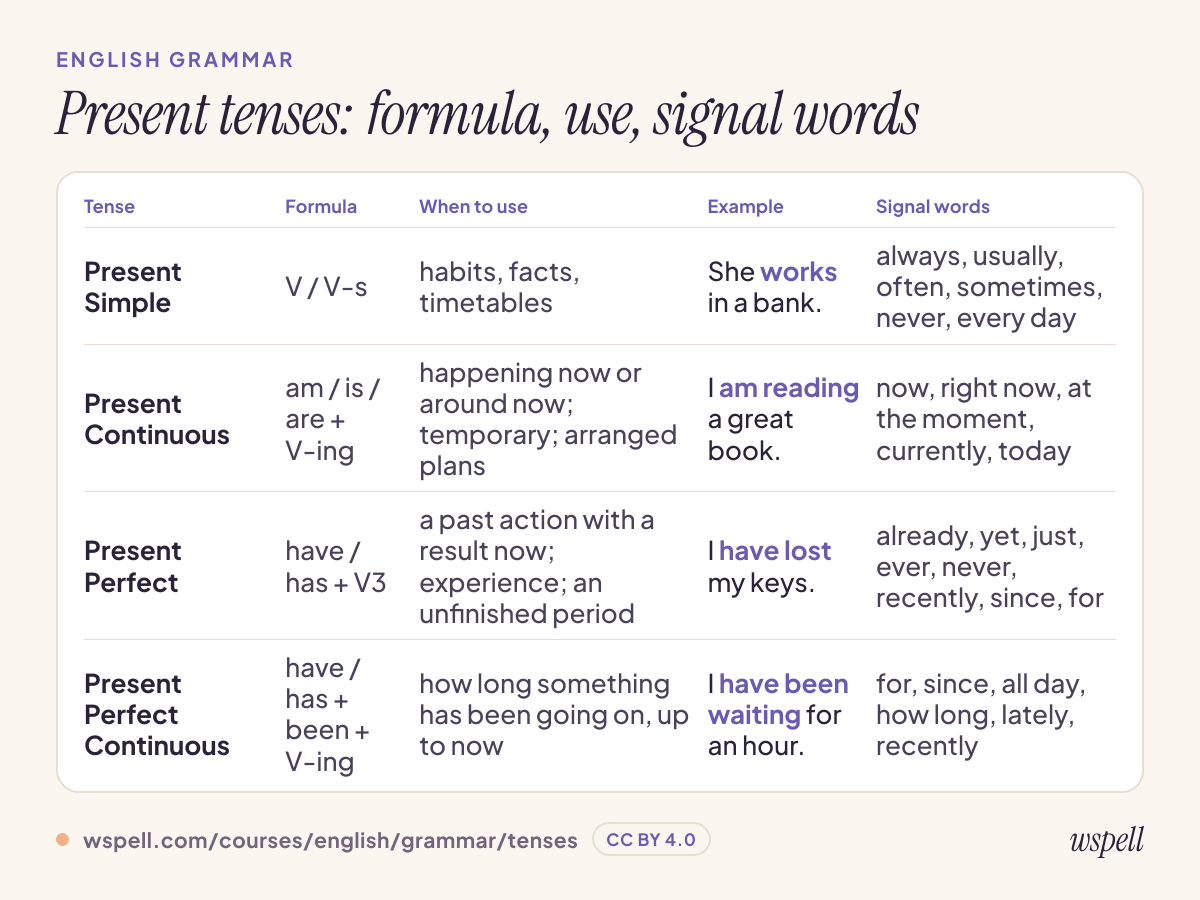
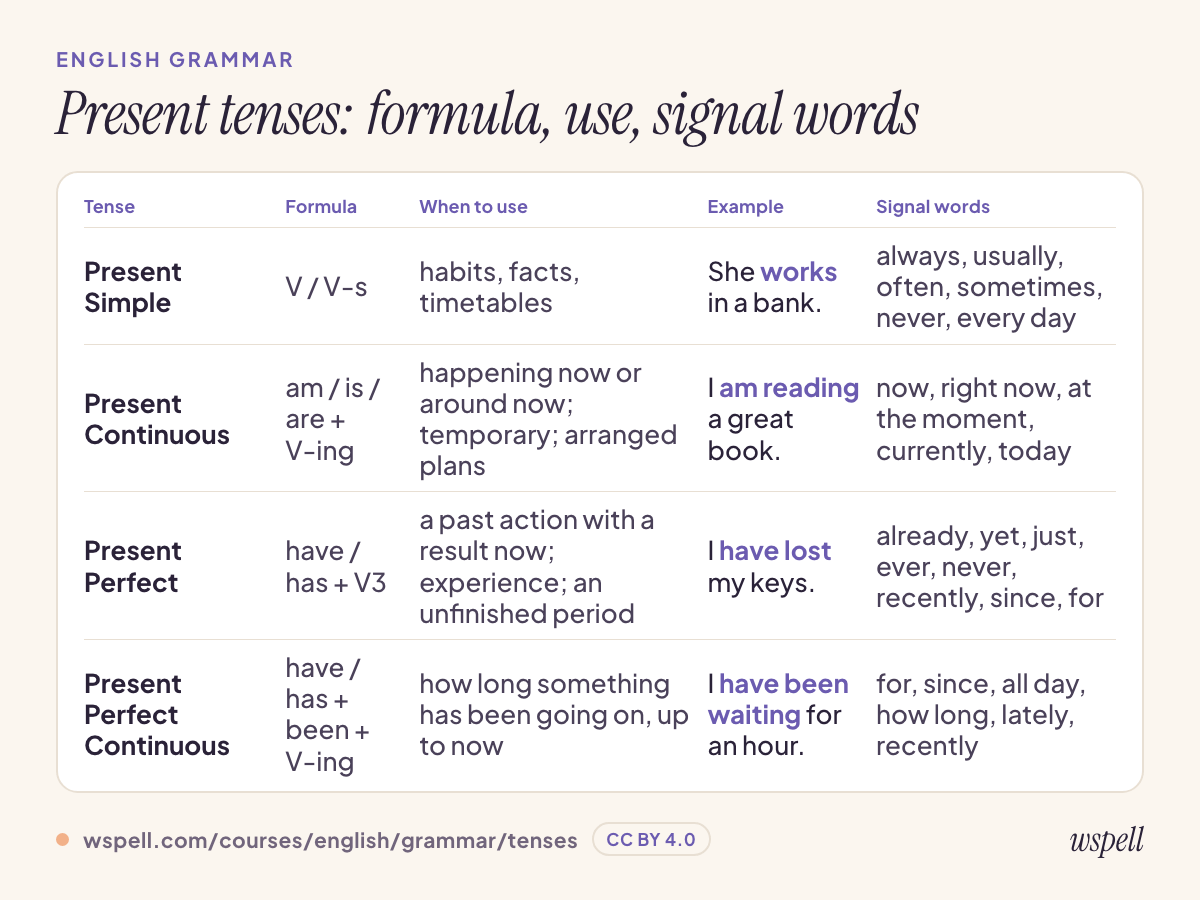
| Tense | Formula | When to use | Example | Signal words |
|---|---|---|---|---|
| Present Simple | V / V-s | habits, facts, timetables | She works in a bank. | always, usually, often, sometimes, never, every day |
| Present Continuous | am / is / are + V-ing | happening now or around now; temporary; arranged plans | I am reading a great book. | now, right now, at the moment, currently, today |
| Present Perfect | have / has + V3 | a past action with a result now; experience; an unfinished period | I have lost my keys. | already, yet, just, ever, never, recently, since, for |
| Present Perfect Continuous | have / has + been + V-ing | how long something has been going on, up to now | I have been waiting for an hour. | for, since, all day, how long, lately, recently |
The past tenses
| Tense | Formula | When to use | Example | Signal words |
|---|---|---|---|---|
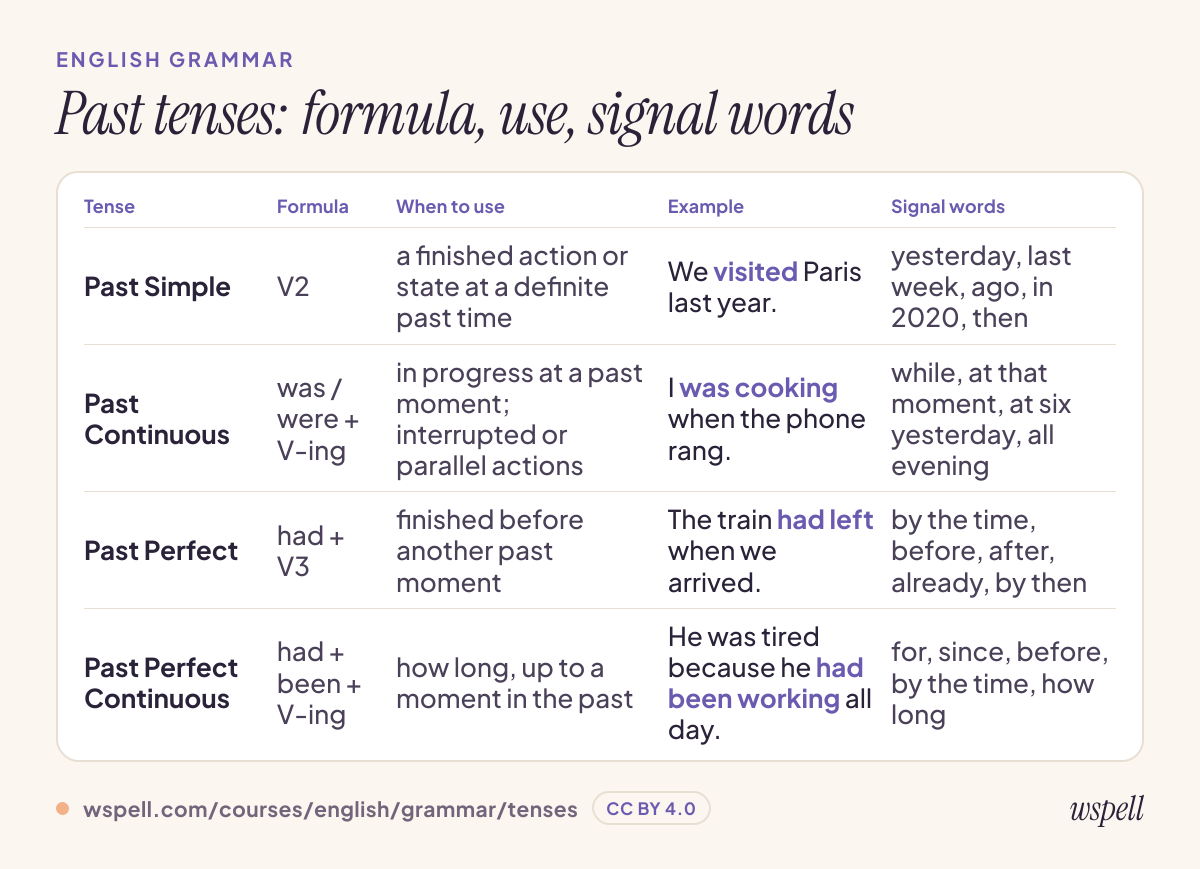
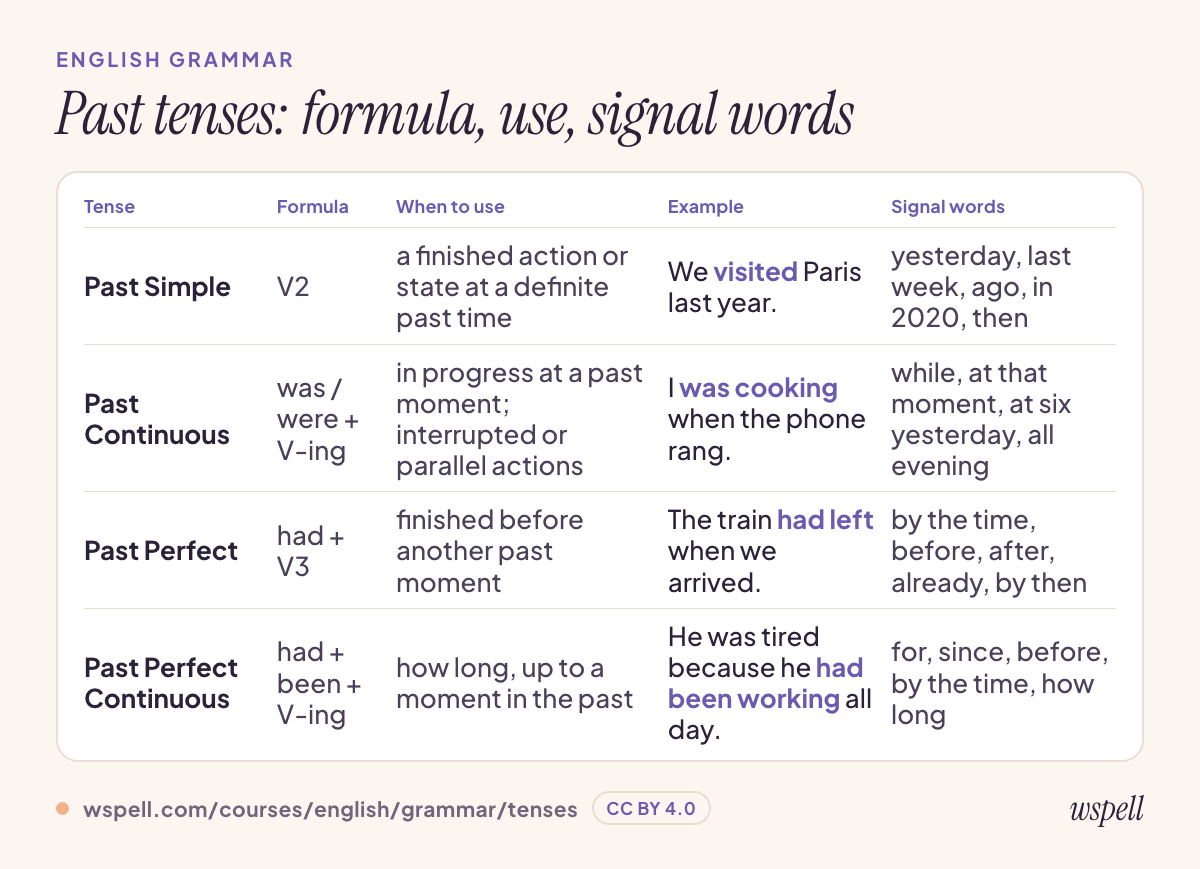
| Past Simple | V2 | a finished action or state at a definite past time | We visited Paris last year. | yesterday, last week, ago, in 2020, then |
| Past Continuous | was / were + V-ing | in progress at a past moment; interrupted or parallel actions | I was cooking when the phone rang. | while, at that moment, at six yesterday, all evening |
| Past Perfect | had + V3 | finished before another past moment | The train had left when we arrived. | by the time, before, after, already, by then |
| Past Perfect Continuous | had + been + V-ing | how long, up to a moment in the past | He was tired because he had been working all day. | for, since, before, by the time, how long |
The future tenses
| Tense | Formula | When to use | Example | Signal words |
|---|---|---|---|---|
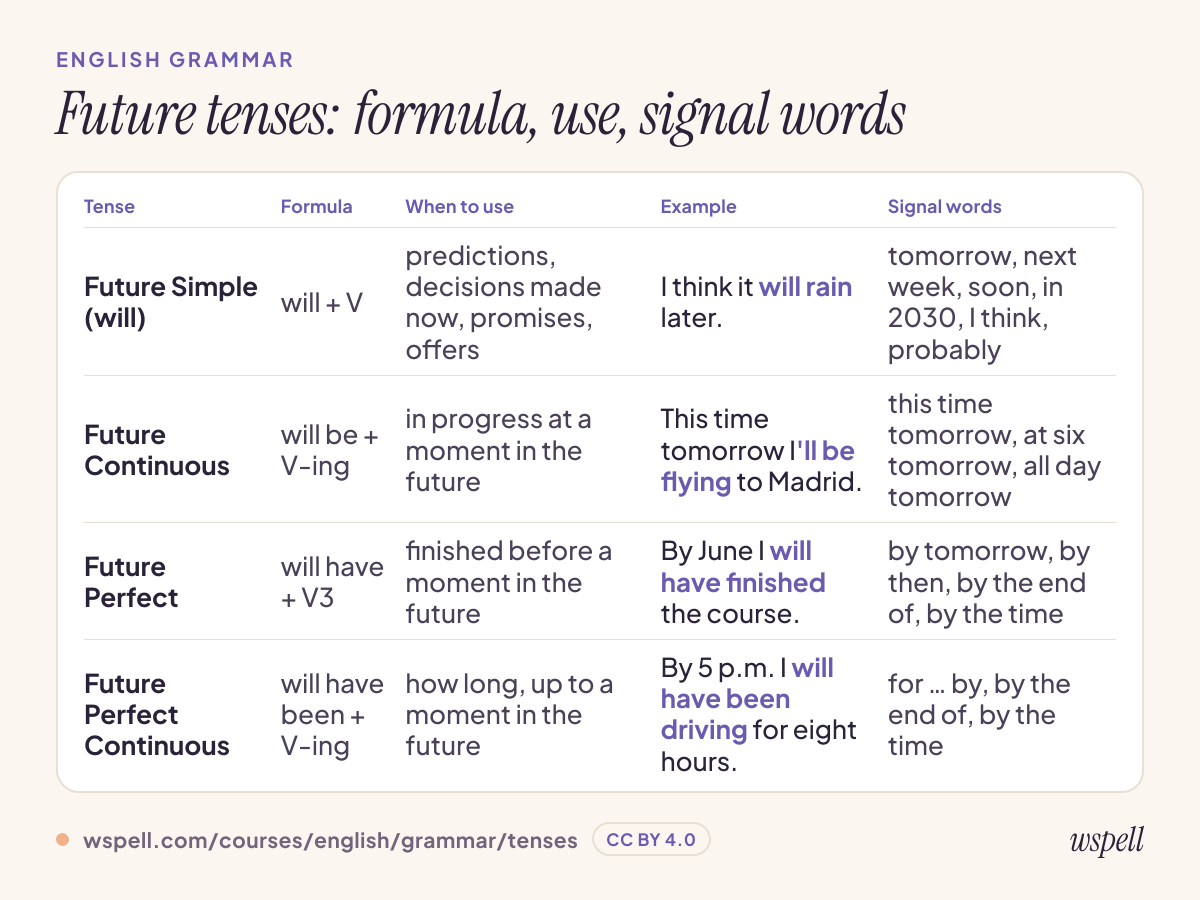
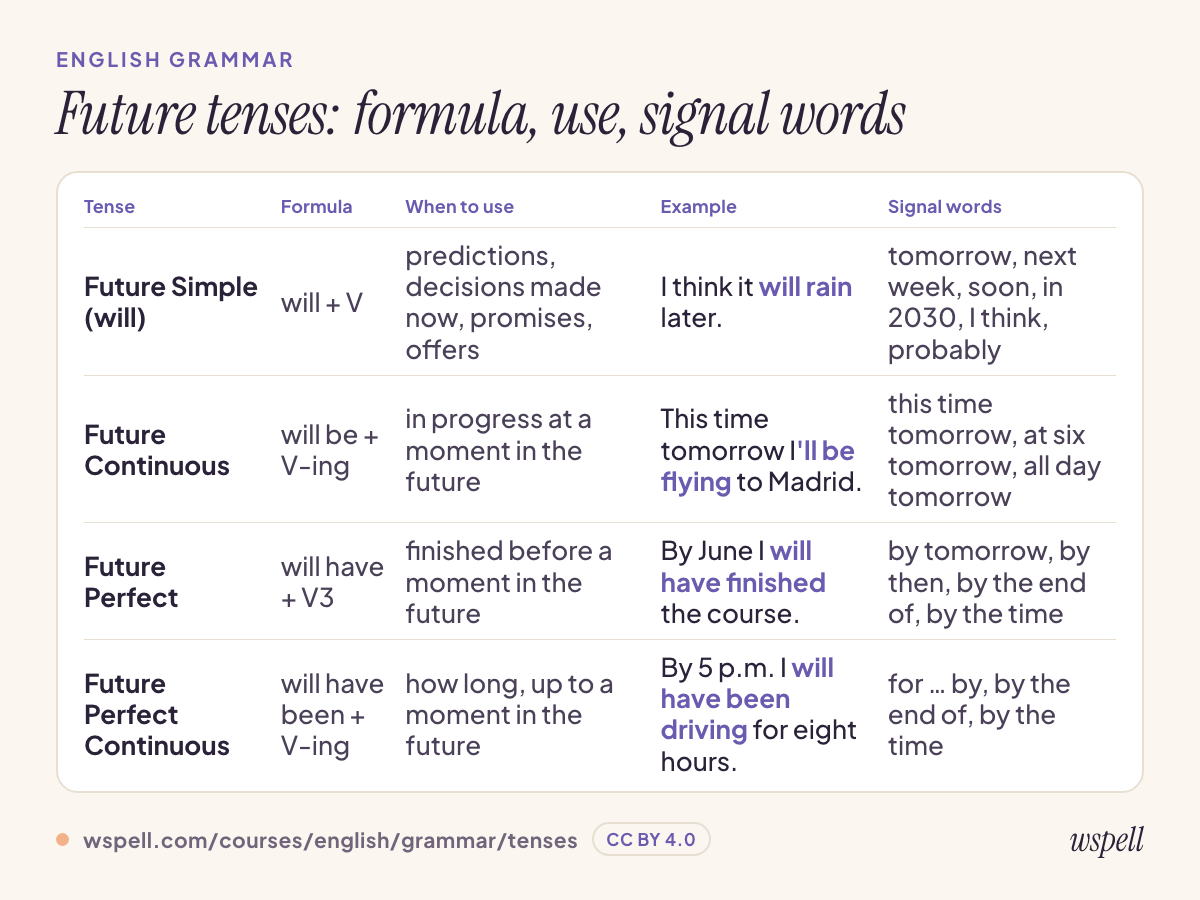
| Future Simple (will) | will + V | predictions, decisions made now, promises, offers | I think it will rain later. | tomorrow, next week, soon, in 2030, I think, probably |
| Future Continuous | will be + V-ing | in progress at a moment in the future | This time tomorrow I'll be flying to Madrid. | this time tomorrow, at six tomorrow, all day tomorrow |
| Future Perfect | will have + V3 | finished before a moment in the future | By June I will have finished the course. | by tomorrow, by then, by the end of, by the time |
| Future Perfect Continuous | will have been + V-ing | how long, up to a moment in the future | By 5 p.m. I will have been driving for eight hours. | for … by, by the end of, by the time |
Negatives and questions in every tense
The Present Simple and Past Simple need do, does or did (except the verb be: Is she? She wasn't); every other tense makes its negative and question with its own first auxiliary.
| Tense | Negative | Question |
|---|---|---|
| Present Simple | She does not write She doesn't write | Does she write? |
| Present Continuous | She is not writing She isn't writing | Is she writing? |
| Present Perfect | She has not written She hasn't written | Has she written? |
| Present Perfect Continuous | She has not been writing She hasn't been writing | Has she been writing? |
| Past Simple | She did not write She didn't write | Did she write? |
| Past Continuous | She was not writing She wasn't writing | Was she writing? |
| Past Perfect | She had not written She hadn't written | Had she written? |
| Past Perfect Continuous | She had not been writing She hadn't been writing | Had she been writing? |
| Future Simple (will) | She will not write She won't write | Will she write? |
| Future Continuous | She will not be writing She won't be writing | Will she be writing? |
| Future Perfect | She will not have written She won't have written | Will she have written? |
| Future Perfect Continuous | She will not have been writing She won't have been writing | Will she have been writing? |
Verbs not normally used in the continuous
Know, want, like: verbs that avoid the continuous
Verbs of state — thinking (know, believe), emotion (like, want), senses (see, hear), and possession (have, own) — normally take the simple, not the continuous. Some shift meaning in the continuous (I'm thinking = considering; I think = opinion).
- I know the answer.
- I'm thinking about moving.
learn it step by step
save or print this chart
Under the main tables on this page sits a picture of each — keep one on your phone, share it or print it.
Free to share and adapt under CC BY 4.0 — credit wspell and link to this page. the licence
credit line to copy: English tenses table: all 12 tenses with formulas and examples — wspell, CC BY 4.0, https://wspell.com/courses/english/grammar/tenses
questions
How many tenses are there in English?
Twelve in the usual count: the present, past and future, each simple, continuous, perfect and perfect continuous. Some grammars count only two true tenses (present and past), and treat the continuous and perfect forms as aspects and will as a modal verb, but the twelve-tense table is how they are usually taught.
How do you make a question in the Present Simple and Past Simple?
With do, does or did before the subject and the base form after it: Does she write? Did she write? In every other tense the first auxiliary moves in front of the subject: Is she writing? Has she written? Will she write? (The verb be needs no do: Is she ready? Was it late?)
What are signal words?
Time words that usually go with a tense: always and every day with the Present Simple, now and at the moment with the Present Continuous, yesterday and ago with the Past Simple, already, yet and since with the Present Perfect. They are hints, not rules.
Why is it 'I know' and not 'I am knowing'?
Verbs of state — know, believe, like, want, own — normally stay in the simple form even when you mean right now. Some change meaning in the continuous: I think (my opinion) but I'm thinking (I'm considering it).