grammar chart · English
The passive voice in every English tense
The passive is be in the tense you need + the past participle (V3): The house is built, was built, has been built, will be built. The tense lives in be; the participle never changes. Use it when the doer is unknown, obvious or unimportant, and name the doer with by when it matters.
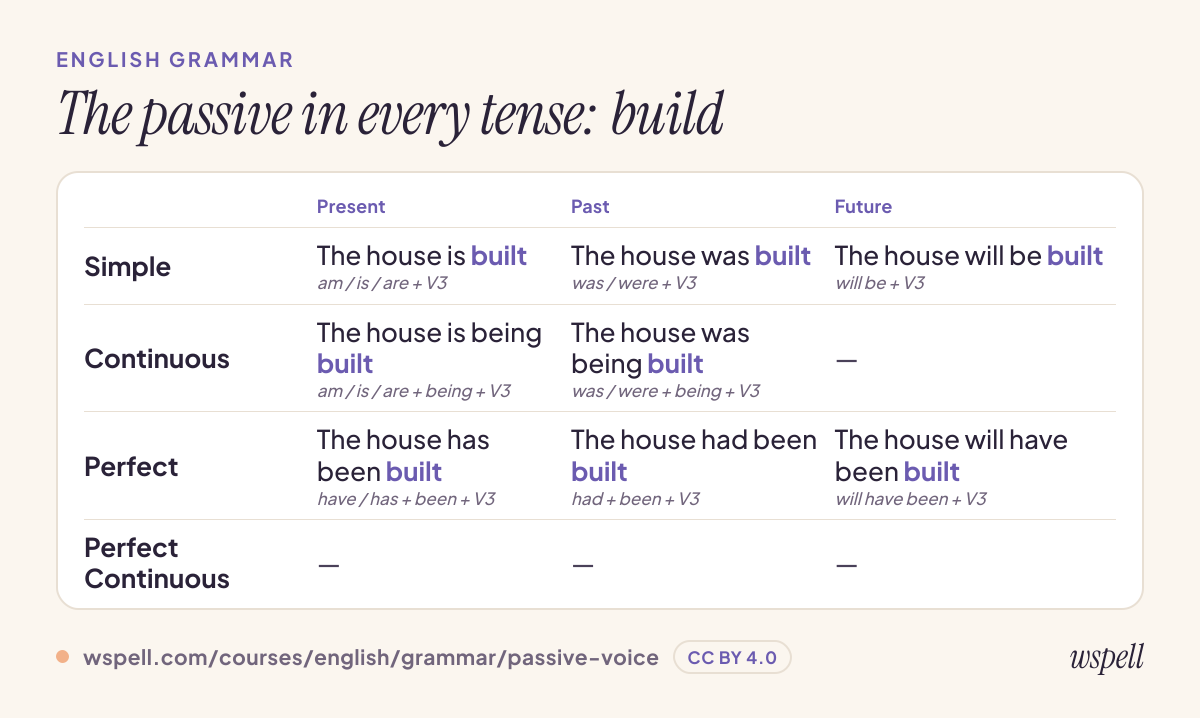
The passive in every tense
A dash marks the perfect continuous and future continuous passives, which English avoids.
| Present | Past | Future | |
|---|---|---|---|
| Simple | The house is built am / is / are + V3 | The house was built was / were + V3 | The house will be built will be + V3 |
| Continuous | The house is being built am / is / are + being + V3 | The house was being built was / were + being + V3 | — |
| Perfect | The house has been built have / has + been + V3 | The house had been built had + been + V3 | The house will have been built will have been + V3 |
| Perfect Continuous | — | — | — |
Formula, statement and question
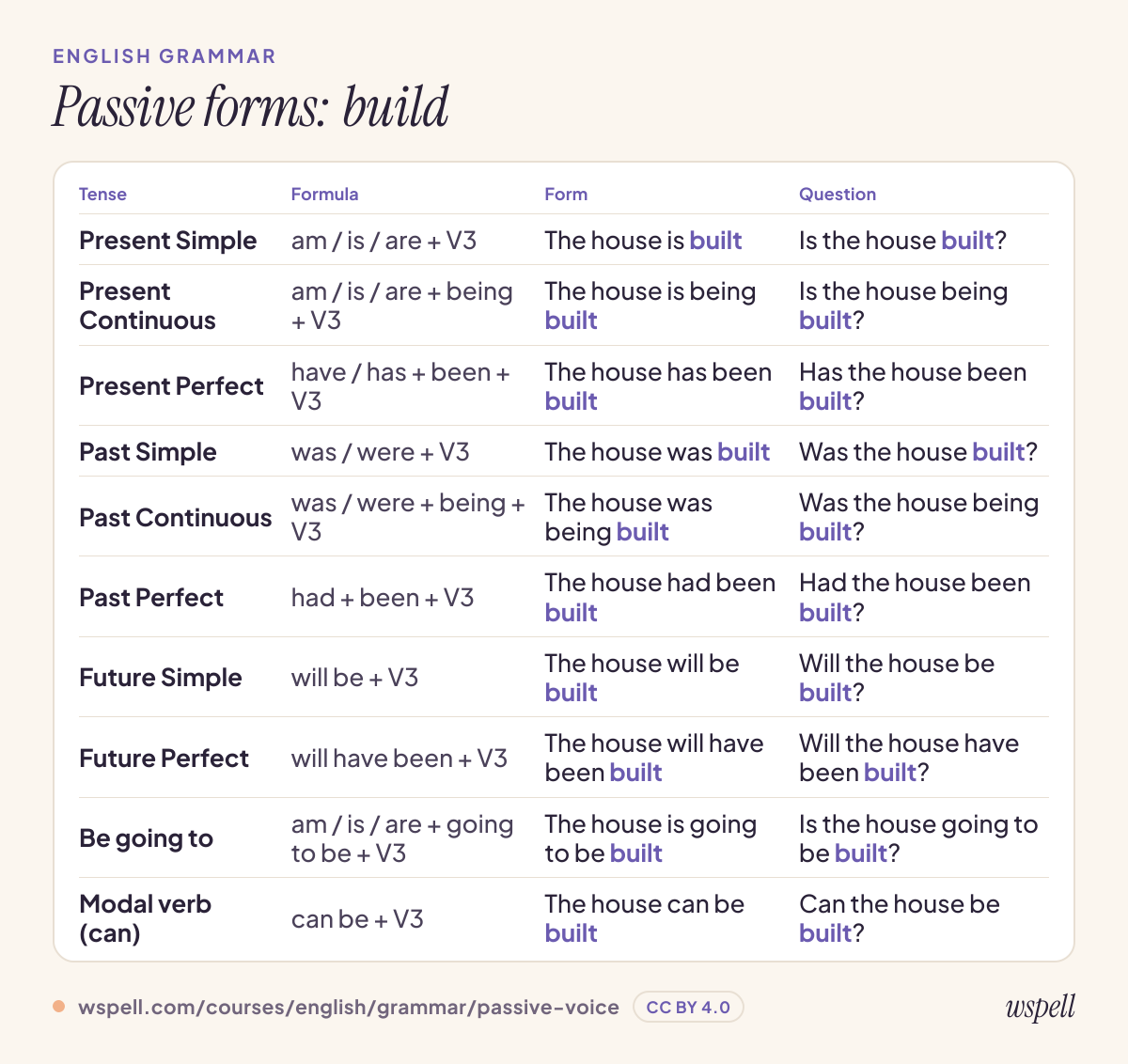
| Tense | Formula | Form | Question |
|---|---|---|---|
| Present Simple | am / is / are + V3 | The house is built | Is the house built? |
| Present Continuous | am / is / are + being + V3 | The house is being built | Is the house being built? |
| Present Perfect | have / has + been + V3 | The house has been built | Has the house been built? |
| Past Simple | was / were + V3 | The house was built | Was the house built? |
| Past Continuous | was / were + being + V3 | The house was being built | Was the house being built? |
| Past Perfect | had + been + V3 | The house had been built | Had the house been built? |
| Future Simple | will be + V3 | The house will be built | Will the house be built? |
| Future Perfect | will have been + V3 | The house will have been built | Will the house have been built? |
| Be going to | am / is / are + going to be + V3 | The house is going to be built | Is the house going to be built? |
| Modal verb (can) | can be + V3 | The house can be built | Can the house be built? |
How the passive is formed
The passive: be + past participle
Turn the object into the subject with be (in the needed tense) + past participle; the doer, if named, follows 'by'. Used when the agent is unknown, obvious or unimportant.
- The house was built in 1900.
- English is spoken here.
The passive in every tense
Every tense passivises by putting 'be' into that tense before the past participle: is done, was done, has been done, is being done, will be done, is going to be done. The perfect continuous passives (has/had been being done) and the future continuous passive (will be being done) are avoided.
- The road is being repaired.
- The results have been announced.
Naming the doer: by
Who did it: by + the doer
When the agent matters it is named with 'by' + noun: "Hamlet was written by Shakespeare." The by-phrase is optional and is left out whenever the doer is obvious, general, or unknown.
- The window was broken by the storm.
Get hurt, have something done
Get hurt, get married: the get-passive
In informal English 'get' replaces 'be' in the passive, often for sudden, unplanned or adverse events (get hurt, get married, got caught).
- He got hurt in the game.
I had my hair cut: have something done
have + object + past participle (or get + object + past participle) means arranging for someone else to do the job, not doing it yourself: 'I had my car repaired'. It also reports something that happened to you ('she had her bag stolen').
- I had my hair cut yesterday.
- We're getting the kitchen painted.
learn it step by step
save or print this chart
Under the main tables on this page sits a picture of each — keep one on your phone, share it or print it.
Free to share and adapt under CC BY 4.0 — credit wspell and link to this page. the licence
credit line to copy: The passive voice in every English tense — wspell, CC BY 4.0, https://wspell.com/courses/english/grammar/passive-voice
questions
How do you form the passive in English?
Put be into the tense you need and add the past participle (V3): is cleaned, was built, has been announced, will be done. The doer, if you name it, follows by.
Does every tense have a passive?
Not in practice. The perfect continuous passives (has been being built) and the future continuous passive (will be being built) are avoided; the other forms are used.
When is the passive used?
When the doer is unknown, obvious or unimportant, or when the thing done is the topic: The bridge was built in 1930. English is spoken here.