grammar chart · English
In, on, at: prepositions of time and place
For time, the choice goes by length: at for a point on the clock, on for a day or a date, in for anything longer, and for parts of the day (in the morning). For place it goes by shape: at for a point, on for a surface, in for inside a space or an area. A few fixed phrases break the pattern — at night, on time, on a bus.
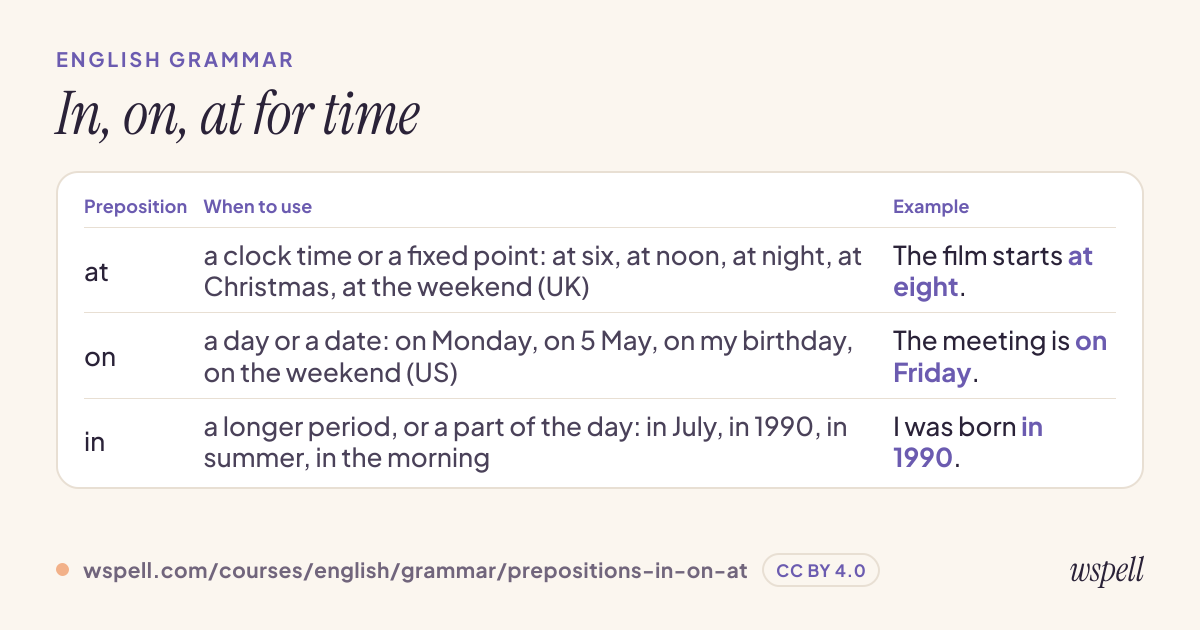
In, on, at for time
| Preposition | When to use | Example |
|---|---|---|
| at | a clock time or a fixed point: at six, at noon, at night, at Christmas, at the weekend (UK) | The film starts at eight. |
| on | a day or a date: on Monday, on 5 May, on my birthday, on the weekend (US) | The meeting is on Friday. |
| in | a longer period, or a part of the day: in July, in 1990, in summer, in the morning | I was born in 1990. |
In, on, at for place
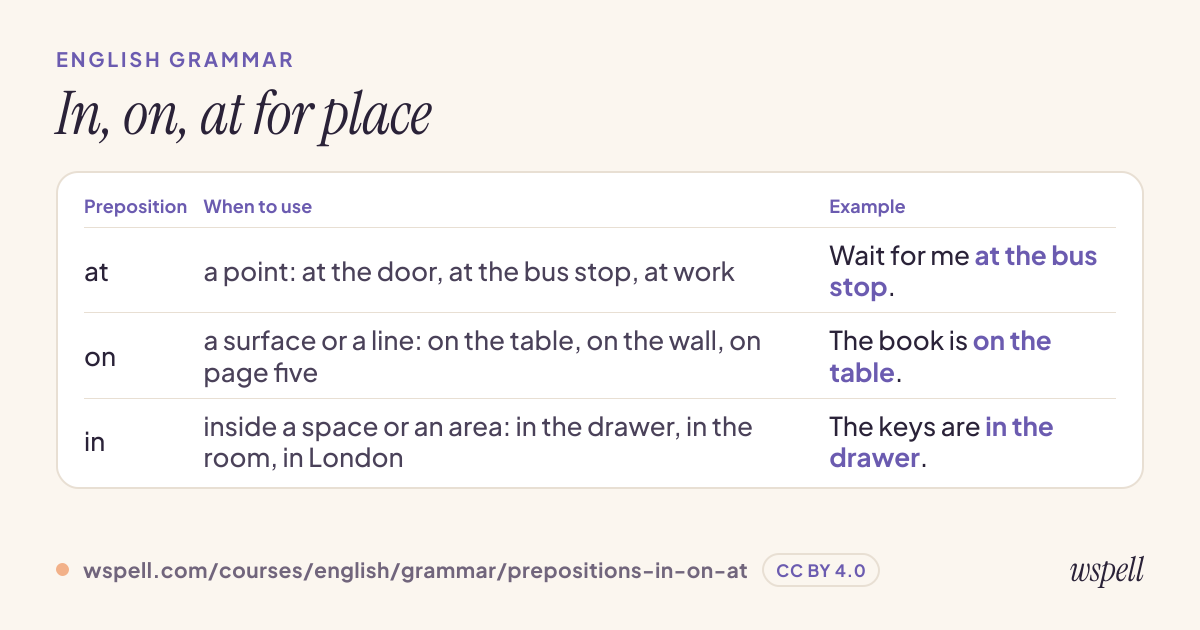
| Preposition | When to use | Example |
|---|---|---|
| at | a point: at the door, at the bus stop, at work | Wait for me at the bus stop. |
| on | a surface or a line: on the table, on the wall, on page five | The book is on the table. |
| in | inside a space or an area: in the drawer, in the room, in London | The keys are in the drawer. |
Time: the rule and the exceptions
In, on or at for time?
By span: at for a point on the clock (at 6), on for a whole day or date (on Monday), in for anything longer (in June, in 2020). Note the idioms at night but in the morning / afternoon / evening.
- We arrive at noon on Sunday in December.
- He never sleeps at night.
On time or in time?
Two set phrases with different meanings: on time means punctual, at the scheduled moment; in time (for) means early enough, before it is too late (just in time = only just early enough). The train left on time / We arrived in time for the film.
- The bus always leaves on time.
- We got there in time for dinner.
Place: the rule, transport and arrive
In, on or at for place?
Choose by dimension: in for enclosed volumes and areas (in London), on for surfaces and lines (on the shelf), at for exact points and addresses (at the station). This one contrast underlies most place errors.
- She lives in London, on the third floor, at number ten.
- Meet me at the entrance.
In a car, on a bus
A fixed idiom split: use in for small vehicles you sit inside (in a car, in a taxi) but on for large public transport you board and can walk in (on a bus, on a train, on a plane, on a ship).
- The children are in the car.
- I met her on the train.
Arrive in, arrive at — never arrive to a place
arrive takes in for towns and countries (arrive in Paris), at for buildings, events, and points (arrive at the airport), and no preposition before home (arrive home). Arrive to before a place is always wrong (arrive to find the door locked is fine).
- We arrived in London late.
- They arrived at the airport early.
learn it step by step
save or print this chart
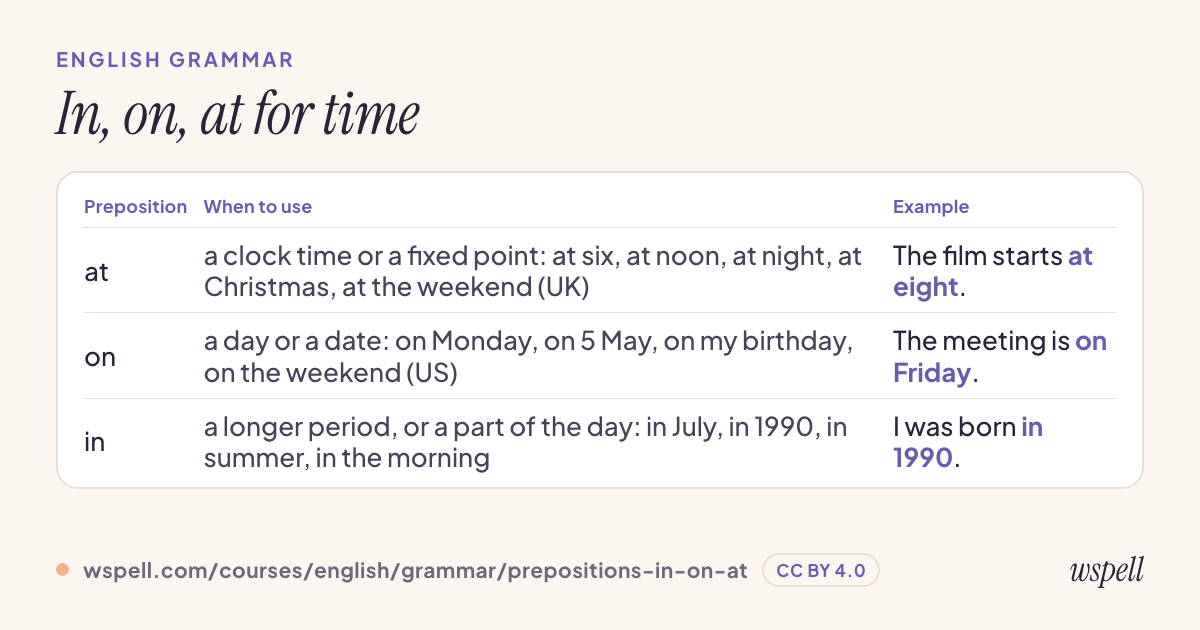
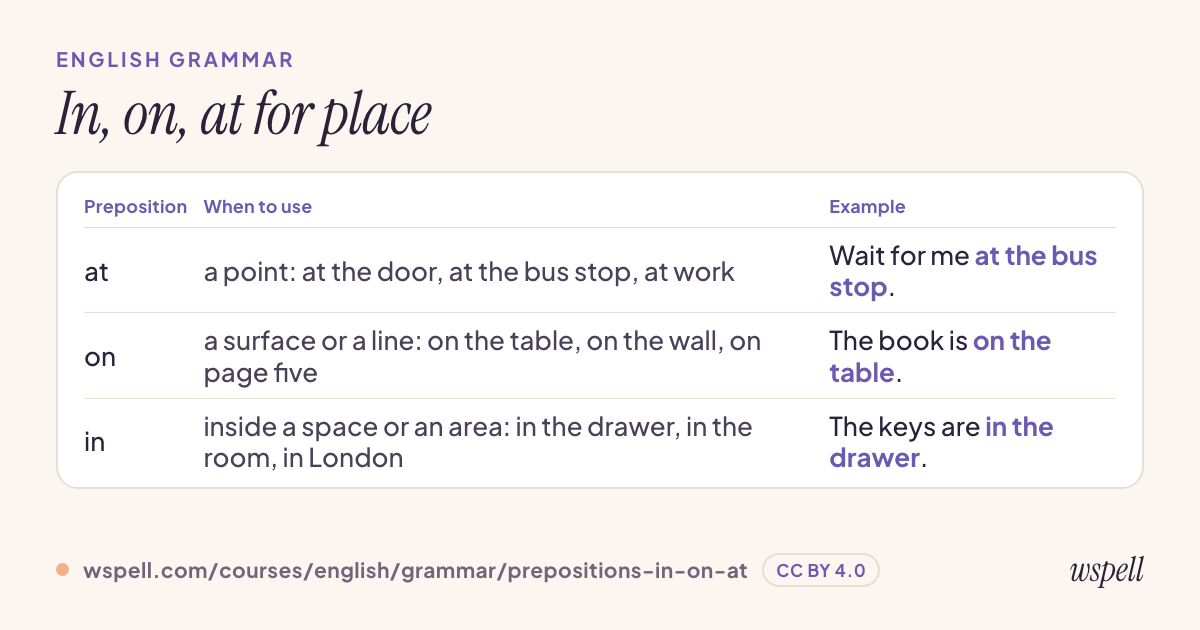
Under the main tables on this page sits a picture of each — keep one on your phone, share it or print it.
Free to share and adapt under CC BY 4.0 — credit wspell and link to this page. the licence
credit line to copy: In, on, at: prepositions of time and place — wspell, CC BY 4.0, https://wspell.com/courses/english/grammar/prepositions-in-on-at
questions
In the morning or at the morning?
In the morning, in the afternoon, in the evening — but at night. Add a day and it becomes on: on Friday morning.
At the weekend or on the weekend?
At the weekend is British English; on the weekend is American English. Both are correct in their variety.
In a car or on a car?
In a car or a taxi — small vehicles you sit inside; on a bus, a train, a plane or a ship — large transport you board and can walk around in.