grammar chart · English
English conditionals: zero, first, second and third
A conditional sentence has two halves: the if-clause (the condition) and the main clause (the result). Which tenses go in each half depends on how real the situation is — always true (zero), possible (first), imaginary now (second) or an imagined past (third).
The four conditionals
V = base form, V3 = past participle. The two halves can come in either order; when the if-clause comes first, a comma follows it.
| Type | If-clause | Main clause | When to use | Example |
|---|---|---|---|---|
| Zero | Present Simple | Present Simple | always true: facts, laws of nature, habits | If you heat ice, it melts. |
| First | Present Simple | will + V | a real, possible future and its result | If it rains, we'll stay home. |
| Second | Past Simple | would + V | imaginary or unlikely, now or in the future | If I had more time, I would travel. |
| Third | Past Perfect | would have + V3 | an imagined past that did not happen; regrets | If I had known, I would have helped. |
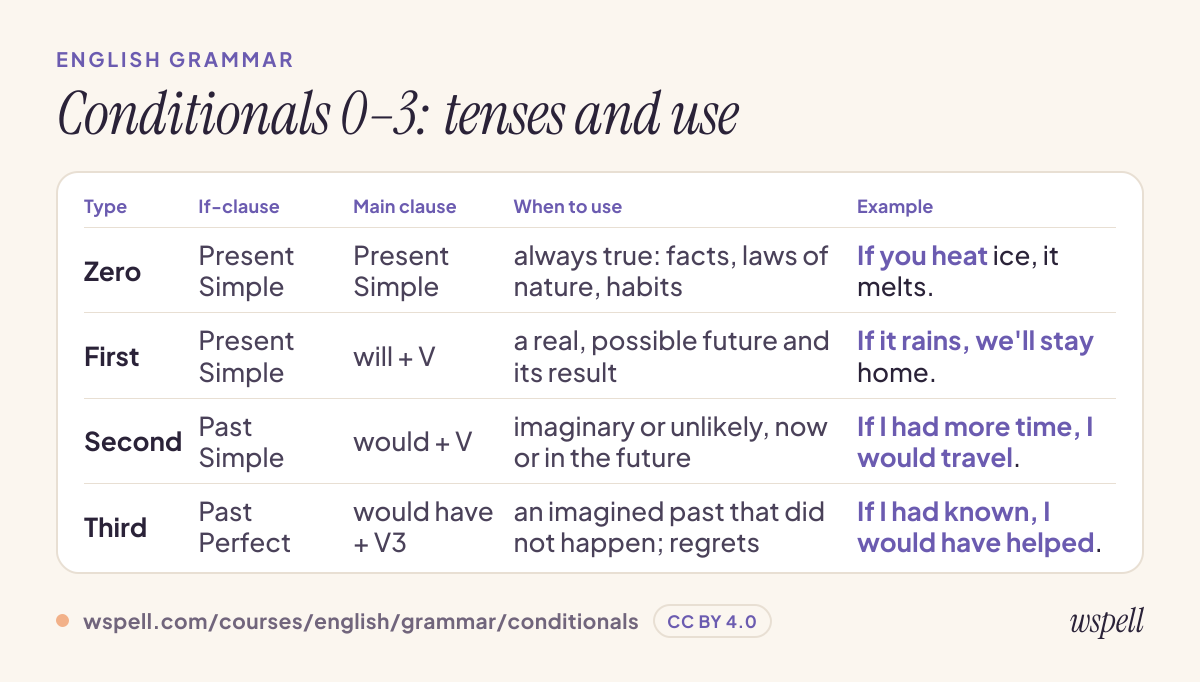
Zero and first conditional
Zero conditional: always true
if/when + present simple, present simple in the main clause, for things always true — laws of nature, habits, definitions.
- If you heat ice, it melts.
First conditional: a real future
if + present simple, will + base for a likely future situation and its result. The if-clause does not normally take 'will' (except for willingness: If you'll wait here, I'll get him).
- If it rains, we'll stay home.
Second and third conditional
Second conditional: imaginary now
if + past simple, would + base for an imaginary or unlikely present/future situation. 'Were' is used for all persons, especially in formal English and always in 'if I were you'; 'was' (if I was) is common in everyday speech.
- If I had more time, I would travel.
- If I were you, I'd apologise.
Third conditional: an imagined past
if + past perfect, would have + past participle for an imagined, unreal past and its imagined result — regrets and missed possibilities.
- If I had known, I would have helped.
Mixed conditionals
Mixed conditionals: past and present crossed
The clauses can cross time: a past condition with a present result (if + past perfect, would + base) or a present condition with a past result (if + past simple, would have + V-en).
- If I had studied medicine, I would be a doctor now.
Unless, as long as, provided that
Other conditional conjunctions refine the condition: unless = 'if not' ("I won't go unless you come"); as long as / provided (that) / on condition that add a requirement ("You can stay as long as you're quiet").
- Unless it rains, we'll play outside.
- You can borrow it as long as you return it.
I wish and if only
After wish/if only, use the past simple for an unreal present, the past perfect for a regret about the past, and would + base to complain about someone else's behaviour.
- I wish I were taller.
- I wish you had told me.
learn it step by step
save or print this chart
Under the main tables on this page sits a picture of each — keep one on your phone, share it or print it.
Free to share and adapt under CC BY 4.0 — credit wspell and link to this page. the licence
credit line to copy: English conditionals: zero, first, second and third — wspell, CC BY 4.0, https://wspell.com/courses/english/grammar/conditionals
questions
Can I use will in the if-clause?
Not normally: If it rains, we'll stay home — not if it will rain. Will belongs in the main clause; the exception is will of willingness: If you'll wait here, I'll get him.
Is it 'if I was' or 'if I were'?
In the second conditional, were is used for every person, especially in formal English, and always in If I were you. If I was is common in everyday speech.
What is the difference between the second and the third conditional?
The second imagines the present or future: If I had more time, I would travel (but I don't have it). The third imagines the past: If I had known, I would have helped (but I didn't know).