grammar chart · English
Present Simple vs Present Continuous
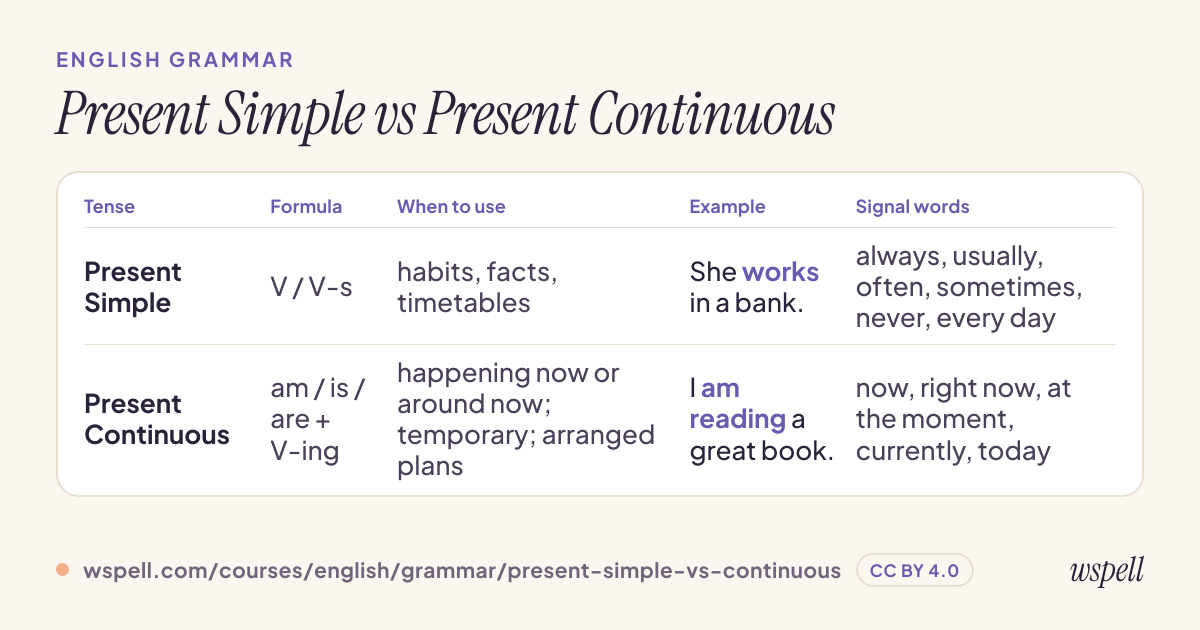
The Present Simple is for what is generally true — habits, facts, timetables: She works in a bank. The Present Continuous is for what is happening now or around now: She is working at the moment. The first table compares them; the next two give each one in every person, positive, negative and question.
The difference at a glance
| Tense | Formula | When to use | Example | Signal words |
|---|---|---|---|---|
| Present Simple | V / V-s | habits, facts, timetables | She works in a bank. | always, usually, often, sometimes, never, every day |
| Present Continuous | am / is / are + V-ing | happening now or around now; temporary; arranged plans | I am reading a great book. | now, right now, at the moment, currently, today |
Present Simple: I work, he works
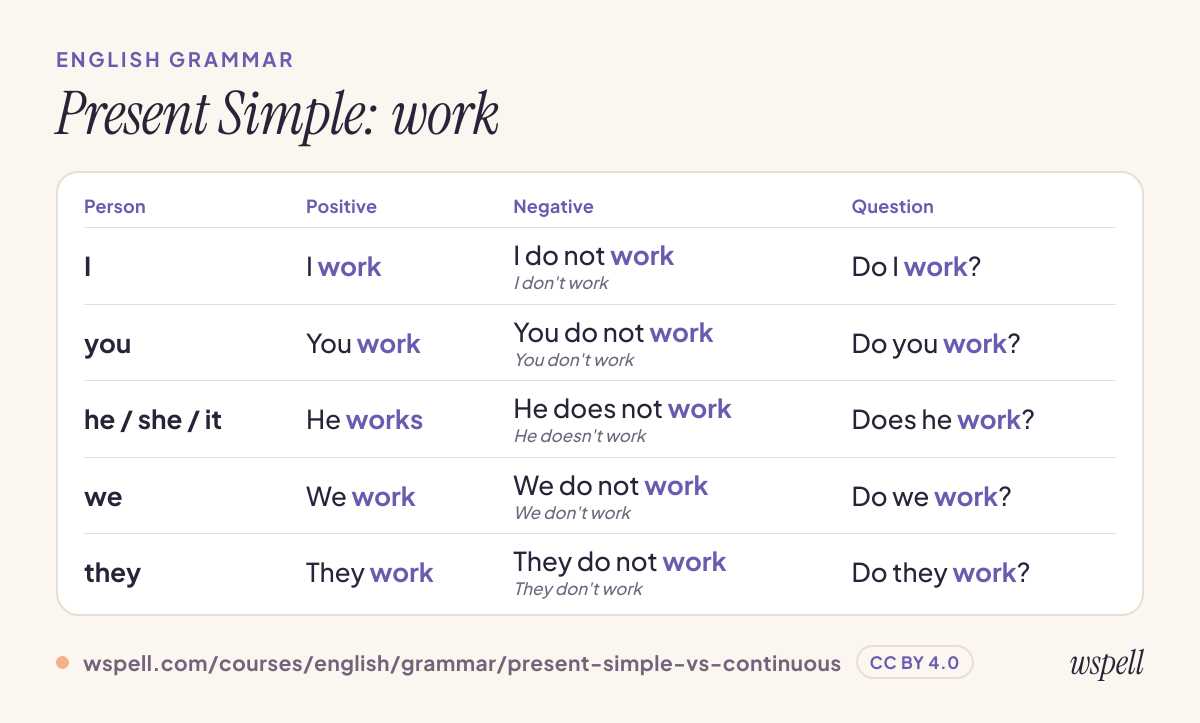
| Person | Positive | Negative | Question |
|---|---|---|---|
| I | I work | I do not work I don't work | Do I work? |
| you | You work | You do not work You don't work | Do you work? |
| he / she / it | He works | He does not work He doesn't work | Does he work? |
| we | We work | We do not work We don't work | Do we work? |
| they | They work | They do not work They don't work | Do they work? |
Present Simple: habits, facts, timetables
Base form for all persons except 3rd singular, which adds -s/-es. Used for habits, permanent states, general truths and scheduled events — not for actions happening right now.
- She works in a bank.
- Water boils at 100 degrees.
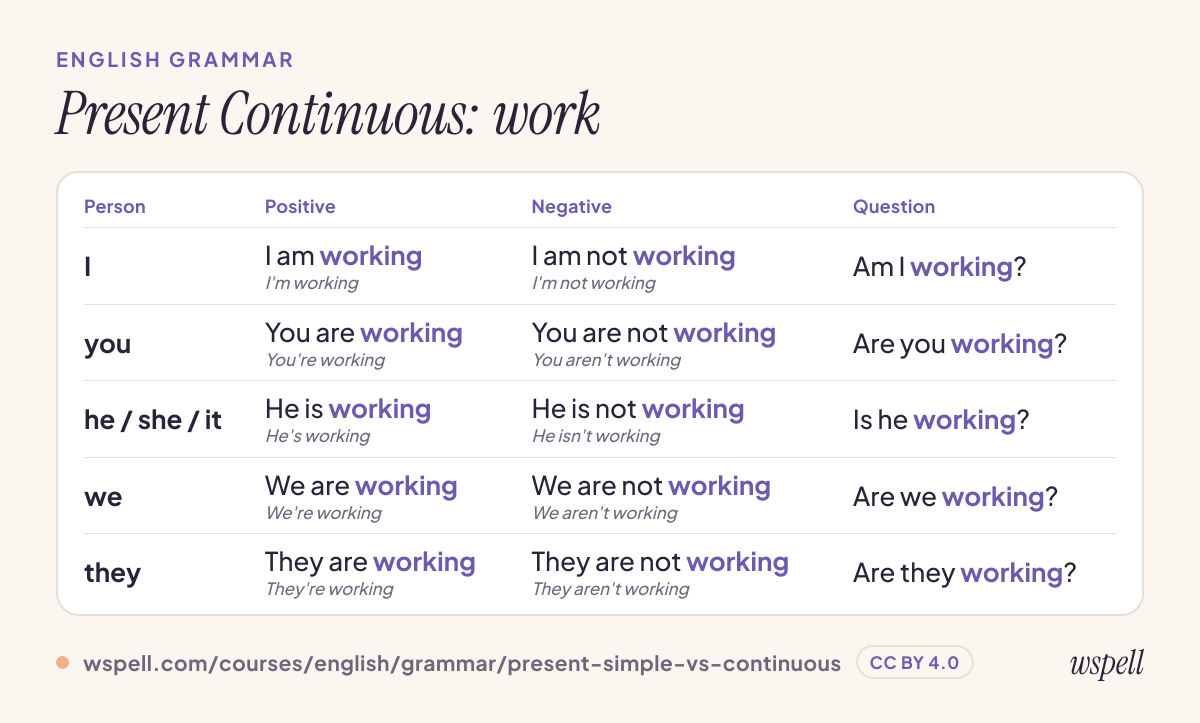
Present Continuous: I am working
| Person | Positive | Negative | Question |
|---|---|---|---|
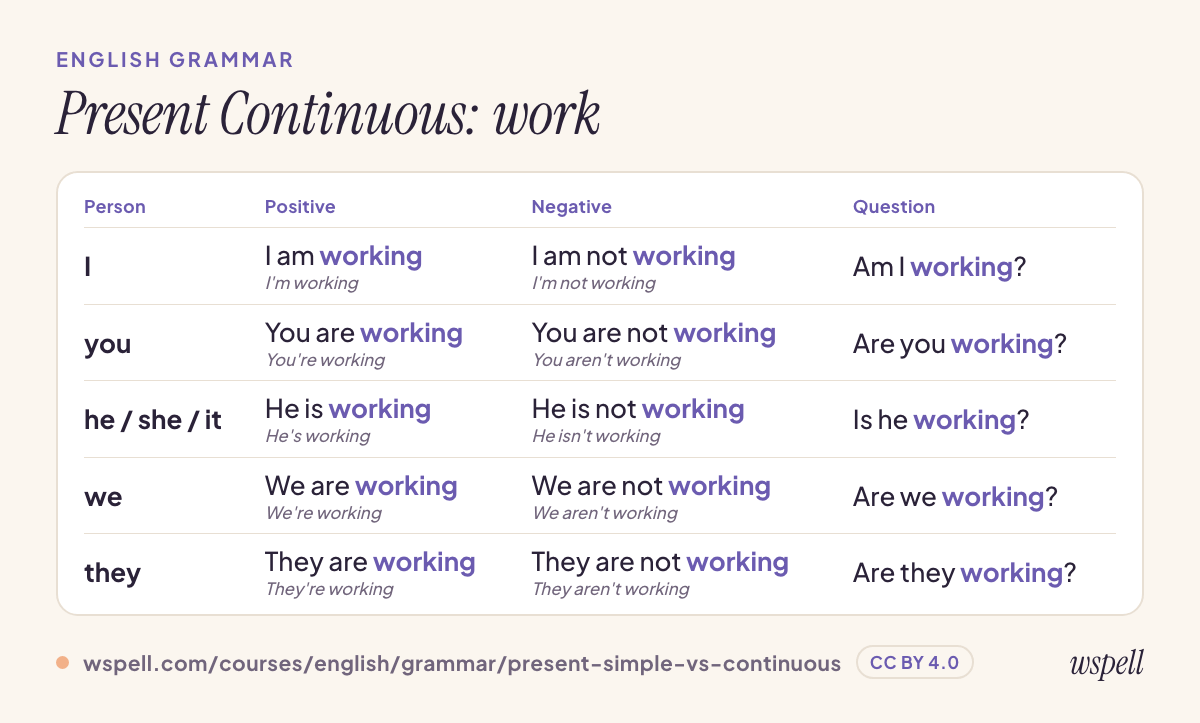
| I | I am working I'm working | I am not working I'm not working | Am I working? |
| you | You are working You're working | You are not working You aren't working | Are you working? |
| he / she / it | He is working He's working | He is not working He isn't working | Is he working? |
| we | We are working We're working | We are not working We aren't working | Are we working? |
| they | They are working They're working | They are not working They aren't working | Are they working? |
Present Continuous: happening now
be + present participle for an action in progress now or around now, and for arranged future plans. Not normally used with stative verbs (know, want, belong).
- I am reading a great book.
- They are meeting us tomorrow.
Spelling: -s, -es, -ies and -ing
He works, she watches, it goes: the -s of he, she and it
Add -es after -s, -ss, -sh, -ch, -x, -z and -o (watches, fixes, goes, does); consonant + y becomes -ies (studies), but vowel + y just adds -s (plays). The ending sounds /ɪz/ after a hissing or hushing sound (watches), /s/ after other voiceless sounds (works), /z/ otherwise (plays, goes).
- He watches the news and studies English.
- The plane goes to Rome.
Making, sitting, dying: spelling the -ing form
Drop a silent final -e (make → making); double a final consonant after a single stressed vowel (sit → sitting, begin → beginning) but not when the stress is elsewhere (open → opening), and never a final w, x or y (snowing, fixing, playing); -ie becomes -y (die → dying). British English also doubles a final -l after an unstressed vowel (travelling; American traveling).
- We are planning a trip and swimming daily.
Verbs not normally used in the continuous
Know, want, like: verbs that avoid the continuous
Verbs of state — thinking (know, believe), emotion (like, want), senses (see, hear), and possession (have, own) — normally take the simple, not the continuous. Some shift meaning in the continuous (I'm thinking = considering; I think = opinion).
- I know the answer.
- I'm thinking about moving.
learn it step by step
save or print this chart
Under the main tables on this page sits a picture of each — keep one on your phone, share it or print it.
Free to share and adapt under CC BY 4.0 — credit wspell and link to this page. the licence
credit line to copy: Present Simple vs Present Continuous — wspell, CC BY 4.0, https://wspell.com/courses/english/grammar/present-simple-vs-continuous
questions
What is the difference between the Present Simple and the Present Continuous?
The Present Simple describes habits, facts and timetables (I drink coffee every morning; water boils at 100 degrees). The Present Continuous describes an action in progress now or around now, or a temporary situation (I'm drinking coffee — right now).
Why does the verb take -s with he, she and it?
In the Present Simple the third person singular adds -s: I work, she works. Verbs ending in -s, -ss, -sh, -ch, -x or -z add -es (watches), consonant + y becomes -ies (studies), and go and do become goes and does.
Can the Present Continuous talk about the future?
Yes, for a fixed personal arrangement: I'm seeing the doctor at three. A timetable takes the Present Simple: The film starts at eight.