grammar chart · English
English articles: a, an, the or no article
English has two articles: a/an, for one thing that is not specific, and the, for the one you both know. A third choice is no article at all — for things in general, most names, meals and languages. The table shows the main cases; the sections below go through each article.
A / an, the or no article
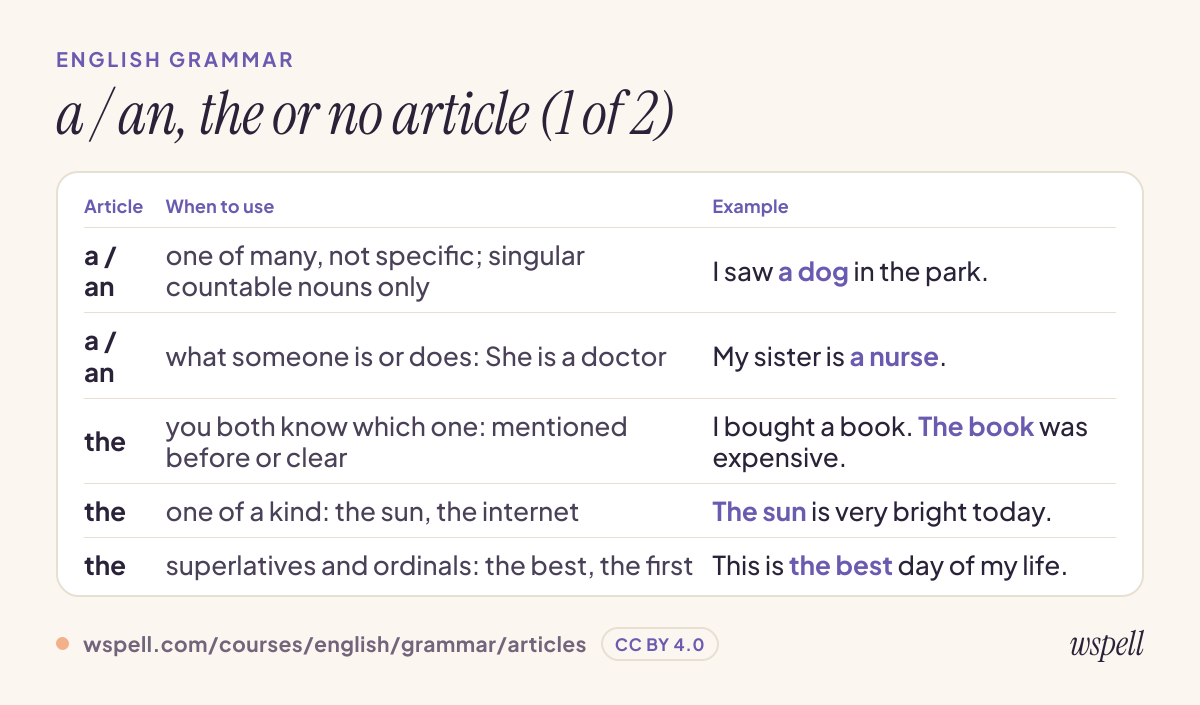
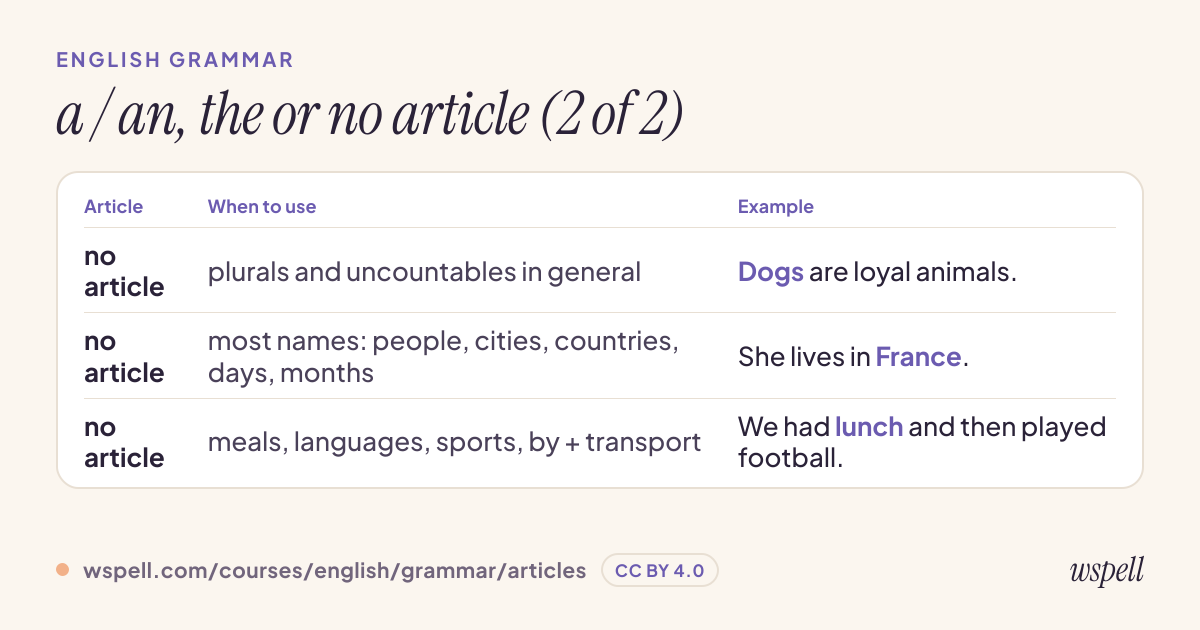
| Article | When to use | Example |
|---|---|---|
| a / an | one of many, not specific; singular countable nouns only | I saw a dog in the park. |
| a / an | what someone is or does: She is a doctor | My sister is a nurse. |
| the | you both know which one: mentioned before or clear | I bought a book. The book was expensive. |
| the | one of a kind: the sun, the internet | The sun is very bright today. |
| the | superlatives and ordinals: the best, the first | This is the best day of my life. |
| no article | plurals and uncountables in general | Dogs are loyal animals. |
| no article | most names: people, cities, countries, days, months | She lives in France. |
| no article | meals, languages, sports, by + transport | We had lunch and then played football. |
A / an, and a or an
A / an: one of many
Use the indefinite article with a singular countable noun mentioned for the first time or not specific; it means roughly 'one / any one'. It does not go before a plural or an uncountable noun (not 'an advice') — unless the uncountable noun names a kind or an amount: a good knowledge of English, a coffee.
- I saw a dog in the park.
- She wants to buy an umbrella.
A or an? The sound decides
Choose 'an' before a vowel SOUND and 'a' before a consonant sound — go by pronunciation: an hour (silent h), a university (/juː/), an MP (/em/).
- We waited for an hour.
- He is a university student.
When to use the
The: you both know which one
Use 'the' when both speaker and listener know which one is meant — because it was mentioned before, is unique, or is clear from context. 'The' is invariable for singular, plural, countable and uncountable.
- I bought a book. The book was expensive.
- Please close the door.
The Thames, the Alps, but Lake Geneva
Use 'the' with rivers, seas, oceans, canals, deserts, mountain ranges, groups of islands, and plural/political country names (the Nile, the Alps, the Netherlands, the USA), but NOT with single mountains, lakes, or most country names (France, Japan).
- The Thames flows through London.
- They sailed across the Atlantic.
Play the piano
Use 'the' with a musical instrument as a skill: 'play the guitar, the violin'. (Leaving out the — play guitar, play piano — is also common, especially in American English; keeping it is always correct.)
- She plays the piano beautifully.
When to use no article
No article: things in general
Use NO article when you talk about plural countable or uncountable nouns in general: 'Cats are independent', 'Water is essential'. Adding 'the' would narrow it to a specific group.
- Dogs are loyal animals.
- Milk contains calcium.
Have lunch, speak English, by bus: no article
No article with meals (have breakfast), languages (speak Spanish), academic subjects, sports (play tennis), and 'by' + means of transport (by bus, by car).
- We had lunch and then played football.
- I go to work by train.
Go to school or go to the school?
Drop the article when using an institution for its primary purpose (go to school = to study, in hospital = as a patient — British; American English says in the hospital); keep 'the' when you mean the physical building or a specific one.
- My son goes to school every day.
- I drove to the school to fix the roof.
Talking about a whole class
Three ways to talk about a whole class
For a whole class you can say 'A dog is loyal' (any typical member), 'The dog is loyal' (the species, formal), or 'Dogs are loyal' (the natural, most common option). The zero-plural is the default; 'the' + singular sounds scientific.
- The tiger is an endangered species.
- Tigers are endangered.
learn it step by step
save or print this chart
Under the main tables on this page sits a picture of each — keep one on your phone, share it or print it.
Free to share and adapt under CC BY 4.0 — credit wspell and link to this page. the licence
credit line to copy: English articles: a, an, the or no article — wspell, CC BY 4.0, https://wspell.com/courses/english/grammar/articles
questions
When do you use a and when an?
By the sound, not the letter: an before a vowel sound (an apple, an hour, an MP), a before a consonant sound (a book, a university, a one-way ticket).
When do you use the?
When the listener knows which one you mean — because it was mentioned before (I bought a book. The book was expensive), because there is only one (the sun) or because it is a superlative or an ordinal (the best, the first).
When is no article used?
With plural and uncountable nouns in general (Dogs are loyal; Milk contains calcium), with most names (London, Anna, Monday), and with meals, languages and sports (have lunch, speak Spanish, play tennis).