grammar chart · English
Comparative and superlative adjectives in English
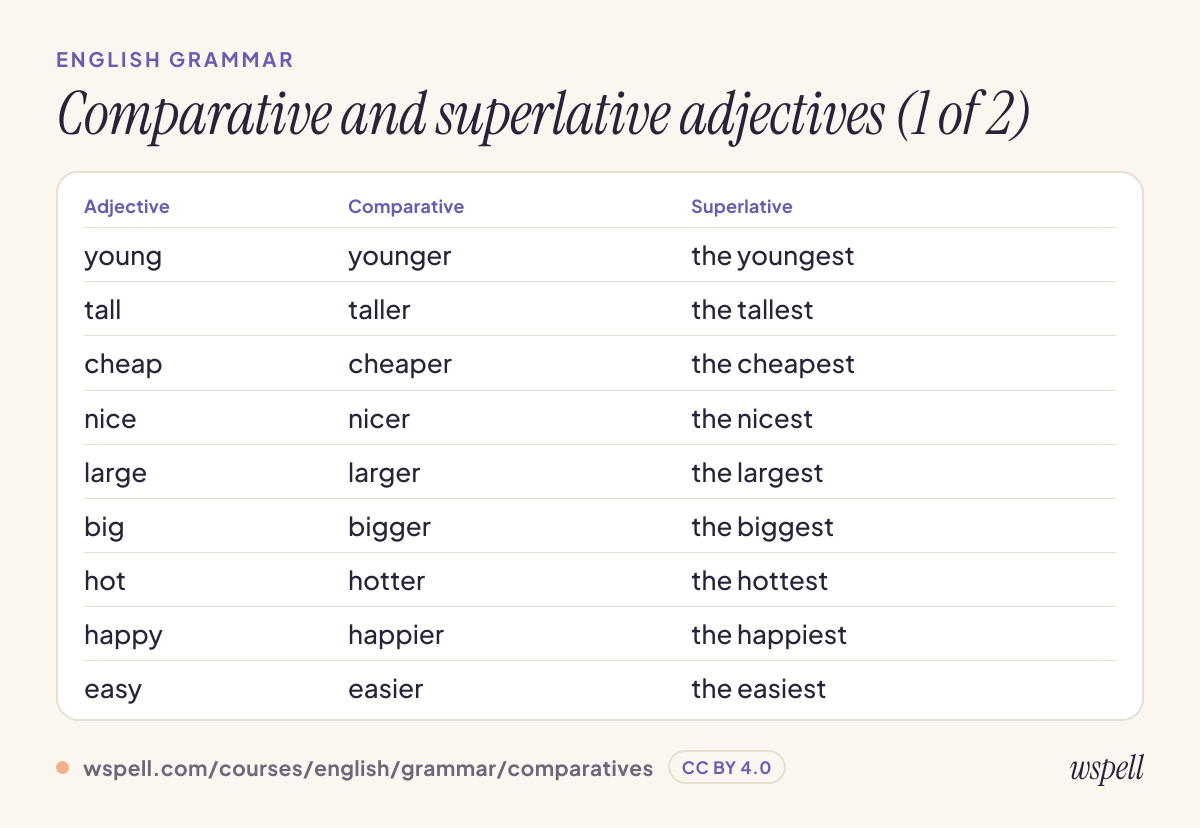
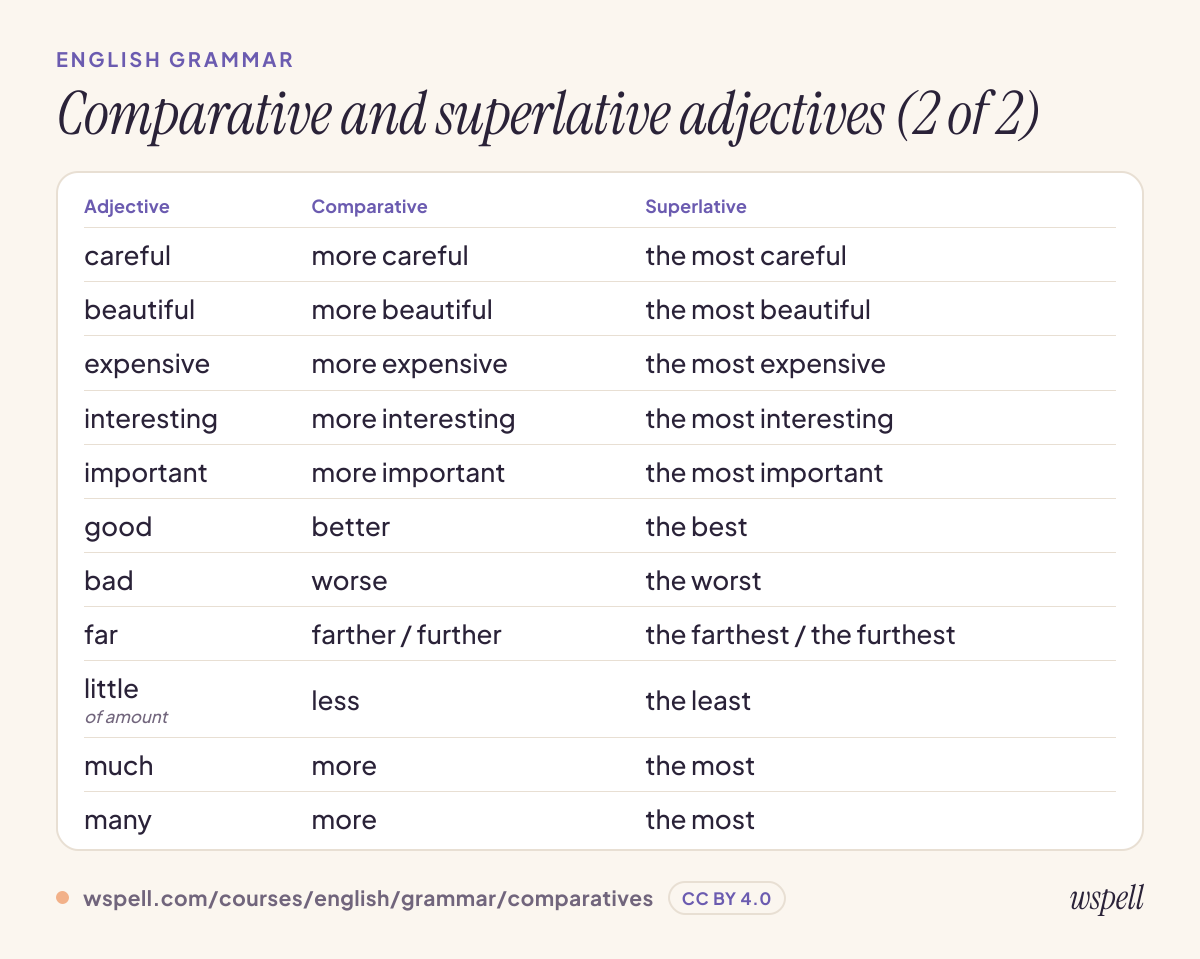
One-syllable adjectives add -er and -est (tall, taller, the tallest); most longer ones take more and the most (expensive, more expensive, the most expensive). The chart groups twenty common adjectives by how they compare; the irregular ones come last.
Twenty adjectives compared
In order: -er/-est, -e adjectives, doubled consonants, -y → -ier, more/most, and the irregulars.
| Adjective | Comparative | Superlative |
|---|---|---|
| young | younger | the youngest |
| tall | taller | the tallest |
| cheap | cheaper | the cheapest |
| nice | nicer | the nicest |
| large | larger | the largest |
| big | bigger | the biggest |
| hot | hotter | the hottest |
| happy | happier | the happiest |
| easy | easier | the easiest |
| careful | more careful | the most careful |
| beautiful | more beautiful | the most beautiful |
| expensive | more expensive | the most expensive |
| interesting | more interesting | the most interesting |
| important | more important | the most important |
| good | better | the best |
| bad | worse | the worst |
| far | farther / further | the farthest / the furthest |
| little of amount | less | the least |
| much | more | the most |
| many | more | the most |
-er or more?
Comparative: -er or more
One-syllable adjectives (and two-syllable ones in -y) add -er: taller, happier; most other two-syllable adjectives and nearly all longer ones take 'more': more careful, more expensive, more interesting (but unhappy → unhappier). A few two-syllable adjectives allow both (cleverer / more clever, quieter / more quiet). The comparison partner follows with 'than'.
- This bag is cheaper than that one.
- Physics is more difficult than maths.
Superlative: the -est or the most
Short adjectives (one syllable, or two ending in -y) add -est (the tallest, the happiest); most others take 'the most' (the most careful, the most expensive). The superlative almost always takes 'the'.
- It's the tallest building in the city.
- She is the most talented singer here.
Spelling changes
Bigger, nicer, happier: spelling changes
Doubling and y-change apply: a one-syllable adjective ending in one vowel + one consonant doubles the consonant (big → bigger, hot → hottest; but not w: new → newer); consonant + -y becomes -i (happy → happier); a silent -e just adds -r/-st (nice → nicer).
- Today is hotter than yesterday.
- She looks happier now.
The irregular adjectives
Good, better, best: the irregulars
A few high-frequency adjectives are suppletive: good → better → best; bad → worse → worst; far → farther/further → farthest/furthest; little → less → least; much/many → more → most.
- This is better than I expected.
- It was the worst day ever.
Than and as … as
As tall as, not as cold as
To say two things are equal, frame the plain adjective with 'as … as': 'as tall as'. The negative 'not as … as' (or 'not so … as') means 'less than'.
- He is as tall as his father.
- It's not as cold as yesterday.
Taller than me
A comparison of inequality uses the comparative (-er or more) followed by 'than': "taller than me", "more expensive than I thought." After than an object pronoun is normal (taller than me); a full clause is more formal (taller than I am).
- This car is faster than mine.
- She works harder than he does.
Much bigger, a bit older
Much bigger, a bit older — never very bigger
Comparatives are graded with 'much / far / a lot / a bit / slightly' — not with 'very' alone: 'much bigger', 'a bit older', 'far more expensive'. 'Very' goes with the plain adjective (very big) and before an -est superlative (the very best, the very first), never straight before a comparative — but very much bigger is fine.
- This car is much faster.
- She's a bit older than me.
learn it step by step
save or print this chart
Under the main tables on this page sits a picture of each — keep one on your phone, share it or print it.
Free to share and adapt under CC BY 4.0 — credit wspell and link to this page. the licence
credit line to copy: Comparative and superlative adjectives in English — wspell, CC BY 4.0, https://wspell.com/courses/english/grammar/comparatives
questions
When do you use -er and when more?
One-syllable adjectives take -er (taller, younger), and so do two-syllable ones ending in -y (happier, easier). Most other two-syllable adjectives and nearly all longer ones take more: more careful, more interesting, more expensive.
What are the comparative and superlative of good, bad and far?
Good, better, the best; bad, worse, the worst; far, farther or further, the farthest or the furthest. Little (of amount) becomes less, the least, and much and many become more, the most.
Can I say 'very bigger'?
No. A comparative is made stronger with much, far or a lot, and weaker with a bit or slightly: much bigger, a bit older. Very goes with the plain adjective (very big), not straight before a comparative; very much bigger is fine.