grammar chart · English
English modal verbs: can, could, may, might, must, should
Modal verbs add ability, permission, possibility, obligation or advice to another verb. They never change: no -s for he, she or it, no do in questions and negatives, and the base form without to after them: She can swim. Can she swim? She cannot swim. Ought to keeps its to; have to, which the table sets beside must, is an ordinary verb: she has to, do you have to?
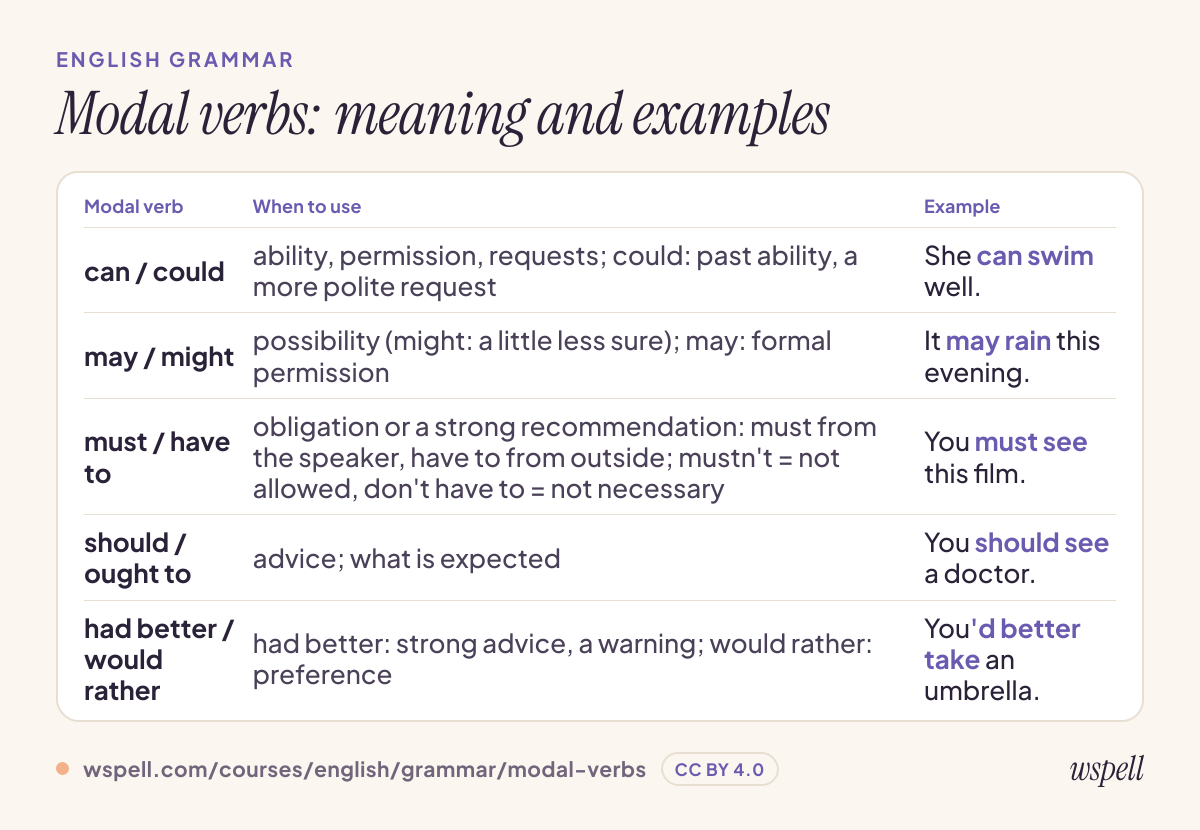
The modal verbs at a glance
| Modal verb | When to use | Example |
|---|---|---|
| can / could | ability, permission, requests; could: past ability, a more polite request | She can swim well. |
| may / might | possibility (might: a little less sure); may: formal permission | It may rain this evening. |
| must / have to | obligation or a strong recommendation: must from the speaker, have to from outside; mustn't = not allowed, don't have to = not necessary | You must see this film. |
| should / ought to | advice; what is expected | You should see a doctor. |
| had better / would rather | had better: strong advice, a warning; would rather: preference | You'd better take an umbrella. |
No -s, no do
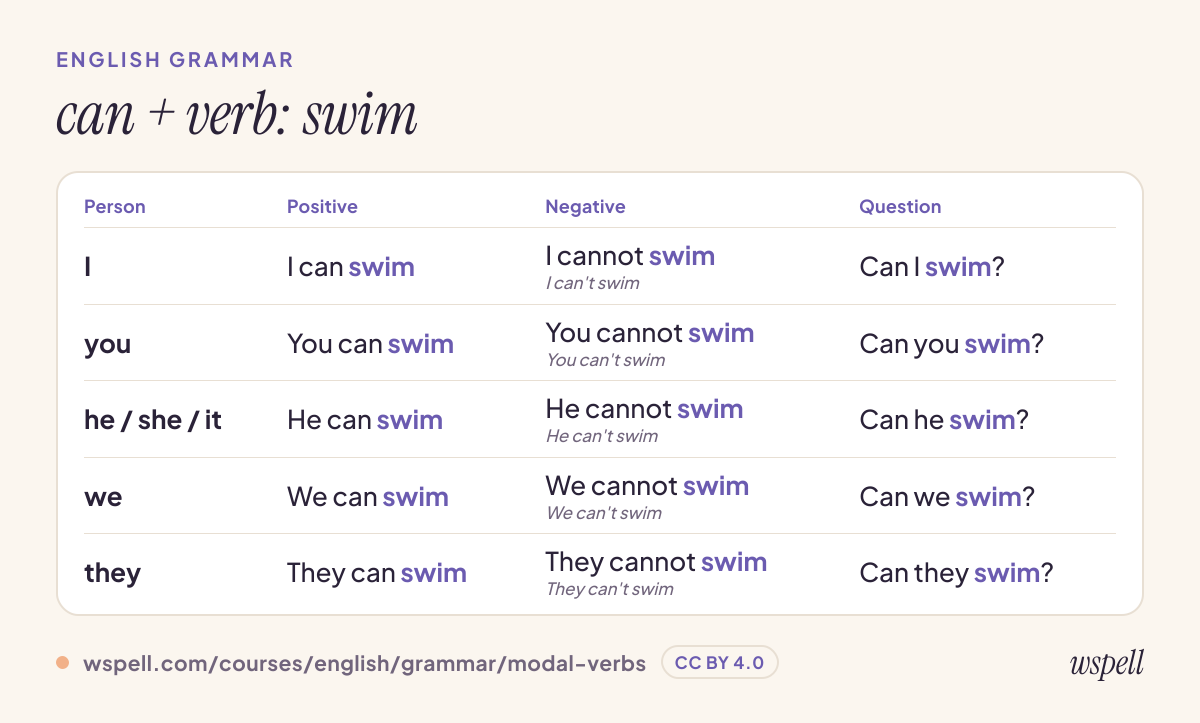
Under each full form is the short one: can't.
| Person | Positive | Negative | Question |
|---|---|---|---|
| I | I can swim | I cannot swim I can't swim | Can I swim? |
| you | You can swim | You cannot swim You can't swim | Can you swim? |
| he / she / it | He can swim | He cannot swim He can't swim | Can he swim? |
| we | We can swim | We cannot swim We can't swim | Can we swim? |
| they | They can swim | They cannot swim They can't swim | Can they swim? |
Can and could: ability, permission, requests
can + base for present ability, permission and requests; could for past ability, tentative present possibility, and more polite requests. Modals take no -s and are followed by the bare infinitive.
- She can swim well.
- Could you open the window?
May and might
May and might: possibility and permission
may/might + base express present or future possibility (might is a touch less certain); may also grants or asks formal permission. Both take the bare infinitive; in reported speech may becomes might (She said she might come).
- It may rain this evening.
- They might be at home.
Must, have to, should
Must or have to: obligation
must expresses obligation felt by the speaker or a strong recommendation; have to expresses external obligation and, unlike must, supplies the missing past ('had to') and other tenses. 'Mustn't' = prohibition, 'don't have to' = no obligation.
- You must see this film.
- I had to work late.
Should and ought to: advice
should and ought to (+ base) give advice or state what is expected/probable. 'Ought' keeps its 'to'; 'should' takes the bare infinitive. 'Had better' is stronger — a warning about a bad consequence.
- You should see a doctor.
- We ought to leave now.
Had better and would rather
had better + base gives strong advice with an implied warning ('you'd better hurry'); would rather + base expresses preference ('I'd rather stay'). Both use the bare infinitive despite the past-form auxiliary.
- You'd better take an umbrella.
- I'd rather walk than drive.
Must be, can't be, might be
Must be, can't be, might be: how sure you are
For logical conclusions about the present: must (I'm sure it's true), can't (I'm sure it's false), and may/might/could (it's possible). In British English 'mustn't' is not used for deduction — use 'can't'; American English also uses 'must not' (He must not be home).
- He must be tired after the trip.
- That can't be right.
Should have, must have, might have
Should have, must have: modals about the past
A modal + have + past participle refers back to the past: must have (certain), can't/couldn't have (impossible), might/may/could have (possible), should have (a criticised or unfulfilled action), needn't have (unnecessary but done).
- You should have told me.
- She must have forgotten.
learn it step by step
save or print this chart
Under the main tables on this page sits a picture of each — keep one on your phone, share it or print it.
Free to share and adapt under CC BY 4.0 — credit wspell and link to this page. the licence
credit line to copy: English modal verbs: can, could, may, might, must, should — wspell, CC BY 4.0, https://wspell.com/courses/english/grammar/modal-verbs
questions
What is the difference between must and have to?
Must is an obligation the speaker feels or a strong recommendation (You must see this film); have to is an obligation from outside, and it has the forms must lacks (I had to work late). In the negative they split: mustn't means it is not allowed, don't have to means it is not necessary.
Do modal verbs take -s with he, she and it?
No. Modal verbs never change: he can, she must, it might. They take the base form without to: She can swim, not she can to swim. Ought to keeps its to. Have to is not a modal but an ordinary verb, so it does change: she has to, she had to.
How do you use modal verbs about the past?
With have + past participle: You should have told me (but you didn't), She must have forgotten (I'm sure she did), They might have left (perhaps they did).