cheat sheet · English
English grammar cheat sheet: the essentials on one page
The English grammar a learner looks up most, on one page: all twelve tenses on one verb, the verb to be, twenty common irregular verbs, the pronouns, the four conditionals and in, on, at for time. Print it or save the pictures.
All 12 tenses on one verb
Each cell is the verb write in one tense, with its formula under it: V = base form, V-s = the he / she / it form, V2 = past simple, V3 = past participle, V-ing = the -ing form.
| Present | Past | Future | |
|---|---|---|---|
| Simple | She writes V / V-s | She wrote V2 | She will write will + V |
| Continuous | She is writing am / is / are + V-ing | She was writing was / were + V-ing | She will be writing will be + V-ing |
| Perfect | She has written have / has + V3 | She had written had + V3 | She will have written will have + V3 |
| Perfect Continuous | She has been writing have / has + been + V-ing | She had been writing had + been + V-ing | She will have been writing will have been + V-ing |
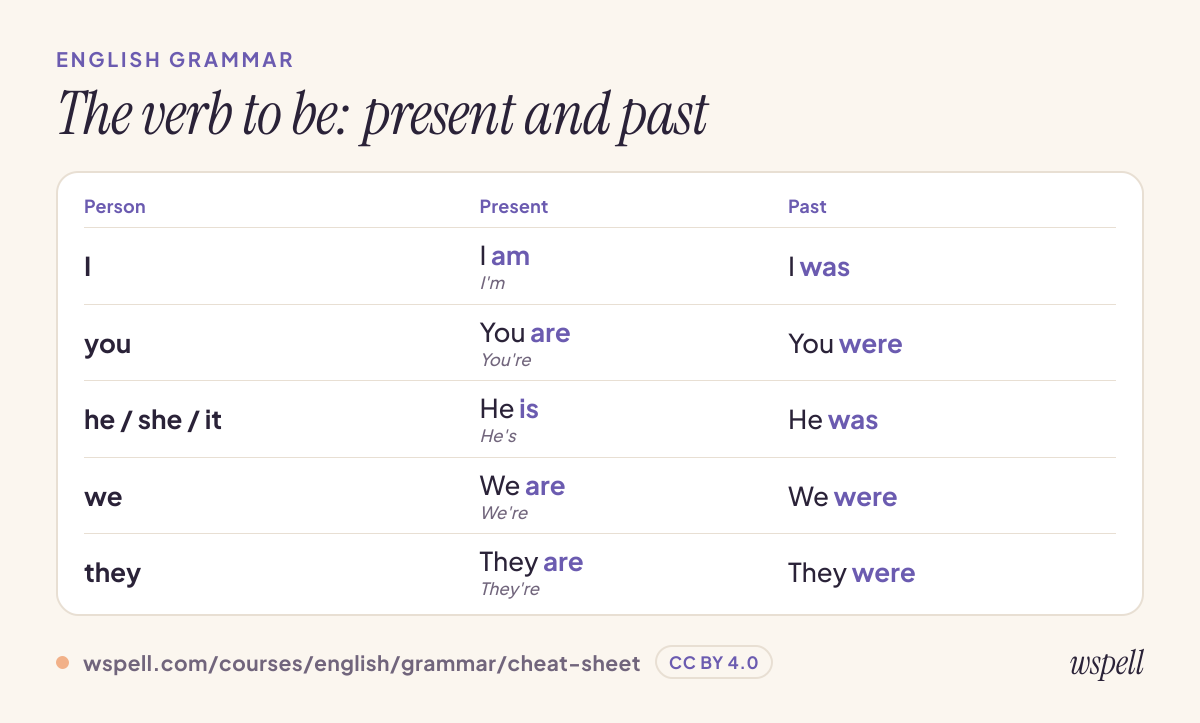
The verb to be
| Person | Present | Past |
|---|---|---|
| I | I am I'm | I was |
| you | You are You're | You were |
| he / she / it | He is He's | He was |
| we | We are We're | We were |
| they | They are They're | They were |
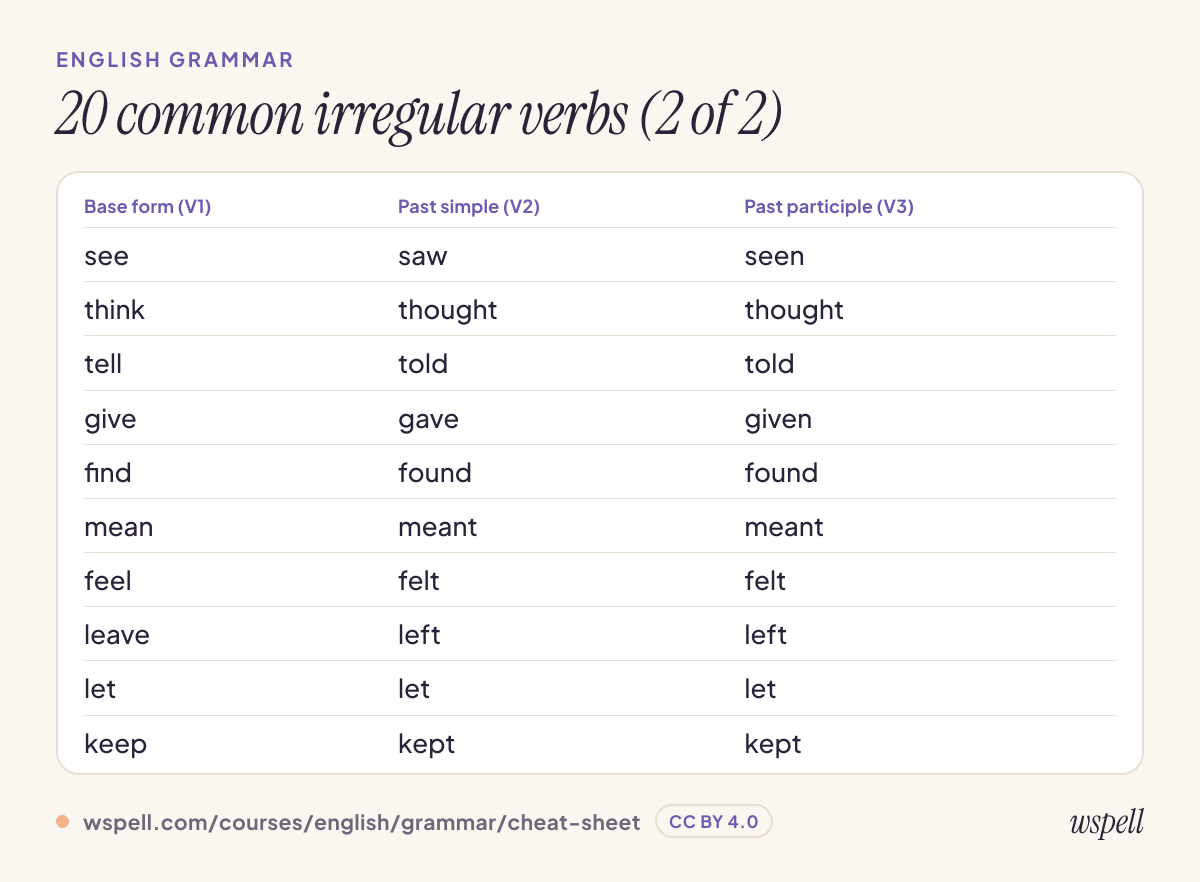
20 common irregular verbs
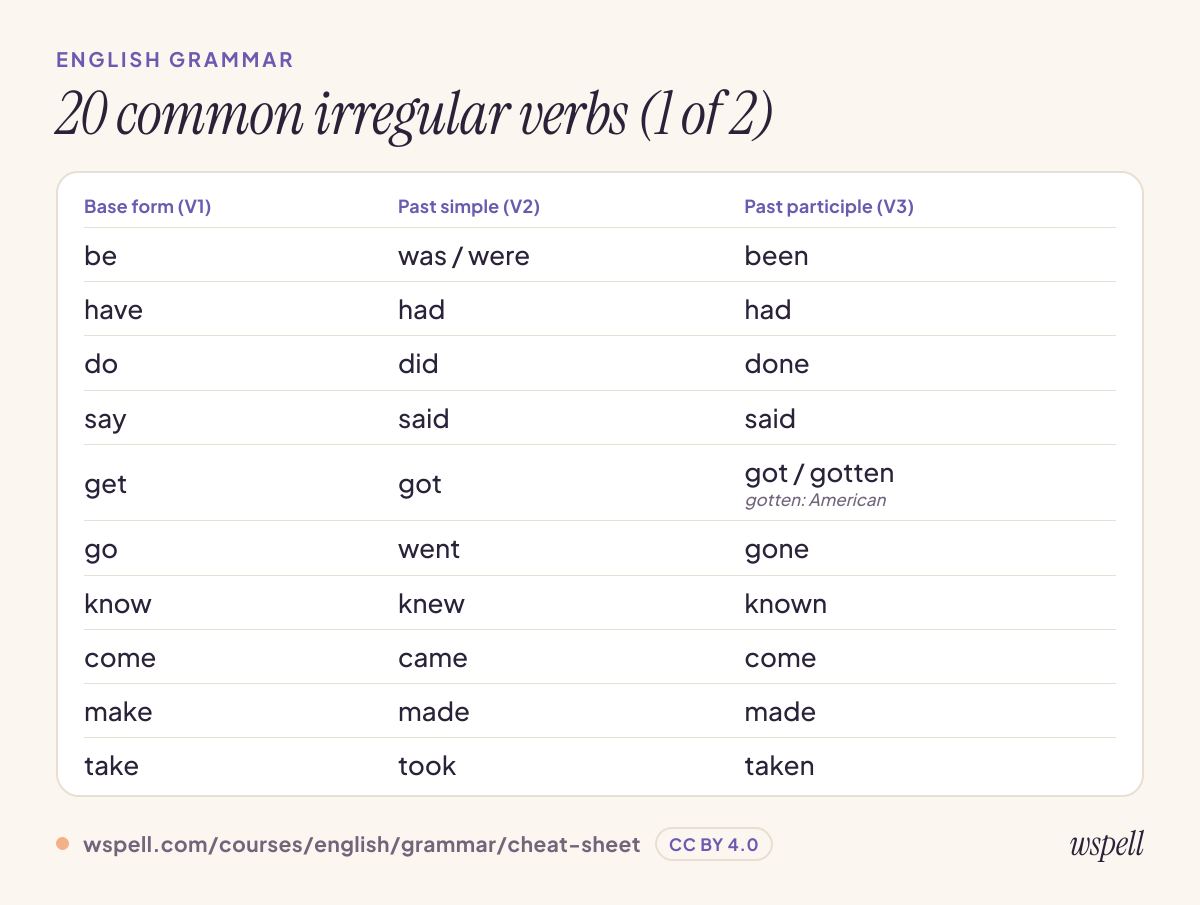
| Base form (V1) | Past simple (V2) | Past participle (V3) |
|---|---|---|
| be | was / were | been |
| have | had | had |
| do | did | done |
| say | said | said |
| get | got | got / gotten gotten: American |
| go | went | gone |
| know | knew | known |
| come | came | come |
| make | made | made |
| take | took | taken |
| see | saw | seen |
| think | thought | thought |
| tell | told | told |
| give | gave | given |
| find | found | found |
| mean | meant | meant |
| feel | felt | felt |
| leave | left | left |
| let | let | let |
| keep | kept | kept |
Pronouns
| Subject | Object | Possessive adjective | Possessive pronoun | Reflexive |
|---|---|---|---|---|
| I | me | my | mine | myself |
| you singular | you | your | yours | yourself |
| he | him | his | his | himself |
| she | her | her | hers | herself |
| it | it | its | — | itself |
| we | us | our | ours | ourselves |
| you plural | you | your | yours | yourselves |
| they | them | their | theirs | themselves |
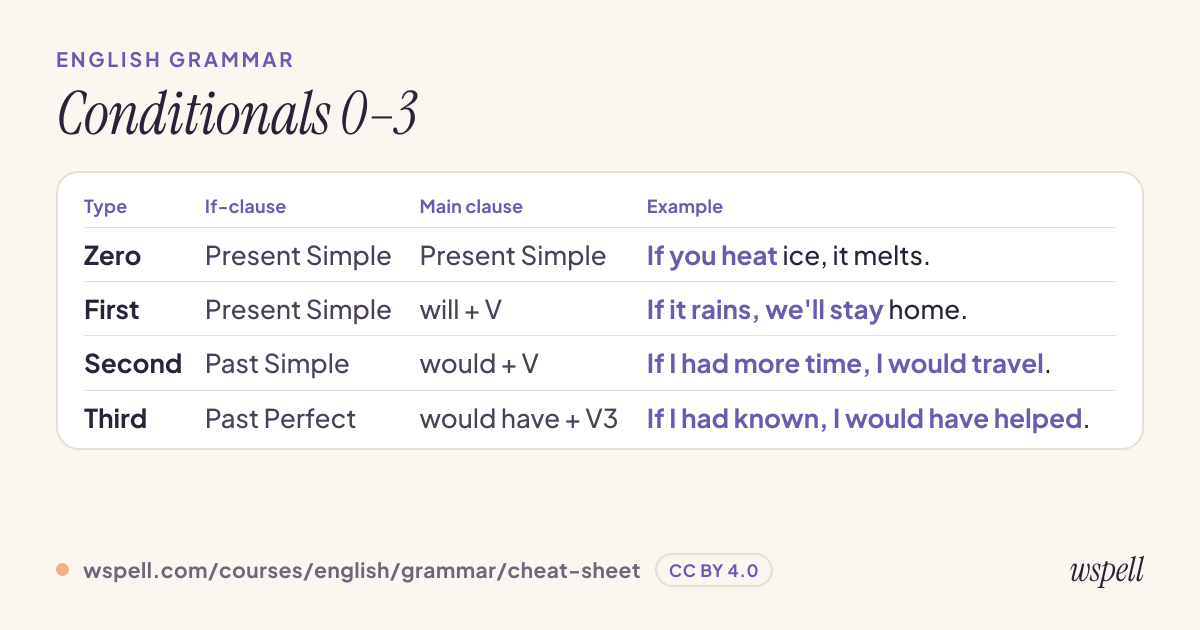
Conditionals
| Type | If-clause | Main clause | Example |
|---|---|---|---|
| Zero | Present Simple | Present Simple | If you heat ice, it melts. |
| First | Present Simple | will + V | If it rains, we'll stay home. |
| Second | Past Simple | would + V | If I had more time, I would travel. |
| Third | Past Perfect | would have + V3 | If I had known, I would have helped. |
In, on, at for time
| Preposition | When to use | Example |
|---|---|---|
| at | a clock time or a fixed point: at six, at noon, at night, at Christmas, at the weekend (UK) | The film starts at eight. |
| on | a day or a date: on Monday, on 5 May, on my birthday, on the weekend (US) | The meeting is on Friday. |
| in | a longer period, or a part of the day: in July, in 1990, in summer, in the morning | I was born in 1990. |
learn it step by step
save or print this chart
Under the main tables on this page sits a picture of each — keep one on your phone, share it or print it.
Free to share and adapt under CC BY 4.0 — credit wspell and link to this page. the licence
credit line to copy: English grammar cheat sheet: the essentials on one page — wspell, CC BY 4.0, https://wspell.com/courses/english/grammar/cheat-sheet
questions
Can I print this English grammar cheat sheet?
Yes. Print the page, or download the pictures of the tables — they are free to share and adapt under CC BY 4.0, with a credit and a link to wspell.
How many tenses does English have?
Twelve, in the usual school count: three times (present, past, future), each in four forms — simple, continuous, perfect and perfect continuous. The first table shows all twelve on the verb write.
What are V1, V2 and V3?
The three forms of a verb: V1 is the base form (write), V2 the past simple (wrote) and V3 the past participle (written). Regular verbs make V2 and V3 with -ed (worked, worked); irregular verbs have to be learned.