grammar chart · English
English pronouns: subject, object, possessive and reflexive
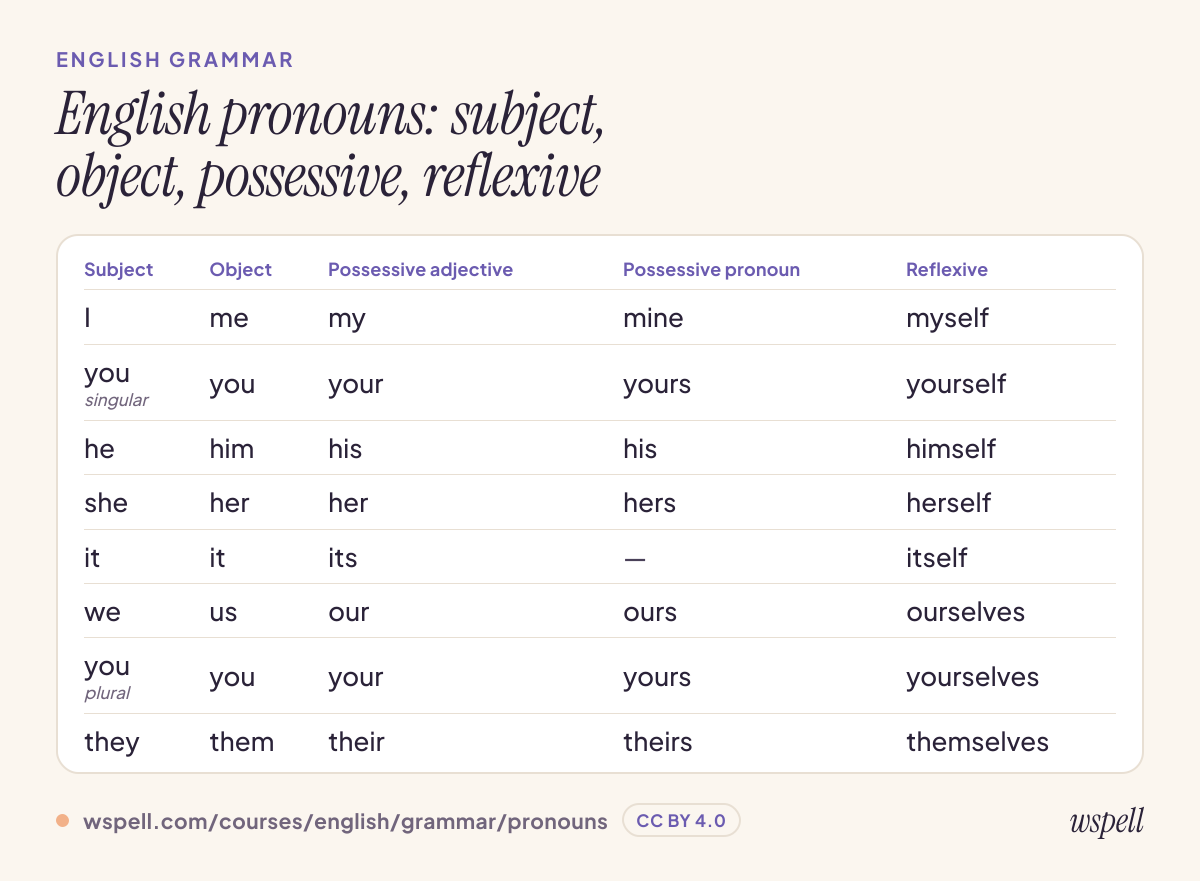
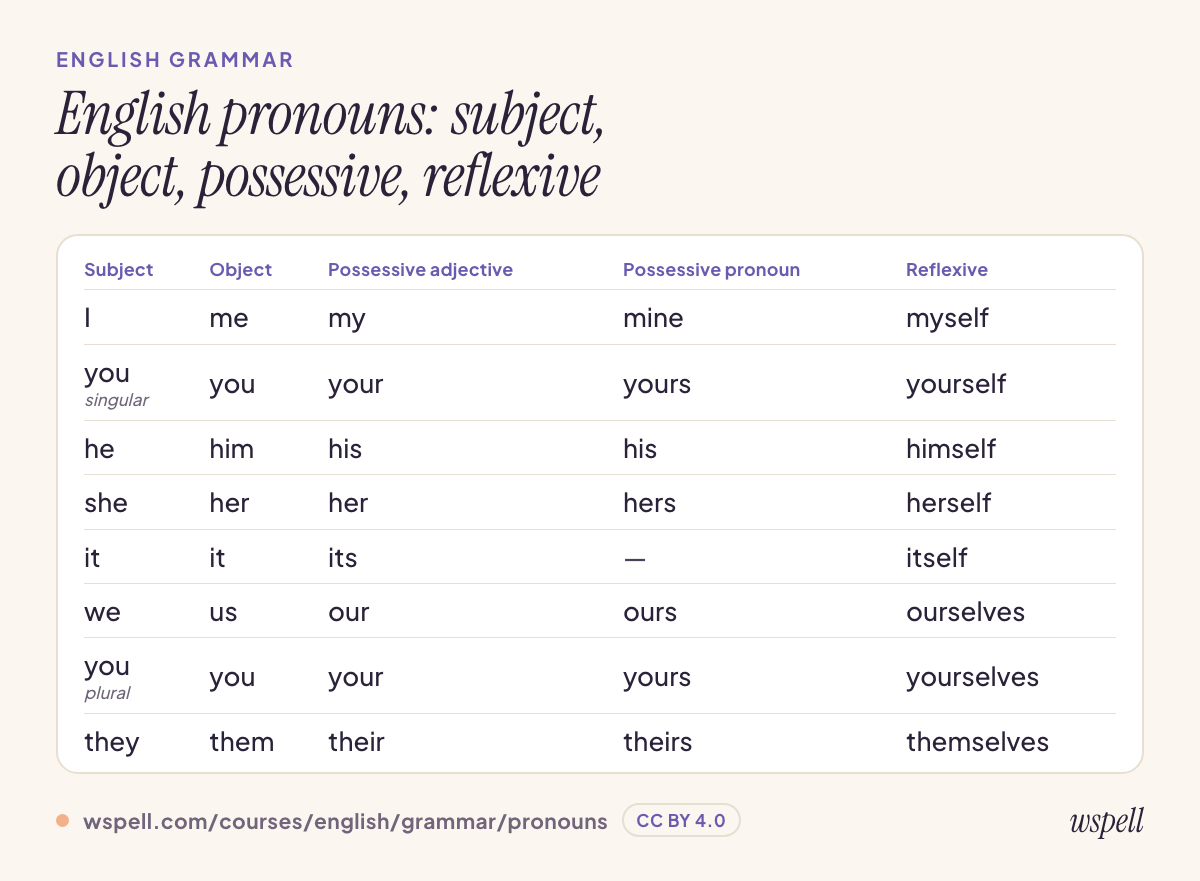
Each English personal pronoun has up to five forms: the subject (I), the object (me), the possessive adjective before a noun (my), the possessive pronoun that stands alone (mine) and the reflexive (myself). The chart lines them up person by person; the rules below say when each one is used.
The pronoun chart
Its has no possessive pronoun of its own; you is the same in the singular and the plural except in the reflexive (yourself, yourselves).
| Subject | Object | Possessive adjective | Possessive pronoun | Reflexive |
|---|---|---|---|---|
| I | me | my | mine | myself |
| you singular | you | your | yours | yourself |
| he | him | his | his | himself |
| she | her | her | hers | herself |
| it | it | its | — | itself |
| we | us | our | ours | ourselves |
| you plural | you | your | yours | yourselves |
| they | them | their | theirs | themselves |
Subject and object: I or me?
Subject pronouns: I, you, he, she, it, we, they
The subject pronoun does the action and stands before the verb; person and number show in these seven forms and in the verb (I am, she is, she works). English nouns have no grammatical gender, so in the third person singular you choose by meaning: he or she for a person, it for a thing — or they when a person's gender is unknown or not relevant.
- She works, and they help her.
- We are ready.
Object pronouns: me, you, him, her, it, us, them
The object form is used for the direct object, the indirect object, AND after every preposition (to me, for us, with them) — English does not split direct and indirect object forms the way case languages do. Only I/he/she/we/they change shape; you and it stay the same.
- I saw them at the station.
- Give it to her.
With me, for him: the object form after a preposition
A personal pronoun following a preposition takes the object form: with me, for him, between us, about them — never the subject form.
- This present is for you and me.
- They talked about us.
My or mine?
Possessive adjectives: my, your, his, her, its, our, their
These sit BEFORE a noun and are chosen by the possessor, never the possessed thing: his car, her car (English marks the owner's gender, not the object's). They cannot stand alone — a noun must follow.
- This is my house and that is their house.
- He lost his keys.
Possessive pronouns: mine, yours, his, hers, ours, theirs
These stand ALONE, replacing 'determiner + noun': This book is mine = my book. Note there is no 'mines', and 'its' as a standalone possessive pronoun does not exist. His is identical in both sets; her→hers.
- That coat is hers, not yours.
- Ours is the blue one.
Its or it's?
'Its' (no apostrophe) is the possessive determiner (the dog wagged its tail); 'it's' (with apostrophe) is only the contraction of it is / it has. If you can expand it to 'it is' or 'it has', use the apostrophe; otherwise not.
- The company changed its logo.
- It's raining again.
Myself, each other — and when no -self is needed
Reflexive pronouns: myself, yourself, themselves
Reflexives are used when subject and object are the same person: I hurt myself. Formed with -self (singular) and -selves (plural): myself, yourself, himself, herself, itself, ourselves, yourselves, themselves. Note 'his' and 'their' switch to himself/themselves (not hisself/theirselves).
- She taught herself to paint.
- Be careful — don't cut yourself.
I feel, I wash, I hurry: no -self needed
Verbs that are reflexive in Russian and other languages are plain intransitives in English: wash, shave, dress, hurry, relax, feel, meet, remember — say 'I wash' and 'I feel tired', NOT 'I wash myself' (except to stress the effort) or 'I feel myself'. Adding -self here is a classic learner error.
- I feel much better today.
- Hurry up, we're late!
Each other and one another
Reciprocals express a mutual action ('A→B and B→A') and are NOT the same as reflexives: They looked at each other (at one another). Some prescribe 'each other' for two and 'one another' for more, but modern usage treats them as interchangeable. Possessive: each other's.
- The two teams respect each other.
- They wore each other's clothes.
This, that, these, those
Demonstratives point: this/these = near the speaker, that/those = far; singular this/that vs plural these/those. As pronouns they stand alone (I like this; those are mine); as determiners they precede a noun (this book).
- This is my seat and those are theirs.
- These are too small.
You and they
You: one person or many
A single 'you' serves both singular and plural, subject and object, formal and informal — English lost the old thou/ye distinction. Plurality is disambiguated lexically (you all, you guys, you two) when needed.
- Are you coming, both of you?
They for one person
'They/them/their' is used for one person whose gender is unknown, irrelevant, or non-binary, and takes a plural verb: If anyone calls, tell them I'm out. Now fully standard, it avoids the clumsy 'he or she'.
- Someone left their umbrella here.
- Ask the doctor what they recommend.
learn it step by step
save or print this chart
Under the main tables on this page sits a picture of each — keep one on your phone, share it or print it.
Free to share and adapt under CC BY 4.0 — credit wspell and link to this page. the licence
credit line to copy: English pronouns: subject, object, possessive and reflexive — wspell, CC BY 4.0, https://wspell.com/courses/english/grammar/pronouns
questions
What is the difference between my and mine?
My goes before a noun (This is my book); mine stands alone and replaces the noun (This book is mine). The same for your/yours, her/hers, our/ours, their/theirs; his is the same in both.
Is it 'my friend and I' or 'my friend and me'?
It depends on the role: as the subject, my friend and I (My brother and I went home); as an object or after a preposition, my friend and me (She invited my brother and me; between you and me). Drop the other person to test: I went, she invited me.
When do I use myself?
When the subject and the object are the same person (I hurt myself) or for emphasis (I did it myself). Many verbs that are reflexive in other languages take no -self in English: I feel tired, I wash and dress, hurry up.