grammar chart · English
The future in English: will, going to and the present tenses
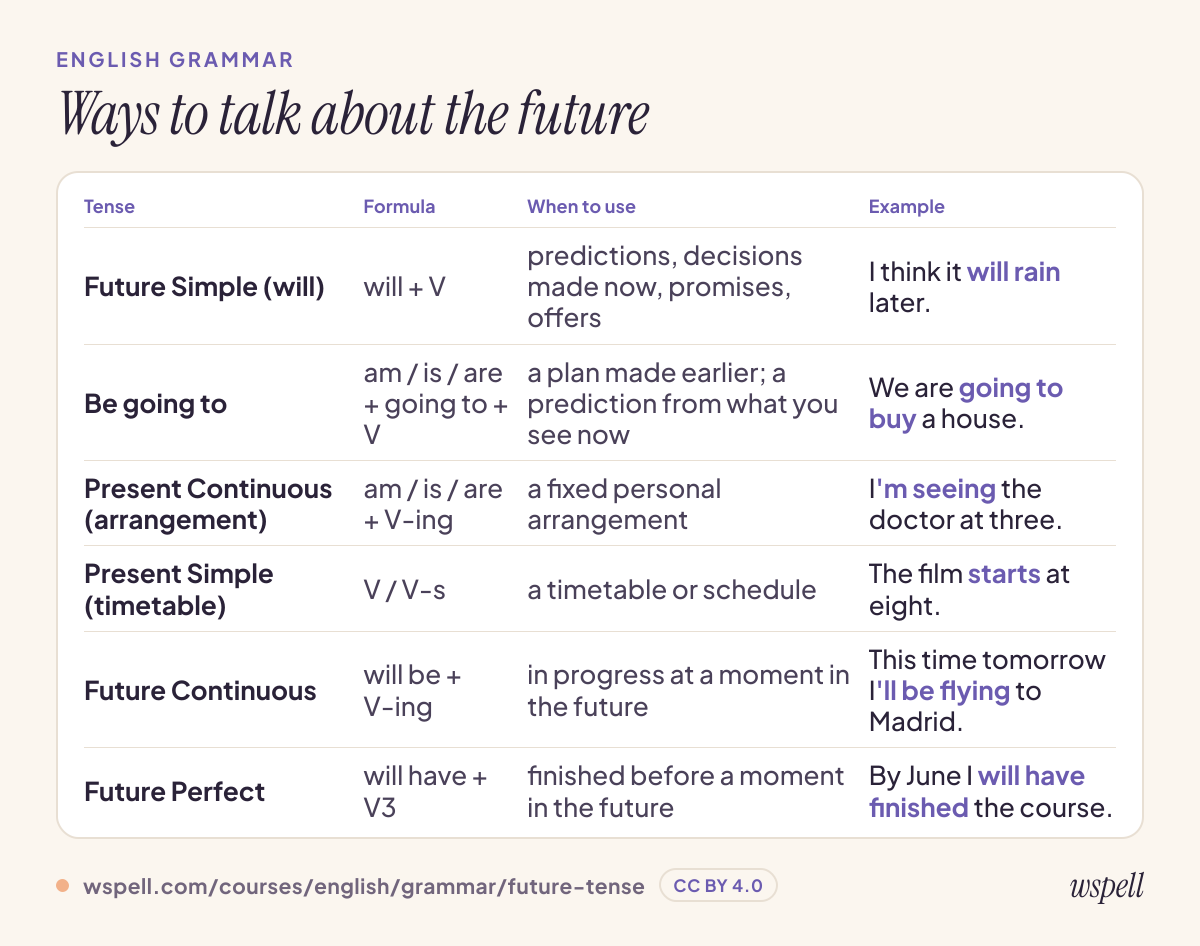
English has no single future tense. Will is for predictions, promises and decisions made on the spot; be going to is for plans made earlier and for what you can see coming; the Present Continuous is for fixed arrangements, and the Present Simple for timetables. The table puts them side by side.
Ways to talk about the future
| Tense | Formula | When to use | Example |
|---|---|---|---|
| Future Simple (will) | will + V | predictions, decisions made now, promises, offers | I think it will rain later. |
| Be going to | am / is / are + going to + V | a plan made earlier; a prediction from what you see now | We are going to buy a house. |
| Present Continuous (arrangement) | am / is / are + V-ing | a fixed personal arrangement | I'm seeing the doctor at three. |
| Present Simple (timetable) | V / V-s | a timetable or schedule | The film starts at eight. |
| Future Continuous | will be + V-ing | in progress at a moment in the future | This time tomorrow I'll be flying to Madrid. |
| Future Perfect | will have + V3 | finished before a moment in the future | By June I will have finished the course. |
Will
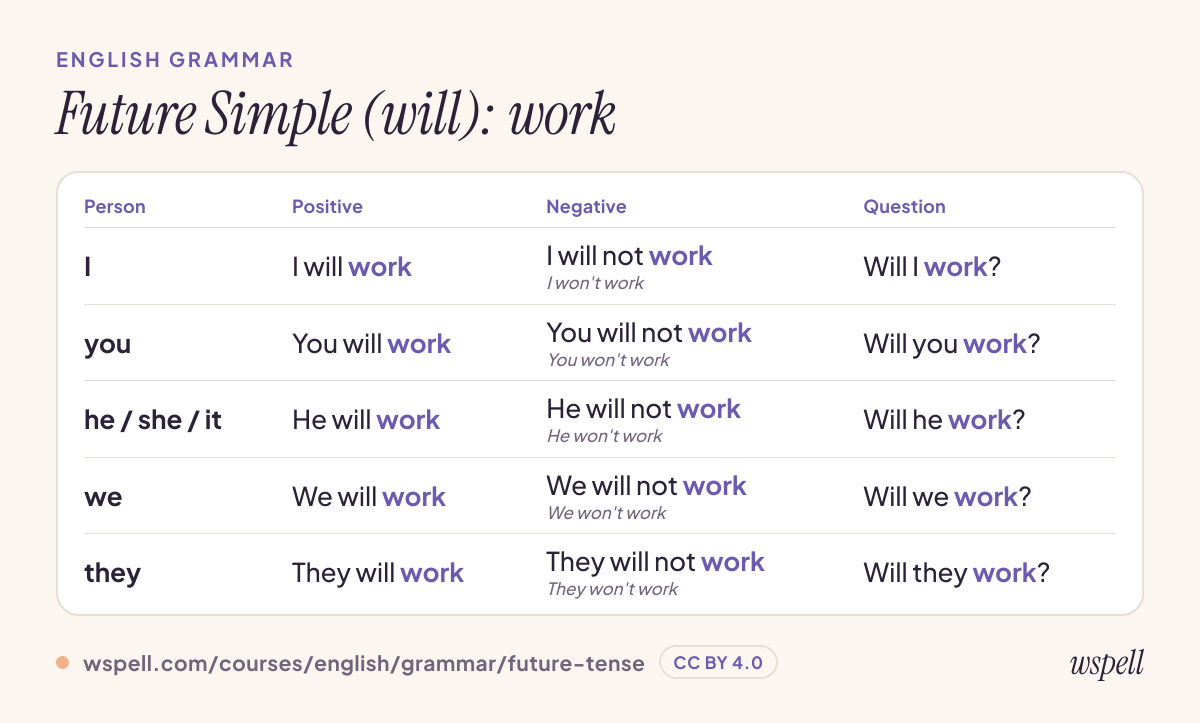
| Person | Positive | Negative | Question |
|---|---|---|---|
| I | I will work | I will not work I won't work | Will I work? |
| you | You will work | You will not work You won't work | Will you work? |
| he / she / it | He will work | He will not work He won't work | Will he work? |
| we | We will work | We will not work We won't work | Will we work? |
| they | They will work | They will not work They won't work | Will they work? |
Will: predictions, decisions, promises
will + base form for facts about the future, on-the-spot decisions, offers, promises and predictions based on opinion. The contracted 'll is normal in speech; 'shall' survives mainly in questions with I/we.
- I think it will rain later.
- OK, I'll help you.
Be going to
| Person | Positive | Negative | Question |
|---|---|---|---|
| I | I am going to write | I am not going to write I'm not going to write | Am I going to write? |
| you | You are going to write | You are not going to write You aren't going to write | Are you going to write? |
| he / she / it | He is going to write | He is not going to write He isn't going to write | Is he going to write? |
| we | We are going to write | We are not going to write We aren't going to write | Are we going to write? |
| they | They are going to write | They are not going to write They aren't going to write | Are they going to write? |
Be going to: plans and evidence
be going to + base form for a prior plan/intention or a prediction based on present evidence. Contrast with 'will' (decision made now) and present continuous (a fixed arrangement).
- We are going to buy a house.
- Look at those clouds — it's going to rain.
Present tenses for the future
The present tenses for the future
The present continuous names a fixed personal arrangement (I'm leaving on Friday); the present simple states a timetabled/scheduled event (the train leaves at six).
- I'm seeing the doctor at three.
- The film starts at eight.
After when, as soon as, until
No will in a time clause: when, as soon as, until
When a time clause introduced by when, as soon as, until, before, after, once or by the time refers to the future, English uses the present simple (or present perfect), not 'will'; the future is carried by the main clause. Questions and indirect questions keep will: When will you arrive? I don't know when he'll come.
- I'll call you when I get home.
- We won't start until everyone has arrived.
- As soon as the rain stops, we'll leave.
Future Continuous and Future Perfect
Future Continuous: in progress at a future moment
will be + participle for an action that will be in progress at a future moment, or a polite/neutral prediction about the future course of events.
- This time tomorrow I'll be flying to Madrid.
Future Perfect: finished by a future moment
will have + past participle for an action that will be completed before a future point, usually with 'by' + time.
- By June I will have finished the course.
learn it step by step
save or print this chart
Under the main tables on this page sits a picture of each — keep one on your phone, share it or print it.
Free to share and adapt under CC BY 4.0 — credit wspell and link to this page. the licence
credit line to copy: The future in English: will, going to and the present tenses — wspell, CC BY 4.0, https://wspell.com/courses/english/grammar/future-tense
questions
What is the difference between will and going to?
Will is for a decision you make while speaking (OK, I'll help you), a promise or a prediction from opinion (I think it will rain). Going to is for a plan you had already made (We are going to buy a house) or a prediction from what you see now (Look at those clouds — it's going to rain).
Can I use will after when or as soon as?
Not in a time clause. When the clause after when, as soon as, until, before or after tells you when the main action happens, it takes the Present Simple: I'll call you when I get home — not when I will get home. In a question, direct or indirect, will stays: When will you be home? I don't know when she'll arrive.
Which tense do I use for something already arranged?
Usually the Present Continuous: I'm seeing the doctor tomorrow at three. It is the usual form for a personal arrangement — a meeting, an appointment, a trip you have booked.