grammar chart · Spanish
The Spanish subjunctive
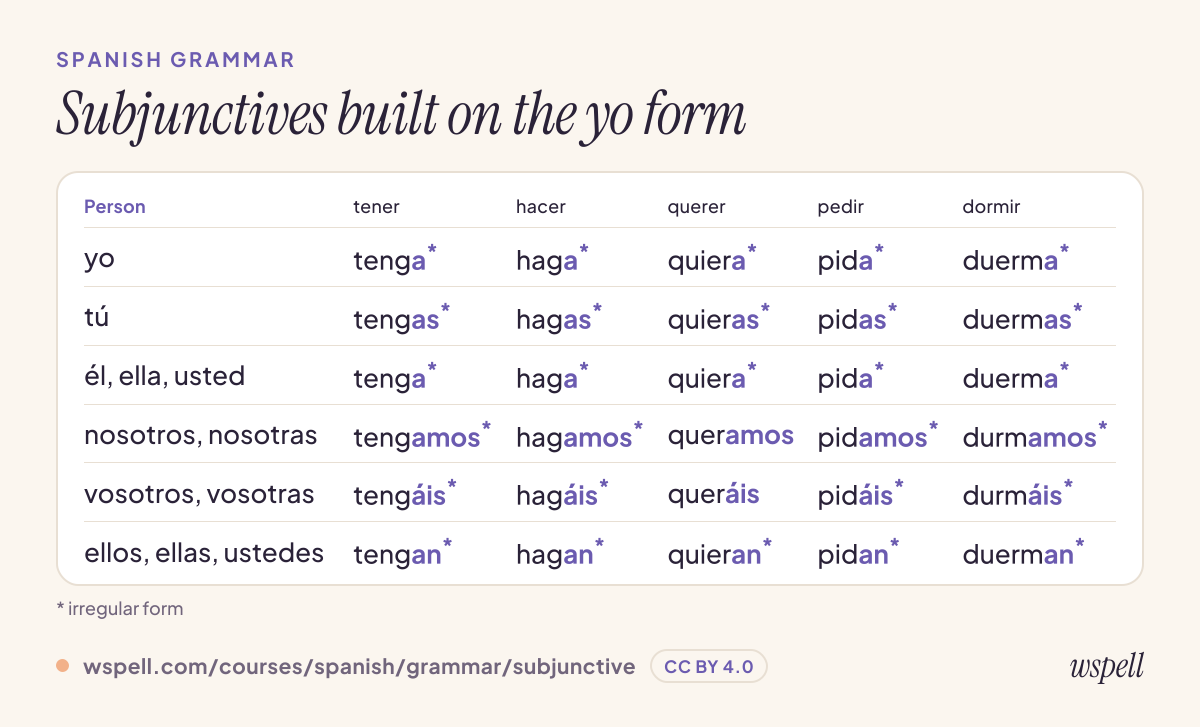
The present subjunctive is built on the yo form of the present: drop the -o and switch the vowel — -ar verbs take endings in -e (hable), -er and -ir verbs endings in -a (coma, viva). Whatever is irregular in the yo form stays: tengo → tenga, hago → haga; a stem-changing verb keeps the present's pattern, so quiera but queramos. It follows wishes and feelings about someone else's action, doubt, value judgements and ojalá.
Regular verbs: hable, coma, viva
| Person | hablar | comer | vivir |
|---|---|---|---|
| yo | hable | coma | viva |
| tú | hables | comas | vivas |
| él, ella, usted | hable | coma | viva |
| nosotros, nosotras | hablemos | comamos | vivamos |
| vosotros, vosotras | habléis | comáis | viváis |
| ellos, ellas, ustedes | hablen | coman | vivan |
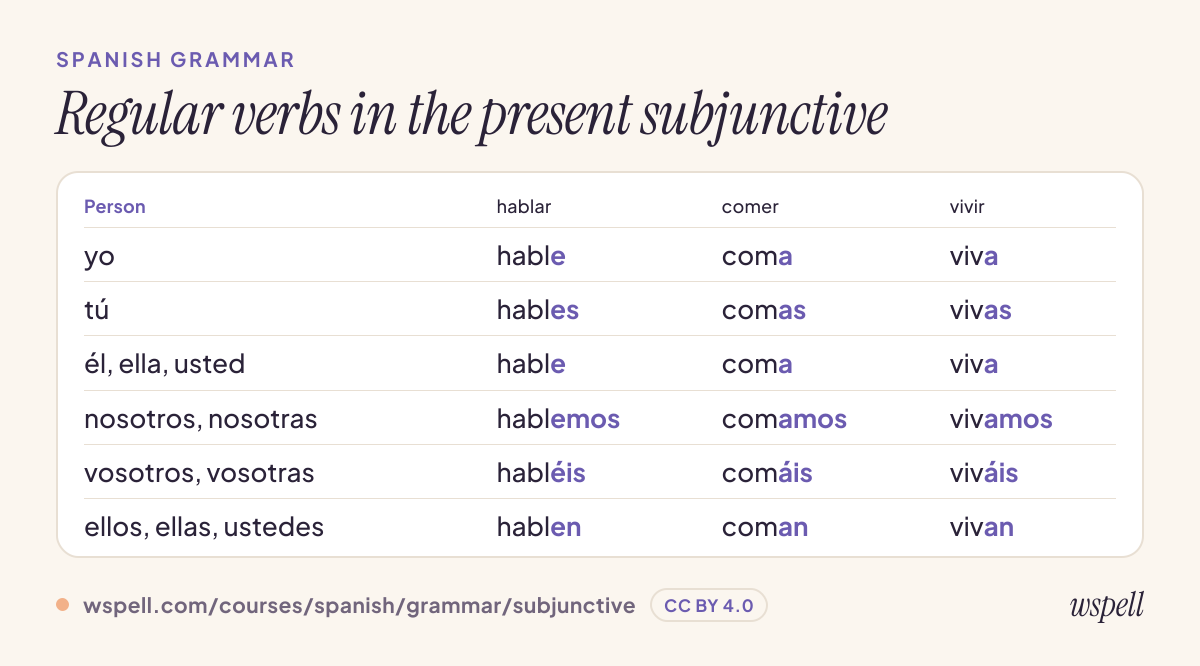
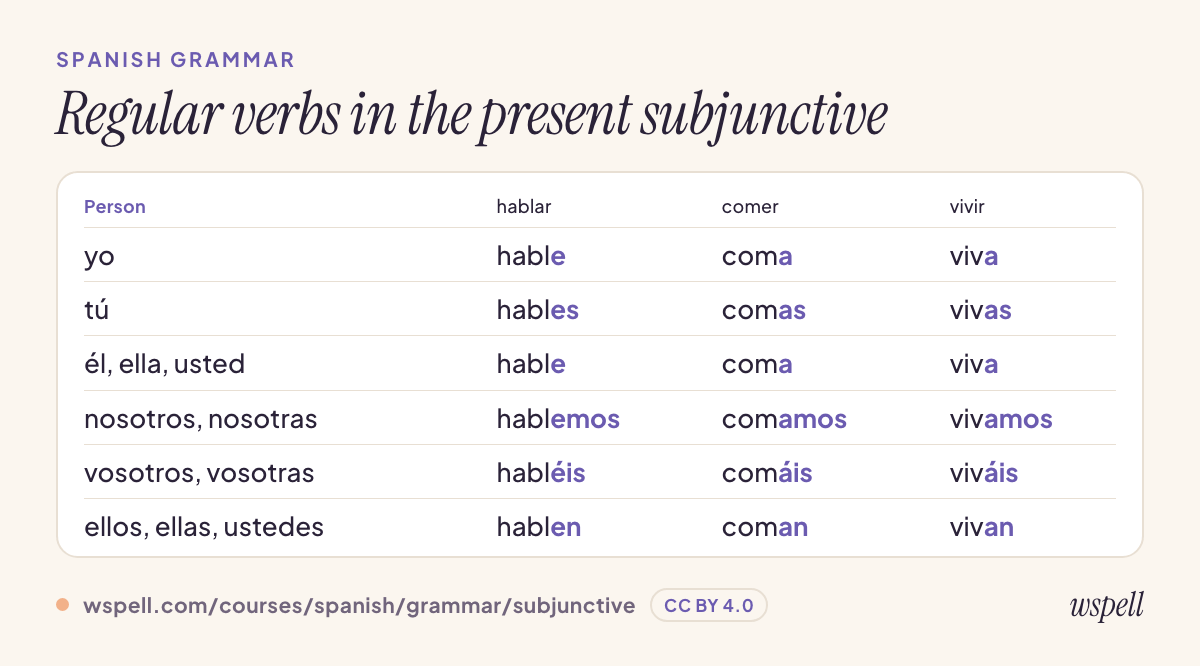
The present subjunctive: from the yo form
Take the present-indicative yo stem (keeping its irregularity), drop -o, and add the 'opposite' vowel: -ar verbs take -e endings, -er/-ir verbs take -a endings (hable; coma). So tener→tenga, conocer→conozca. Six verbs are irregular: ser (sea), estar (esté), ir (vaya), haber (haya), saber (sepa), dar (dé).
- Quiero que vengas a la fiesta. — I want you to come to the party.
- Es importante que sepas la verdad. — It's important that you know the truth.
From the yo form: tenga, haga, quiera, pida, duerma
| Person | tener | hacer | querer | pedir | dormir |
|---|---|---|---|---|---|
| yo | tenga* | haga* | quiera* | pida* | duerma* |
| tú | tengas* | hagas* | quieras* | pidas* | duermas* |
| él, ella, usted | tenga* | haga* | quiera* | pida* | duerma* |
| nosotros, nosotras | tengamos* | hagamos* | queramos | pidamos* | durmamos* |
| vosotros, vosotras | tengáis* | hagáis* | queráis | pidáis* | durmáis* |
| ellos, ellas, ustedes | tengan* | hagan* | quieran* | pidan* | duerman* |
* irregular form
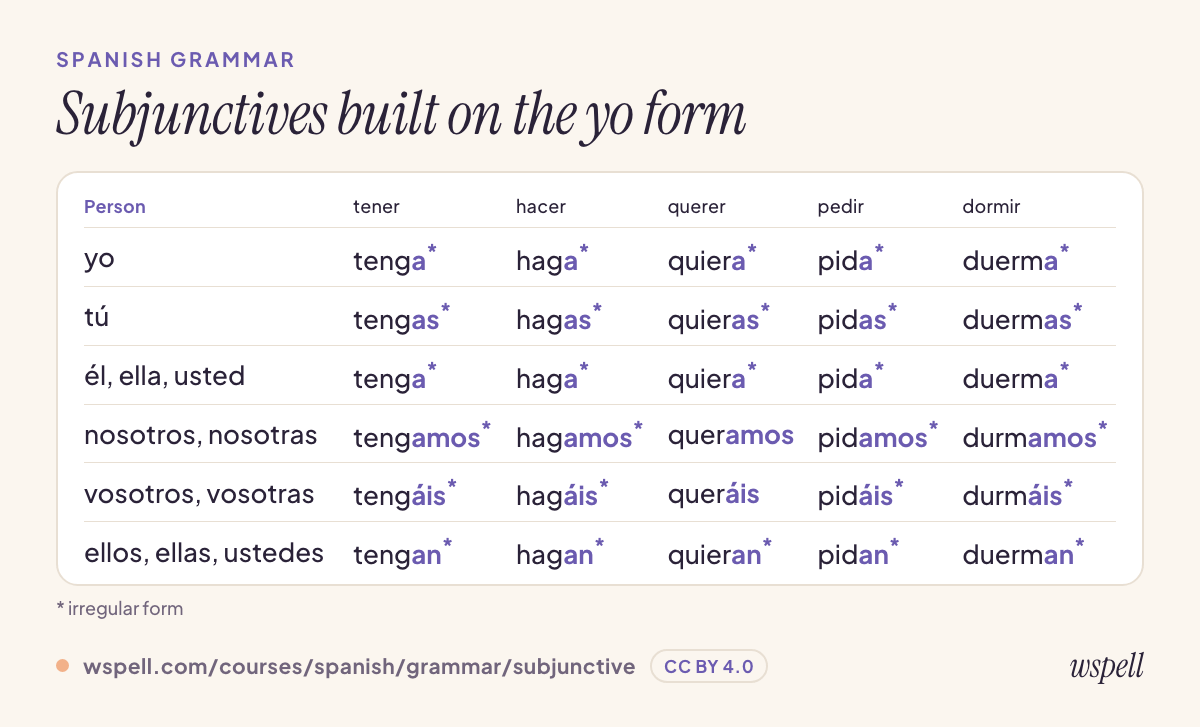
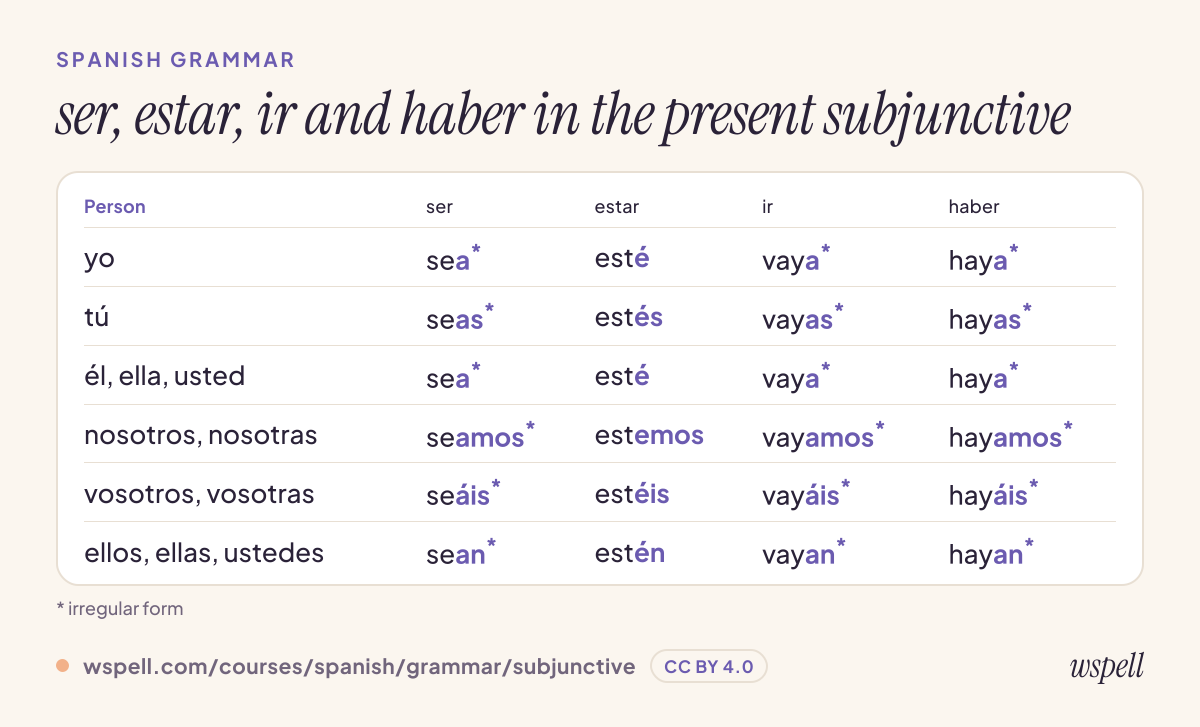
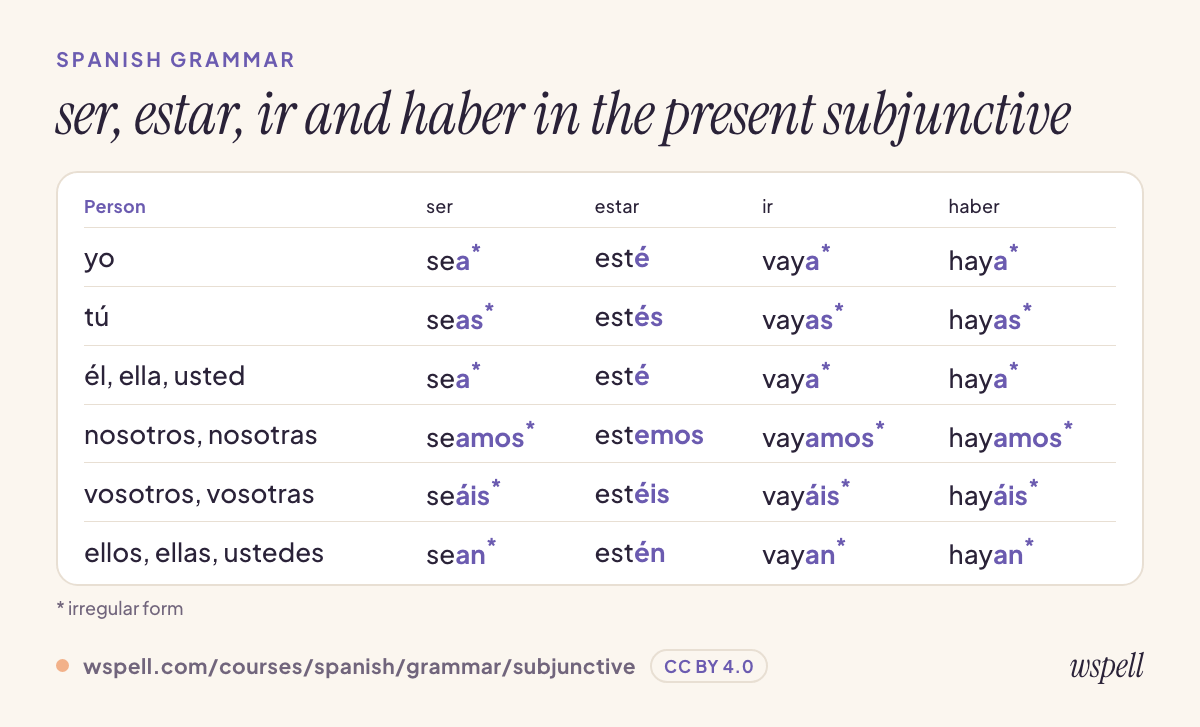
Six verbs that do not follow the yo form
| Person | ser | estar | ir | haber |
|---|---|---|---|---|
| yo | sea* | esté | vaya* | haya* |
| tú | seas* | estés | vayas* | hayas* |
| él, ella, usted | sea* | esté | vaya* | haya* |
| nosotros, nosotras | seamos* | estemos | vayamos* | hayamos* |
| vosotros, vosotras | seáis* | estéis | vayáis* | hayáis* |
| ellos, ellas, ustedes | sean* | estén | vayan* | hayan* |
* irregular form
| Infinitive | Subjunctive | Infinitive | Subjunctive | Infinitive | Subjunctive |
|---|---|---|---|---|---|
| ser | sea | ir | vaya | saber | sepa |
| estar | esté | haber | haya | dar | dé |
When to use the subjunctive
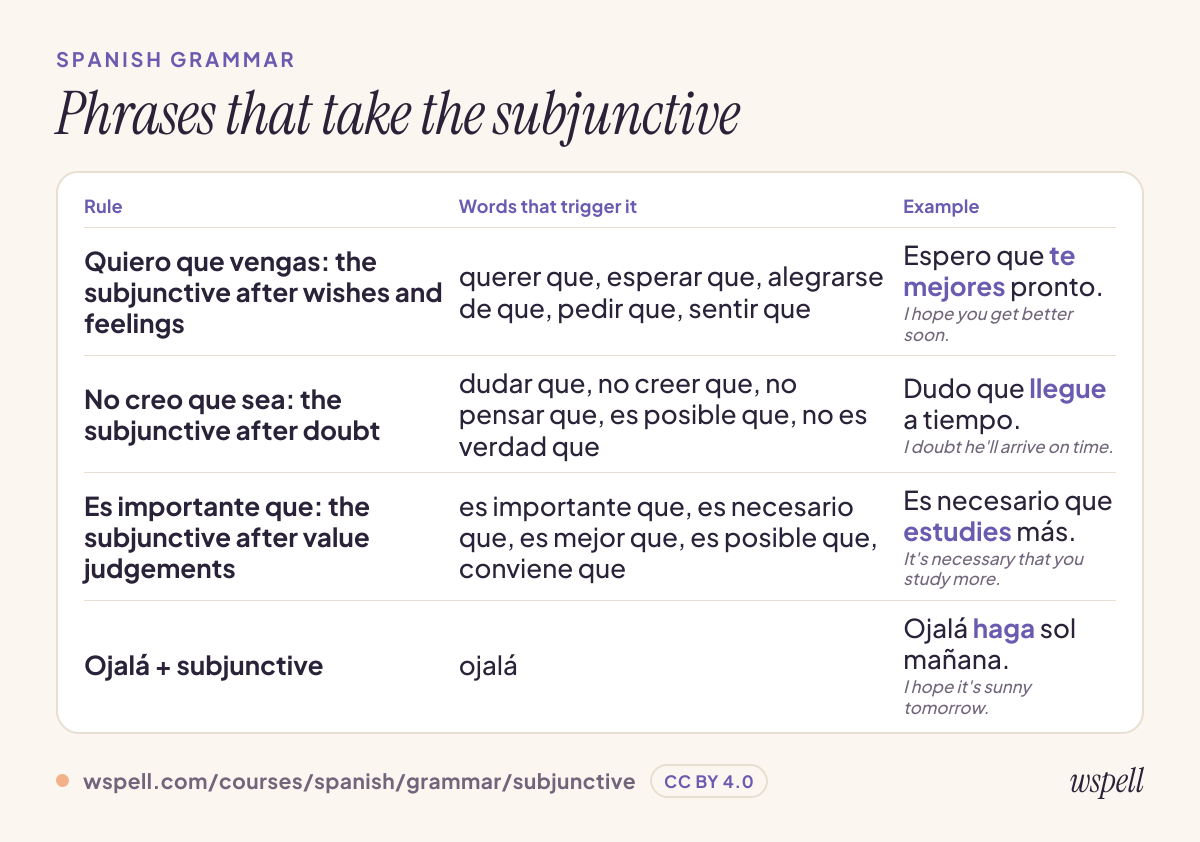
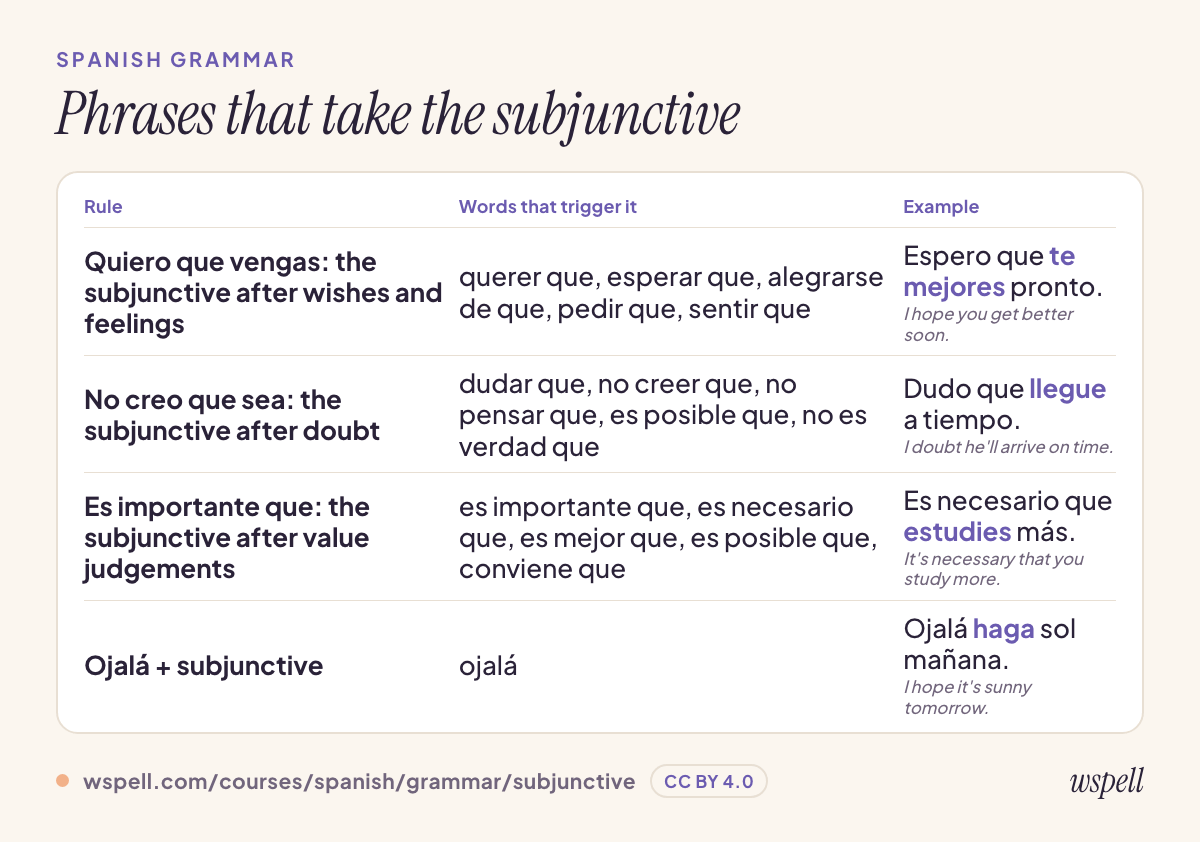
| Rule | Words that trigger it | Example |
|---|---|---|
| Quiero que vengas: the subjunctive after wishes and feelings | querer que, esperar que, alegrarse de que, pedir que, sentir que | Espero que te mejores pronto. I hope you get better soon. |
| No creo que sea: the subjunctive after doubt | dudar que, no creer que, no pensar que, es posible que, no es verdad que | Dudo que llegue a tiempo. I doubt he'll arrive on time. |
| Es importante que: the subjunctive after value judgements | es importante que, es necesario que, es mejor que, es posible que, conviene que | Es necesario que estudies más. It's necessary that you study more. |
| Ojalá + subjunctive | ojalá | Ojalá haga sol mañana. I hope it's sunny tomorrow. |
Quiero que vengas: the subjunctive after wishes and feelings
A main clause of wanting, hoping, feeling, or requesting triggers the subjunctive in a que-clause WHEN the two subjects differ: querer que, esperar que, alegrarse de que, gustar que, pedir que. Same subject → plain infinitive (quiero salir, not quiero que salga).
- Espero que te mejores pronto. — I hope you get better soon.
- Me alegro de que estés aquí. — I'm glad you're here.
No creo que sea: the subjunctive after doubt
Expressions of doubt or negated belief take the subjunctive: dudar que, no creer que, no pensar que, es posible que, no es verdad que. Their affirmative counterparts (creer que, es verdad que) assert reality and take the indicative.
- Dudo que llegue a tiempo. — I doubt he'll arrive on time.
- No creo que sea buena idea. — I don't think it's a good idea.
Es importante que: the subjunctive after value judgements
Impersonal 'es + adjective + que' clauses of value, necessity or possibility take the subjunctive: es importante que, es necesario que, es mejor que, es raro que, conviene que. Those asserting fact (es cierto/evidente que) take the indicative.
- Es necesario que estudies más. — It's necessary that you study more.
Ojalá + subjunctive
ojalá ('I hope / if only') is always followed by the subjunctive, with or without que (ojalá venga = ojalá que venga): present subjunctive for a feasible wish ('ojalá venga'), imperfect subjunctive for an unlikely/counterfactual one ('ojalá viniera' = I wish he would come).
- Ojalá haga sol mañana. — I hope it's sunny tomorrow.
- Ojalá pudiera ayudarte. — I wish I could help you.
The imperfect subjunctive: hablara, comiera
| Person | hablar | comer | vivir | ser | tener |
|---|---|---|---|---|---|
| yo | hablara | comiera | viviera | fuera | tuviera |
| tú | hablaras | comieras | vivieras | fueras | tuvieras |
| él, ella, usted | hablara | comiera | viviera | fuera | tuviera |
| nosotros, nosotras | habláramos | comiéramos | viviéramos | fuéramos | tuviéramos |
| vosotros, vosotras | hablarais | comierais | vivierais | fuerais | tuvierais |
| ellos, ellas, ustedes | hablaran | comieran | vivieran | fueran | tuvieran |
The imperfect subjunctive: hablara, comiera
Take the 3rd-person plural preterite (hablaron, comieron, tuvieron), drop -ron, and add -ra or -se: hablara/hablase, comiera/comiese, tuviera/tuviese. All preterite irregularities carry over. Used in past subjunctive contexts and unreal si-clauses, where the two are interchangeable; only the -ra form also stands for the conditional, as in the polite quisiera (never *quisiese).
- Me pidió que le ayudara. — He asked me to help him.
- Quisiera reservar una mesa. — I would like to reserve a table.
learn it step by step
The DELE Spanish exam, A2 to B2: structure, scoring and practice
save or print this chart
Under the main tables on this page sits a picture of each — keep one on your phone, share it or print it.
Free to share and adapt under CC BY 4.0 — credit wspell and link to this page. the licence
credit line to copy: The Spanish subjunctive — wspell, CC BY 4.0, https://wspell.com/courses/spanish/grammar/subjunctive
questions
How do you form the present subjunctive in Spanish?
Take the yo form of the present, drop -o and add -e, -es, -e, -emos, -éis, -en to -ar verbs or -a, -as, -a, -amos, -áis, -an to -er and -ir verbs: hablo → hable, como → coma, tengo → tenga. Stem-changing verbs keep the present's pattern — quiera, but queramos — and -ir stem-changers also change e→i and o→u in the nosotros and vosotros forms: pidamos, durmamos.
Which verbs are irregular in the present subjunctive?
Six do not follow the yo form: ser (sea), estar (esté), ir (vaya), haber (haya), saber (sepa) and dar (dé).
When do you use the subjunctive?
Mainly after a wish, feeling or request about someone else's action — quiero que vengas — after doubt — no creo que sea buena idea — after value judgements such as es importante que, after ojalá, and after para que, antes de que and cuando referring to the future: cuando llegues, llámame.