grammar chart · Spanish
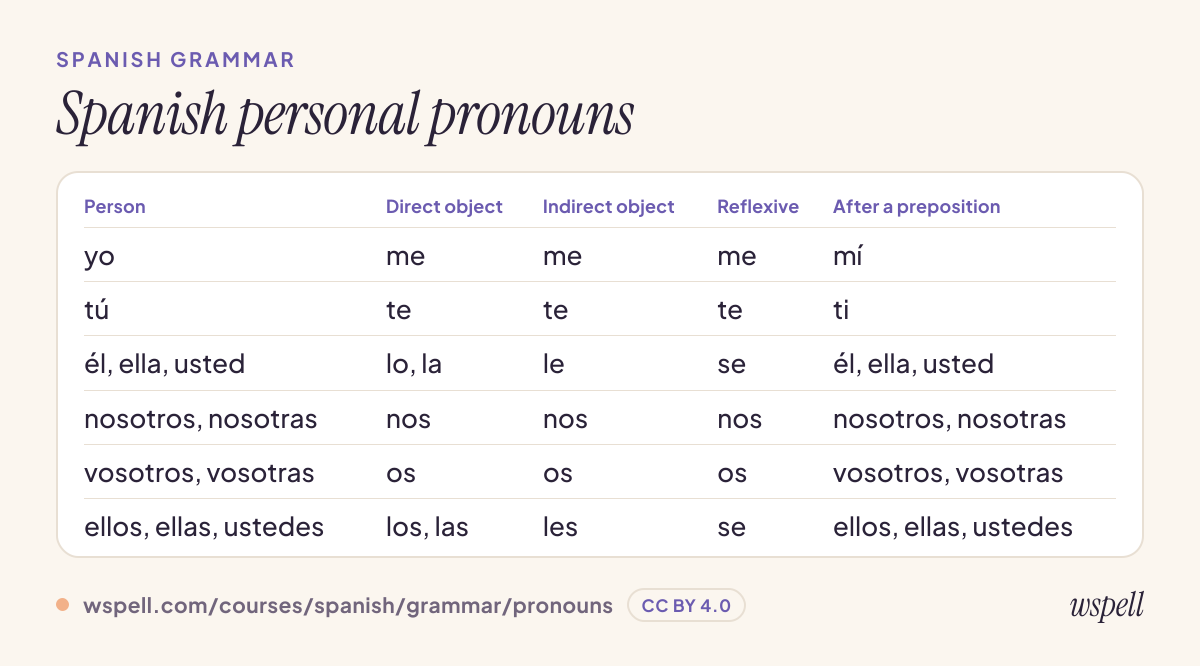
Spanish pronouns chart
One row per person, one column per job: the direct object (me, te, lo, la…), the indirect object (me, te, le…), the reflexive (me, te, se…) and the form after a preposition (mí, ti, él…); each row starts with its subject pronouns. Below the table: when to leave the subject out, where object pronouns go, and why le lo becomes se lo.
All the personal pronouns
| Person | Direct object | Indirect object | Reflexive | After a preposition |
|---|---|---|---|---|
| yo | me | me | me | mí |
| tú | te | te | te | ti |
| él, ella, usted | lo, la | le | se | él, ella, usted |
| nosotros, nosotras | nos | nos | nos | nosotros, nosotras |
| vosotros, vosotras | os | os | os | vosotros, vosotras |
| ellos, ellas, ustedes | los, las | les | se | ellos, ellas, ustedes |
Subject pronouns: yo, tú, usted
Subject pronouns: yo, tú, usted, él, ella…
The subject pronouns are yo, tú, usted, él/ella; nosotros/nosotras, vosotros/vosotras, ustedes, ellos/ellas. usted/ustedes are grammatically 3rd person (they take él/ellos verb forms) even though they mean 'you'.
- Nosotras somos estudiantes. — We (fem.) are students.
- ¿Usted habla español? — Do you (formal) speak Spanish?
The subject pronoun is usually left out
The verb ending already marks the person, so the subject pronoun is normally omitted (Hablo español rather than Yo hablo español). Use it only for contrast, emphasis, or to remove ambiguity — especially with él/ella/usted, which share one verb form.
- Trabajo en Madrid. — I work in Madrid.
- Yo trabajo, pero él descansa. — I work, but he rests.
tú or usted
tú is the informal 'you' (friends, family, peers); usted is the polite/formal 'you' (strangers, elders, hierarchy) and takes 3rd-person verb forms. Choosing wrong reads as rude or oddly distant.
- ¿Cómo estás? — How are you? (to a friend)
- ¿Cómo está usted? — How are you? (formal)
vosotros or ustedes
In Spain the informal plural 'you' is vosotros/vosotras (with its own verb forms) and ustedes is formal; in Latin America vosotros does not exist and ustedes covers all plural 'you', formal or not.
- ¿Vosotros venís a la fiesta? — Are you (pl., Spain) coming to the party?
- ¿Ustedes tienen entradas? — Do you (pl.) have tickets?
Object pronouns: lo, la, le
Direct object pronouns: me, te, lo, la, nos, os, los, las
Direct-object (accusative) clitics are me, te, lo/la, nos, os, los/las. They replace the thing/person acted upon and normally sit before a finite verb.
- ¿El libro? Lo compré ayer. — The book? I bought it yesterday.
- Te veo mañana. — I'll see you tomorrow.
lo, la, los, las agree with the noun they replace
The 3rd-person direct-object clitic matches the gender AND number of its antecedent noun: lo (m sg), la (f sg), los (m pl), las (f pl) — regardless of whether the noun is a person or a thing.
- ¿Las llaves? Las tengo yo. — The keys? I have them.
- A mis primos los invité a cenar. — I invited my cousins to dinner.
Indirect object pronouns: me, te, le, nos, os, les
Indirect-object (dative) clitics are me, te, le, nos, os, les — marking the recipient/beneficiary ('to/for whom'). Only the 3rd person (le/les) differs from the direct-object set, and it does NOT vary by gender.
- Le di el regalo a mi madre. — I gave the gift to my mother.
- ¿Me pasas la sal? — Can you pass me the salt?
le lo becomes se lo
When an indirect le/les meets a direct lo/la/los/las, the dative turns into se: 'le lo' is impossible → se lo. This se is NOT reflexive; it is a phonetic replacement for le/les.
- El libro se lo di a Marta. — The book, I gave it to Marta.
- ¿La carta? Se la mandé ayer. — The letter? I sent it to him yesterday.
Me gusta, me gustan: verbs like gustar
With gustar, encantar, doler, interesar, faltar… the thing liked is the grammatical subject and the person is an indirect object: Me gusta el café (lit. 'coffee pleases to-me'). The verb agrees with the liked thing, not with the person.
- Me gustan los perros. — I like dogs.
- A Ana le duele la cabeza. — Ana has a headache.
Where object pronouns go
Pronouns before the conjugated verb: te llamo
With a finite (conjugated) verb the object/reflexive clitics stand immediately before it, as separate words: te llamo, lo veo, nos ayudan. Nothing but another clitic may stand between them and the verb; no goes before the whole group: no lo entiendo.
- Te llamo esta noche. — I'll call you tonight.
- No lo entiendo. — I don't understand it.
Pronouns joined to the end: verlo, dámelo
With an infinitive, a gerund, or an affirmative command the clitic is written ONTO the end of the verb as one word: verlo, viéndolo, dámelo. This attachment is obligatory when the pronoun goes with one of those forms; in a periphrasis such as voy a hacerlo it may move before the conjugated verb instead (lo voy a hacer).
- Quiero verte pronto. — I want to see you soon.
- Estoy escribiéndolo ahora. — I'm writing it now.
Lo voy a hacer = voy a hacerlo
In a periphrasis (querer/ir a/poder/estar + infinitive or gerund) the clitic may either climb before the finite verb OR attach to the non-finite one — both are correct: lo voy a hacer = voy a hacerlo. It cannot be split across both.
- Te lo voy a explicar. — I'm going to explain it to you.
- Voy a explicártelo. — I'm going to explain it to you.
Two pronouns together: me lo, te lo, se lo
When clitics cluster, the order is fixed: se → te/os (2nd) → me/nos (1st) → lo/la/le (3rd). Reflexive/indirect before direct. So 'to me it' = me lo, 'to you it' = te lo, and the le→se rule applies inside a cluster (se lo).
- ¿Me lo prestas? — Will you lend it to me?
- Se te cayó el móvil. — You dropped your phone.
Reflexive pronouns: me lavo
Reflexive pronouns: me, te, se, nos, os, se
Reflexive clitics are me, te, se, nos, os, se — used when subject and object are the same. The 3rd-person form is se for both singular and plural. Verbs cited with -se (lavarse, levantarse) are reflexive/pronominal.
- Me lavo las manos. — I wash my hands.
- Los niños se visten solos. — The children dress themselves.
Reflexive verbs: me levanto, te levantas
Pronominal verbs carry a reflexive pronoun agreeing with the subject (me, te, se, nos, os, se): levantarse → me levanto, te levantas, se levanta. The pronoun precedes a conjugated verb but attaches to an infinitive or gerund (voy a ducharme / duchándome).
- Me levanto a las siete. — I get up at seven.
- Tengo que acostarme temprano. — I have to go to bed early.
After a preposition: para mí, contigo
After a preposition: mí, ti, él, nosotros
After a preposition the pronoun takes its stressed forms: mí, ti, él/ella/usted, nosotros/as, vosotros/as, ellos/ellas/ustedes. mí carries a written accent (unlike the possessive mi), and so does él (unlike the article el); ti never does.
- Este regalo es para ti. — This gift is for you.
- No puedo vivir sin ti. — I can't live without you.
conmigo, contigo, consigo
The preposition con does not combine with mí, ti, sí as two words; it fuses into single forms: conmigo, contigo, consigo (con + sí, reflexive). Every other pronoun uses plain 'con' (con él, con nosotros).
- ¿Vienes conmigo? — Are you coming with me?
- Quiero hablar contigo. — I want to talk with you.
entre tú y yo, según tú: subject forms after a few prepositions
A handful of prepositions and adverbs take the subject forms yo/tú, not mí/ti: entre tú y yo, según tú, excepto yo, incluso yo, menos tú, hasta yo. Elsewhere after a preposition you still use mí/ti.
- Entre tú y yo hay un secreto. — Between you and me there's a secret.
- Según tú, ¿quién ganó? — According to you, who won?
learn it step by step
The DELE Spanish exam, A2 to B2: structure, scoring and practice
save or print this chart
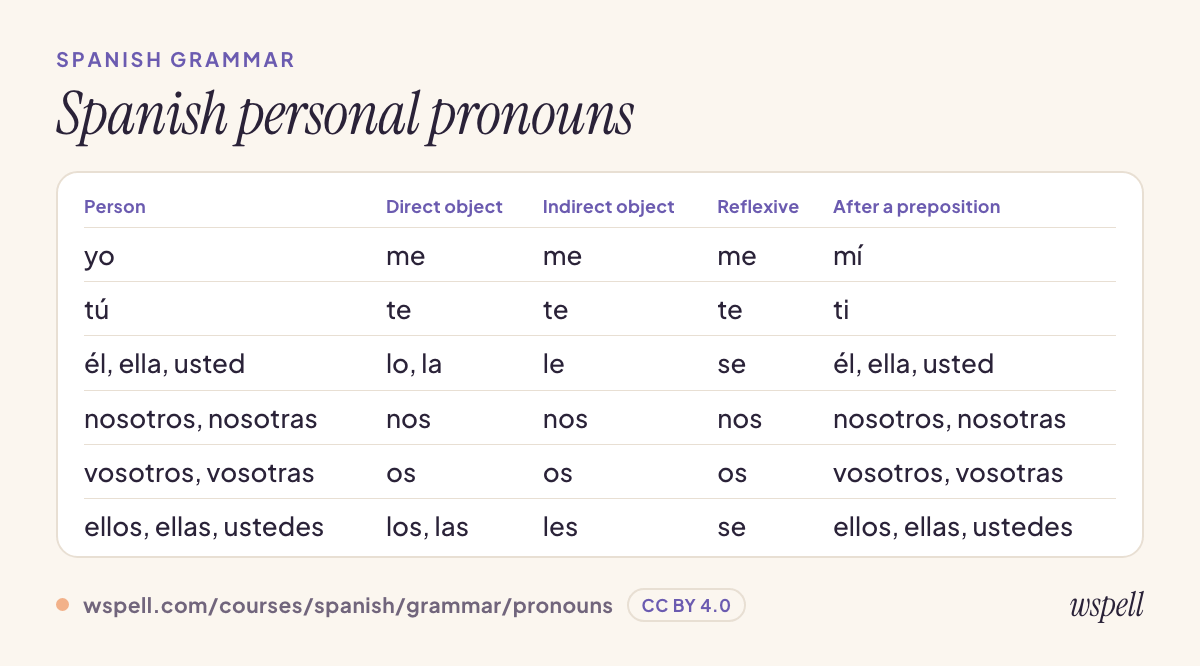
Under the main tables on this page sits a picture of each — keep one on your phone, share it or print it.
Free to share and adapt under CC BY 4.0 — credit wspell and link to this page. the licence
credit line to copy: Spanish pronouns chart — wspell, CC BY 4.0, https://wspell.com/courses/spanish/grammar/pronouns
questions
What is the difference between lo and le?
Lo and la are direct objects — ¿el libro? lo compré ayer — and change with gender and number: lo, la, los, las. Le and les are indirect objects — le di el regalo a mi madre — and have no gender.
Why is it se lo and not le lo?
When le or les comes before lo, la, los or las, it turns into se: el libro se lo di a Marta. This se is not reflexive; it only replaces le or les.
Where do object pronouns go?
Before a conjugated verb — te llamo, no lo entiendo — and on the end of an infinitive, a gerund or an affirmative command: verte, escribiéndolo, dámelo. With voy a + infinitive both places work: te lo voy a explicar, voy a explicártelo.