grammar chart · Spanish
Ser vs estar: when to use each
Spanish has two verbs for 'to be'. Ser says what something is: its identity, origin, material, the time, its characteristics — es médica, es de madera. Estar says where something is and what state it is in: location, a state or condition, the result of a change, an action in progress — está en casa, está cansada. The test is what something is against the state it is in, not how long it lasts: está casado, es joven. Where an event takes place takes ser: la fiesta es en mi casa.
What each verb is for
| Verb | When to use | Example |
|---|---|---|
| ser | identity, job | Mi hermana es abogada. My sister is a lawyer. |
| ser | origin | Soy de España. I am from Spain. |
| ser | the time | Son las cinco. It is five o'clock. |
| ser | material | La mesa es de madera. The table is made of wood. |
| ser | a characteristic | Mi hermano es muy listo. My brother is very clever. |
| ser | where an event takes place | La fiesta es en mi casa. The party is at my house. |
| estar | where someone or something is | El plato está en la mesa. The plate is on the table. |
| estar | a state or condition | El agua está fría. The water is cold. |
| estar | the result of a change | La tienda está cerrada los domingos. The shop is closed on Sundays. |
| estar | an action in progress (+ gerund) | No puedo hablar, estoy conduciendo. I can't talk, I'm driving. |
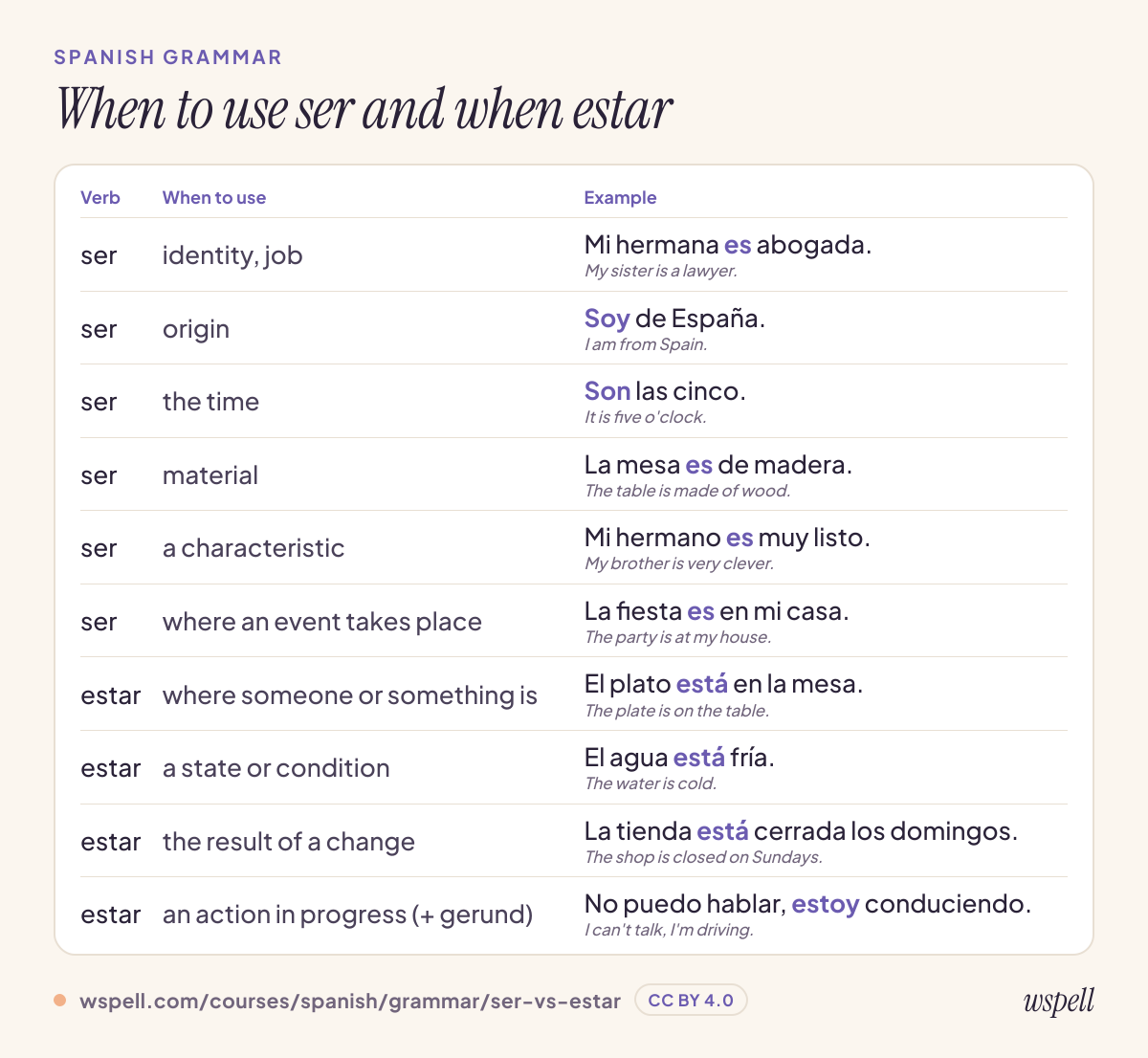
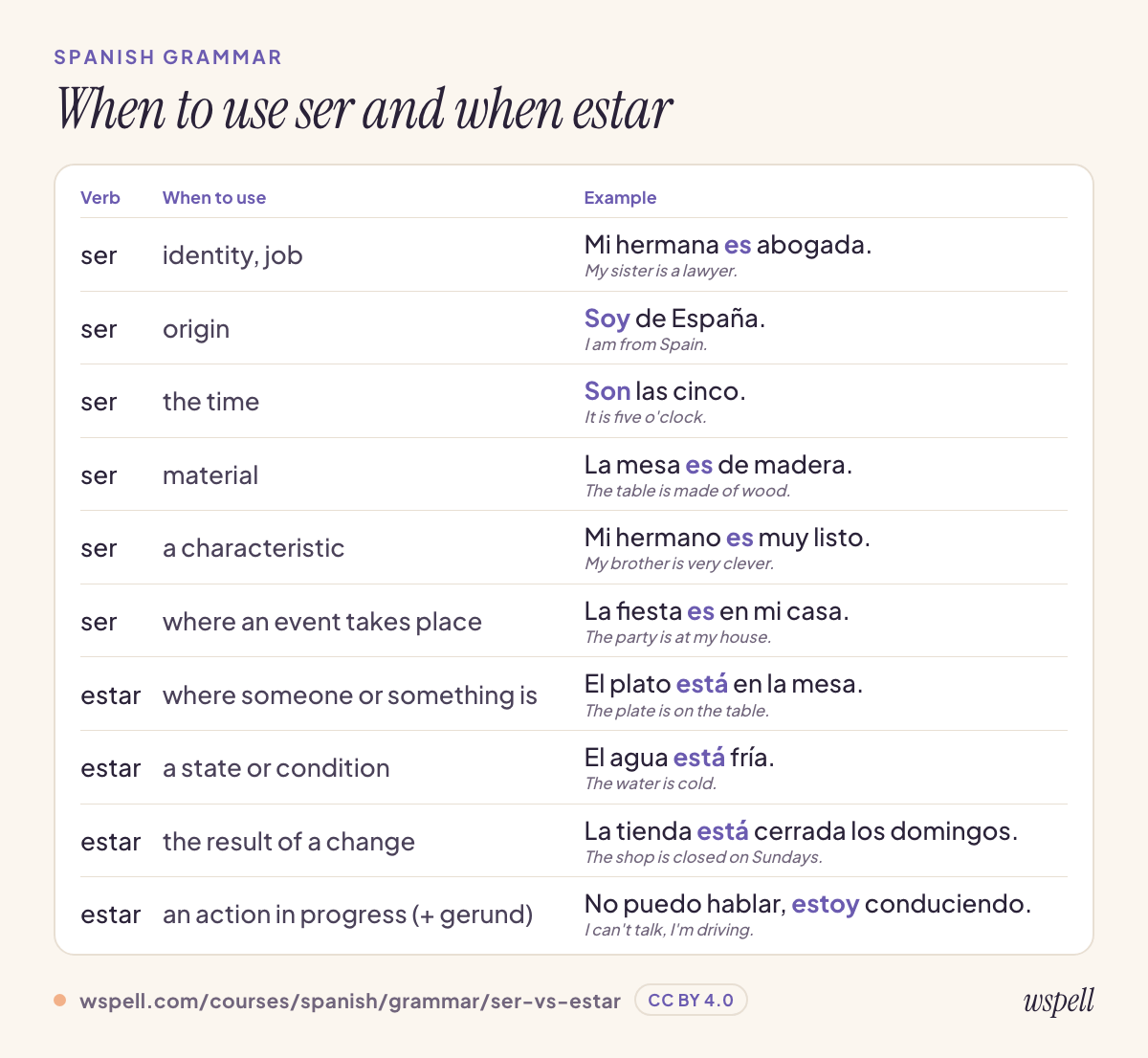
ser vs estar: identity and traits, or state and location
ser marks identity, origin, material, time and inherent traits; estar marks location, temporary states, results and the progressive. 'Es aburrido' = he is boring (trait); 'está aburrido' = he is bored (state). Location of things/people is always estar, but location of events is ser.
- Ella es médica y está cansada. — She is a doctor and is tired.
- La fiesta es en mi casa; los platos están en la mesa. — The party is at my house; the plates are on the table.
Ser and estar in the present, preterite and imperfect
| Person | ser Present | estar Present | ser Preterite | estar Preterite | ser Imperfect | estar Imperfect |
|---|---|---|---|---|---|---|
| yo | soy* | estoy* | fui* | estuve* | era* | estaba |
| tú | eres* | estás | fuiste* | estuviste* | eras* | estabas |
| él, ella, usted | es* | está | fue* | estuvo* | era* | estaba |
| nosotros, nosotras | somos* | estamos | fuimos* | estuvimos* | éramos* | estábamos |
| vosotros, vosotras | sois* | estáis | fuisteis* | estuvisteis* | erais* | estabais |
| ellos, ellas, ustedes | son* | están | fueron* | estuvieron* | eran* | estaban |
* irregular form
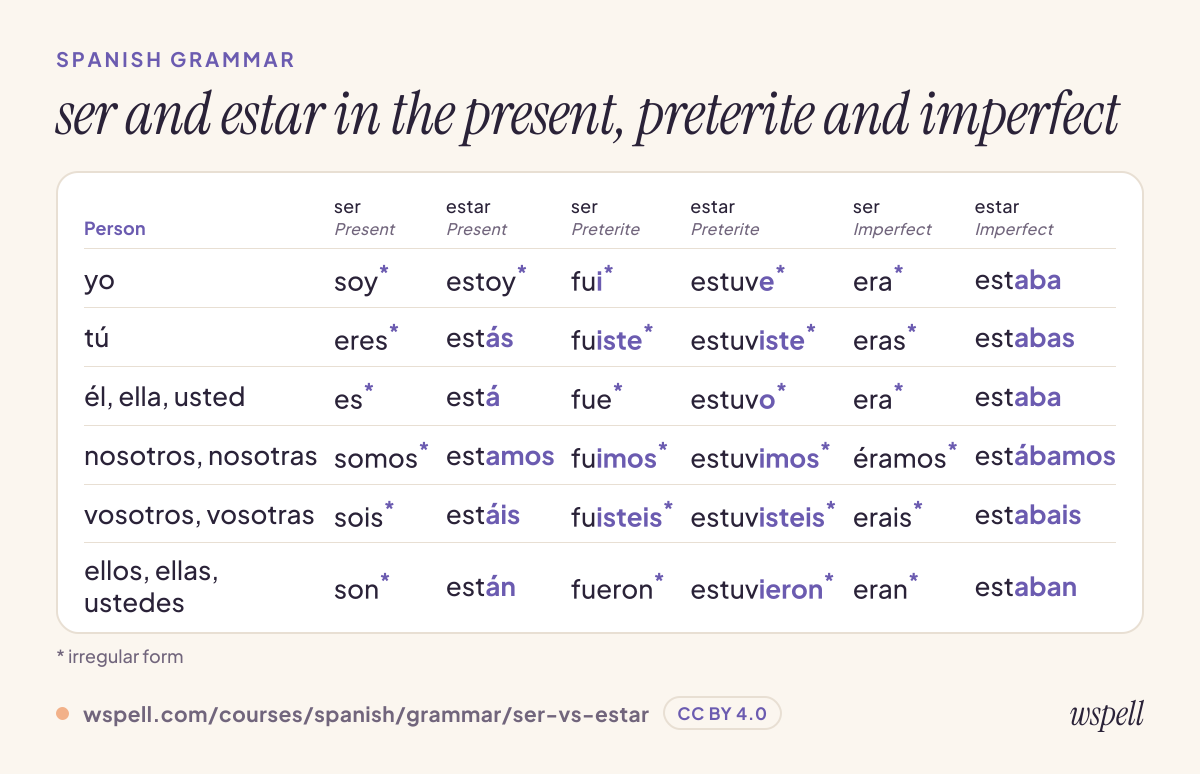
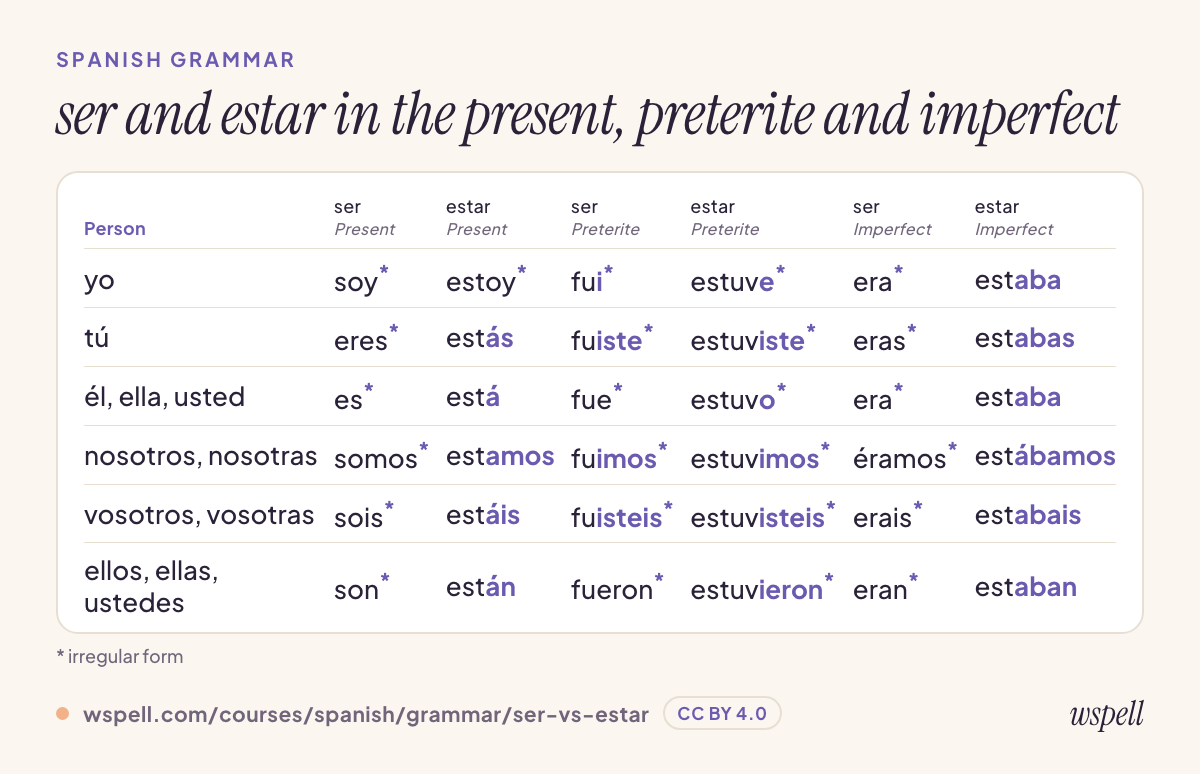
Adjectives that change meaning
| Adjective | With ser | With estar |
|---|---|---|
| listo | clever | ready |
| aburrido | boring | bored |
| rico | rich | tasty |
| malo | bad | ill |
| verde | green | unripe |
Adjectives that change meaning: ser listo, estar listo
Some adjectives mean different things with each copula: ser listo (clever) vs estar listo (ready); ser aburrido (boring) vs estar aburrido (bored); ser rico (rich) vs estar rico (tasty); ser malo (bad) vs estar malo (ill). estar signals a state or subjective impression.
- La sopa está muy rica. — The soup is very tasty.
- Mi hermano es muy listo. — My brother is very clever.
Hay or estar?
hay: there is, there are
hay (from haber) is the invariable existential for indefinite quantities: hay un libro / hay tres libros. Use estar, not hay, for a definite located thing (el libro está aquí). Other tenses use the 3rd-singular of haber: había, hubo, habrá.
- Hay mucha gente en la plaza. — There are a lot of people in the square.
- Había un problema. — There was a problem.
learn it step by step
The DELE Spanish exam, A2 to B2: structure, scoring and practice
save or print this chart
Under the main tables on this page sits a picture of each — keep one on your phone, share it or print it.
Free to share and adapt under CC BY 4.0 — credit wspell and link to this page. the licence
credit line to copy: Ser vs estar: when to use each — wspell, CC BY 4.0, https://wspell.com/courses/spanish/grammar/ser-vs-estar
questions
What is the difference between ser and estar?
Ser describes what something is — identity, origin, material, time, characteristics. Estar describes where it is and what state it is in — location, states and conditions however long they last, results, actions in progress. Es aburrido means 'he is boring'; está aburrido means 'he is bored'.
Is it ser or estar for location?
Estar for where a person or a thing is — los platos están en la mesa — but ser for where an event takes place: la fiesta es en mi casa.
Is it ser or estar for a job?
Ser, without an article: mi hermana es abogada. The article comes back when the noun is described: es un abogado muy bueno.