grammar chart · Spanish
Spanish numbers
Up to 15 every number is its own word; 16 to 29 are written as one word (dieciséis, veintidós); from 31 the tens and the units are joined by y (treinta y uno). Uno becomes un before a masculine noun and una before a feminine one, and the hundreds agree too: doscientos euros, doscientas casas.
0 to 29
| Number | In words | Number | In words | Number | In words |
|---|---|---|---|---|---|
| 0 | cero | 10 | diez | 20 | veinte |
| 1 | uno un · una | 11 | once | 21 | veintiuno veintiún · veintiuna |
| 2 | dos | 12 | doce | 22 | veintidós |
| 3 | tres | 13 | trece | 23 | veintitrés |
| 4 | cuatro | 14 | catorce | 24 | veinticuatro |
| 5 | cinco | 15 | quince | 25 | veinticinco |
| 6 | seis | 16 | dieciséis | 26 | veintiséis |
| 7 | siete | 17 | diecisiete | 27 | veintisiete |
| 8 | ocho | 18 | dieciocho | 28 | veintiocho |
| 9 | nueve | 19 | diecinueve | 29 | veintinueve |
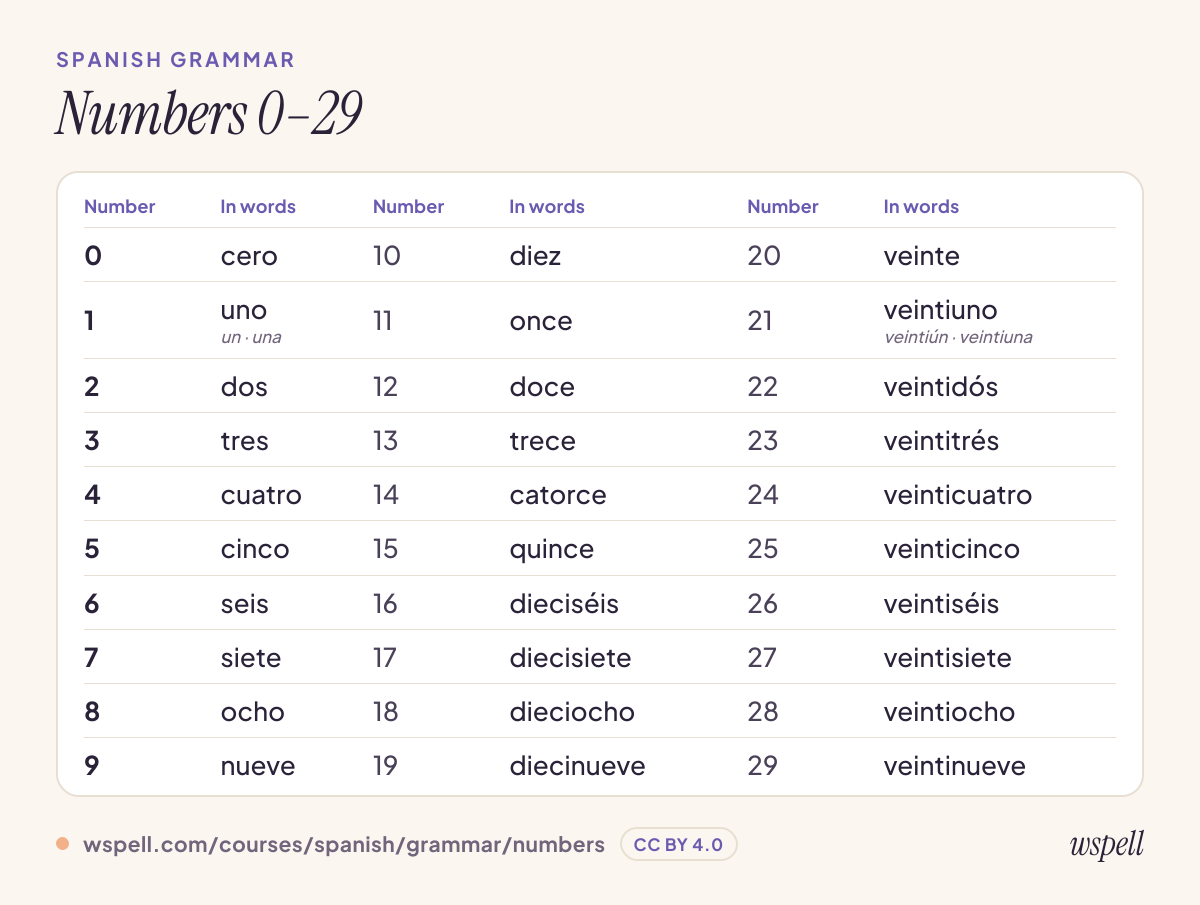
0 to 15: words to learn by heart
The numbers 0–15 are irregular single words that must be learned by heart (cero, uno, dos … quince); the regular building system only starts at 16.
- Tengo tres hermanos y dos gatos. — I have three siblings and two cats.
16 to 29: one word (dieciséis, veintidós)
From 16 to 29 the tens and units fuse into ONE word with an accent where needed: dieciséis, diecisiete, veintiuno, veintidós, veintitrés, veintiséis — the older three-word spelling (diez y seis) is no longer used.
- Somos veintiún estudiantes. — We are twenty-one students.
- El libro cuesta veintidós euros. — The book costs twenty-two euros.
uno or un: un libro, veintiún años
uno drops its -o to un directly before a masculine noun (un libro, veintiún años, treinta y un días); it keeps uno only when counting or standing alone.
- Necesito un boleto. — I need one ticket.
- ¿Cuántos hay? Solo uno. — How many are there? Just one.
Tens, hundreds and thousands
| Number | In words | Number | In words | Number | In words |
|---|---|---|---|---|---|
| 30 | treinta | 90 | noventa | 600 | seiscientos seiscientas |
| 31 | treinta y uno treinta y un · treinta y una | 100 | cien | 700 | setecientos setecientas |
| 40 | cuarenta | 101 | ciento uno ciento un · ciento una | 800 | ochocientos ochocientas |
| 50 | cincuenta | 200 | doscientos doscientas | 900 | novecientos novecientas |
| 60 | sesenta | 300 | trescientos trescientas | 1000 | mil |
| 70 | setenta | 400 | cuatrocientos cuatrocientas | 2000 | dos mil |
| 80 | ochenta | 500 | quinientos quinientas | 1.000.000 | un millón |
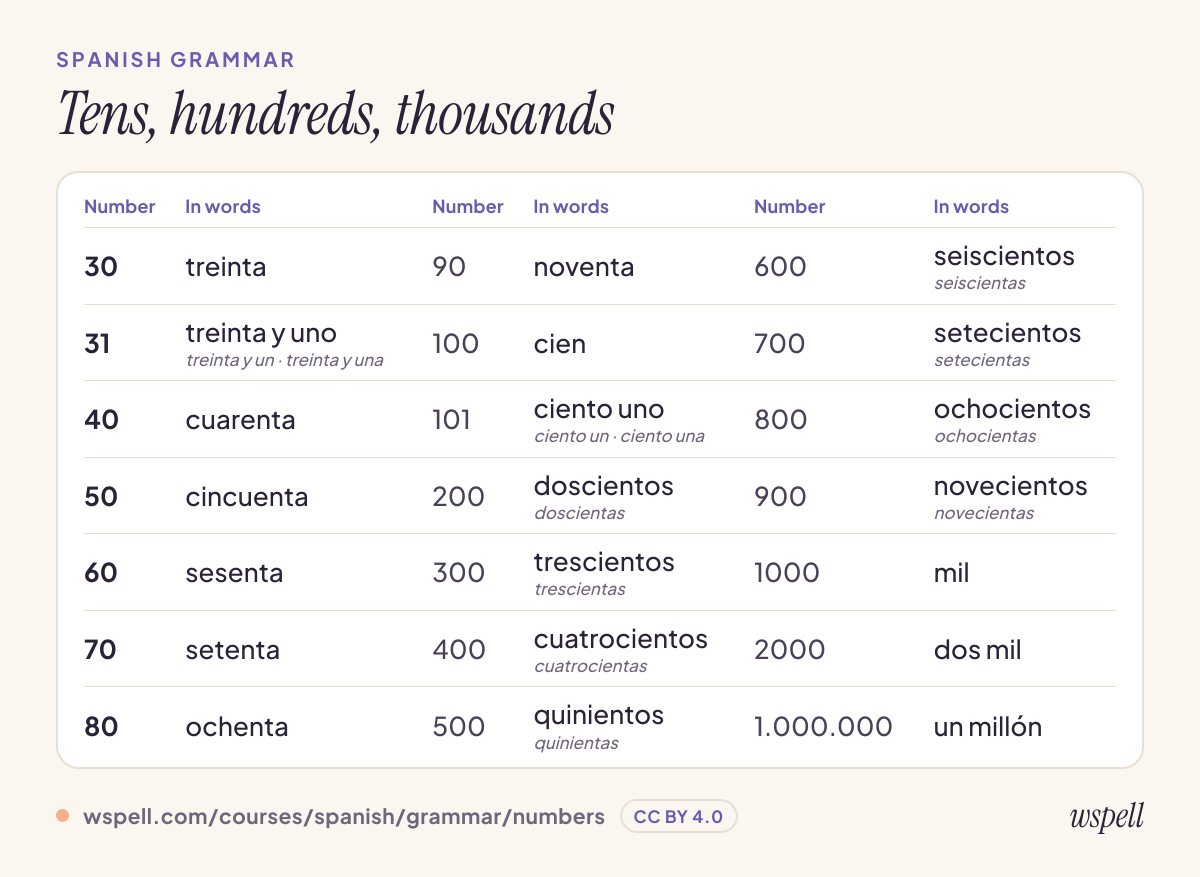
31 to 99: treinta y uno, three words
From 31 upward the tens and units stay as three separate words joined by y: treinta y uno, cuarenta y cinco, noventa y nueve. The connector y appears ONLY between tens and units.
- Mi abuela tiene noventa y nueve años. — My grandmother is ninety-nine years old.
y only between the tens and the units
Spanish does NOT put y between hundreds and the rest (unlike English 'one hundred AND five'): ciento cinco, doscientos treinta, mil dos. The y surfaces only between a tens word and a units word.
- Ciento cinco personas. — One hundred and five people.
- Trescientos cuarenta y dos. — Three hundred and forty-two.
cien or ciento
Use cien for exactly 100 and before any noun or before mil/millones (cien euros, cien mil); use ciento when a smaller number follows (ciento uno, ciento cincuenta) and in por ciento.
- Cien años de soledad. — One hundred years of solitude.
- Ciento veinte kilómetros. — One hundred twenty kilometres.
The hundreds agree: doscientos euros, doscientas casas
The hundreds from 200 to 900 agree in gender with the counted noun: doscientas casas, trescientas personas, quinientos euros. Note the irregular stems quinientos (500), setecientos (700), novecientos (900).
- Doscientas cincuenta mujeres asistieron. — Two hundred fifty women attended.
- El vuelo cuesta quinientos euros. — The flight costs five hundred euros.
mil never changes: mil, dos mil
mil never takes un before it and never pluralizes when counting: mil, dos mil, cien mil (not 'un mil', not 'dos miles'). The plural miles exists only as a vague collective (miles de personas).
- Ganó dos mil dólares. — He earned two thousand dollars.
- Miles de personas salieron a la calle. — Thousands of people took to the streets.
un millón de: a noun, with de
Unlike mil, millón is a noun: it takes un (un millón), pluralizes (dos millones), and requires de before the counted noun (un millón de habitantes) — unless another number follows (un millón doscientos mil).
- La ciudad tiene tres millones de habitantes. — The city has three million inhabitants.
- Un millón de gracias. — A million thanks.
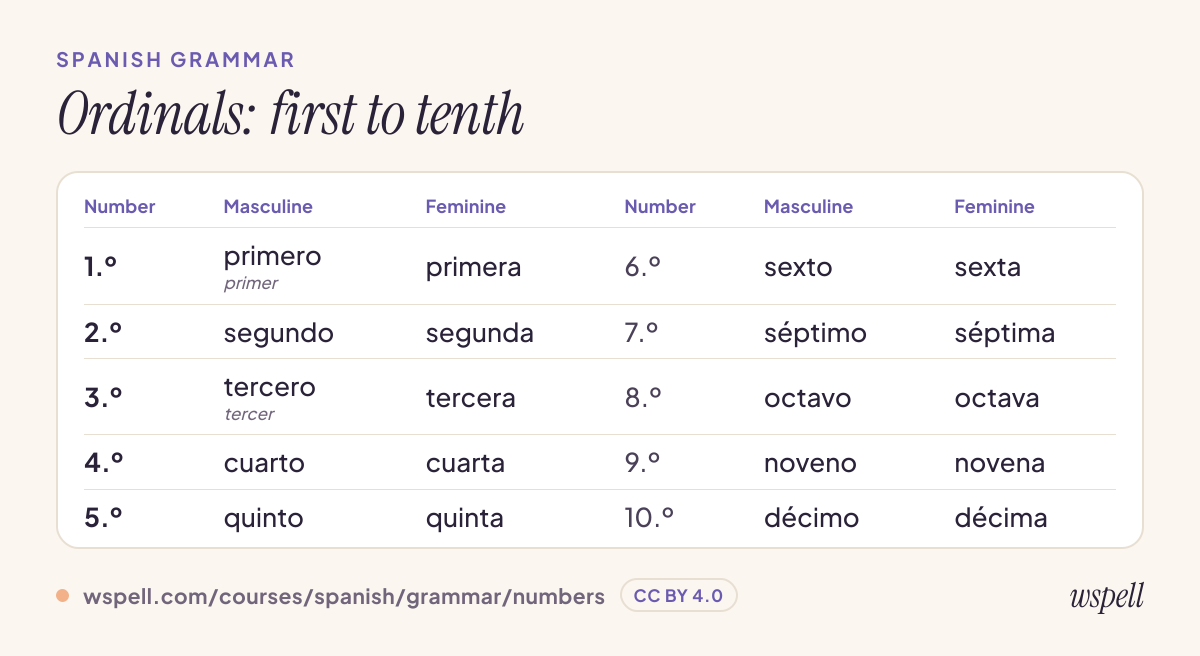
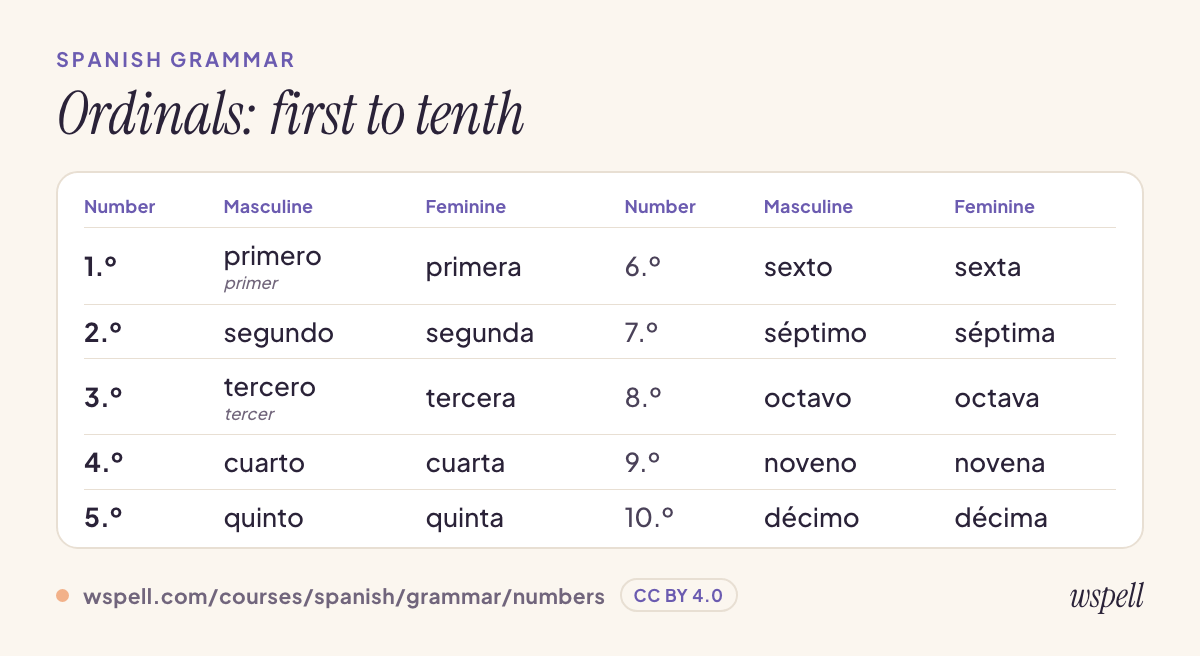
Ordinals: primero to décimo
| Number | Masculine | Feminine | Number | Masculine | Feminine |
|---|---|---|---|---|---|
| 1.º | primero primer | primera | 6.º | sexto | sexta |
| 2.º | segundo | segunda | 7.º | séptimo | séptima |
| 3.º | tercero tercer | tercera | 8.º | octavo | octava |
| 4.º | cuarto | cuarta | 9.º | noveno | novena |
| 5.º | quinto | quinta | 10.º | décimo | décima |
First to tenth: primero … décimo
The core ordinals primero, segundo, tercero, cuarto, quinto, sexto, séptimo, octavo, noveno, décimo behave like adjectives, agreeing in gender and number: la segunda puerta, los primeros días.
- Vivo en el tercer piso, segunda puerta. — I live on the third floor, second door.
primer, tercer before a masculine noun
primero and tercero drop the -o before a masculine singular noun: el primer día, el tercer intento — parallel to uno → un. The feminine (primera, tercera) never apocopates.
- Es mi primer viaje a España. — It is my first trip to Spain.
Above tenth, say the number: el piso once
Higher ordinals (undécimo/decimoprimero, vigésimo, trigésimo…) exist but sound formal; everyday Spanish uses the cardinal after the noun instead: el piso once, el capítulo veinte, Alfonso trece.
- Vivo en el piso once. — I live on the eleventh floor.
- Estamos en el siglo veintiuno. — We are in the twenty-first century.
Age, time, dates and prices
Age: tengo veinte años
Age uses tener, not ser: tengo veinte años (I am twenty). The word años is normally said (in a short answer, tengo veinte is fine). Ask with ¿Cuántos años tienes?
- Mi hijo tiene ocho años. — My son is eight years old.
What time is it? Es la una, son las tres
Clock time uses ser + the feminine article agreeing with the implied hora(s): singular es la una for one o'clock, plural son las for all other hours (son las tres). The article is always feminine.
- Son las cinco. — It is five o'clock.
- Es la una en punto. — It is one o'clock sharp.
y cuarto, y media, menos cuarto
Add minutes with y up to the half hour (y cuarto, y media, y veinte) and subtract from the next hour after it with menos (menos cuarto, menos diez). Alternatively state the raw time (las tres y cuarenta).
- Son las ocho y media. — It is half past eight.
- Llegó a las nueve menos cuarto. — He arrived at a quarter to nine.
Dates: el doce de octubre
Dates use the cardinal (not ordinal): el quince de marzo, el uno/primero de mayo — only the first optionally takes primero (common in Latin America). Months are lowercase and joined with de.
- La fiesta es el doce de octubre. — The party is on the twelfth of October.
Years: mil novecientos noventa y nueve
Years are read as a single whole number, not paired digits like English: 1999 = mil novecientos noventa y nueve; 2026 = dos mil veintiséis. The preposition en marks 'in a year' (en 1999).
- Nació en mil novecientos ochenta y cinco. — She was born in nineteen eighty-five.
Prices: cuesta veinte euros
Prices use costar or valer agreeing with the item (cuesta / cuestan), with the currency name after the number: cuesta veinte euros, cuestan cinco dólares. The symbol usually follows the figure (20 €).
- Las entradas cuestan treinta euros. — The tickets cost thirty euros.
learn it step by step
The DELE Spanish exam, A2 to B2: structure, scoring and practice
save or print this chart
Under the main tables on this page sits a picture of each — keep one on your phone, share it or print it.
Free to share and adapt under CC BY 4.0 — credit wspell and link to this page. the licence
credit line to copy: Spanish numbers — wspell, CC BY 4.0, https://wspell.com/courses/spanish/grammar/numbers
questions
How do you count to 100 in Spanish?
Learn 0 to 15 by heart, then dieciséis to diecinueve, veinte and veintiuno to veintinueve — one word each. From 31, join the tens and the units with y: treinta y uno, cuarenta y cinco. 100 is cien.
Cien or ciento?
Cien for exactly 100 and before a noun, mil or millones: cien euros, cien mil. Ciento when a smaller number follows — ciento uno, ciento cincuenta — and in por ciento.
How do you tell the time in Spanish?
With ser and the feminine article: es la una, son las tres. Add the minutes with y and subtract them with menos: son las ocho y media, a las nueve menos cuarto.