grammar chart · Spanish
Preterite vs imperfect: the Spanish past tenses
Spanish tells the past with two simple tenses. The preterite (pretérito indefinido) reports what happened — a finished event: comí, hablaron. The imperfect (pretérito imperfecto) paints what was going on around it — the background, a description, a habit: comía, hablaban. The uses come first, then both tenses on regular and irregular verbs, and the present perfect, he hablado.
When to use each
| Tense | When to use | Example |
|---|---|---|
| Preterite pretérito indefinido | a completed event | Ayer comí en casa de mis abuelos. Yesterday I ate at my grandparents' house. |
| Preterite pretérito indefinido | an action with set limits | Hablaron durante dos horas. They talked for two hours. |
| Preterite pretérito indefinido | events one after another | Llegué tarde y empecé a correr. I arrived late and started to run. |
| Imperfect pretérito imperfecto | something going on | Eran las tres y llovía. It was three o'clock and it was raining. |
| Imperfect pretérito imperfecto | description, background | Era tarde, así que me fui a casa. It was late, so I went home. |
| Imperfect pretérito imperfecto | a past habit | De niño jugaba en la calle todos los días. As a child I used to play in the street every day. |
| Imperfect pretérito imperfecto | an action that gets interrupted | Leía tranquilamente cuando sonó el teléfono. I was reading calmly when the phone rang. |
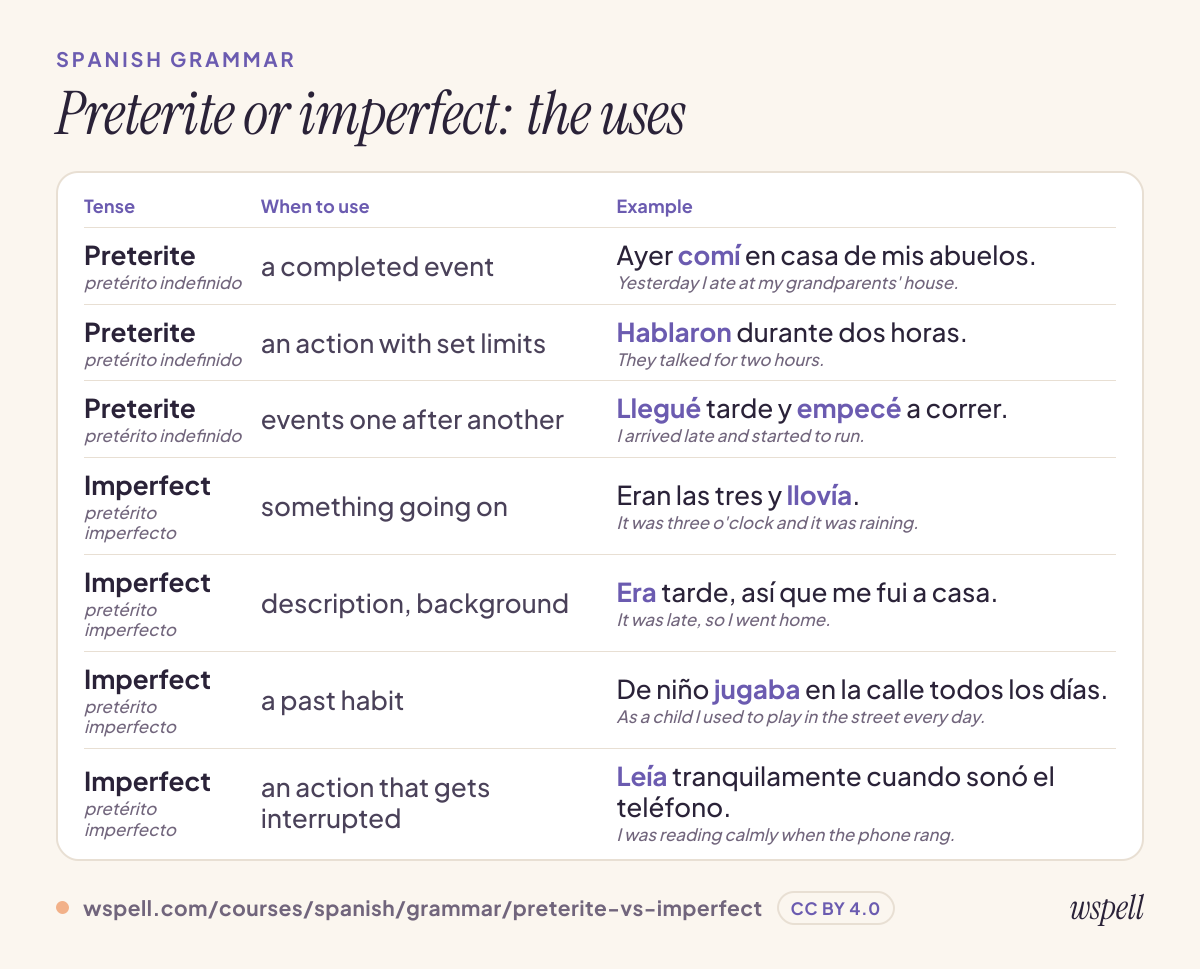
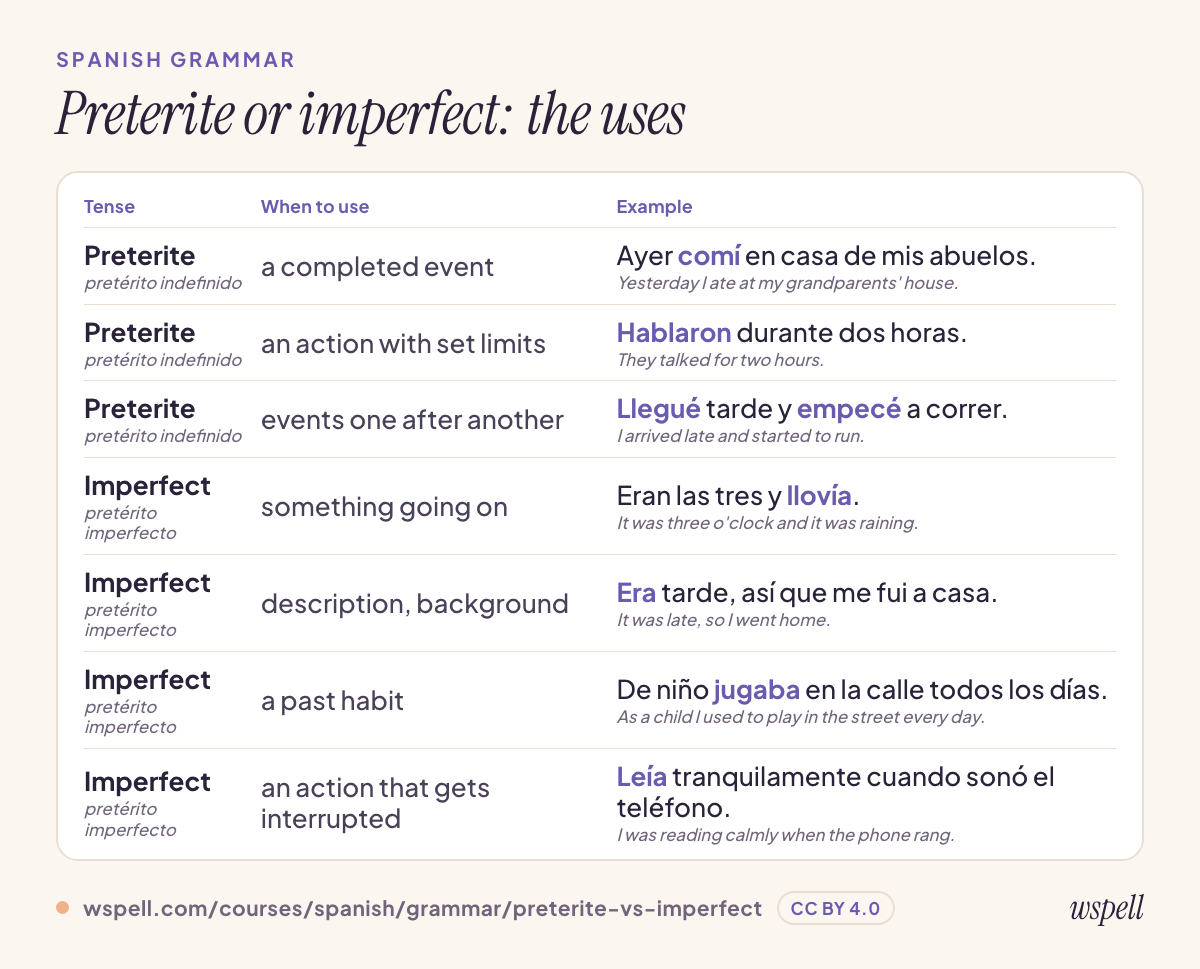
The preterite for the event, the imperfect for the setting
The preterite advances the narrative with a single bounded event; the imperfect paints the ongoing background, description, or repeated habit it sits inside. A completed action interrupting an ongoing one: imperfect for the setting, preterite for the interruption.
- Leía tranquilamente cuando sonó el teléfono. — I was reading calmly when the phone rang.
- Era tarde, así que me fui a casa. — It was late, so I went home.
The preterite: hablé, comí, viví
| Person | hablar | comer | vivir |
|---|---|---|---|
| yo | hablé | comí | viví |
| tú | hablaste | comiste | viviste |
| él, ella, usted | habló | comió | vivió |
| nosotros, nosotras | hablamos | comimos | vivimos |
| vosotros, vosotras | hablasteis | comisteis | vivisteis |
| ellos, ellas, ustedes | hablaron | comieron | vivieron |
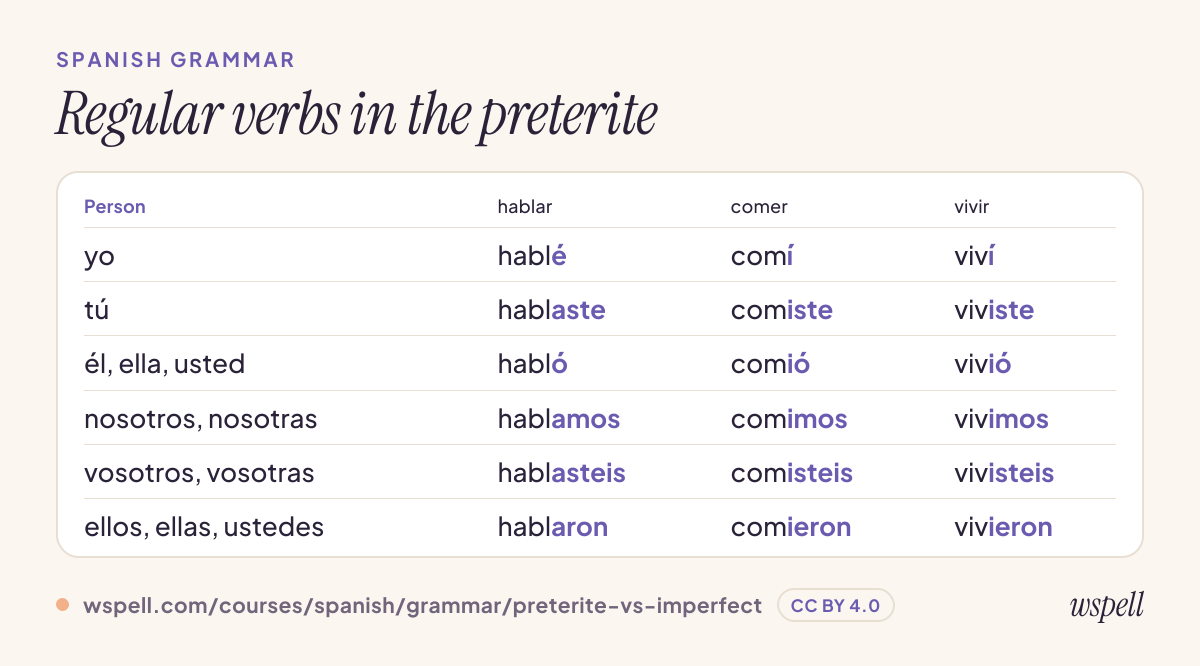
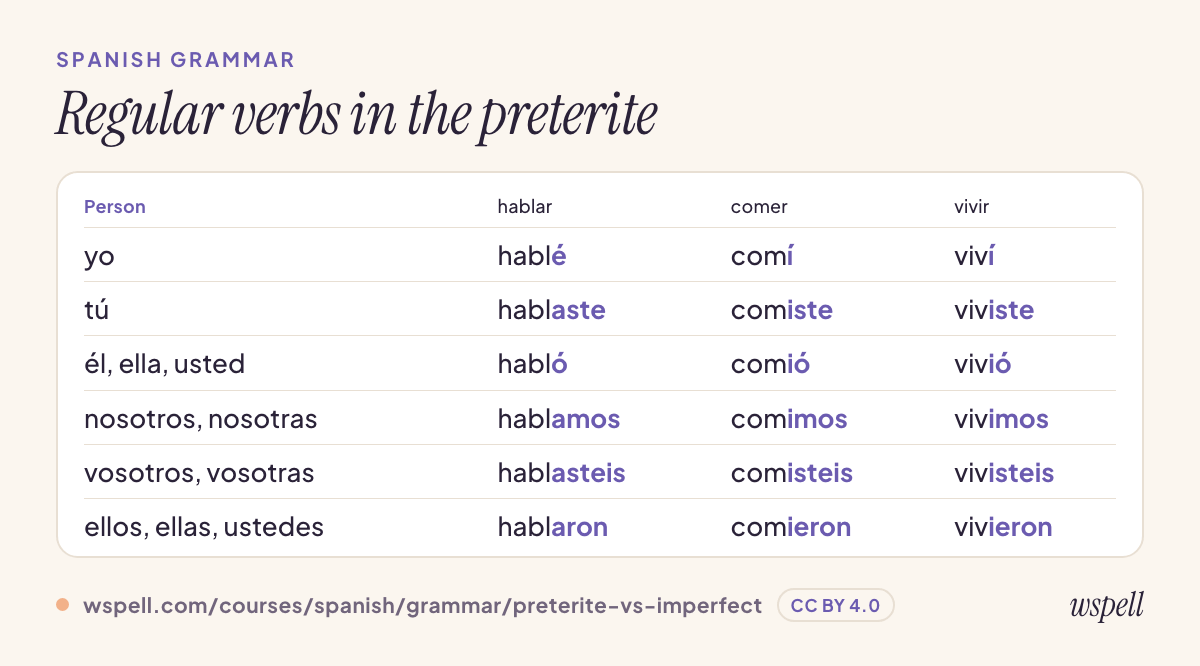
Preterite endings: -é, -aste, -ó; -í, -iste, -ió
The preterite reports completed, bounded past events. -ar: -é, -aste, -ó, -amos, -asteis, -aron. -er/-ir share: -í, -iste, -ió, -imos, -isteis, -ieron. Note the written accents on the 1st and 3rd singular.
- Ayer comí en casa de mis abuelos. — Yesterday I ate at my grandparents' house.
- Hablaron durante dos horas. — They talked for two hours.
The imperfect: hablaba, comía, vivía
Only three verbs are irregular in the imperfect: ser, ir and ver.
| Person | hablar | comer | vivir |
|---|---|---|---|
| yo | hablaba | comía | vivía |
| tú | hablabas | comías | vivías |
| él, ella, usted | hablaba | comía | vivía |
| nosotros, nosotras | hablábamos | comíamos | vivíamos |
| vosotros, vosotras | hablabais | comíais | vivíais |
| ellos, ellas, ustedes | hablaban | comían | vivían |
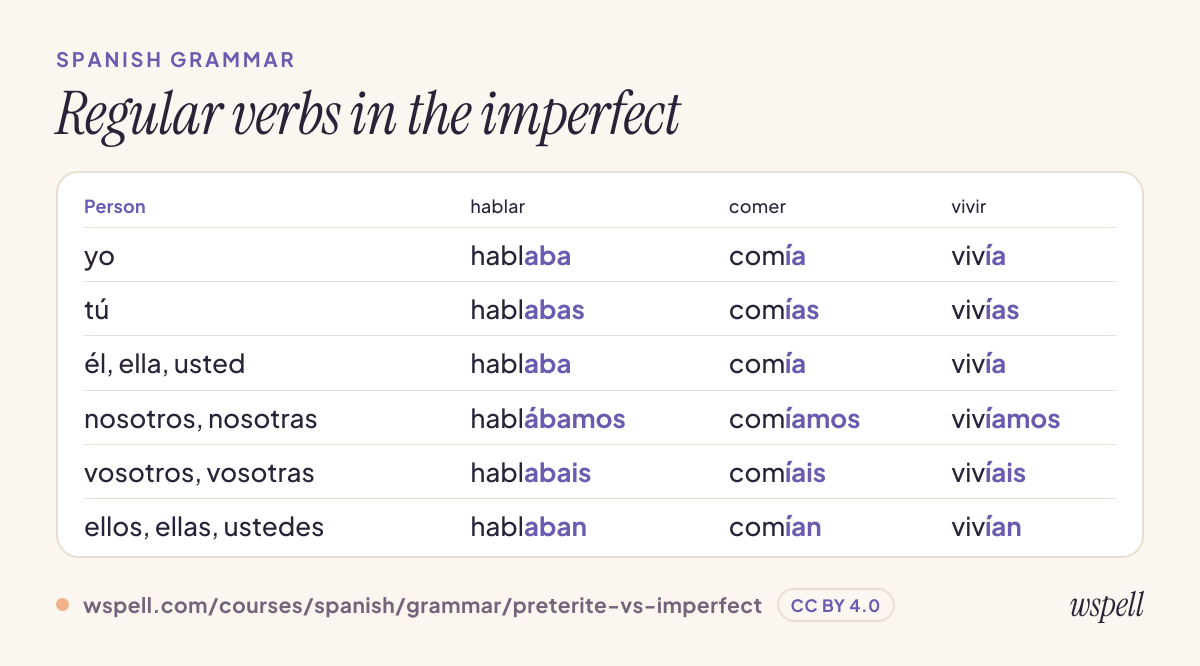
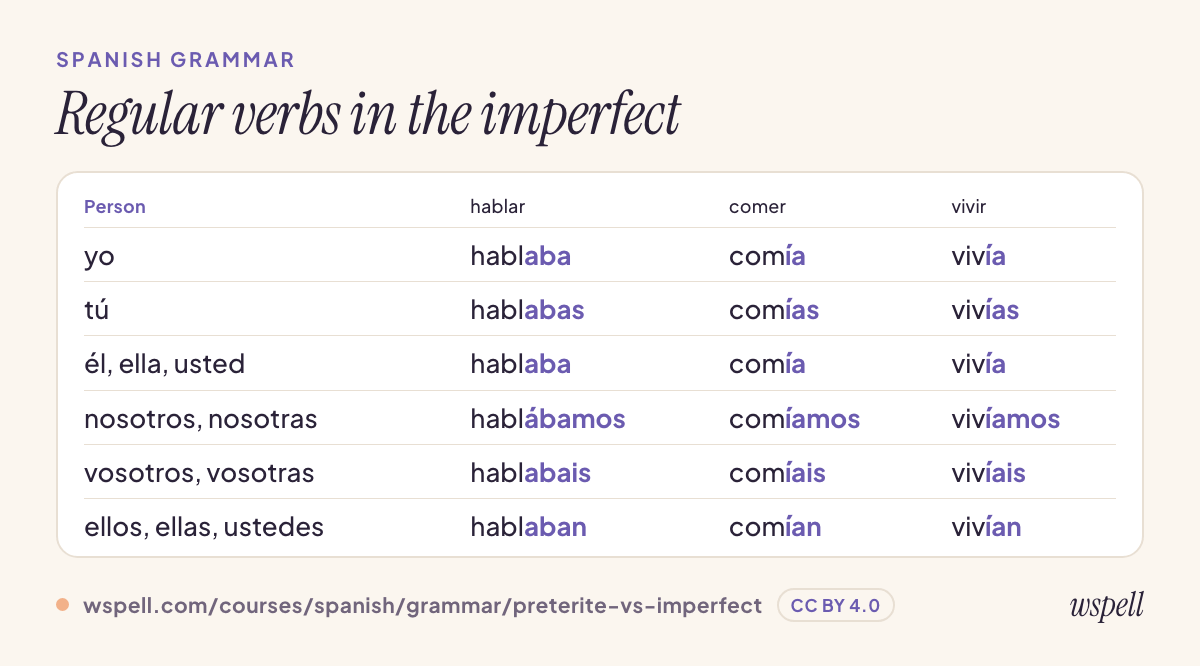
The imperfect: -aba, -ía
The imperfect describes ongoing, habitual or background past actions ('used to', 'was ...-ing'). -ar: -aba, -abas, -aba, -ábamos, -abais, -aban. -er/-ir: -ía, -ías, -ía, -íamos, -íais, -ían. Only three verbs are irregular: ser (era), ir (iba), ver (veía).
- De niño jugaba en la calle todos los días. — As a child I used to play in the street every day.
- Eran las tres y llovía. — It was three o'clock and it was raining.
| Person | ser | ir | ver |
|---|---|---|---|
| yo | era* | iba* | veía* |
| tú | eras* | ibas* | veías* |
| él, ella, usted | era* | iba* | veía* |
| nosotros, nosotras | éramos* | íbamos* | veíamos* |
| vosotros, vosotras | erais* | ibais* | veíais* |
| ellos, ellas, ustedes | eran* | iban* | veían* |
* irregular form
Irregular preterites
| Person | ser | estar | tener | hacer | poder | querer |
|---|---|---|---|---|---|---|
| yo | fui* | estuve* | tuve* | hice* | pude* | quise* |
| tú | fuiste* | estuviste* | tuviste* | hiciste* | pudiste* | quisiste* |
| él, ella, usted | fue* | estuvo* | tuvo* | hizo* | pudo* | quiso* |
| nosotros, nosotras | fuimos* | estuvimos* | tuvimos* | hicimos* | pudimos* | quisimos* |
| vosotros, vosotras | fuisteis* | estuvisteis* | tuvisteis* | hicisteis* | pudisteis* | quisisteis* |
| ellos, ellas, ustedes | fueron* | estuvieron* | tuvieron* | hicieron* | pudieron* | quisieron* |
* irregular form
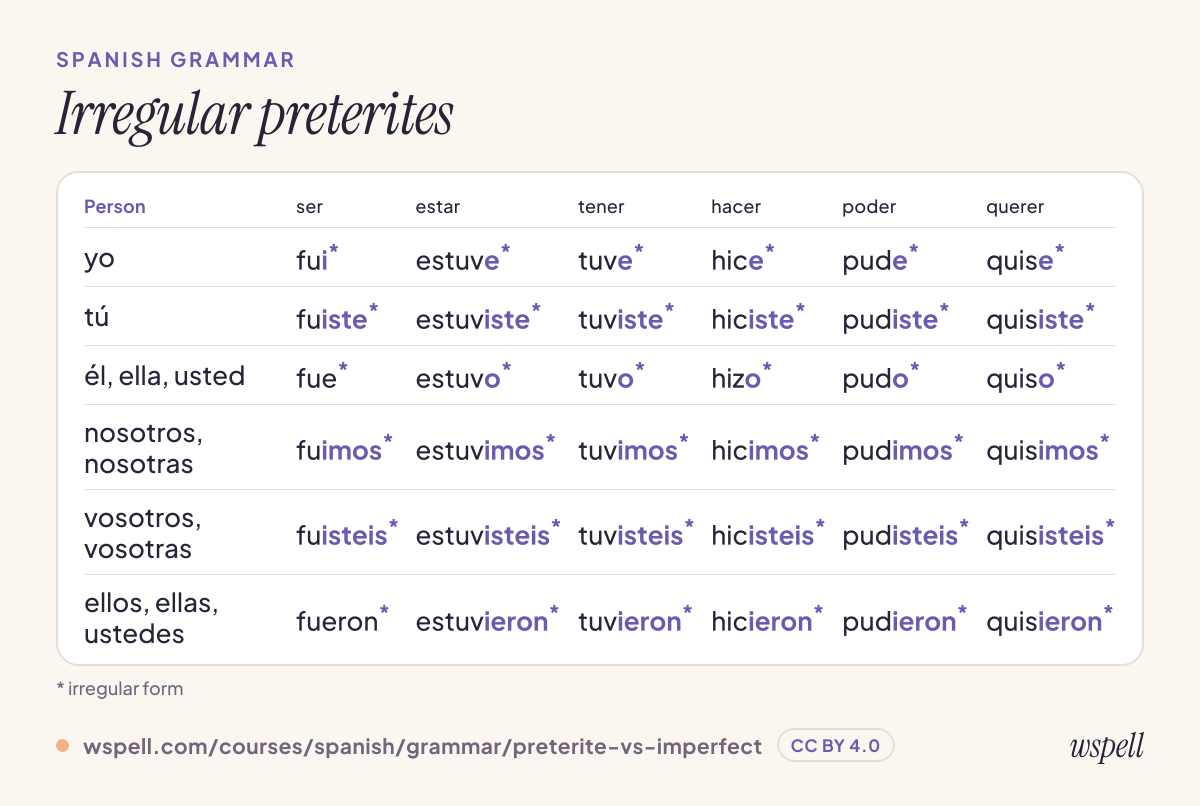
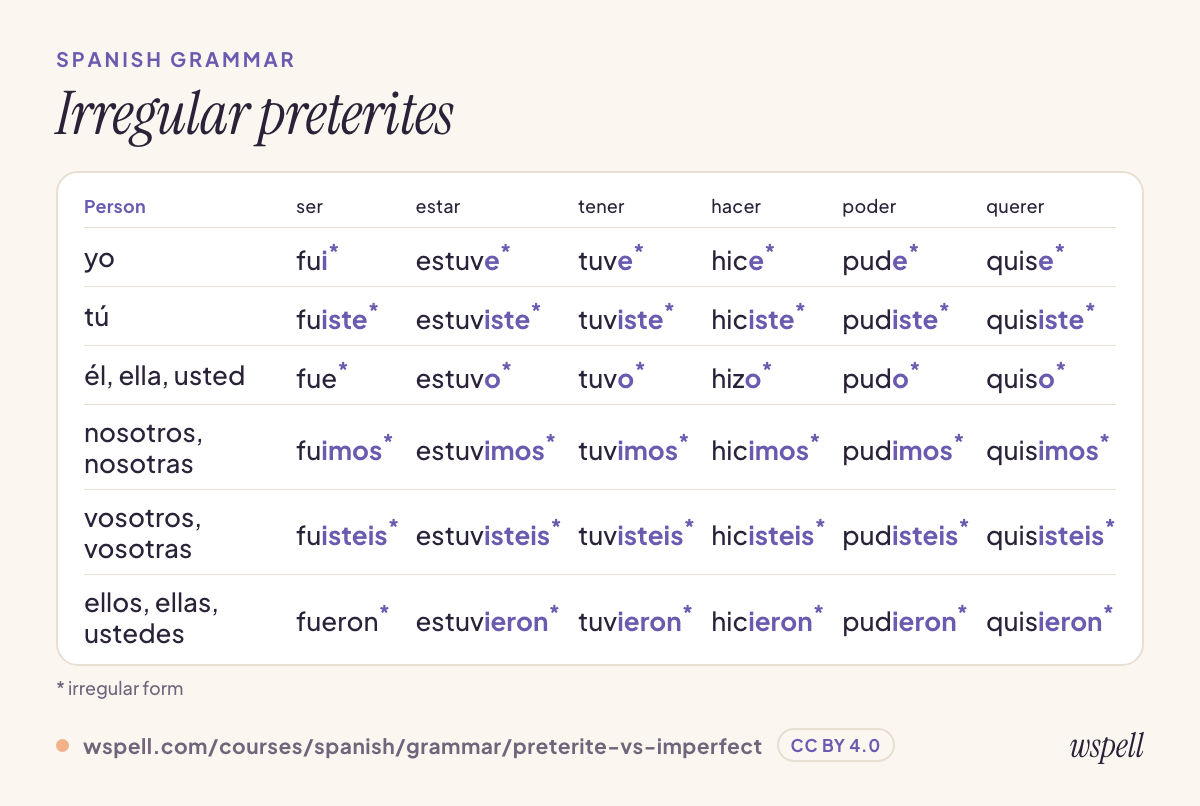
Irregular preterites: tuve, estuve, pude, hice, dije
A large group has an irregular stem plus the endings -e, -iste, -o, -imos, -isteis, -ieron, with no written accent: yo and él/ella are stressed on the stem (tuve, tuvo — not *tuví, *tuvió): tener→tuv-, estar→estuv-, poder→pud-, poner→pus-, hacer→hic-/hiz-, venir→vin-, querer→quis-, decir→dij-, traer→traj-. Stems ending in -j drop the i: dijeron, trajeron.
- No pude venir porque tuve que trabajar. — I couldn't come because I had to work.
- Me dijeron la verdad. — They told me the truth.
fui, fue: ser and ir share the preterite
ser and ir have identical, fully irregular preterites: fui, fuiste, fue, fuimos, fuisteis, fueron. Only context tells them apart: 'fui médico' (I was a doctor) vs 'fui al médico' (I went to the doctor).
- Fui a la playa el domingo. — I went to the beach on Sunday.
- La reunión fue un desastre. — The meeting was a disaster.
-ir verbs that change in the third person
| Person | pedir | dormir |
|---|---|---|
| yo | pedí | dormí |
| tú | pediste | dormiste |
| él, ella, usted | pidió* | durmió* |
| nosotros, nosotras | pedimos | dormimos |
| vosotros, vosotras | pedisteis | dormisteis |
| ellos, ellas, ustedes | pidieron* | durmieron* |
* irregular form
pidió, durmió, busqué, leyó: preterite spelling and stem changes
-ir stem-changing verbs shift the vowel in the 3rd person only: e→i (pedir→pidió, pidieron), o→u (dormir→durmió, murió). -ar verbs adjust spelling in the 1st singular: -car→-qué (buscar→busqué), -gar→-gué (llegar→llegué), -zar→-cé (empezar→empecé). Unstressed i→y between vowels: leer→leyó, oír→oyó.
- El niño durmió toda la noche. — The child slept all night.
- Llegué tarde y empecé a correr. — I arrived late and started to run.
The present perfect: he hablado
| Person | hablar | comer | vivir |
|---|---|---|---|
| yo | he hablado | he comido | he vivido |
| tú | has hablado | has comido | has vivido |
| él, ella, usted | ha hablado | ha comido | ha vivido |
| nosotros, nosotras | hemos hablado | hemos comido | hemos vivido |
| vosotros, vosotras | habéis hablado | habéis comido | habéis vivido |
| ellos, ellas, ustedes | han hablado | han comido | han vivido |
The present perfect: he hablado
haber (present: he, has, ha, hemos, habéis, han) + invariable past participle. Reports past actions in a time frame still open or relevant now; in much of Spain it also covers 'today/this week'. The auxiliary and participle are never split.
- Hoy he trabajado mucho. — Today I have worked a lot.
- ¿Alguna vez has estado en Perú? — Have you ever been to Peru?
| Infinitive | Participle | Infinitive | Participle | Infinitive | Participle |
|---|---|---|---|---|---|
| hacer | hecho | poner | puesto | abrir | abierto |
| decir | dicho | volver | vuelto | romper | roto |
| ver | visto | escribir | escrito | morir | muerto |
The participle: -ado, -ido, and hecho, dicho, visto
Regular participles: -ar→-ado (hablado), -er/-ir→-ido (comido, vivido). Common irregulars end in -to/-cho: hacer→hecho, decir→dicho, ver→visto, poner→puesto, volver→vuelto, escribir→escrito, abrir→abierto, romper→roto, morir→muerto.
- He escrito tres cartas y he abierto el paquete. — I have written three letters and opened the package.
Verbs that change meaning
quise, pude, supe, conocí: verbs that change meaning in the preterite
A handful of verbs read differently by aspect: querer — quería (wanted) vs quise (tried) / no quise (refused); poder — podía (was able, general) vs pude (managed to) / no pude (failed to); saber — sabía (knew) vs supe (found out); conocer — conocía (knew) vs conocí (met); tener — tenía (had) vs tuve (got/received).
- Quise abrir la caja, pero no pude. — I tried to open the box, but I couldn't (didn't manage).
- Supe la noticia esa misma tarde. — I found out the news that very afternoon.
learn it step by step
The DELE Spanish exam, A2 to B2: structure, scoring and practice
save or print this chart
Under the main tables on this page sits a picture of each — keep one on your phone, share it or print it.
Free to share and adapt under CC BY 4.0 — credit wspell and link to this page. the licence
credit line to copy: Preterite vs imperfect: the Spanish past tenses — wspell, CC BY 4.0, https://wspell.com/courses/spanish/grammar/preterite-vs-imperfect
questions
What is the difference between the preterite and the imperfect?
The preterite reports a completed event — ayer comí en casa. The imperfect describes the background, a state or a habit — de niño jugaba en la calle. When one action interrupts another, the interrupted one is in the imperfect and the interruption in the preterite: leía cuando sonó el teléfono.
Which verbs are irregular in the imperfect?
Only three: ser (era), ir (iba) and ver (veía). Every other verb takes -aba (-ar verbs) or -ía (-er and -ir verbs).
Is the preterite the same as the pretérito indefinido?
Yes. Many textbooks, especially in Spain, call it the pretérito indefinido; the Real Academia Española calls it the pretérito perfecto simple; English-language courses call it the preterite.
When do I use he hablado instead of hablé?
In most of Spain, he hablado is for a time that is not over yet — hoy, esta mañana, esta semana, este año — and for experience up to now: hoy he trabajado mucho, ¿alguna vez has estado en Perú? For a finished time — ayer, el lunes, el año pasado, en 2010 — use the preterite: ayer trabajé mucho. In much of Latin America the preterite covers today too: hoy trabajé mucho.