grammar chart · Spanish
Spanish commands: the imperative
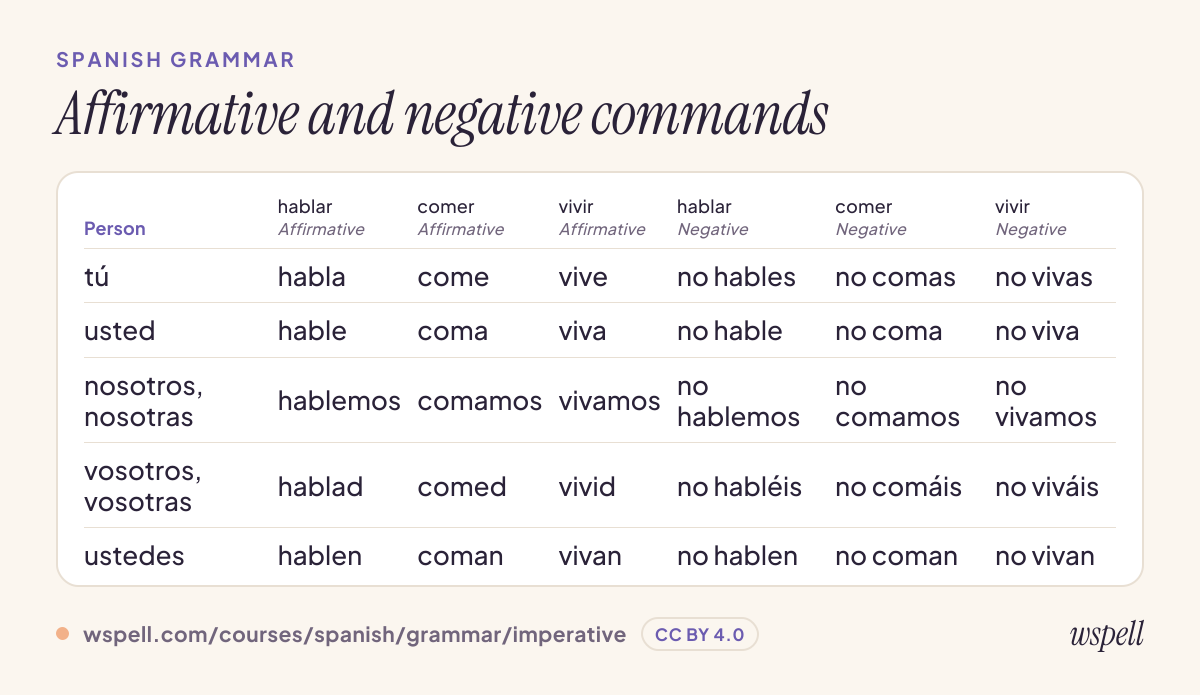
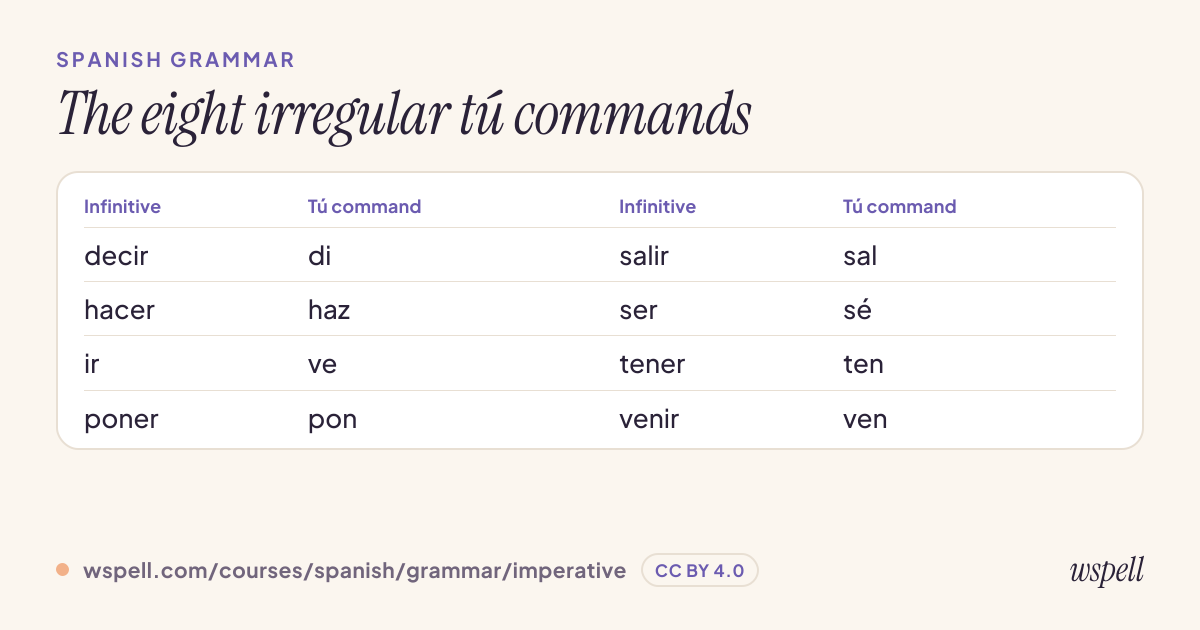
Only two command forms are the imperative's own: affirmative tú (habla) and vosotros (hablad). Every other command — usted, ustedes, nosotros and every negative — is the present subjunctive: hable, hablen, hablemos, no hables — with one exception: ir has vamos for 'let's go' (the negative is no vayamos). The tables show both, then the eight irregular tú commands and where object pronouns go.
Affirmative and negative commands
| Person | hablar Affirmative | comer Affirmative | vivir Affirmative | hablar Negative | comer Negative | vivir Negative |
|---|---|---|---|---|---|---|
| tú | habla | come | vive | no hables | no comas | no vivas |
| usted | hable | coma | viva | no hable | no coma | no viva |
| nosotros, nosotras | hablemos | comamos | vivamos | no hablemos | no comamos | no vivamos |
| vosotros, vosotras | hablad | comed | vivid | no habléis | no comáis | no viváis |
| ustedes | hablen | coman | vivan | no hablen | no coman | no vivan |
tú and vosotros commands: habla, hablad
Affirmative tú = the 3rd-singular present indicative (habla, come, escribe), with eight irregulars: di, haz, ve, pon, sal, sé, ten, ven. Affirmative vosotros replaces the infinitive -r with -d (hablad, comed, venid).
- Ven aquí y cierra la puerta. — Come here and close the door.
- Comprad el pan, por favor. — Buy the bread, please.
usted, nosotros and every negative command: the subjunctive
The subjunctive supplies every command form except affirmative tú/vosotros: usted/ustedes (hable, hablen), nosotros 'let's' (hablemos), and ALL negatives (no hables, no habléis, no hable). So the negative of 'ven' is 'no vengas', not 'no ven'.
- No hagas ruido, por favor. — Don't make noise, please.
- Pasen y siéntense. — Come in and sit down.
Irregular tú commands: di, haz, ve, pon, sal, sé, ten, ven
| Infinitive | Tú command | Infinitive | Tú command |
|---|---|---|---|
| decir | di | salir | sal |
| hacer | haz | ser | sé |
| ir | ve | tener | ten |
| poner | pon | venir | ven |
| Person | ser | ir | tener | hacer |
|---|---|---|---|---|
| tú | sé | ve | ten | haz |
| usted | sea | vaya | tenga | haga |
| nosotros, nosotras | seamos | vamos | tengamos | hagamos |
| vosotros, vosotras | sed | id | tened | haced |
| ustedes | sean | vayan | tengan | hagan |
Where the pronouns go: dímelo, no me lo digas
Dímelo, siéntate: pronouns with commands
Object/reflexive pronouns attach to the END of an affirmative command (dímelo, siéntate), often adding a written accent to keep stress; with a negative command they go BEFORE the verb (no me lo digas). Affirmative nosotros drops the final -s before nos/se (sentémonos), and vosotros drops -d before os (sentaos).
- Dímelo ahora mismo. — Tell it to me right now.
- No te preocupes. — Don't worry.
No me lo digas: pronouns before a negative command
Among commands, only AFFIRMATIVE ones take the pronoun on the end. A negative command behaves like a normal finite verb, so the clitic goes before it: dámelo → no me lo des, siéntate → no te sientes.
- No me lo digas. — Don't tell me (that).
- No te preocupes. — Don't worry.
learn it step by step
The DELE Spanish exam, A2 to B2: structure, scoring and practice
save or print this chart
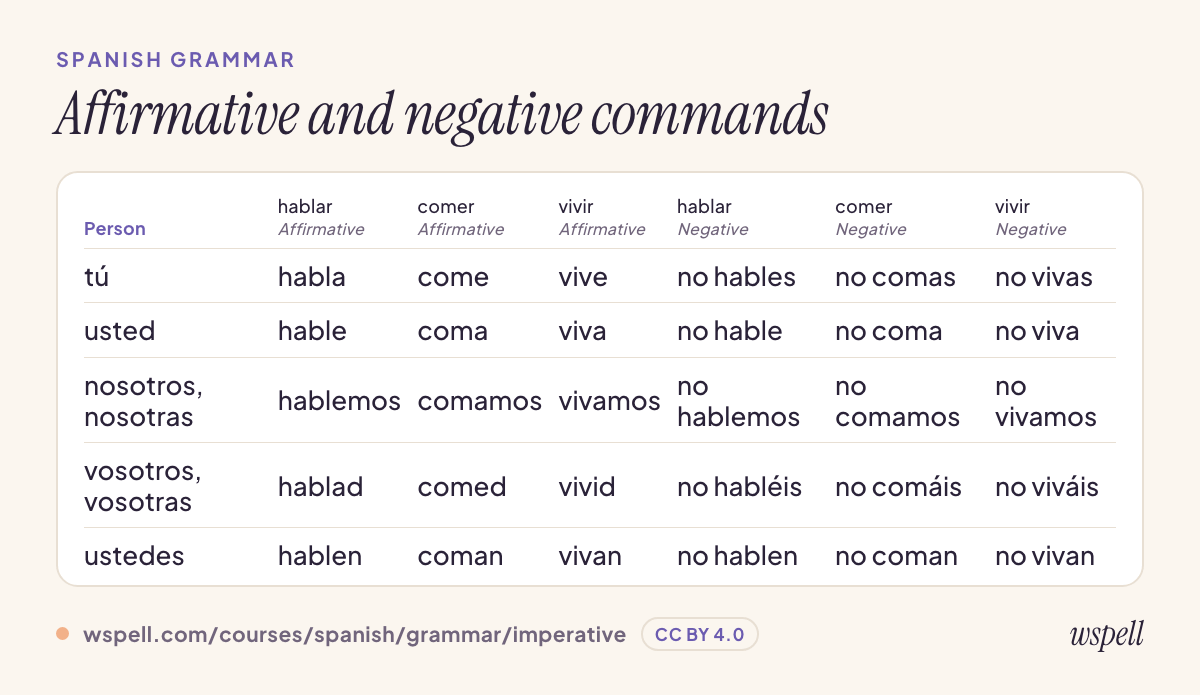
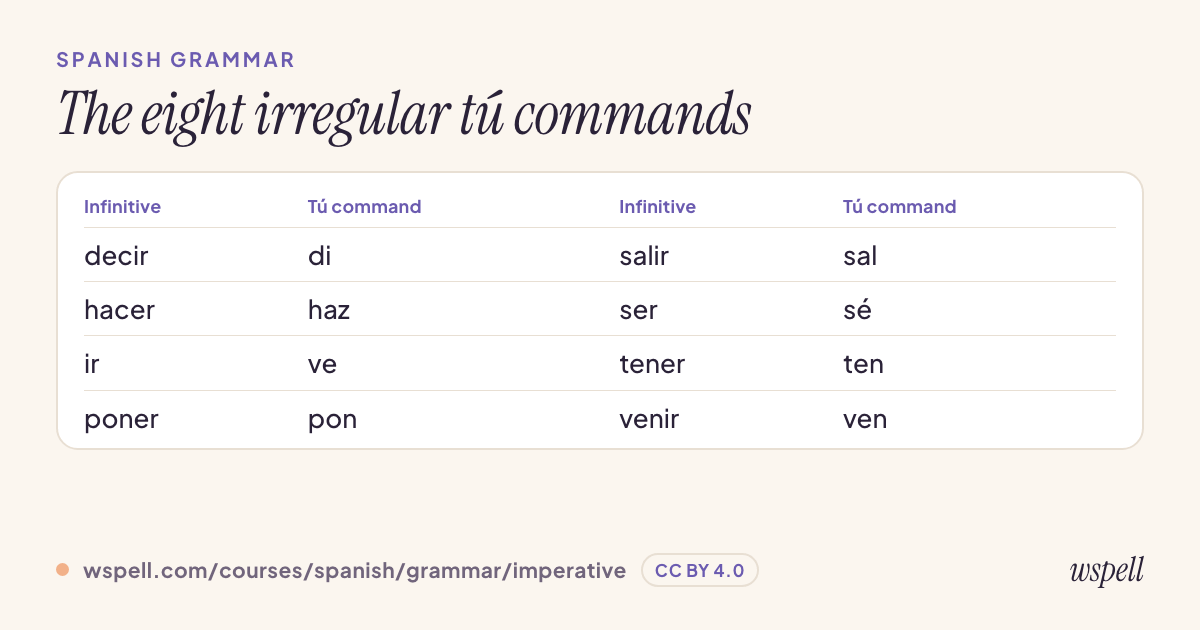
Under the main tables on this page sits a picture of each — keep one on your phone, share it or print it.
Free to share and adapt under CC BY 4.0 — credit wspell and link to this page. the licence
credit line to copy: Spanish commands: the imperative — wspell, CC BY 4.0, https://wspell.com/courses/spanish/grammar/imperative
questions
How do you make a tú command in Spanish?
Use the él form of the present: habla, come, escribe. Eight verbs are irregular: decir → di, hacer → haz, ir → ve, poner → pon, salir → sal, ser → sé, tener → ten, venir → ven.
How do you make a negative command?
Put no before the present subjunctive, in every person: no hables, no comas, no vengas. The negative of ven is no vengas.
Where do pronouns go in Spanish commands?
On the end of an affirmative command — dímelo, siéntate — and before a negative one: no me lo digas, no te sientes.