grammar chart · Spanish
The Spanish future and conditional
Both tenses add their endings to the whole infinitive: hablaré, comeré, viviré; hablaría, comería, viviría. A verb with an irregular stem uses it in both tenses — tendré, tendría — with the same endings. For plans, everyday Spanish often prefers ir a + infinitive: voy a hablar.
The near future: voy a + infinitive
| Person | hablar |
|---|---|
| yo | voy a hablar |
| tú | vas a hablar |
| él, ella, usted | va a hablar |
| nosotros, nosotras | vamos a hablar |
| vosotros, vosotras | vais a hablar |
| ellos, ellas, ustedes | van a hablar |
ir a + infinitive: voy a estudiar
The everyday spoken future is ir (present) + a + infinitive, expressing intention or near future: 'voy a estudiar' (I'm going to study). More frequent than the synthetic future for plans.
- Mañana vamos a ver una película. — Tomorrow we are going to watch a film.
- Voy a llamarte esta noche. — I'm going to call you tonight.
The simple future: hablaré
| Person | hablar | comer | vivir |
|---|---|---|---|
| yo | hablaré | comeré | viviré |
| tú | hablarás | comerás | vivirás |
| él, ella, usted | hablará | comerá | vivirá |
| nosotros, nosotras | hablaremos | comeremos | viviremos |
| vosotros, vosotras | hablaréis | comeréis | viviréis |
| ellos, ellas, ustedes | hablarán | comerán | vivirán |
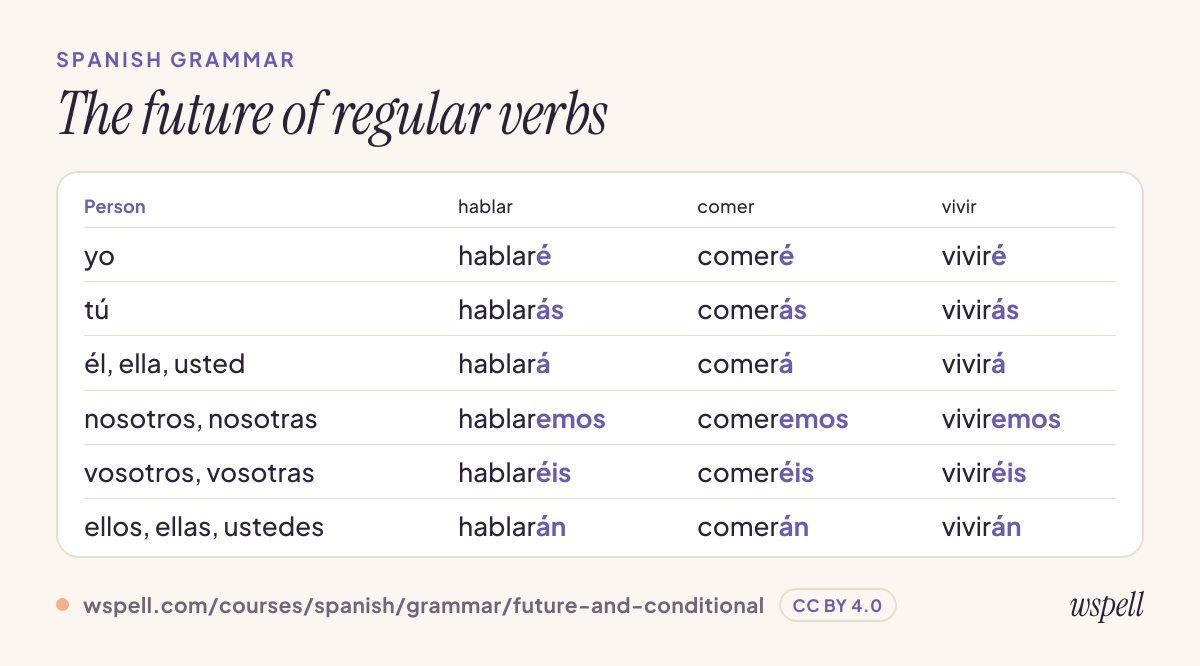
The simple future: -é, -ás, -á on the infinitive
Add -é, -ás, -á, -emos, -éis, -án to the FULL infinitive (all three conjugations share them): hablaré, comeré, viviré. Used for predictions and promises; in speech ir a + inf is more common for plans.
- El año que viene viajaré a Japón. — Next year I will travel to Japan.
- Te lo prometo, llegaremos a tiempo. — I promise you, we will arrive on time.
The conditional: hablaría
| Person | hablar | comer | vivir |
|---|---|---|---|
| yo | hablaría | comería | viviría |
| tú | hablarías | comerías | vivirías |
| él, ella, usted | hablaría | comería | viviría |
| nosotros, nosotras | hablaríamos | comeríamos | viviríamos |
| vosotros, vosotras | hablaríais | comeríais | viviríais |
| ellos, ellas, ustedes | hablarían | comerían | vivirían |
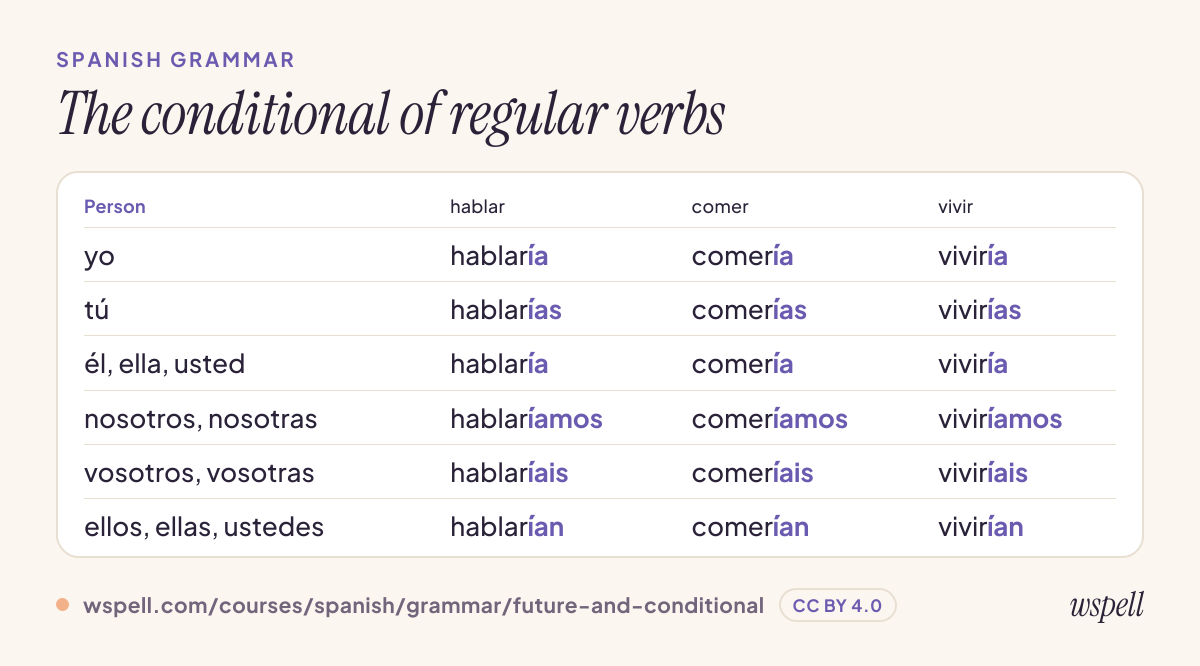
The conditional: -ía on the infinitive
Add -ía, -ías, -ía, -íamos, -íais, -ían to the full infinitive (same irregular stems as the future). It expresses hypothetical results, polite requests, and future-in-the-past: 'me gustaría' (I would like), 'dijo que vendría' (he said he would come).
- ¿Podrías ayudarme, por favor? — Could you help me, please?
- Me gustaría un poco más de tiempo. — I would like a little more time.
¿Podría…?: the conditional for polite requests
The conditional turns a blunt present into a courteous request or a hedged opinion: ¿Podría…?, ¿Te importaría…?, Yo diría que…, Sería mejor… It signals that the speaker is not imposing — the default polite register for asking favours of strangers or superiors.
- ¿Podría ayudarme con esto? — Could you help me with this?
- ¿Te importaría bajar la música? — Would you mind turning the music down?
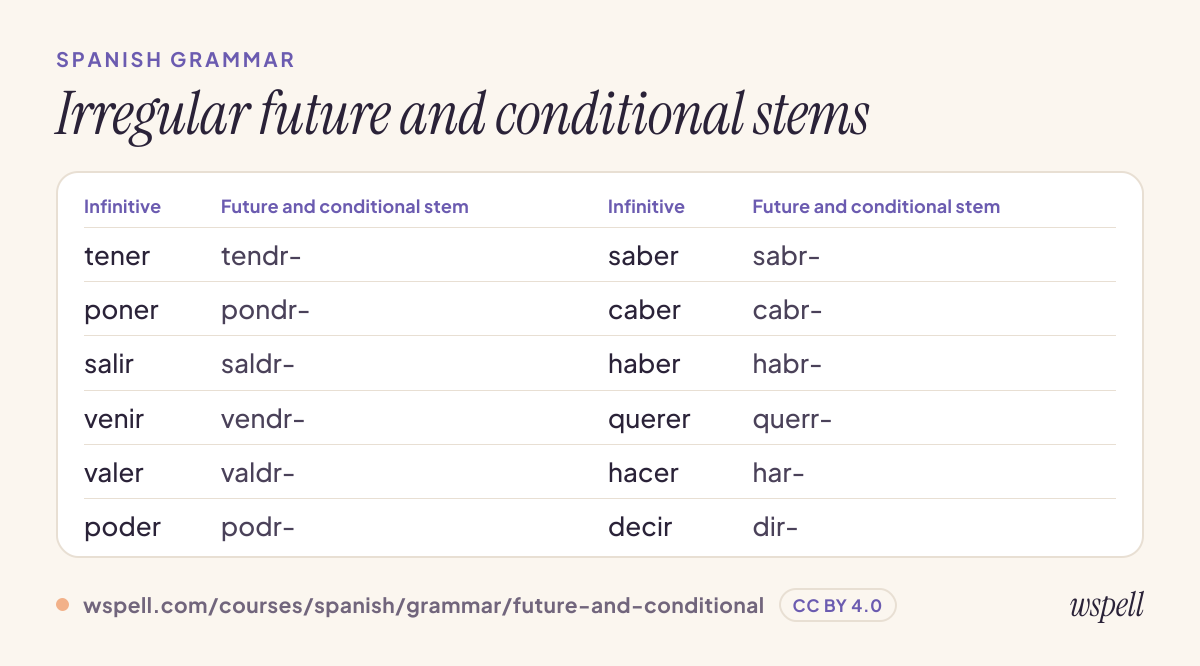
Irregular stems
| Infinitive | Future and conditional stem | Infinitive | Future and conditional stem |
|---|---|---|---|
| tener | tendr- | saber | sabr- |
| poner | pondr- | caber | cabr- |
| salir | saldr- | haber | habr- |
| venir | vendr- | querer | querr- |
| valer | valdr- | hacer | har- |
| poder | podr- | decir | dir- |
| Person | tener Future | hacer Future | poder Future | tener Conditional | hacer Conditional | poder Conditional |
|---|---|---|---|---|---|---|
| yo | tendré* | haré* | podré* | tendría* | haría* | podría* |
| tú | tendrás* | harás* | podrás* | tendrías* | harías* | podrías* |
| él, ella, usted | tendrá* | hará* | podrá* | tendría* | haría* | podría* |
| nosotros, nosotras | tendremos* | haremos* | podremos* | tendríamos* | haríamos* | podríamos* |
| vosotros, vosotras | tendréis* | haréis* | podréis* | tendríais* | haríais* | podríais* |
| ellos, ellas, ustedes | tendrán* | harán* | podrán* | tendrían* | harían* | podrían* |
* irregular form
Irregular future and conditional stems: tendr-, har-, podr-
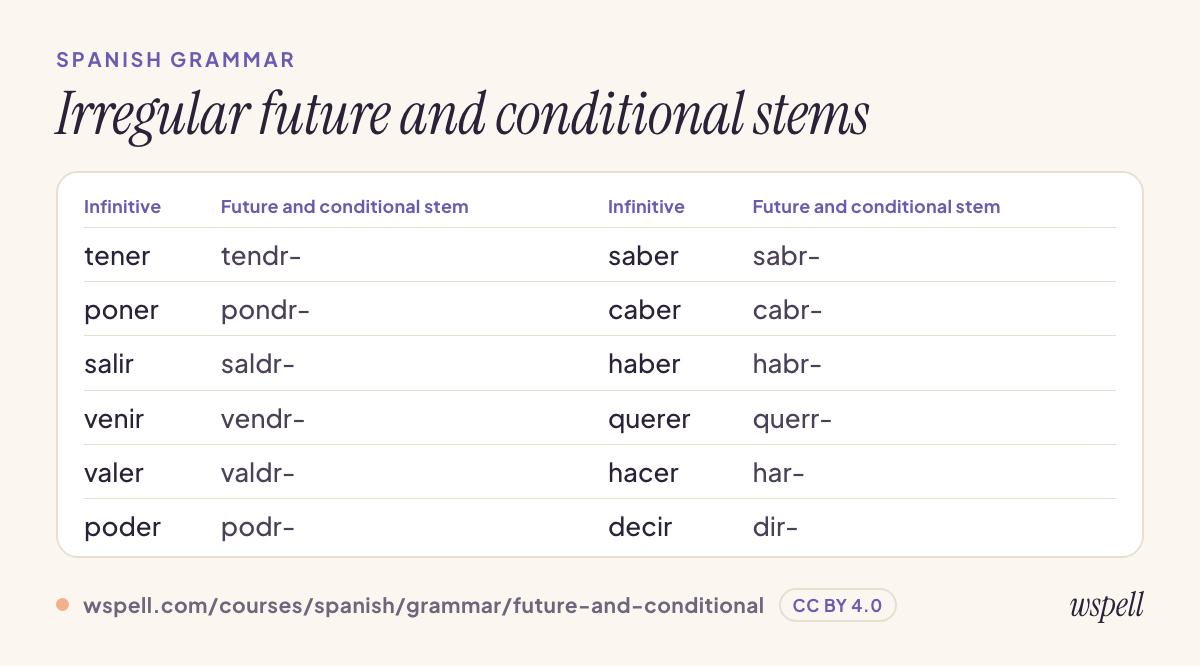
Twelve verbs use a modified stem for BOTH future and conditional (the endings stay regular): the vowel drops (poder→podr-, saber→sabr-, caber→cabr-, haber→habr-, querer→querr-), turns into d (tener→tendr-, poner→pondr-, salir→saldr-, venir→vendr-, valer→valdr-), or the stem contracts (hacer→har-, decir→dir-).
- Habrá mucha gente en el concierto. — There will be a lot of people at the concert.
- ¿Qué harás este fin de semana? — What will you do this weekend?
The future for a guess
Estará en casa: the future for a guess
The synthetic future often expresses a guess about the PRESENT rather than a future event: 'serán las diez' = it must be around ten. Equivalent to 'probablemente + present'. The conditional does the same for the past.
- ¿Dónde está Ana? — Estará en el trabajo. — Where's Ana? — She's probably at work.
- Tendrá unos cuarenta años. — He must be about forty.
learn it step by step
The DELE Spanish exam, A2 to B2: structure, scoring and practice
save or print this chart
Under the main tables on this page sits a picture of each — keep one on your phone, share it or print it.
Free to share and adapt under CC BY 4.0 — credit wspell and link to this page. the licence
credit line to copy: The Spanish future and conditional — wspell, CC BY 4.0, https://wspell.com/courses/spanish/grammar/future-and-conditional
questions
How do you form the future tense in Spanish?
Add -é, -ás, -á, -emos, -éis, -án to the whole infinitive: hablaré, comerás, vivirá. All three conjugations share the endings.
What is the difference between voy a hablar and hablaré?
Ir a + infinitive is the everyday way to talk about plans and the near future; the simple future is used for predictions and promises.
Which verbs are irregular in the future and conditional?
A small group with a changed stem, the same in both tenses. The most common: tener → tendré, tendría; poner → pondré; salir → saldré; venir → vendré; poder → podré; saber → sabré; haber → habré; querer → querré; hacer → haré; decir → diré.
How do you say 'I would like' in Spanish?
Me gustaría, the conditional of gustar: me gustaría un poco más de tiempo. The conditional also makes a request polite: ¿Podría ayudarme con esto?