grammar chart · Spanish
Spanish articles, noun gender and plurals
Every Spanish noun is masculine or feminine, and the article and the adjective follow it in gender and number: el libro rojo, la casa roja, los libros rojos. The first table gives the eight articles; below it, how to tell a noun's gender from its ending (and the exceptions), how to make the plural, and how adjectives agree.
The articles: el, la, un, una
| Masc. sing. | Fem. sing. | Masc. pl. | Fem. pl. | |
|---|---|---|---|---|
| The (definite) | el | la | los | las |
| A, some (indefinite) | un | una | unos | unas |
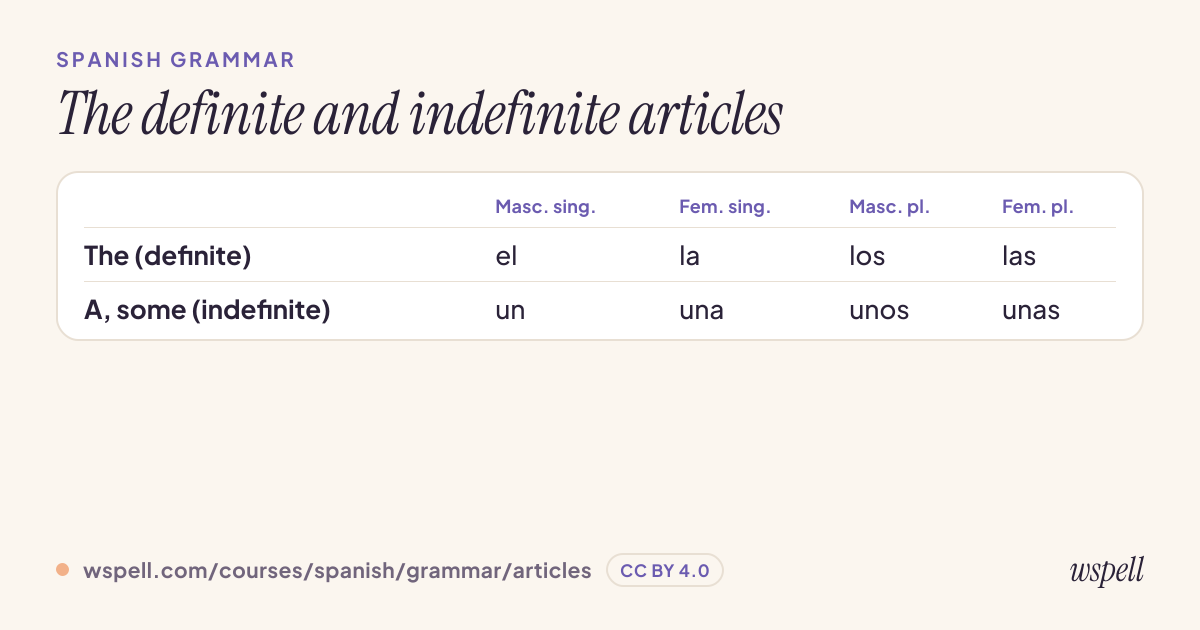
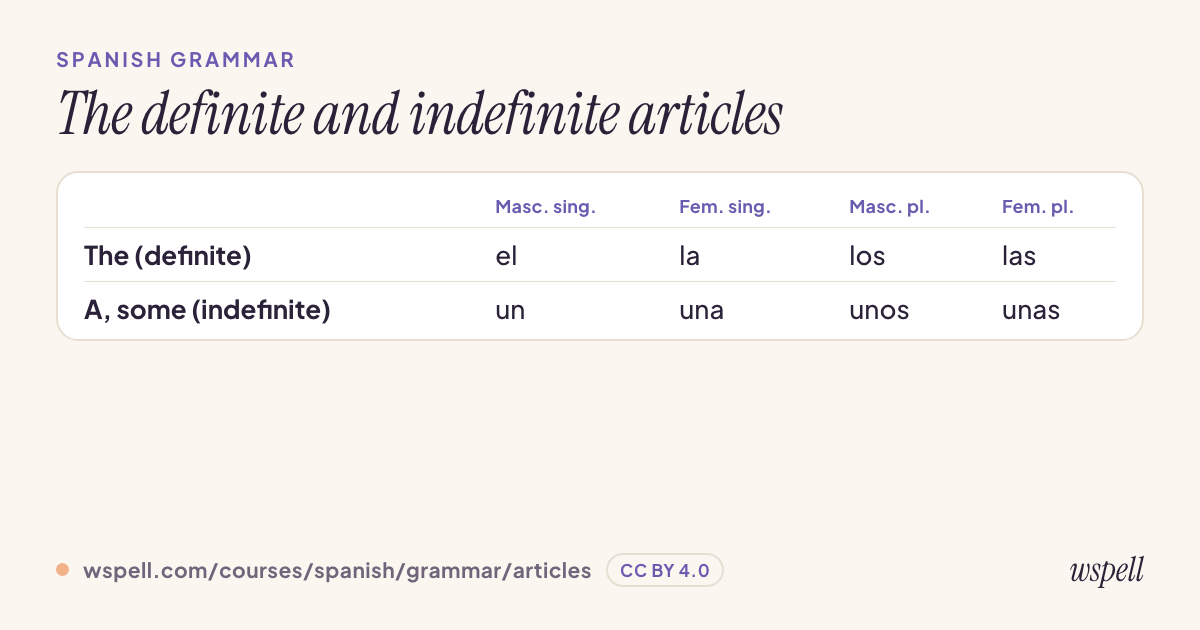
The definite article: el, la, los, las
The definite article agrees with the noun in gender and number: el (m sg), la (f sg), los (m pl), las (f pl). Unlike English 'the', it is required before most nouns used in a general sense.
- El niño y la niña leen los libros. — The boy and the girl read the books.
- Las casas son grandes. — The houses are big.
The indefinite article: un, una, unos, unas
The indefinite article agrees in gender and number: un (m sg), una (f sg). The plurals unos/unas mean 'some' or 'a few' and are often left out, as English leaves out 'some'.
- Un hombre y una mujer entran. — A man and a woman come in.
- Compré unas manzanas. — I bought some apples.
al, del and el agua
a + el = al, de + el = del
The preposition a or de plus the masculine singular el fuses into al / del. This is obligatory; the other articles (la, los, las) never contract, and el is not contracted when it is part of a proper name (de El Salvador).
- Vamos al cine después del trabajo. — We go to the cinema after work.
- Es la capital de El Salvador. — It is the capital of El Salvador.
El agua: el before a stressed a-
A feminine singular noun beginning with a stressed a-/ha- sound takes el (not la) to avoid the clash of two a's: el agua, el águila, el hambre. The noun stays feminine (el agua fría) and the plural reverts to las (las aguas).
- El agua está fría. — The water is cold.
- Las águilas vuelan alto. — The eagles fly high.
Masculine or feminine?
| Rule | Example |
|---|---|
| -o is masculine, -a is feminine | el libro rojo y la mesa blanca the red book and the white table |
| Exceptions: la mano, la foto, el día, el mapa | la mano derecha the right hand |
| Masculine nouns in -ma: el problema, el idioma | Es un problema serio. It is a serious problem. |
| Feminine endings: -ción, -sión, -dad, -tad, -tud, -umbre | la decisión final the final decision |
| People: el hijo / la hija, el profesor / la profesora | el profesor y la profesora the (male) teacher and the (female) teacher |
| One form, two genders: el/la estudiante | la artista famosa the famous (female) artist |
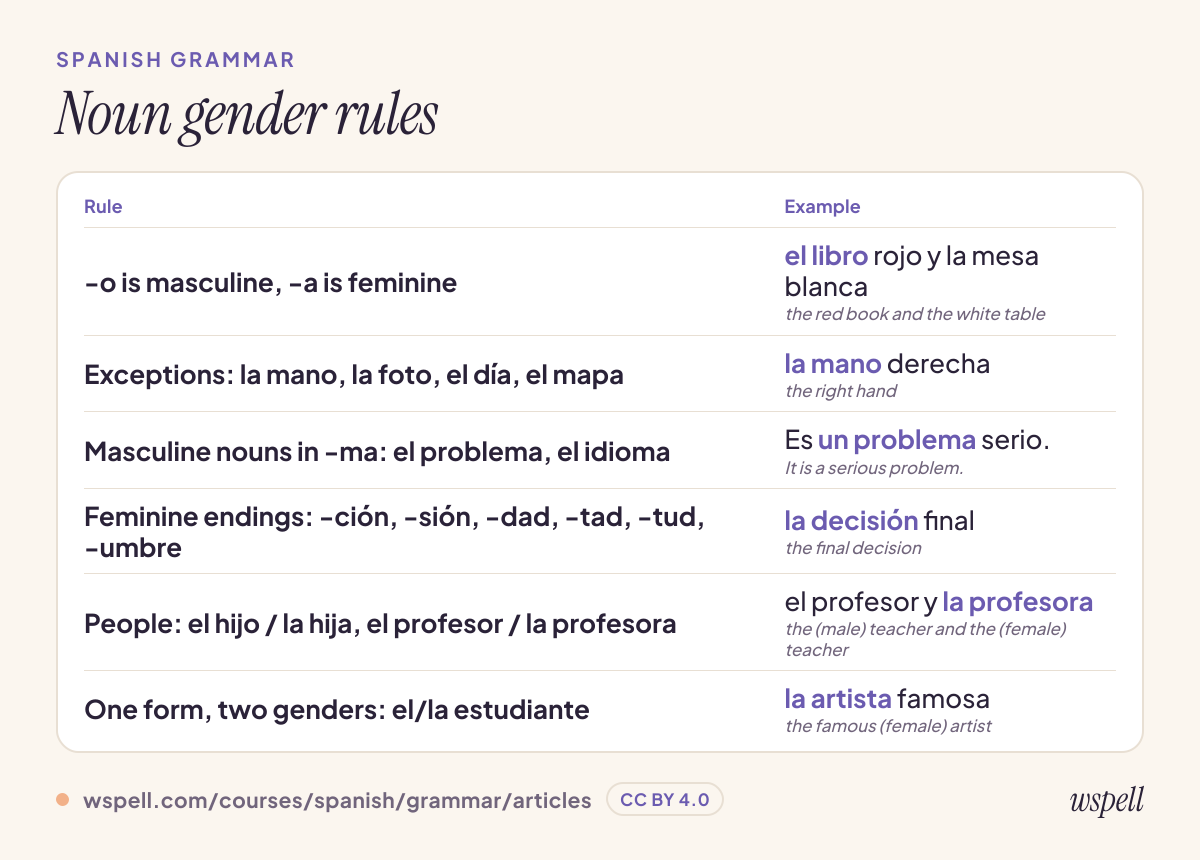
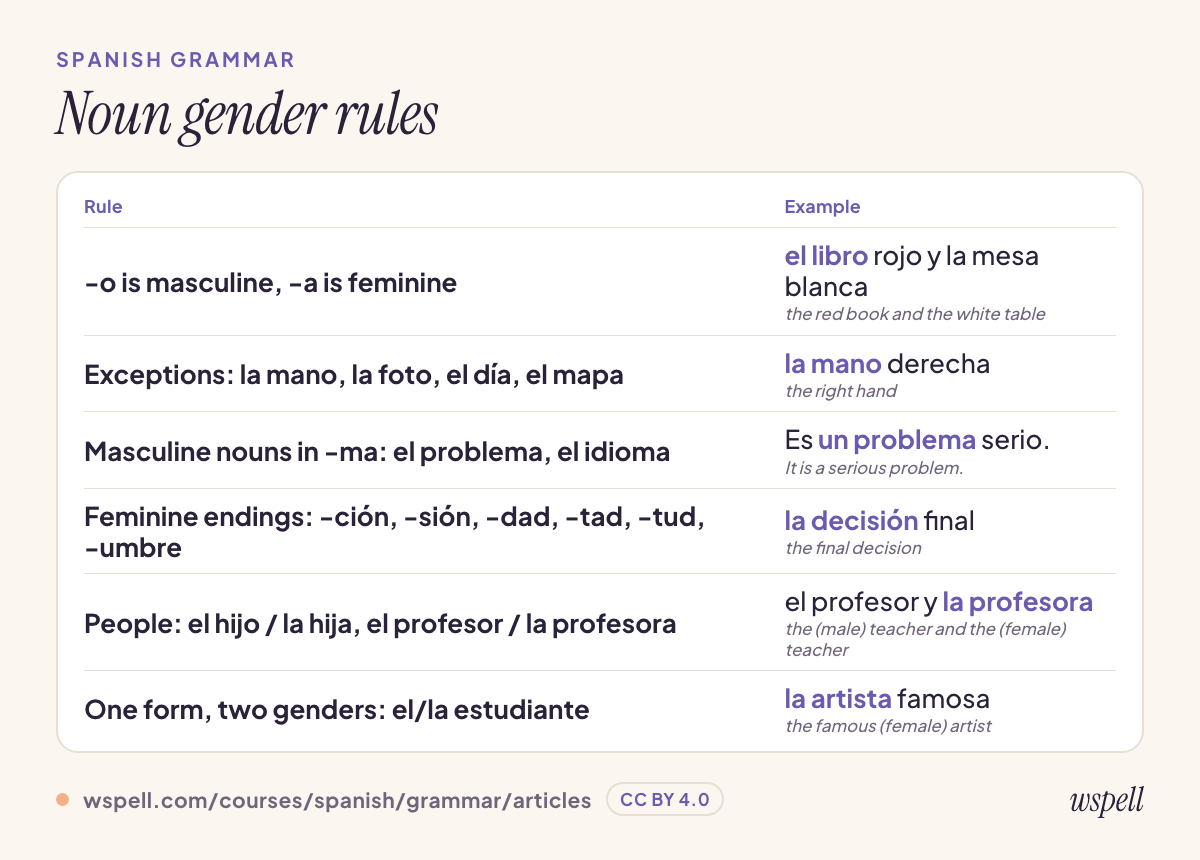
-o is masculine, -a is feminine
As a default, nouns ending in -o are masculine (el libro, el vaso) and nouns in -a are feminine (la mesa, la casa). Gender is grammatical and must be learned with the noun; it drives every agreement.
- el libro rojo y la mesa blanca — the red book and the white table
- un vaso de agua — a glass of water
Exceptions: la mano, la foto, el día, el mapa
The -o/-a rule has stubborn exceptions to memorise: feminine in -o (la mano, la foto, la moto, la radio) and masculine in -a (el día, el mapa, el sofá, el planeta).
- la mano derecha — the right hand
- un día largo — a long day
Masculine nouns in -ma: el problema, el idioma
A large group of nouns in -ma (from Greek) are masculine despite the -a: el problema, el tema, el sistema, el programa, el idioma, el clima, el poema. Not all -ma nouns qualify (la cama, la rama are feminine), so learn the set.
- Es un problema serio. — It is a serious problem.
- el sistema educativo — the education system
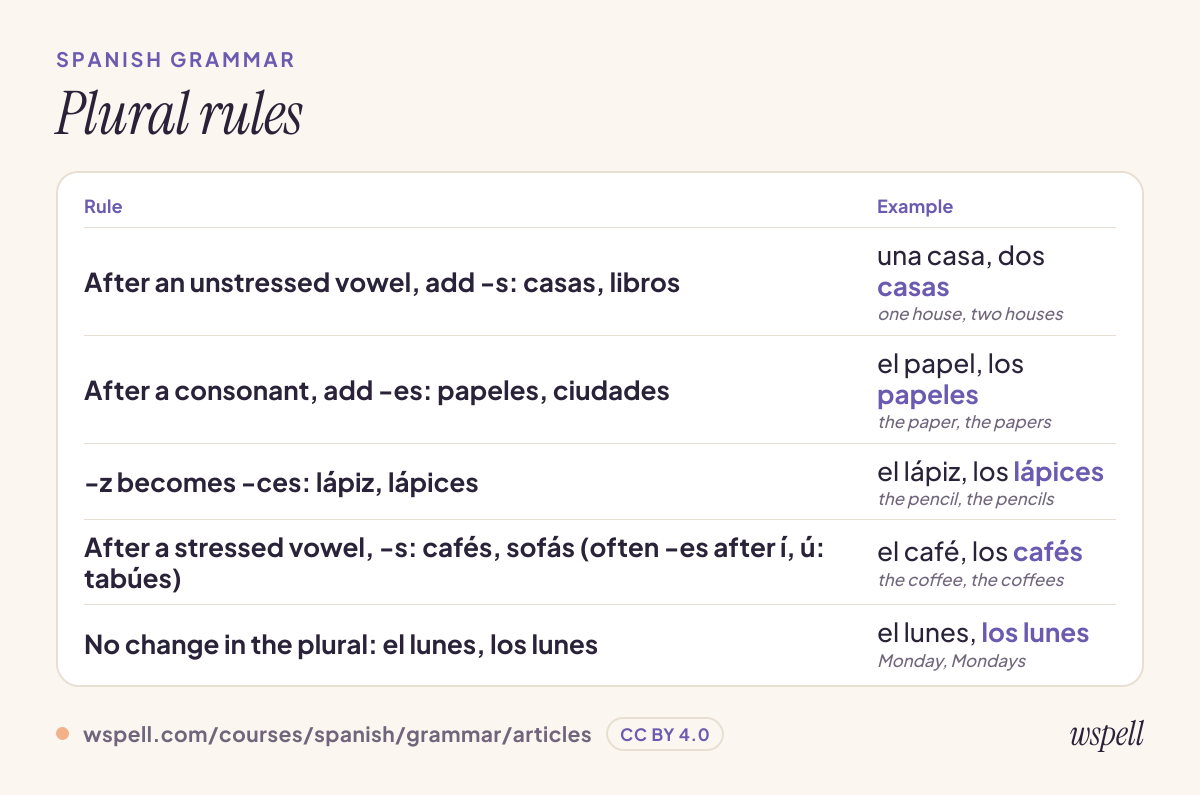
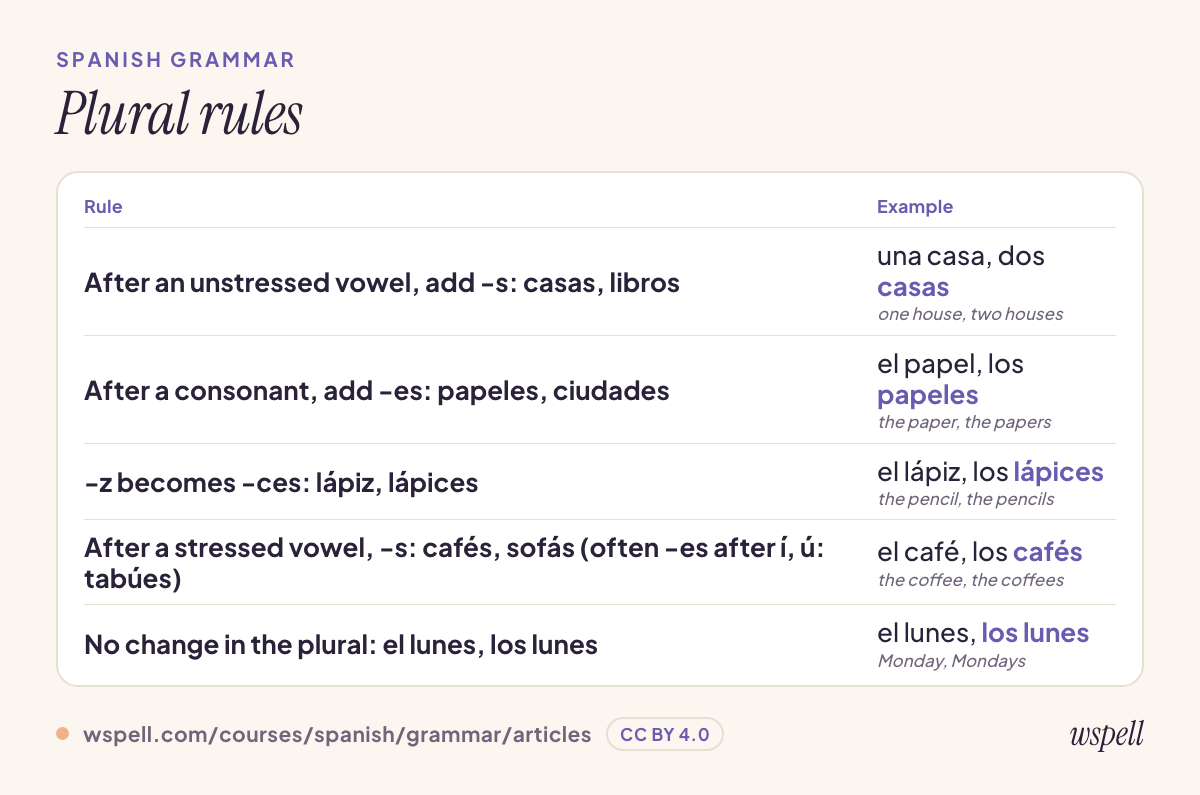
Making the plural
| Rule | Example |
|---|---|
| After an unstressed vowel, add -s: casas, libros | una casa, dos casas one house, two houses |
| After a consonant, add -es: papeles, ciudades | el papel, los papeles the paper, the papers |
| -z becomes -ces: lápiz, lápices | el lápiz, los lápices the pencil, the pencils |
| After a stressed vowel, -s: cafés, sofás (often -es after í, ú: tabúes) | el café, los cafés the coffee, the coffees |
| No change in the plural: el lunes, los lunes | el lunes, los lunes Monday, Mondays |
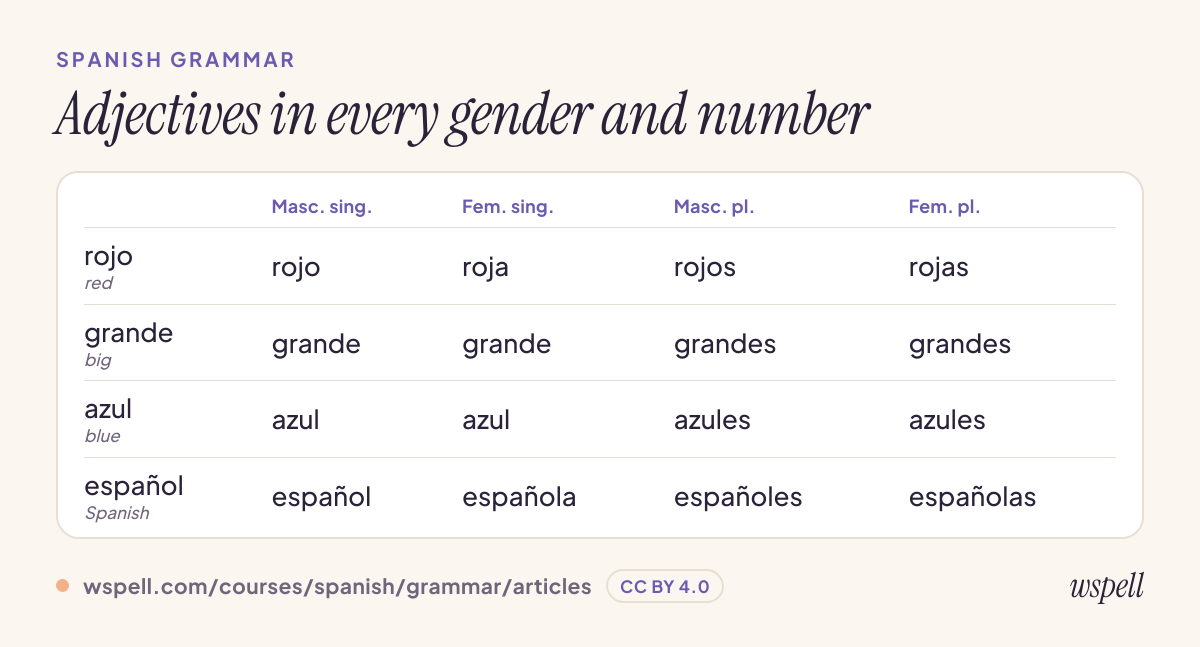
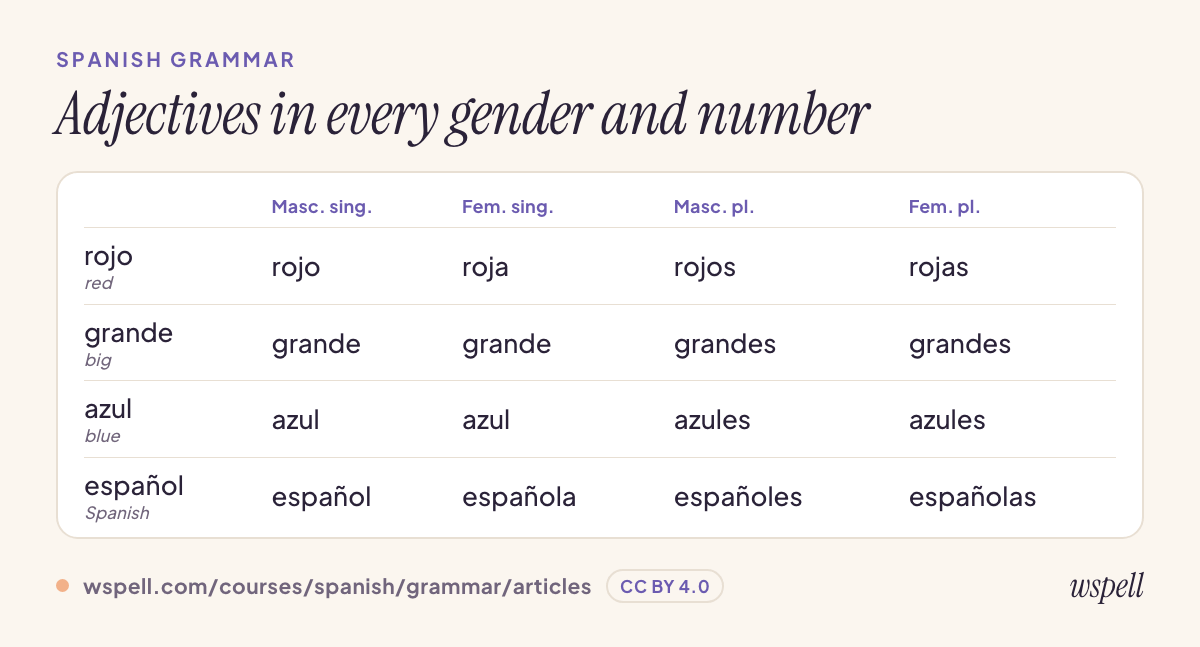
Adjective agreement: rojo, roja, rojos, rojas
| Masc. sing. | Fem. sing. | Masc. pl. | Fem. pl. | |
|---|---|---|---|---|
| rojo red | rojo | roja | rojos | rojas |
| grande big | grande | grande | grandes | grandes |
| azul blue | azul | azul | azules | azules |
| español Spanish | español | española | españoles | españolas |
Adjectives agree in gender and number
An adjective must match its noun in both gender and number, whether it sits next to the noun or after a linking verb: la casa blanca, las casas son blancas. Pick the form whose gender/number match the noun.
- Las flores son bonitas. — The flowers are pretty.
- unos zapatos caros — some expensive shoes
Adjectives in -e and most in a consonant: one form for both genders
Adjectives ending in -e (grande, verde, inteligente) or in most consonants (azul, fácil, joven) have ONE form for both genders and change only for number: grande/grandes, azul/azules. Gender is invisible here.
- un hombre inteligente y una mujer inteligente — an intelligent man and an intelligent woman
- ojos azules — blue eyes
The adjective usually follows the noun: un coche rojo
The neutral position for a descriptive or classifying adjective is AFTER the noun: un coche rojo, una casa grande, vino tinto. This distinguishes ('the red car, not the blue one').
- Quiero una mesa redonda. — I want a round table.
- Es un problema difícil. — It's a hard problem.
When Spanish uses the article and when it does not
The article with general and abstract nouns: me gusta el café
Where English drops 'the', Spanish keeps the definite article for nouns taken in a general or total sense, and for abstractions: me gusta el café, el amor es ciego, los perros son fieles.
- Me gusta la música clásica. — I like classical music.
- El tiempo es oro. — Time is money.
No article after ser with a job: es médico
After ser, an unqualified profession, religion or nationality takes NO article: es médico, soy española. The article returns only when the noun is modified: es un médico excelente.
- Mi hermana es abogada. — My sister is a lawyer.
- Es un abogado muy bueno. — He is a very good lawyer.
No article for 'some': quiero pan
Unlike French (du pain) or Italian (del pane), Spanish uses NO article for an unspecified quantity of an uncountable noun: bebo agua, compro pan, hay leche. Adding el/la would make it definite.
- Quiero pan y agua. — I want (some) bread and water.
- ¿Hay leche en la nevera? — Is there (any) milk in the fridge?
learn it step by step
The DELE Spanish exam, A2 to B2: structure, scoring and practice
save or print this chart
Under the main tables on this page sits a picture of each — keep one on your phone, share it or print it.
Free to share and adapt under CC BY 4.0 — credit wspell and link to this page. the licence
credit line to copy: Spanish articles, noun gender and plurals — wspell, CC BY 4.0, https://wspell.com/courses/spanish/grammar/articles
questions
How do you know if a Spanish noun is masculine or feminine?
Usually from its ending: -o is masculine (el libro), -a feminine (la casa), and nouns in -ción, -sión, -dad, -tad, -tud and -umbre are feminine. Learn the exceptions with their article: la mano, el día, el mapa, el problema.
Why is it el agua if agua is feminine?
A feminine noun that starts with a stressed a- sound takes el in the singular: el agua, el águila. It stays feminine — el agua fría — and its plural is las aguas.
How do you make nouns plural in Spanish?
Add -s after an unstressed vowel (casas), -es after a consonant (papeles), and turn -z into -ces (lápices). A noun ending in an unstressed vowel plus -s does not change: el lunes, los lunes.