grammar chart · Spanish
The Spanish present tense
The present tense is the stem of the infinitive plus one ending per person: hablo, hablas, habla. Three tables: the regular endings on hablar, comer and vivir; the stem-changing verbs, whose stressed vowel changes in four of the six forms (quiero, but queremos); and the irregular verbs every learner needs first.
Regular verbs: -ar, -er, -ir
| Person | hablar | comer | vivir |
|---|---|---|---|
| yo | hablo | como | vivo |
| tú | hablas | comes | vives |
| él, ella, usted | habla | come | vive |
| nosotros, nosotras | hablamos | comemos | vivimos |
| vosotros, vosotras | habláis | coméis | vivís |
| ellos, ellas, ustedes | hablan | comen | viven |
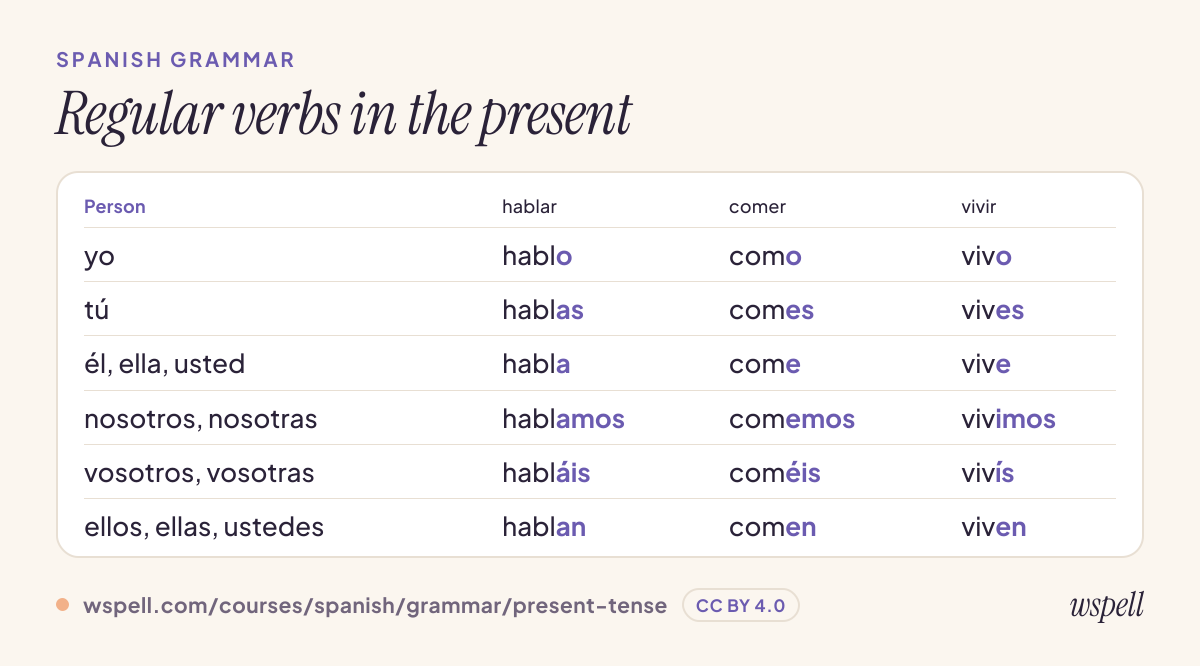
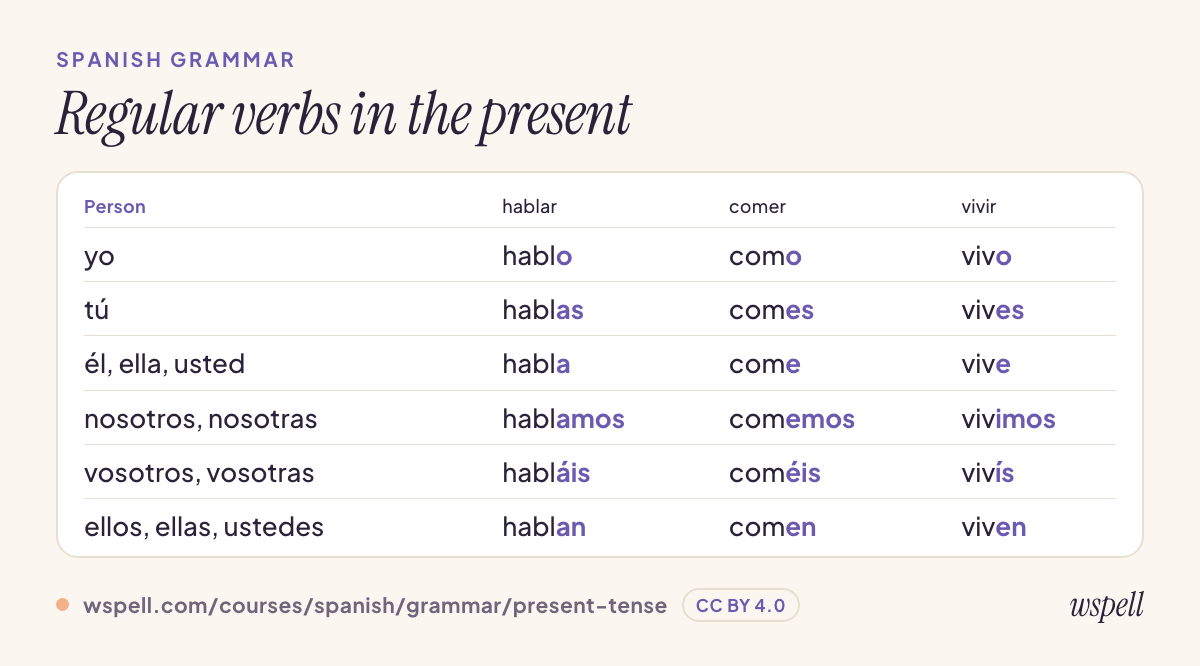
Present tense endings: -ar, -er, -ir
Drop the infinitive ending and add the personal endings. -ar: -o, -as, -a, -amos, -áis, -an. -er: -o, -es, -e, -emos, -éis, -en. -ir: -o, -es, -e, -imos, -ís, -en. -er and -ir differ only in the nosotros/vosotros forms.
- Hablo español y estudio francés. — I speak Spanish and study French.
- Vivimos en Madrid. — We live in Madrid.
Stem-changing verbs: e→ie, o→ue, e→i
Only nosotros and vosotros keep the infinitive's vowel.
| Person | querer | poder | pedir |
|---|---|---|---|
| yo | quiero* | puedo* | pido* |
| tú | quieres* | puedes* | pides* |
| él, ella, usted | quiere* | puede* | pide* |
| nosotros, nosotras | queremos | podemos | pedimos |
| vosotros, vosotras | queréis | podéis | pedís |
| ellos, ellas, ustedes | quieren* | pueden* | piden* |
* irregular form
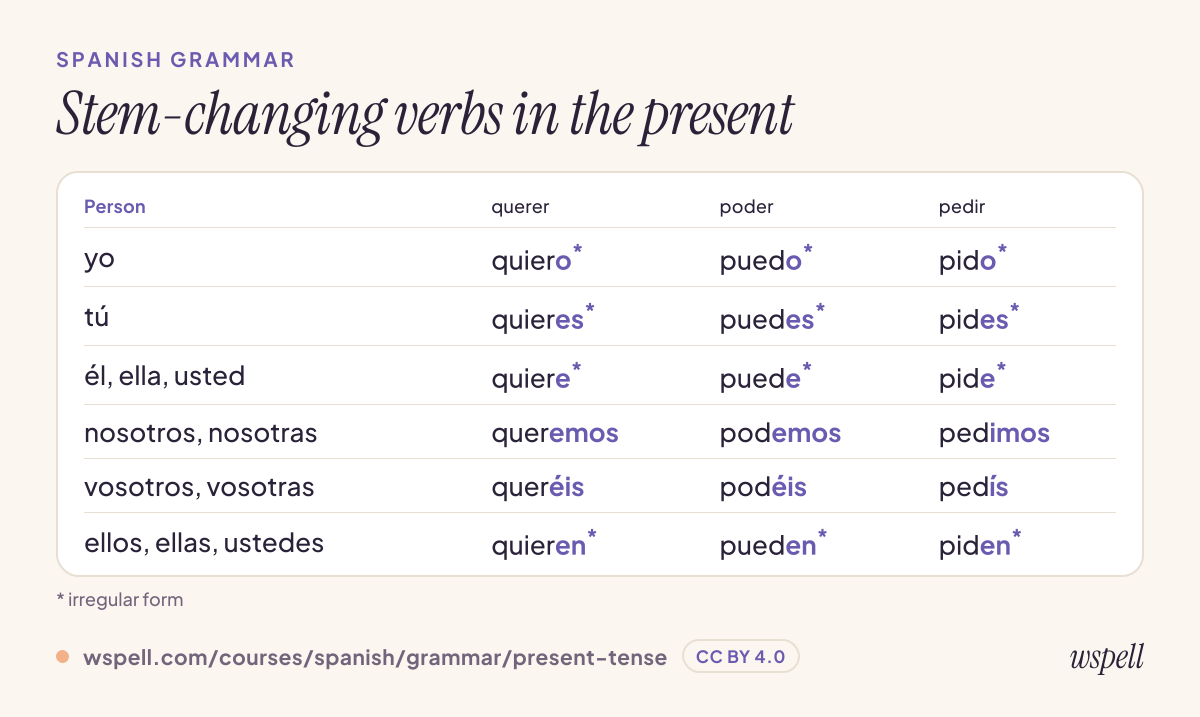
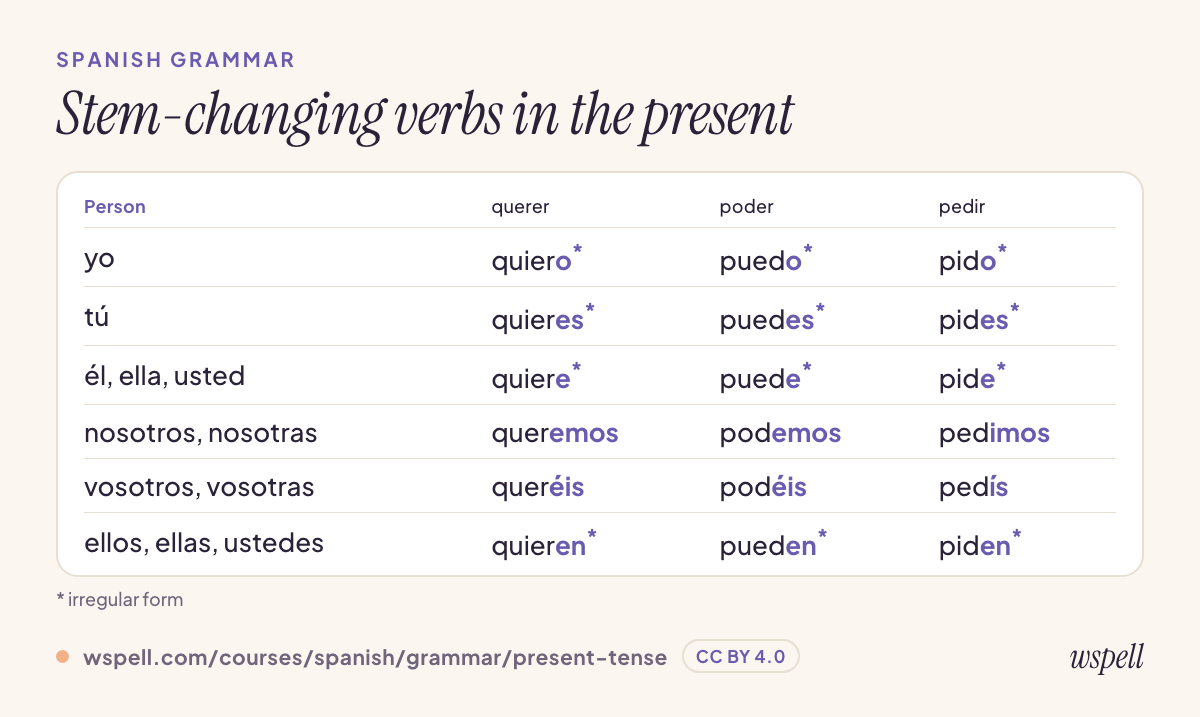
Stem-changing verbs: quiero, puedo, pido
In stressed syllables the stem vowel changes in every form except nosotros/vosotros (the 1-2-3-6 'boot'): e→ie (querer→quiero), o→ue (poder→puedo), e→i in -ir verbs (pedir→pido), u→ue only in jugar (juego).
- Quiero dormir, pero no puedo. — I want to sleep, but I can't.
- Ella pide un café. — She orders a coffee.
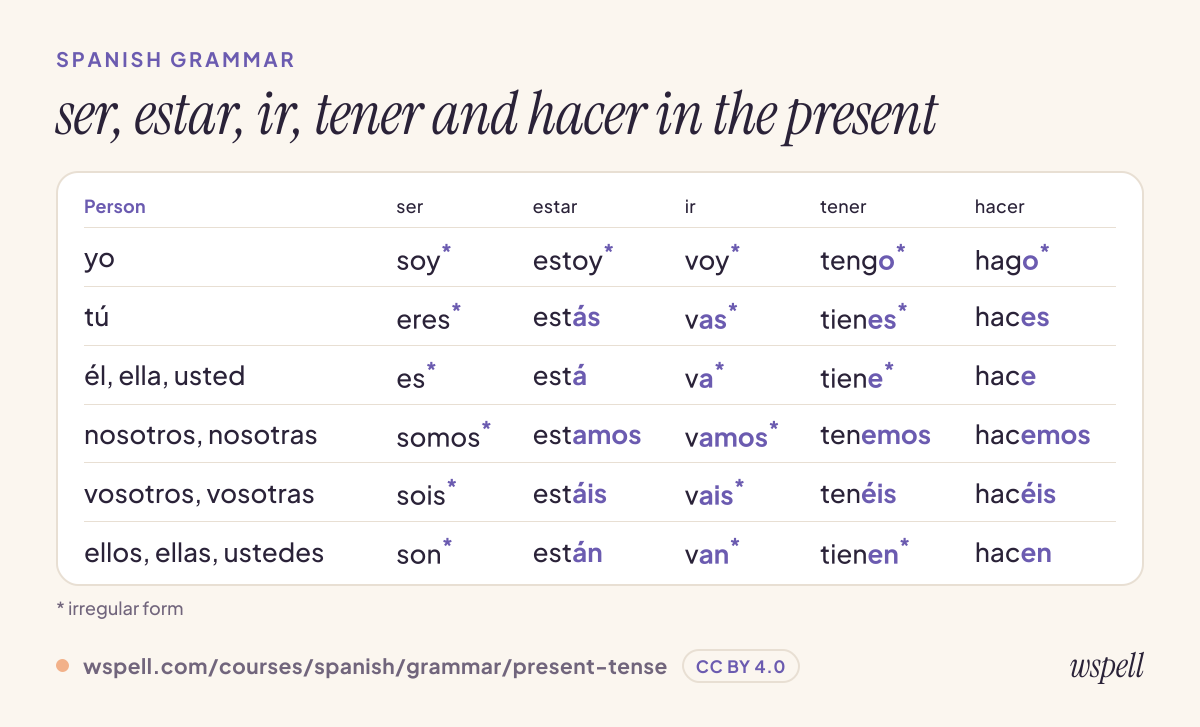
Irregular verbs: soy, estoy, voy, tengo, hago
| Person | ser | estar | ir | tener | hacer |
|---|---|---|---|---|---|
| yo | soy* | estoy* | voy* | tengo* | hago* |
| tú | eres* | estás | vas* | tienes* | haces |
| él, ella, usted | es* | está | va* | tiene* | hace |
| nosotros, nosotras | somos* | estamos | vamos* | tenemos | hacemos |
| vosotros, vosotras | sois* | estáis | vais* | tenéis | hacéis |
| ellos, ellas, ustedes | son* | están | van* | tienen* | hacen |
* irregular form
Irregular yo forms: tengo, hago, conozco, doy
Many verbs are regular except an irregular first-person singular: -go (hacer→hago, poner→pongo, salir→salgo, traer→traigo), -zco after a vowel (conocer→conozco, conducir→conduzco), -oy (dar→doy, estar→estoy). Several combine this with a stem change (tener→tengo, tienes; venir→vengo, vienes).
- Hago la tarea y salgo. — I do the homework and go out.
- No conozco a nadie aquí. — I don't know anyone here.
Using the present
The subject pronoun is usually left out
The verb ending already marks the person, so the subject pronoun is normally omitted (Hablo español rather than Yo hablo español). Use it only for contrast, emphasis, or to remove ambiguity — especially with él/ella/usted, which share one verb form.
- Trabajo en Madrid. — I work in Madrid.
- Yo trabajo, pero él descansa. — I work, but he rests.
Hace dos años que vivo aquí: the present for 'have been'
For an action that started in the past and still continues, Spanish uses the PRESENT tense (where English uses the present perfect): 'hace + time + que + present' or 'present + desde hace + time'. In the negative it takes the present or perfect: 'hace años que no lo veo'.
- Hace dos años que vivo aquí. — I've been living here for two years.
- Te conozco desde hace mucho tiempo. — I've known you for a long time.
- Hace meses que no lo veo. — I haven't seen him for months.
estar + gerund: estoy comiendo
estar + gerund emphasizes an action happening right now: 'estoy comiendo' (I am eating). Unlike English, Spanish does NOT use it for scheduled future ('salgo mañana', not estoy saliendo). seguir/llevar/ir + gerund add continuity or gradual change.
- No puedo hablar, estoy conduciendo. — I can't talk, I'm driving.
learn it step by step
The DELE Spanish exam, A2 to B2: structure, scoring and practice
save or print this chart
Under the main tables on this page sits a picture of each — keep one on your phone, share it or print it.
Free to share and adapt under CC BY 4.0 — credit wspell and link to this page. the licence
credit line to copy: The Spanish present tense — wspell, CC BY 4.0, https://wspell.com/courses/spanish/grammar/present-tense
questions
How do you conjugate regular verbs in the Spanish present tense?
Drop -ar, -er or -ir and add the endings: -o, -as, -a, -amos, -áis, -an for -ar verbs; -o, -es, -e, -emos, -éis, -en for -er verbs; -o, -es, -e, -imos, -ís, -en for -ir verbs.
What are stem-changing verbs?
Verbs whose stem vowel changes when it is stressed: e→ie (quiero), o→ue (puedo), e→i (pido); jugar changes u→ue (juego). The nosotros and vosotros forms keep the infinitive's vowel: queremos, podemos, pedimos.
Do I need yo, tú and él with the verb?
Usually not: the ending already says who acts, so hablo means 'I speak'. The pronoun is added for contrast or emphasis, or where usted, él and ella share a form.