grammar chart · Spanish
Por vs para
Para looks ahead to a goal: what something is for, where it is going, when it is due and who receives it. Por looks back to a cause or through a route: why it happened, what it was exchanged for, how long it lasted, by what means, and who did it in the passive. Lucho por mis hijos — they are my reason; trabajo para mis hijos — they are who it is for.
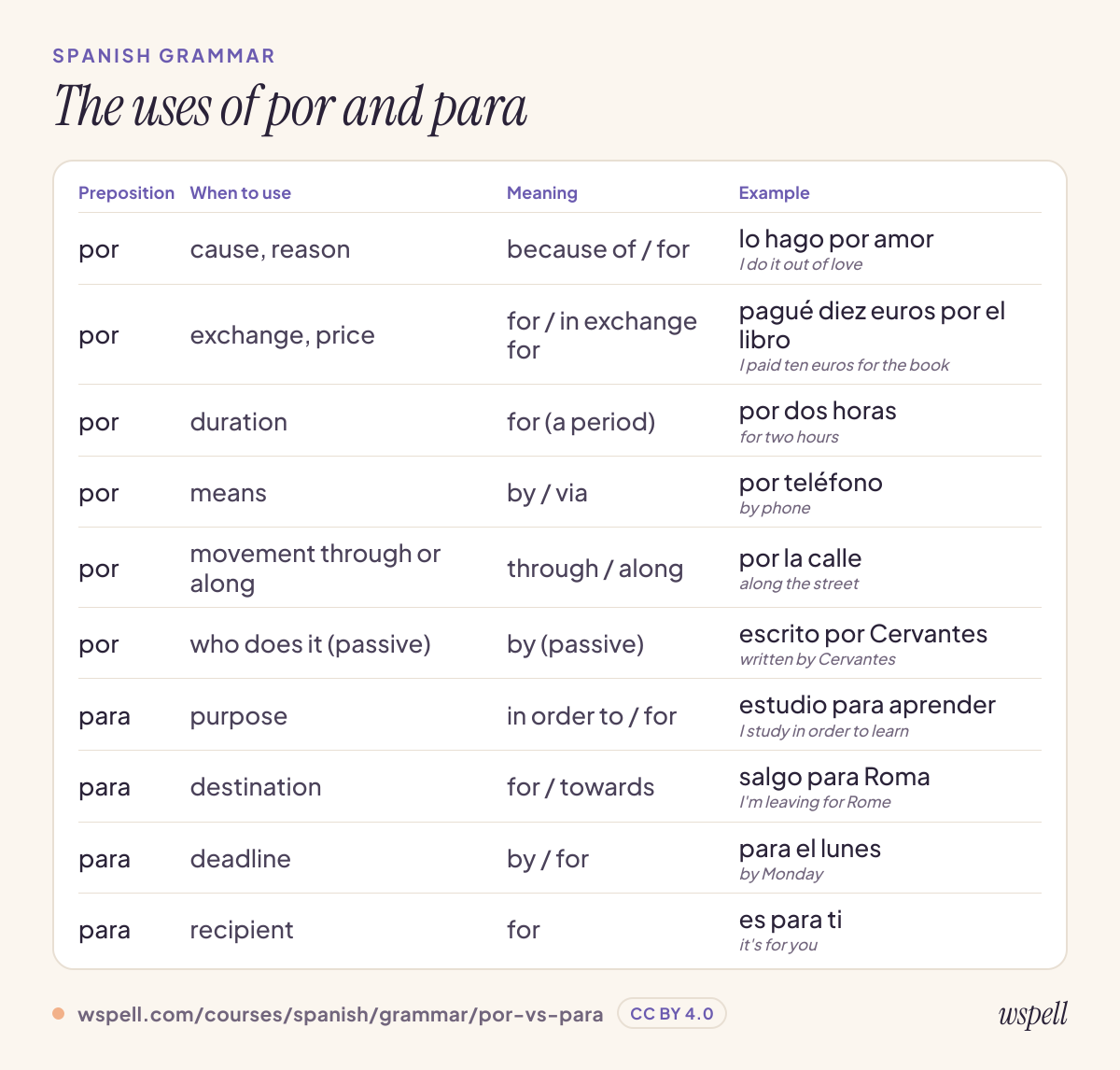
The main uses of por and para
| Preposition | When to use | Meaning | Example |
|---|---|---|---|
| por | cause, reason | because of / for | lo hago por amor I do it out of love |
| por | exchange, price | for / in exchange for | pagué diez euros por el libro I paid ten euros for the book |
| por | duration | for (a period) | por dos horas for two hours |
| por | means | by / via | por teléfono by phone |
| por | movement through or along | through / along | por la calle along the street |
| por | who does it (passive) | by (passive) | escrito por Cervantes written by Cervantes |
| para | purpose | in order to / for | estudio para aprender I study in order to learn |
| para | destination | for / towards | salgo para Roma I'm leaving for Rome |
| para | deadline | by / for | para el lunes by Monday |
| para | recipient | for | es para ti it's for you |
Por or para: cause or goal
para expresses goal, destination and purpose (the intended end); por expresses cause, exchange and the route or agent (the reason or path). Lucho por mis hijos (motivated by them) vs trabajo para mis hijos (for their benefit / goal).
- Trabajo para vivir, no vivo para trabajar. — I work in order to live, I don't live in order to work.
- Lo hice por ti. — I did it because of you / for your sake.
Por: cause, exchange, duration, means, route
por: cause, exchange, duration, means, route, agent
por points backward or through: cause/motive (lo hago por amor), exchange or price (pagué diez euros por el libro), duration (por dos horas), means (por teléfono), movement through (por la calle) and the agent in the passive (escrito por Cervantes).
- Gracias por tu ayuda. — Thanks for your help.
- Paseamos por el parque. — We stroll through the park.
Para: purpose, destination, deadline, recipient
para: purpose, destination, deadline, recipient
para points forward: purpose or goal (estudio para aprender), destination (salgo para Roma), deadline (para el lunes) and recipient (es para ti). Think of it as the arrow's target.
- Estudio para aprobar el examen. — I study in order to pass the exam.
- Este regalo es para ti. — This gift is for you.
¿Por qué? or ¿para qué?
¿por qué? asks for the cause (why? — because…), while ¿para qué? asks for the purpose (what for? — in order to…). Answering a purpose question with a cause, or vice versa, sounds off.
- ¿Por qué lloras? — Why are you crying?
- ¿Para qué sirve esto? — What is this for?
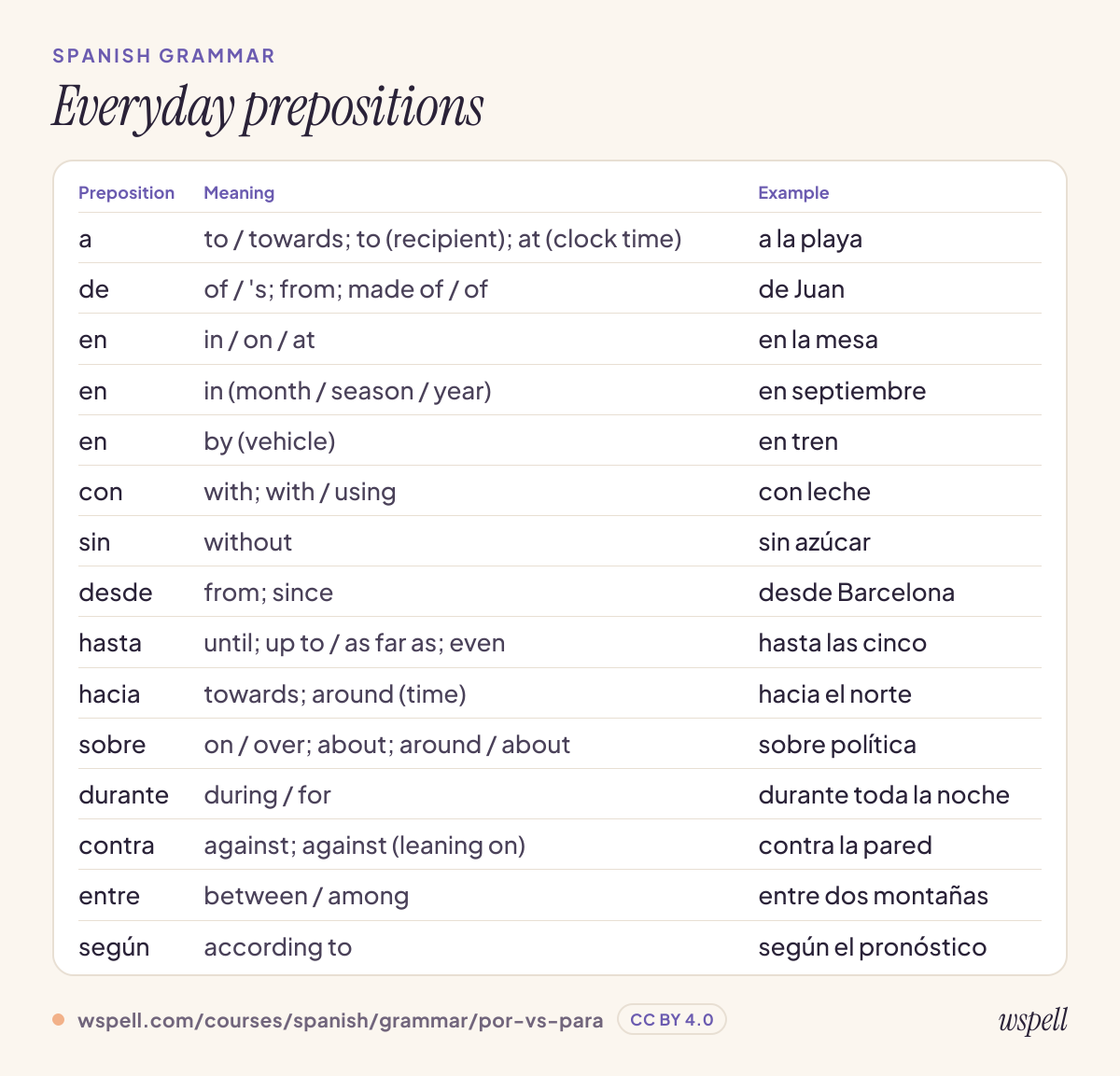
The everyday prepositions
| Preposition | Meaning | Example |
|---|---|---|
| a | to / towards; to (recipient); at (clock time) | a la playa |
| de | of / 's; from; made of / of | de Juan |
| en | in / on / at | en la mesa |
| en | in (month / season / year) | en septiembre |
| en | by (vehicle) | en tren |
| con | with; with / using | con leche |
| sin | without | sin azúcar |
| desde | from; since | desde Barcelona |
| hasta | until; up to / as far as; even | hasta las cinco |
| hacia | towards; around (time) | hacia el norte |
| sobre | on / over; about; around / about | sobre política |
| durante | during / for | durante toda la noche |
| contra | against; against (leaning on) | contra la pared |
| entre | between / among | entre dos montañas |
| según | according to | según el pronóstico |
a for where to, en for where
a expresses movement to a destination (voy a la escuela), while en expresses being at or in a place (estoy en la escuela). Choosing en for a verb of motion, or a for a static state, is a classic error.
- Llego a la oficina a las nueve. — I arrive at the office at nine.
- Trabajo en la oficina todo el día. — I work in the office all day.
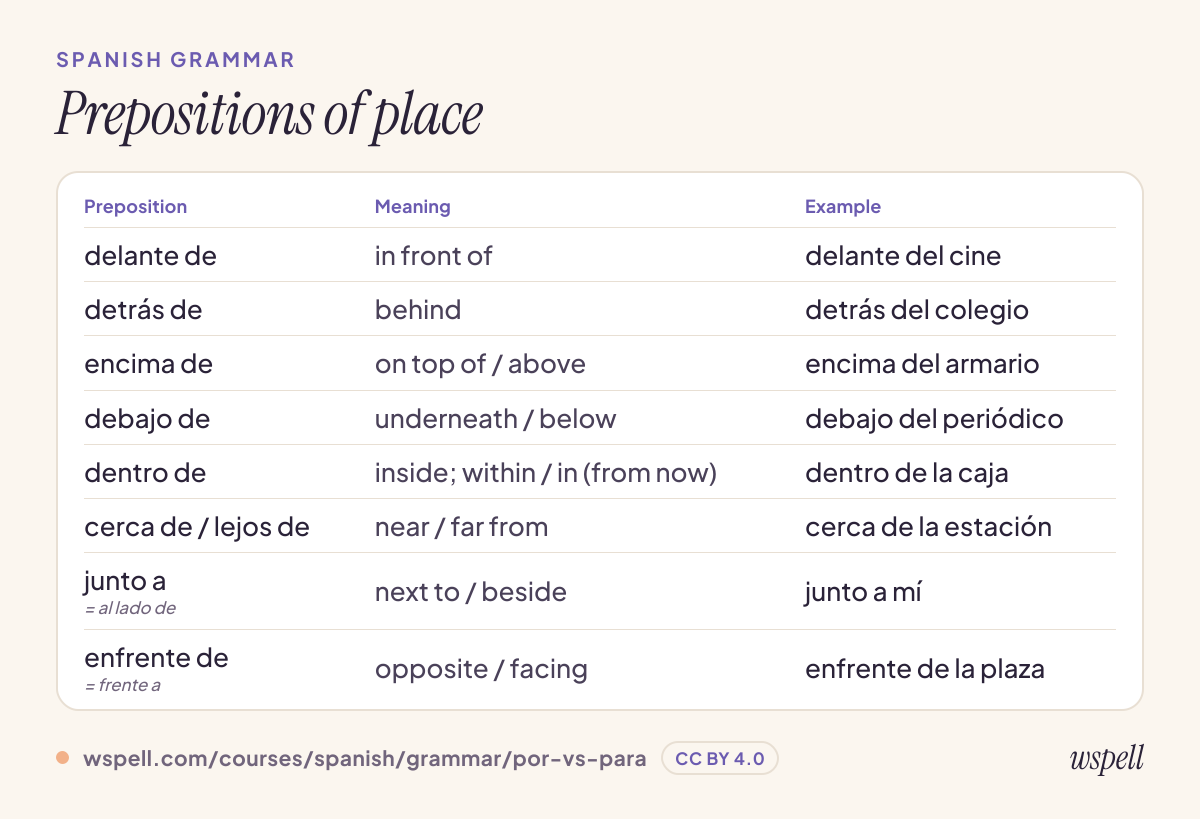
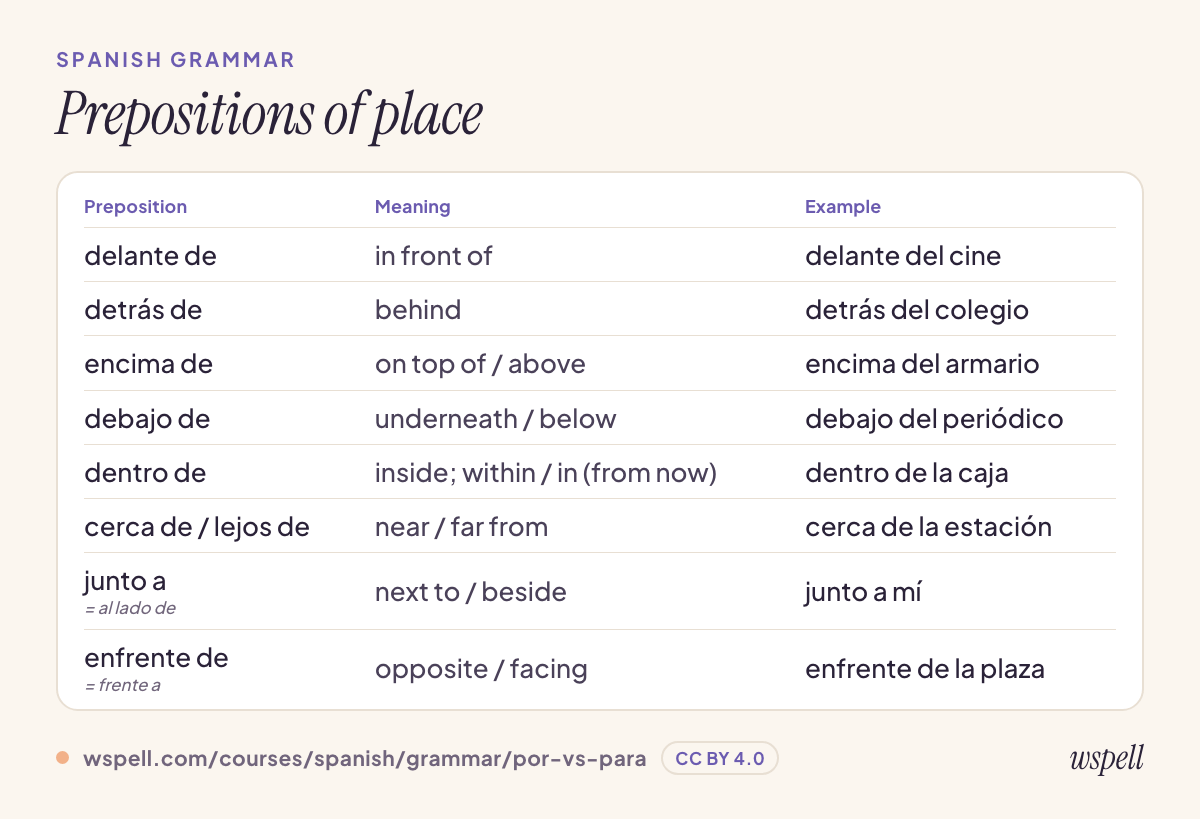
Prepositions of place
| Preposition | Meaning | Example |
|---|---|---|
| delante de | in front of | delante del cine |
| detrás de | behind | detrás del colegio |
| encima de | on top of / above | encima del armario |
| debajo de | underneath / below | debajo del periódico |
| dentro de | inside; within / in (from now) | dentro de la caja |
| cerca de / lejos de | near / far from | cerca de la estación |
| junto a = al lado de | next to / beside | junto a mí |
| enfrente de = frente a | opposite / facing | enfrente de la plaza |
learn it step by step
The DELE Spanish exam, A2 to B2: structure, scoring and practice
save or print this chart
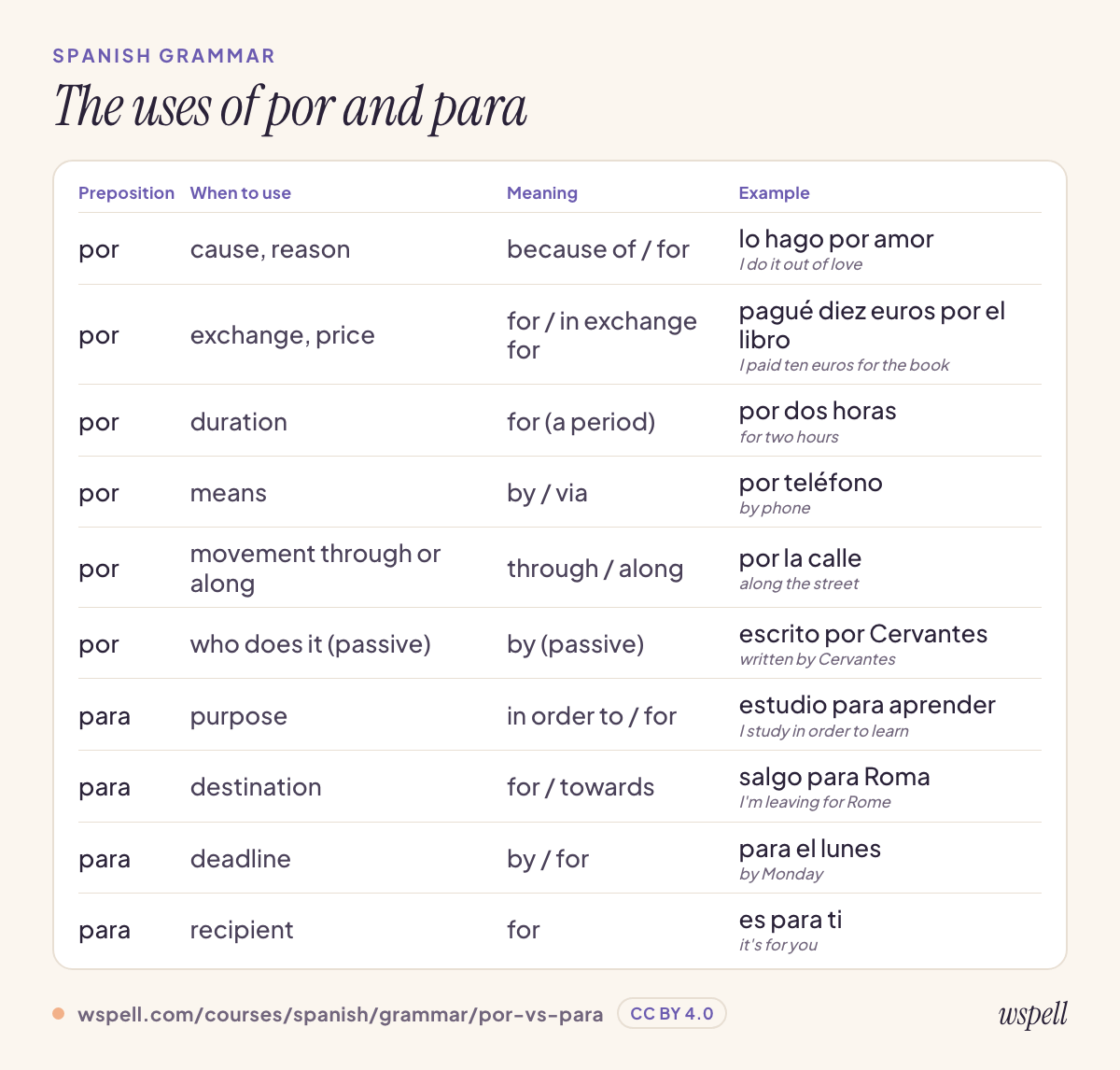
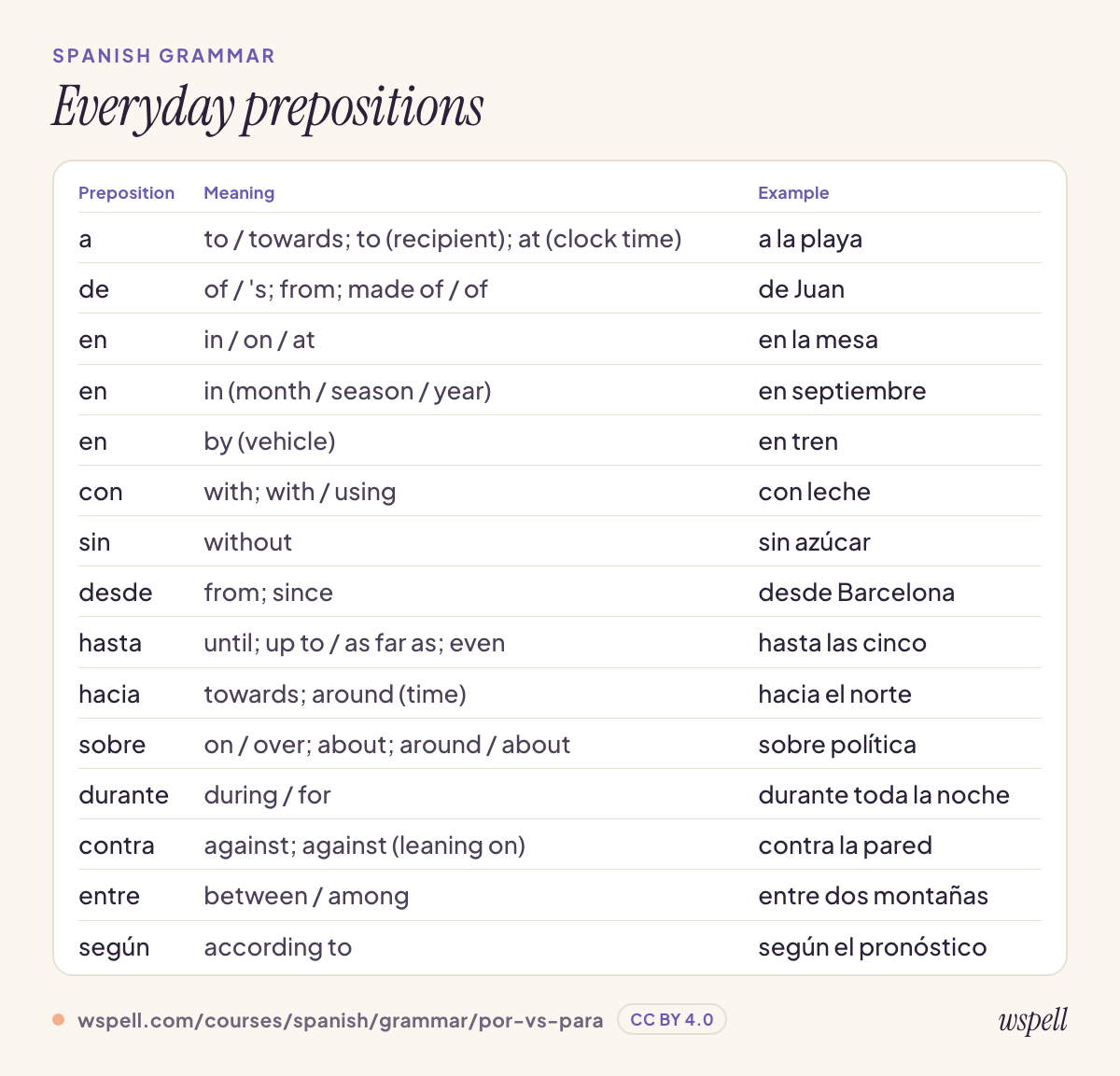
Under the main tables on this page sits a picture of each — keep one on your phone, share it or print it.
Free to share and adapt under CC BY 4.0 — credit wspell and link to this page. the licence
credit line to copy: Por vs para — wspell, CC BY 4.0, https://wspell.com/courses/spanish/grammar/por-vs-para
questions
What is the difference between por and para?
Para expresses a goal — a purpose, a destination, a deadline, a recipient: estudio para aprobar el examen, este regalo es para ti. Por expresses a cause or a path — a reason, an exchange, a duration, a means, a route, the agent of a passive: gracias por tu ayuda, paseamos por el parque.
Is it gracias por or gracias para?
Gracias por: you thank someone for a cause — gracias por tu ayuda.
What is the difference between ¿por qué? and ¿para qué?
¿Por qué? asks for the cause — why? — and is answered with porque. ¿Para qué? asks for the purpose — what for? — and is answered with para.